
A perfume bottle that will not spray can quickly make customers think the whole package is defective, even when the glass bottle and perfume are still fine.
A perfume bottle may stop spraying because of trapped air, a blocked dip tube, pump pressure loss, installation problems, nozzle blockage, poor sealing, or a perfume formula that is too oily. I first check whether the bottle is new or whether it stopped working after several weeks.
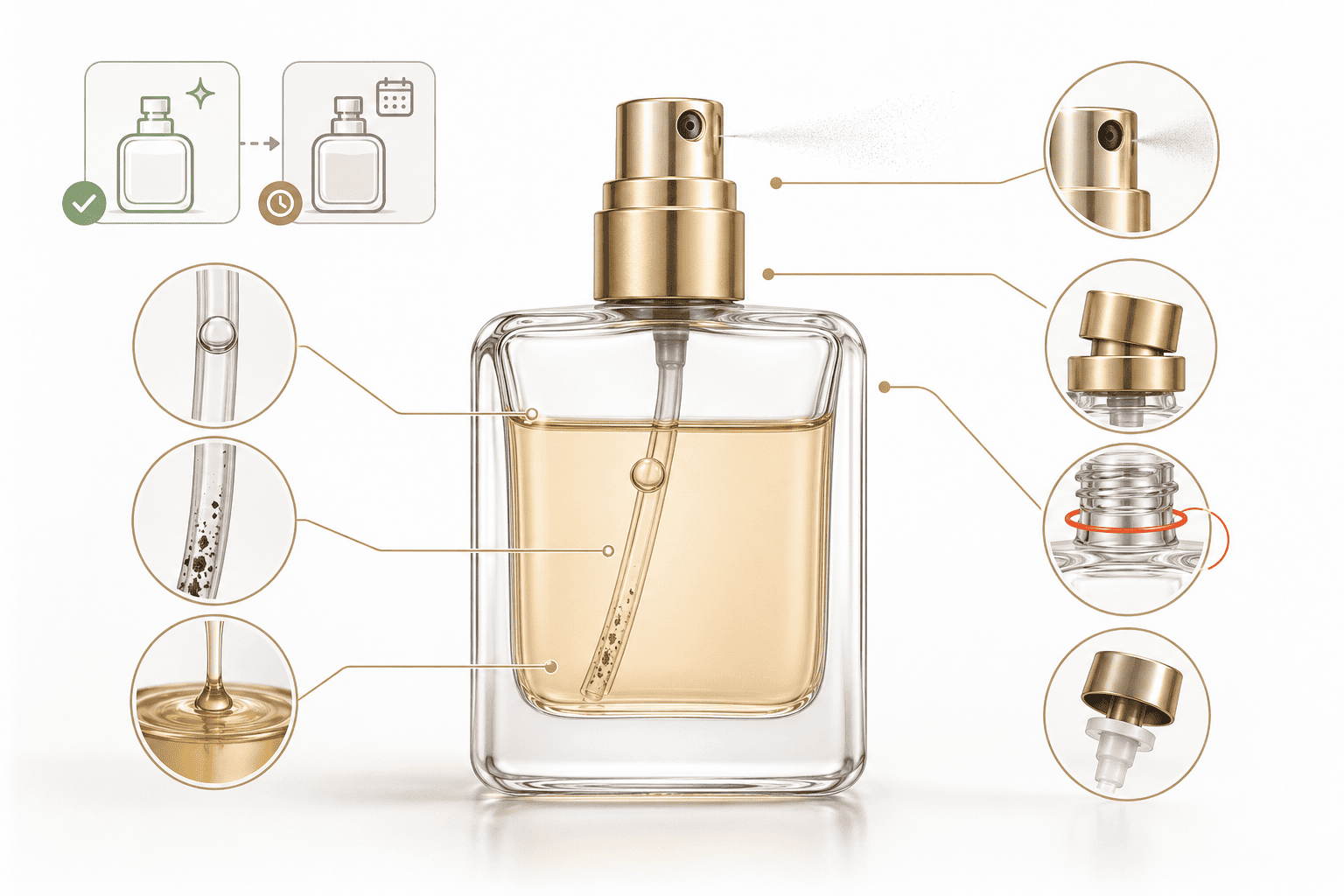
From my experience with perfume glass bottle packaging, I do not immediately blame the spray pump when a bottle stops working. I first look at when the problem started.
If a brand-new bottle cannot spray from the first use, I usually check the air inside the pump, the dip tube, and the installation process.
If the bottle sprayed normally at first but stopped after several days or weeks, I pay more attention to the spring, valve, perfume formula, corrosion, and material compatibility.
This simple difference can save a lot of time during troubleshooting.
Does a new perfume bottle have trapped air inside the pump?
A new perfume bottle sometimes does not spray because air remains inside the pump chamber. The atomizer has not yet created the pressure difference needed to pull perfume through the dip tube.
If a new perfume bottle does not spray, I often turn it upside down and press the atomizer several times. This can help push trapped air out of the pump. I then turn the bottle upright and spray again so the pump can rebuild suction and start drawing perfume.
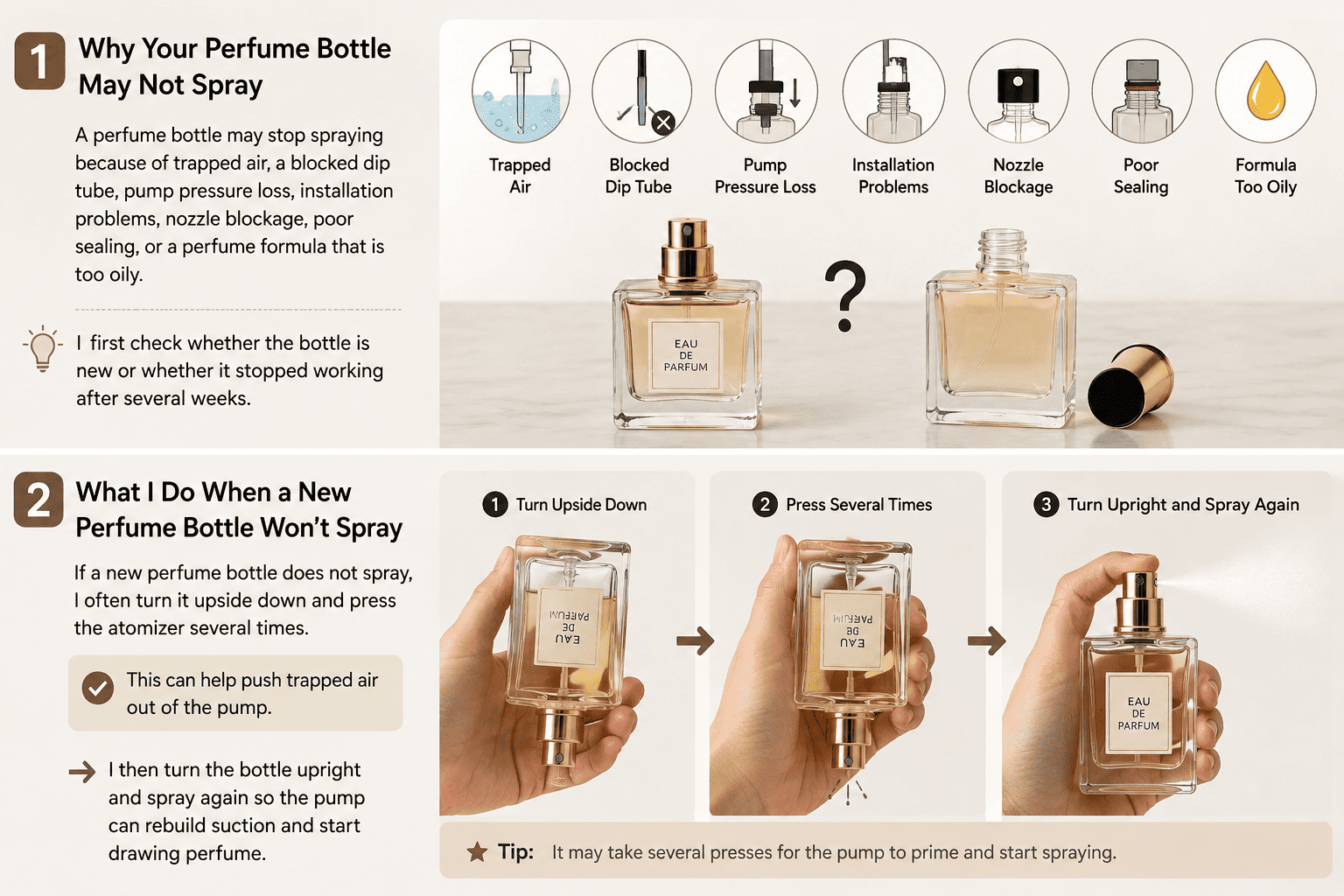
Why I sometimes turn the perfume bottle upside down
This is one of the simplest methods I use when a newly filled perfume bottle cannot spray for the first time.
I turn the bottle upside down.
Then I press the spray head several times.
After that, I turn the bottle back to its normal position and press the atomizer again.
The reason is not that I am trying to shake the perfume into the nozzle. The real purpose is to help remove air trapped inside the pump.
A perfume atomizer needs to create a small vacuum and pressure difference inside the pump system. This allows the pump to draw perfume upward through the dip tube.
If too much air remains inside the pump chamber, the pump may keep moving without pulling enough liquid.
When I turn the bottle upside down, the perfume moves closer to the pump inlet. Repeated pressing can help push trapped air out and allow liquid to enter the pump more easily.
| Step | What I do | Purpose |
|---|---|---|
| 1 | Turn the bottle upside down | Move perfume closer to the pump |
| 2 | Press the atomizer several times | Push trapped air out |
| 3 | Return the bottle upright | Restore normal working position |
| 4 | Press several more times | Rebuild suction and prime the pump |
I mainly use this method when the bottle is new.
If a perfume bottle worked normally for several weeks and then suddenly stopped, trapped air is usually not my first suspect.
In that case, I start checking the internal pump structure or the perfume formula.
I also do not expect a customer to press a new atomizer twenty or thirty times before it works.
A few priming presses can be normal. Too many empty presses can still indicate another problem.
Is the dip tube blocked by the bottom of the glass bottle?
For a new perfume bottle that cannot draw liquid, I always inspect the dip tube. A tube can reach the bottom of the bottle so closely that its opening becomes blocked by the glass.
If the dip tube has a flat horizontal cut and sits directly against the glass bottom, perfume may have no space to enter the tube. I prefer an angled or V-shaped tube end because liquid can still enter from the sides even when the tube touches the bottle bottom.
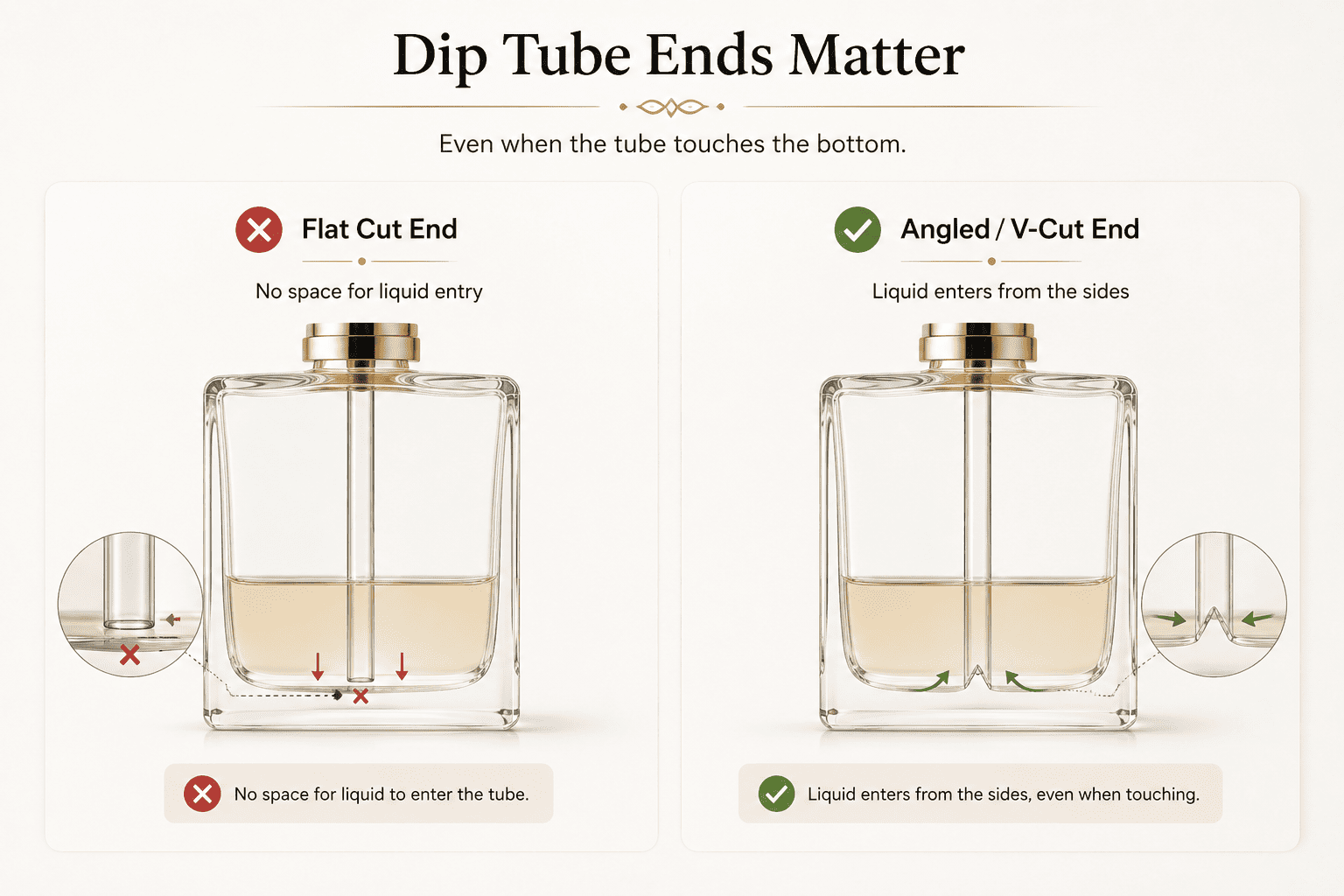
The shape of the dip tube cut is more important than it looks
This is a detail that I think many perfume brands overlook.
The dip tube carries the liquid from the bottle into the pump.
Most people only ask whether the tube is long enough.
I also care about how the bottom of the tube is cut.
If someone cuts the tube straight across, the end becomes completely flat.
If this flat opening presses directly against the inner bottom or wall of the glass bottle, the glass can block the entire opening.
The pump may still feel normal when I press it.
The spring may still return normally.
But no perfume can enter the tube.
| Dip tube design | Possible effect | My preference |
|---|---|---|
| Flat horizontal cut | Can seal against the glass | Higher risk |
| Angled cut | Leaves one side open | Good |
| V-shaped cut | Leaves two liquid entry paths | Better |
| Tube too long | Can bend or press hard against glass | Adjust |
| Tube too short | Leaves perfume unreachable | Adjust |
For machine-cut tubes, I often prefer a V-shaped cut when viewed from the side.
This creates open spaces on both sides of the tube.
Even when the tube touches the glass bottom, the perfume still has a path into the tube.
If workers cut the tube manually, I also prefer an angled cut instead of cutting straight across.
Tube length matters too.
I do not want the dip tube to fit against the bottle interior so tightly that it follows the glass shape with no room left.
I want it long enough to reach close to the bottom, but I still want the end to have enough space for liquid entry.
Glass bottles also have internal variation.
The outer base may look flat, but the inside can have a thicker center, a curved area, or a raised section.
This is why I prefer testing the actual dip tube with the actual glass bottle instead of calculating the tube length only from an external bottle drawing.
Is the spray nozzle blocked by perfume residue?
A perfume atomizer has a very small outlet. Dried perfume, oil, dust, or other residue can block this opening and prevent the liquid from forming a [normal mist][1].
If the spray becomes weak, uneven, or completely blocked, I remove the actuator and inspect the nozzle. Cleaning the nozzle can solve the problem when dried fragrance or oil residue has blocked the small spray channel.
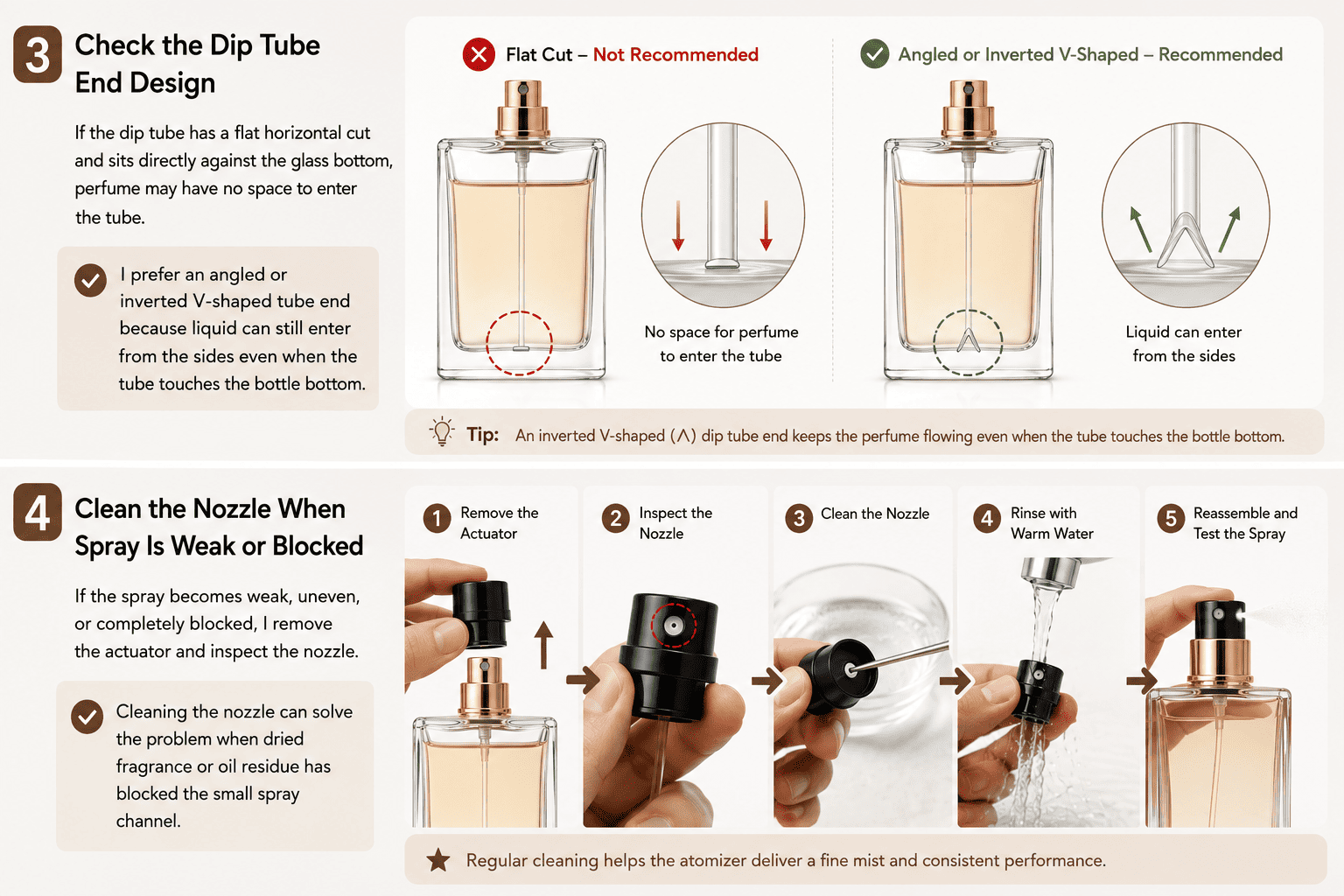
Why fine-mist nozzles can block easily
A fine perfume mist requires a very small spray opening.
This small opening helps break the liquid into tiny droplets.
It also means that a very small amount of residue can change the spray performance.
I see this more often when the perfume has a high fragrance-oil content.
I may also see it when the bottle has been stored for a long period and perfume around the nozzle has dried.
| Symptom | Possible cause | What I check |
|---|---|---|
| No spray | Full blockage | Nozzle opening |
| Large droplets | Partial blockage | Actuator channel |
| Sideways spray | Damaged or dirty nozzle | Spray head |
| Weak mist | Residue or low pressure | Nozzle and pump |
| Intermittent spray | Partial blockage | Internal flow path |
I normally start with the visible actuator because it is easier to inspect.
If cleaning the actuator restores the spray, I know the problem was near the outlet.
If the nozzle is clean but the pump still does not draw perfume, I move deeper into the pump system.
I think this distinction matters.
A blocked nozzle and a failed pump can look similar to the customer, but the solutions are very different.
Did the perfume atomizer stop working after several weeks?
If a bottle sprays normally in the beginning but fails after some storage time, I become more concerned about chemical compatibility between the perfume formula and the internal pump components.
When a perfume bottle works at first but stops spraying after several weeks, I inspect the spring, ball, valve, and other pump parts. High fragrance concentration or certain perfume chemicals may react with internal materials, reduce spring rebound, cause corrosion, or stop the pump from building pressure.
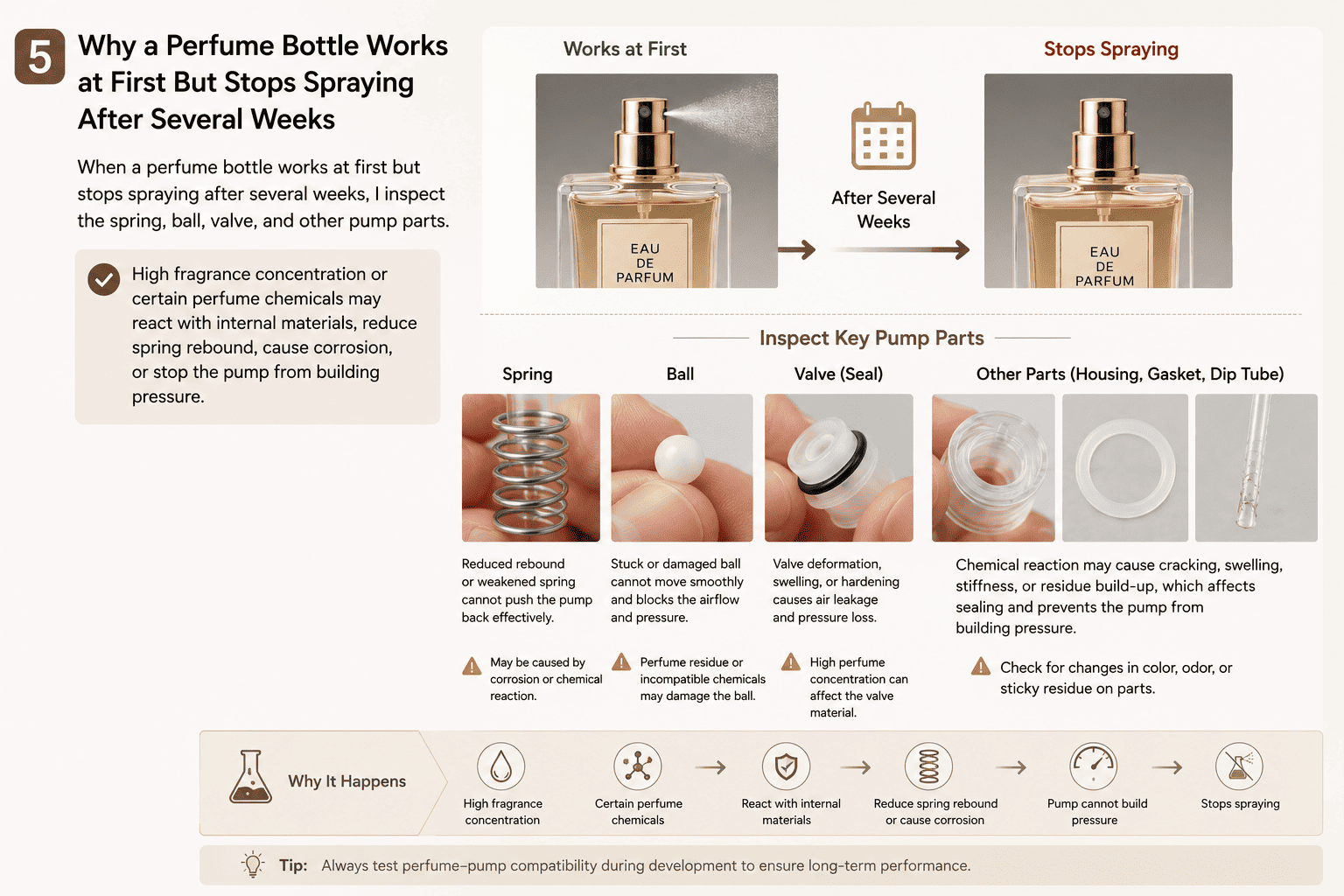
I have seen internal springs oxidize and lose performance
Inside many perfume pumps, there is a very small mechanical system.
Depending on the pump design, it can include a spring, ball, piston, valve, gasket, and other sealing parts.
These parts move every time the customer presses the atomizer.
In some projects, I have seen sprayers work perfectly at the beginning.
Then, after being filled with the real perfume formula for some time, the spray becomes weaker or stops.
This is a very different problem from a new bottle that never worked.
In the past, I have seen some pump springs show clear oxidation or rust.
This tells me that the internal materials can react with the perfume environment.
Once the spring is affected, its rebound force can become weaker.
The valve may also fail to return to the correct position.
Then the pump can no longer create enough suction and pressure.
| What I see | What it may suggest |
|---|---|
| Spray becomes weaker over time | Pump compatibility issue |
| Button returns slowly | Spring rebound is reduced |
| Button stays down | Spring or valve failure |
| Rust on spring | Chemical interaction |
| Bottle stops after weeks | Long-term compatibility issue |
This is why I do not think a simple water spray test is enough for every perfume project.
Water tells me whether a pump works mechanically at that moment.
It does not tell me whether the pump will still work after the real perfume has stayed inside for several weeks or months.
For a new perfume brand, I recommend keeping filled samples from the final formula.
I then check them again after storage.
This type of test is especially useful when the perfume contains a high amount of fragrance oil or unusual ingredients.
I would much rather discover an internal pump problem during sampling than after thousands of bottles have already been filled and shipped.
Is the perfume pump losing pressure?
A perfume atomizer needs stable internal pressure to pull fragrance through the tube and push it through the nozzle. If the spring, valve,[ piston][2], or seal does not work correctly, the spray can become weak or stop completely.
I check whether the actuator returns quickly and whether each press has stable resistance. If the button feels unusually soft, returns slowly, or stays down, the pump may have lost pressure and the internal atomizer may need to be replaced.
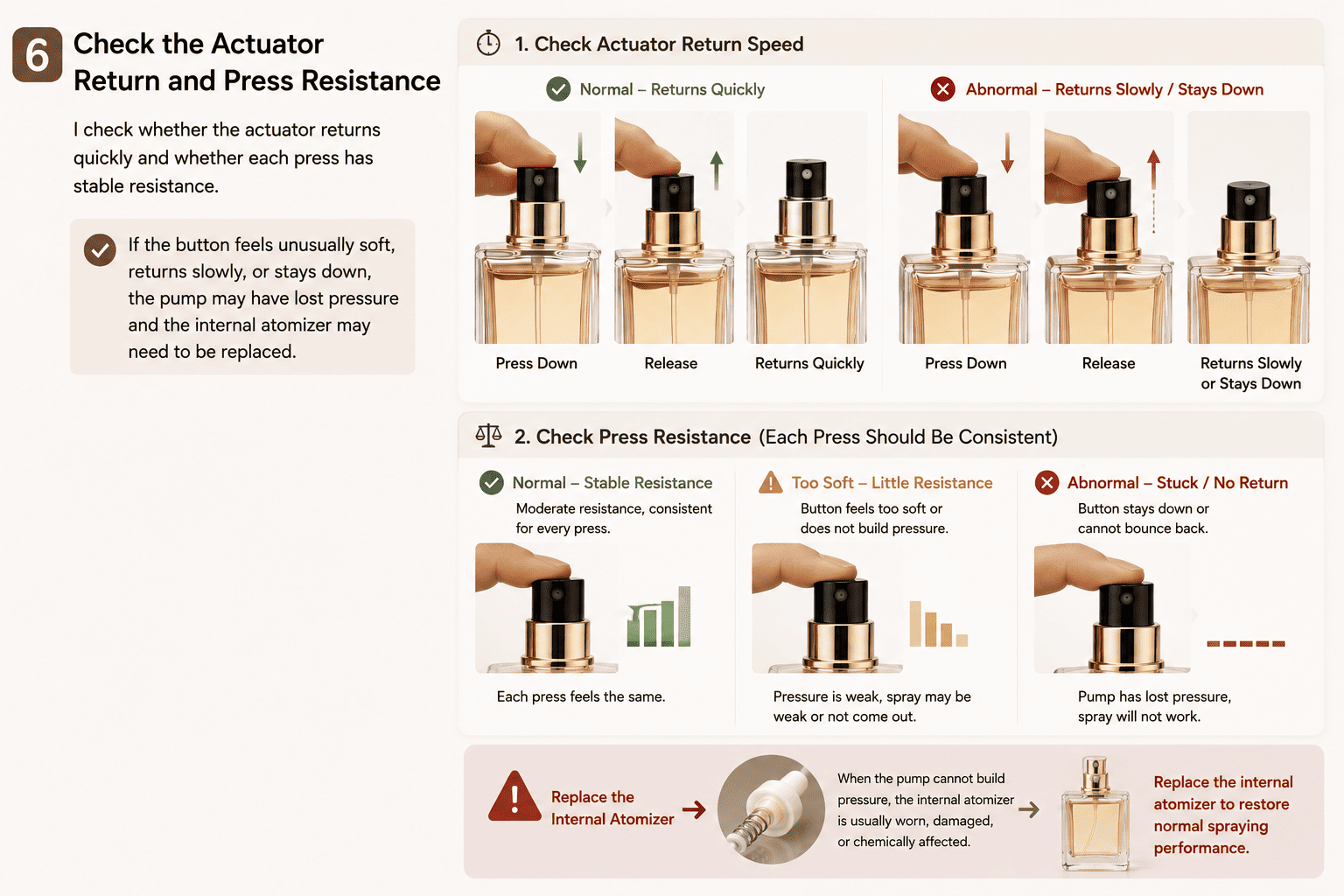
How I judge whether pressure is the real problem
I often compare the problem bottle with a known good sample.
This helps me feel small differences in the pump action.
A normal atomizer has a clear cycle.
I press it.
The pump moves down.
It sprays.
Then it returns to the original position.
If any step changes, I pay attention.
| Pump behavior | Possible cause |
|---|---|
| Very soft press | Poor internal pressure |
| Slow return | Weak spring rebound |
| Stays down | Valve or spring problem |
| Weak spray | Pressure loss |
| Unstable spray volume | Valve inconsistency |
I usually do not try to repair the internal pump.
The parts are very small, and the atomizer is designed as one complete unit.
Replacing the pump is normally more practical.
Still, for a perfume brand, I want to understand why the pump failed.
If only one atomizer fails out of many bottles, it may be an individual defect.
If many atomizers start failing after the same storage period, I start looking for a common cause.
That can be the perfume formula, the internal materials, or the assembly process.
This difference is important because changing one defective pump solves only one bottle.
Finding the root cause protects the whole production batch.
Why is the perfume spraying a stream instead of a fine mist?
Sometimes the atomizer is technically working, but the output looks like a water jet instead of a soft mist. In this situation, I often look at the concentration and oil content of the perfume.
If a perfume sprayer produces a stream instead of a fine mist, the fragrance may be too oily or viscous for that atomizer. Very high perfume-oil concentrations can be difficult for a fine-mist pump to break into small droplets, so the output becomes heavier and narrower.
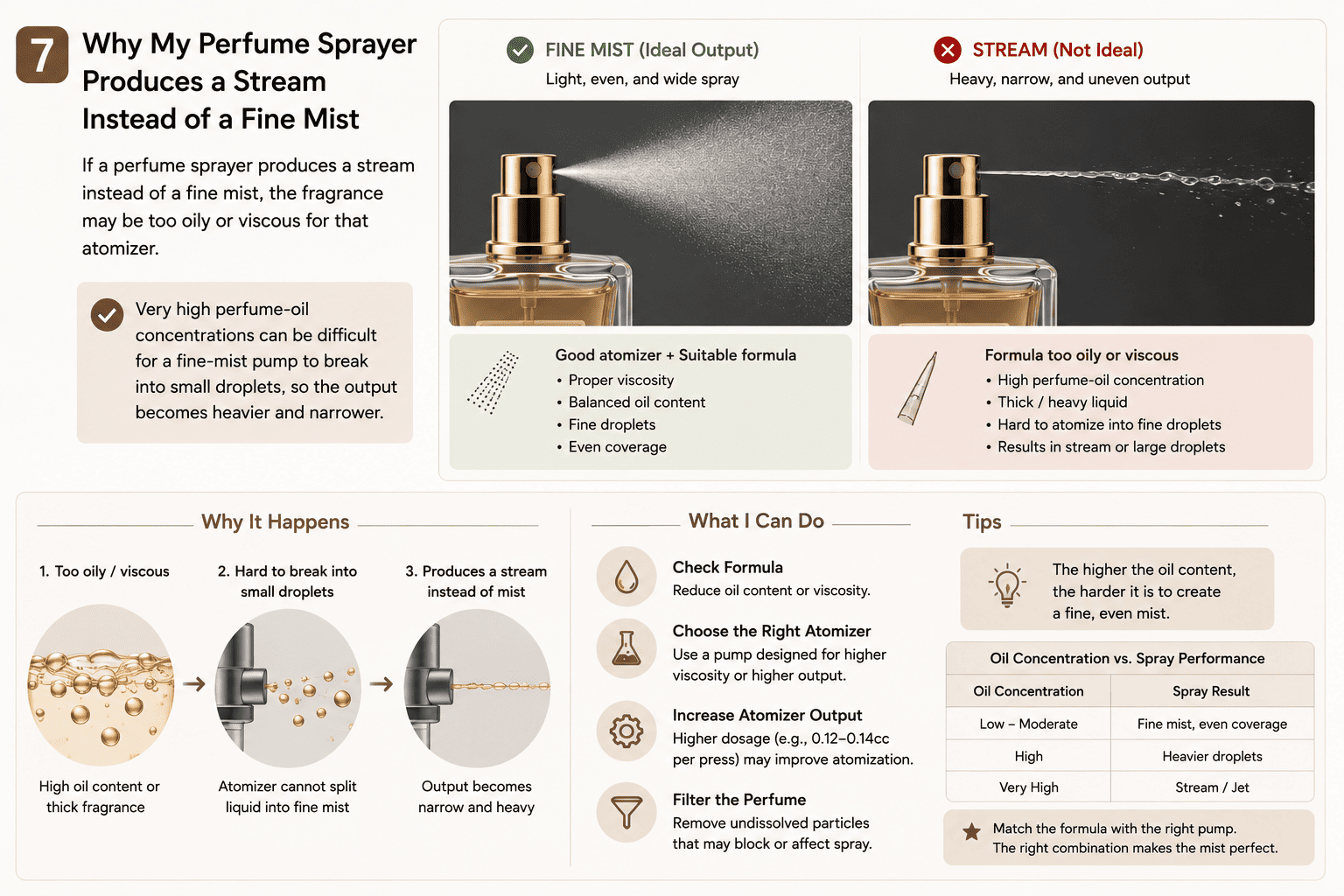
High perfume oil concentration changes atomization
This is a problem I often think brands should consider before deciding that the pump quality is bad.
Different perfume formulas behave differently.
A lighter alcohol-based perfume can pass through a fine-mist atomizer very easily.
A very concentrated perfume can behave more like an oily liquid.
Some concentrated perfumes can reach around 30% or 35% fragrance oil, or even higher depending on the formula.
At this level, the liquid can be harder for a standard fine-mist pump to atomize.
| Spray pattern | What I suspect |
|---|---|
| Fine wide mist | Good formula and pump match |
| Large droplets | Higher viscosity or nozzle issue |
| Narrow heavy spray | High oil concentration |
| Water-like stream | Poor atomization |
| Weak mist | Pressure or viscosity problem |
The pump still pushes the perfume out.
But instead of breaking it into many small droplets, it may send out larger drops or one narrow stream.
This is why I never rely only on a water test.
A pump can produce a very beautiful mist with water and still perform poorly with the customer's real perfume.
If a customer is developing an extrait de parfum or another high-concentration formula, I want to know this early.
Then I can test the actual formula with the actual atomizer.
Sometimes the solution is not changing the glass bottle.
The better solution is selecting a different pump specification that is more suitable for the formula.
For me, the perfume formula and the atomizer always need to be tested together.
Can too much installation force make the perfume pump stop spraying?
Yes. I have seen perfume atomizers work before assembly but fail after they are fully snapped onto the glass bottle. In that case, I check the installation force and pump position.
A snap-on perfume pump is installed with downward force. If the force is too strong, the valve can be compressed too tightly or become stuck. If the force is too weak, the gasket may not seal correctly. I adjust the installation pressure until the pump locks and seals without damaging its working position.
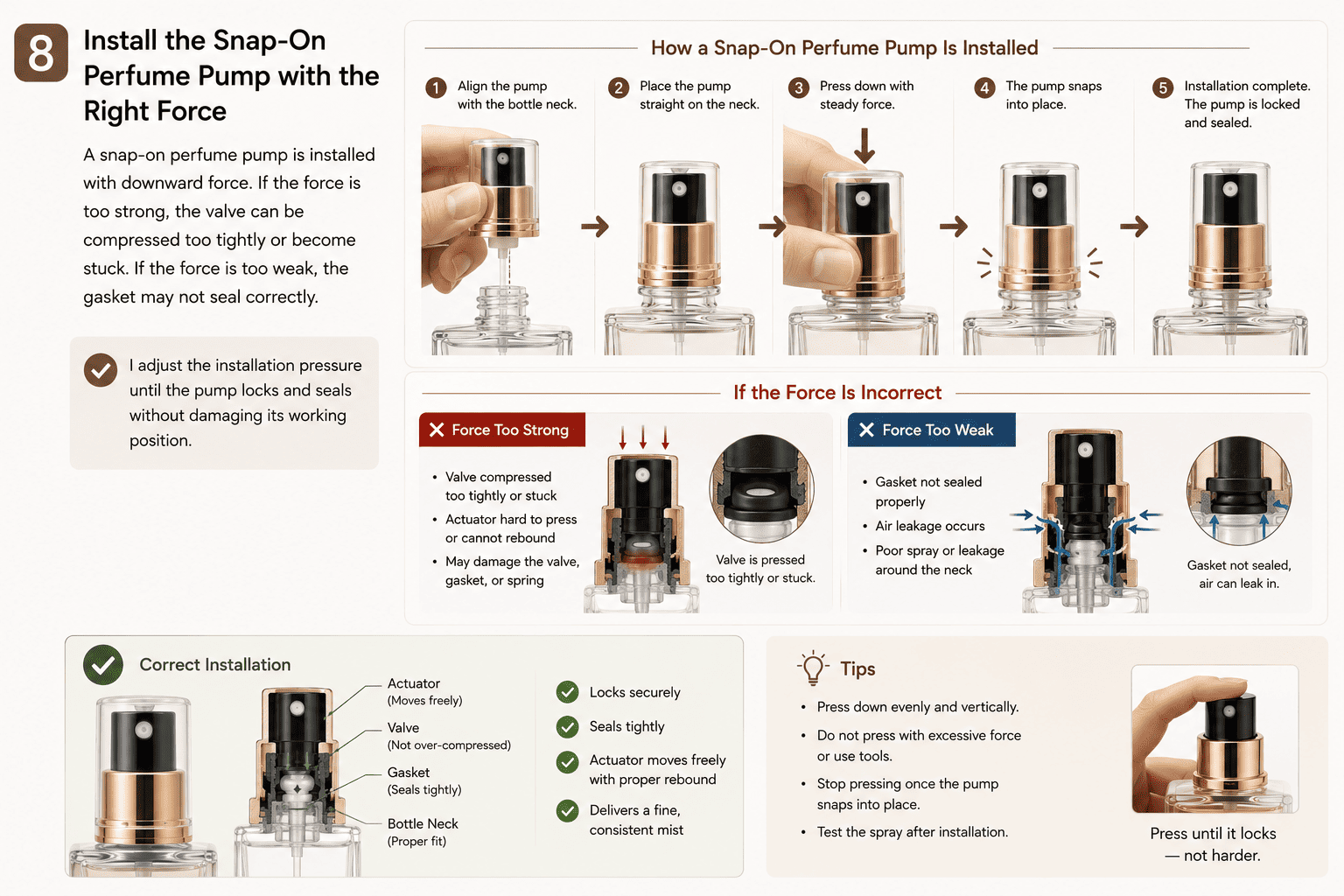
I always test the pump before and after final installation
This is one of the most useful production checks in my experience.
A snap-on atomizer needs downward pressure to lock onto the bottle neck.
The installation force cannot be random.
If the force is too high, the pump structure can be pushed down too much.
The valve may be compressed beyond its normal working position.
In some cases, it can even become stuck.
If the pressure is too low, the pump may not fully lock onto the bottle neck.
Then the sealing gasket can sit incorrectly.
Air can enter the system, and the pump may fail to build the vacuum it needs.
| Installation condition | Possible result | My action |
|---|---|---|
| Too much downward force | Valve becomes stuck | Reduce force |
| Too little force | Poor sealing | Increase carefully |
| Pump is off-center | Uneven gasket compression | Re-center pump |
| Gasket sits incorrectly | Air leakage | Check assembly |
| Works before locking but fails after | Installation pressure issue | Adjust machine setting |
I have seen a very specific situation.
Before the pump is fully installed, I place it on the bottle neck and press it.
It sprays normally.
Then the atomizer is snapped fully into position.
I press it again.
Now it does not spray.
This tells me something important.
The pump itself was able to work.
The installation process changed its working condition.
At this point, I do not immediately replace the pump.
I first adjust the installation force.
I also check whether the pump is centered on the glass bottle neck.
If the atomizer is not centered, the gasket may be compressed more on one side than the other.
The outside can look acceptable, but the internal sealing condition may be wrong.
For this reason, I believe bottle and pump compatibility cannot be judged only from technical dimensions.
The installation process is part of compatibility too.
Is poor sealing or assembly causing the atomizer problem?
A perfume pump needs a good seal with the glass bottle. If the gasket, neck, crimp, or snap connection is wrong, air may enter the system and reduce the pump's ability to draw perfume.
If the spray becomes unstable after assembly, I check the bottle neck, gasket, pump position, and sealing condition. A pump can match the nominal bottle size but still fail if the neck tolerance, gasket compression, or final assembly is not correct.
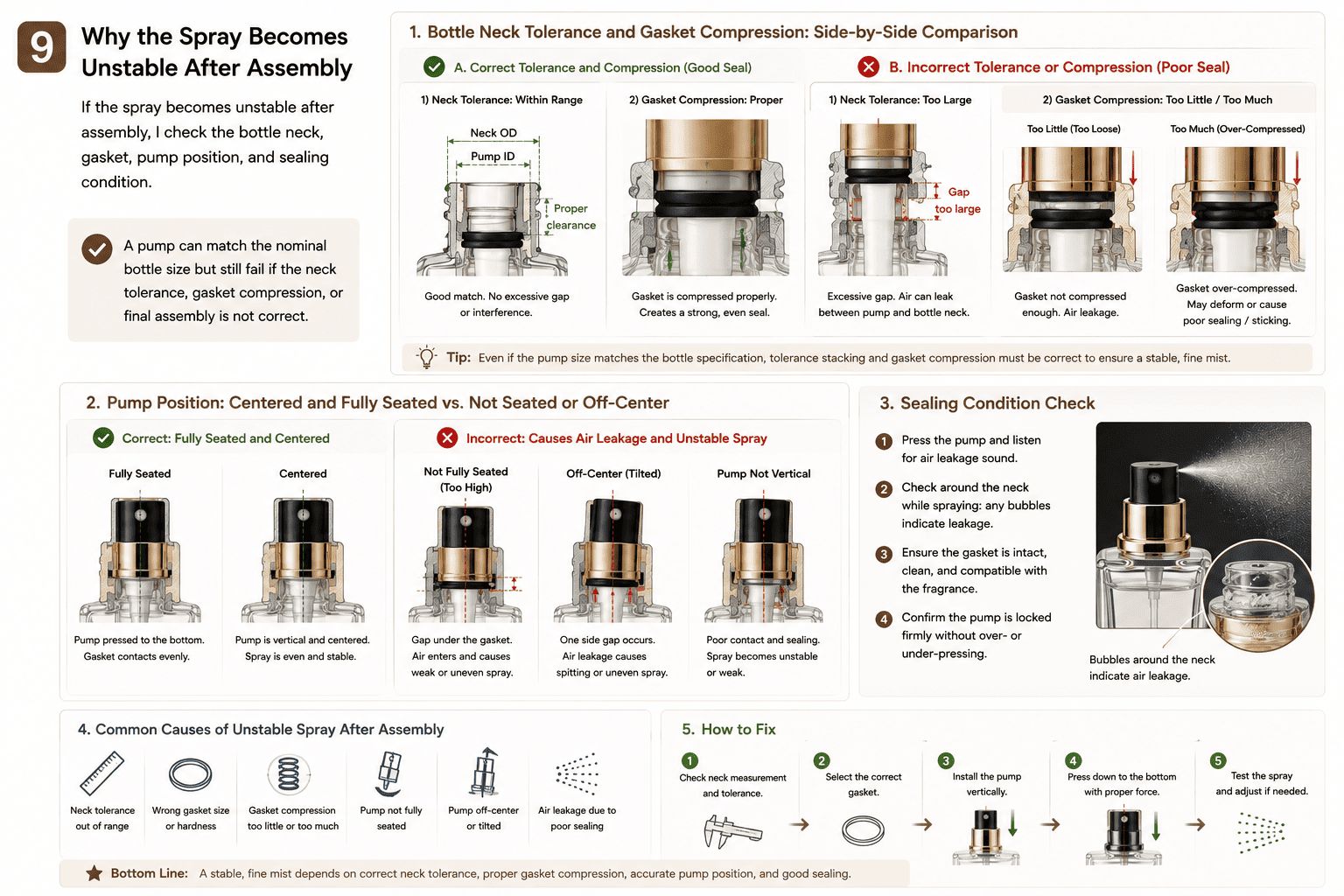
The bottle, pump, gasket, and installation process are one system
I do not like treating the glass bottle and atomizer as two completely separate products.
They have to work together.
The glass bottle neck has dimensions and tolerances.
The pump has its own structure.
The gasket has its own thickness and flexibility.
Then the assembly machine adds another variable.
| Sealing issue | Possible effect |
|---|---|
| Pump not fully locked | Air leakage |
| Gasket compressed unevenly | Poor suction |
| Bottle neck variation | Unstable pump fit |
| Wrong pump specification | Seal failure |
| Off-center assembly | Pump may not work correctly |
This is also why I recommend testing real assembled samples before mass production.
A supplier can tell me that the pump and bottle have matching specifications.
That is useful.
But I still want to press the final assembled bottle.
I want to test whether it primes correctly.
I want to check whether the pump returns normally.
I also want to see whether leakage appears after storage.
For brands that buy bottles and pumps from different suppliers, this becomes even more important.
Small dimensional differences can create problems that are difficult to see in a drawing.
The same principle applies when we add caps and decorative parts.
A cap that presses too hard on the actuator can also affect the pump during shipping or storage.
For me, perfume packaging is not just a bottle plus a list of accessories.
It is one complete working system.
Conclusion
When a perfume bottle stops spraying, I first check when the failure started. Air, dip tube design, pump materials, perfume concentration, sealing, and installation pressure usually reveal the real cause.