Sustainable perfume packaging can look difficult for a small brand. Many founders worry about cost, MOQ, appearance, and whether eco-friendly materials can still feel premium.
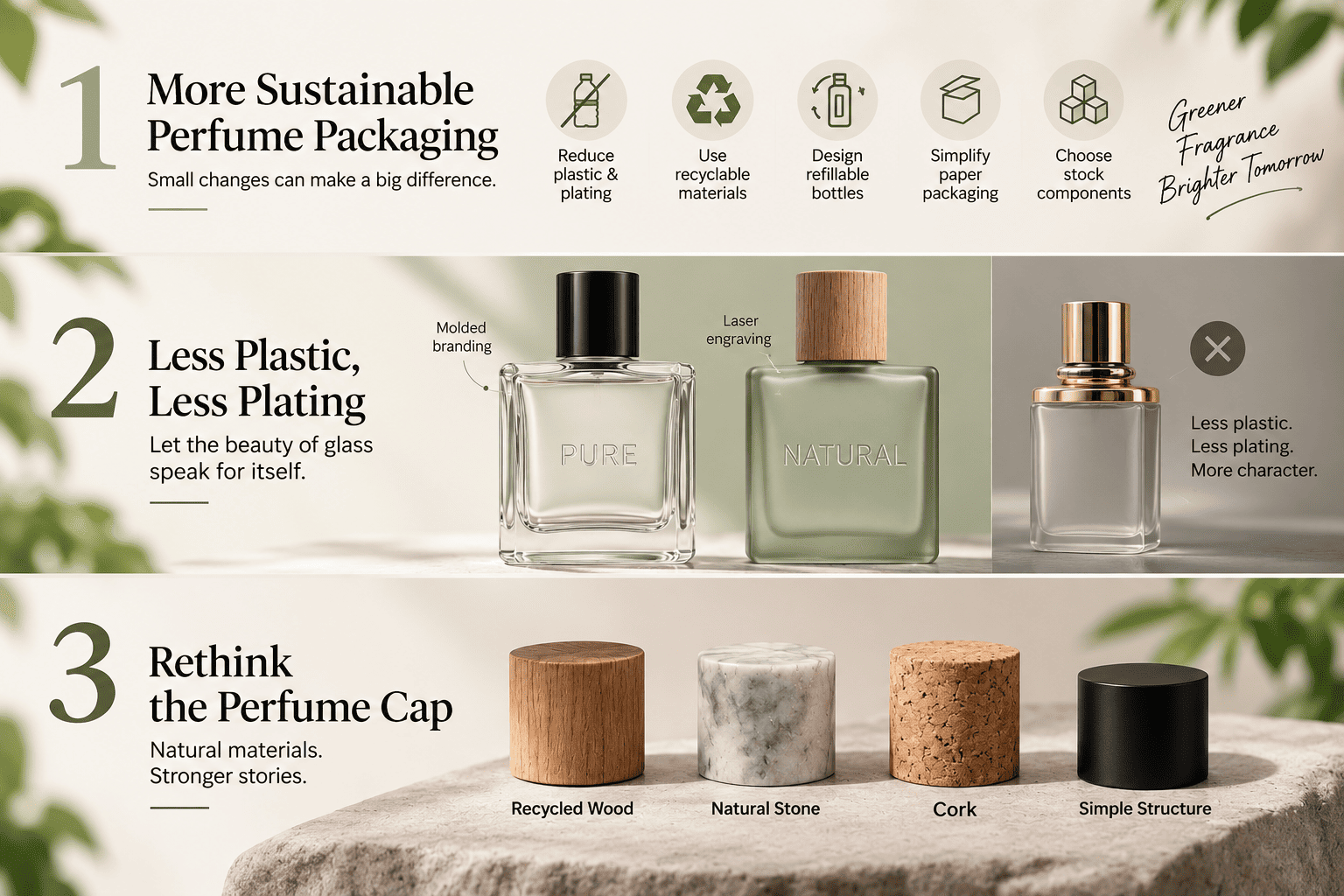
I believe niche perfume brands can make packaging more sustainable by reducing plastic and plating, using recyclable materials, designing refillable bottles, simplifying paper packaging, and choosing stock components that need fewer extra processes.
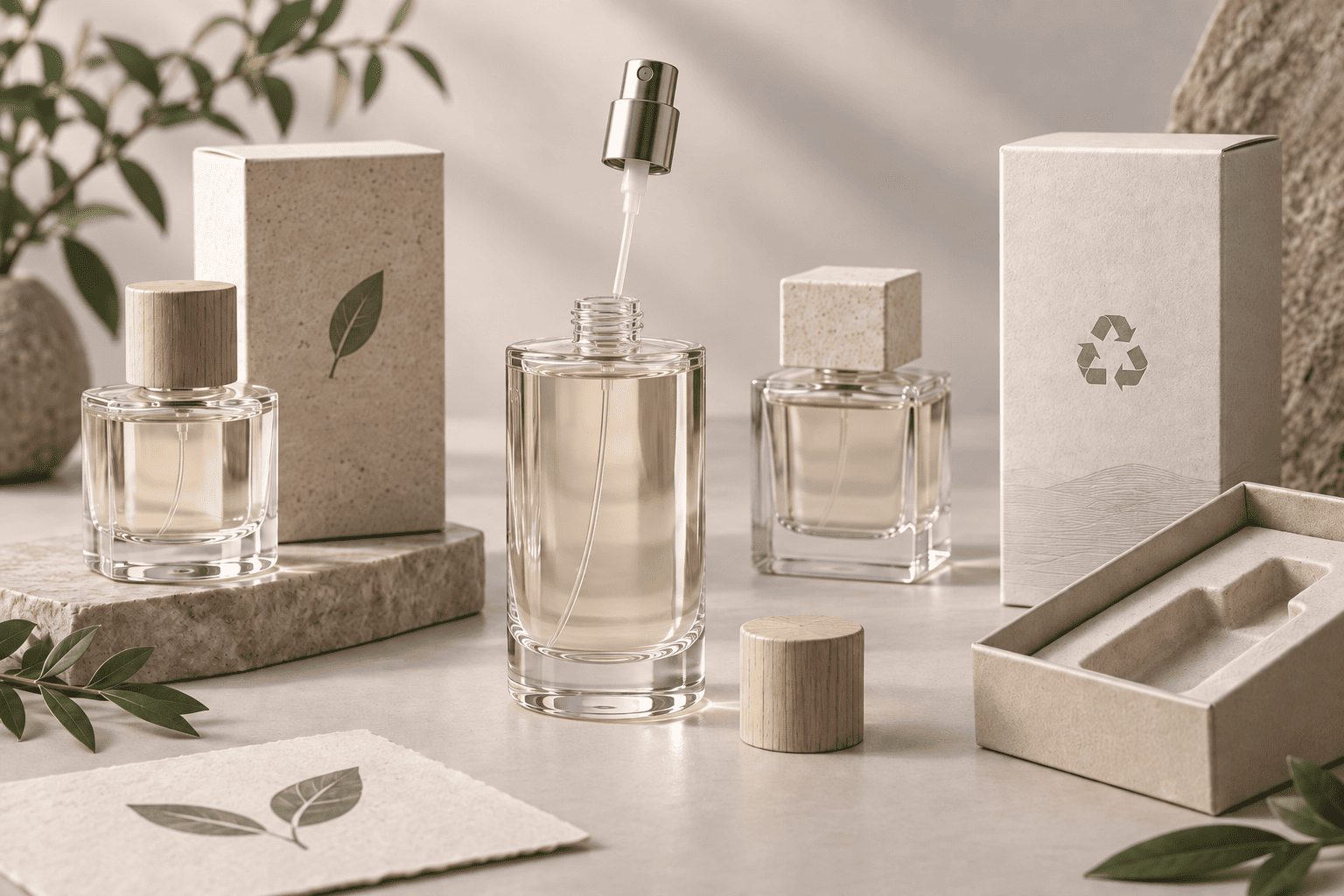
From my experience in perfume glass packaging, [sustainability][[1]] does not always require a completely new packaging system. I can often make a package more sustainable by changing several practical details. These changes can also control cost and MOQ, which is very important for niche perfume brands.
1. How Can I Reduce Plastic and Electroplating in Perfume Packaging?
Many perfume packages depend heavily on ABS plastic, plated collars, plated caps, and other decorative parts. These materials can create a luxury appearance, but they also make the packaging structure more complicated.
I normally reduce unnecessary plastic and electroplating first. I can then use the glass structure, molded branding, engraving, and simpler materials to keep the bottle distinctive without adding too many decorative processes.
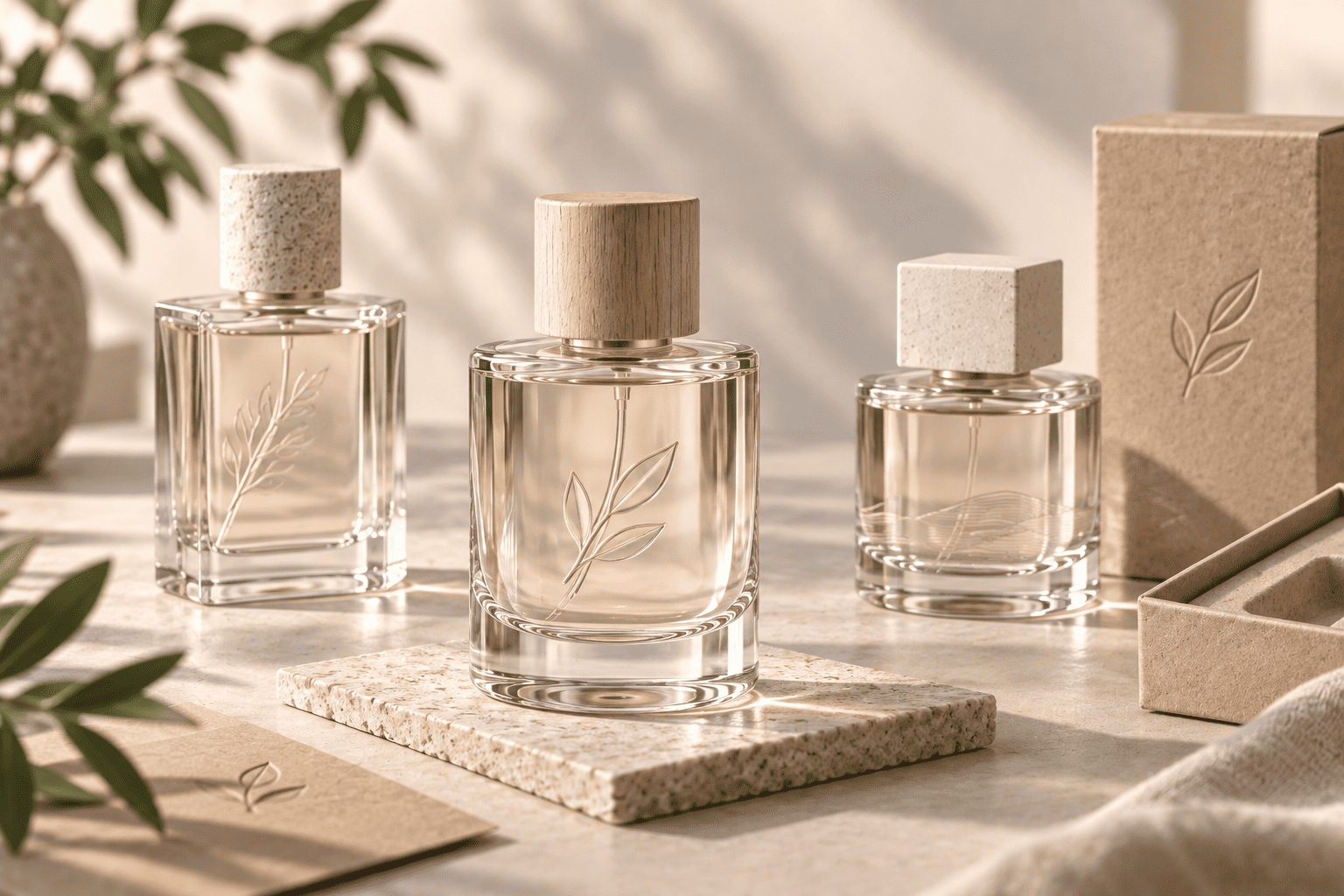
I Let the Glass Become Part of the Brand Design
When we develop a perfume glass packaging solution, one of the first things I look at is whether we can reduce plastic components and electroplated decoration.
I do not think a premium perfume bottle always needs a large amount of gold plating, silver plating, or ABS plastic.
A good glass bottle can already communicate quality.
One practical method is to build the brand logo directly into the glass mold. The logo can be raised from the glass surface or pressed inward. This creates an embossed or debossed brand mark.
The biggest advantage is that the logo becomes part of the bottle itself.
I do not need to add another plastic label, metallic decoration, or chemical coating simply to show the brand name.
| Branding Method | Extra Material | Visual Effect | Practical Benefit |
|---|---|---|---|
| Embossed glass logo | Very little | Strong and premium | Logo becomes part of the bottle |
| Debossed glass logo | Very little | Minimal and elegant | No additional label needed |
| Laser engraving | Very little | Clean and detailed | Flexible for smaller customization |
| Electroplated decoration | Higher | Metallic luxury effect | Strong appearance but more processing |
| Plastic decorative part | Higher | Flexible shapes | Adds another material |
For a custom bottle project, molded branding is one solution I like very much.
The transparent glass can remain the main visual material. The logo still has depth and texture when light passes through the bottle.
For smaller brands that do not want to develop a new mold, I often recommend another method: [laser engraving.][[2]]
We can engrave a logo, perfume name, short message, or design element directly onto the glass. We can also use laser engraving on some wooden perfume caps.
This gives the brand another way to tell its story without adding another printed plastic decoration or another coating layer.
I think this is an important point.
Sustainable design is not only about replacing one material with another. I first ask whether I can remove the material completely.
Sometimes the most sustainable decoration is simply the decoration that I do not need to add.
2. Which Perfume Caps Can Help Reduce the Use of ABS Plastic?
Perfume caps are often made from ABS plastic with metallic finishes. The cap may look small, but it can contain several materials and decorative layers.
I can reduce conventional plastic caps by choosing recycled-material wood caps, natural stone caps, or simpler structures. These options can create a strong niche identity while reducing dependence on heavily decorated ABS components.
I Use the Cap as a Natural Brand Element
I think the perfume cap gives niche brands a very good opportunity to experiment with alternative materials.
One option we see in practical packaging projects is a cap made from recycled wood material.
For example, some caps can be produced using leftover wood materials from industries such as wine cork production. Instead of treating these small leftover pieces as waste, manufacturers can process them into a new cap material.
This gives the cap a natural texture.
It can also match a brand story based on nature, craftsmanship, wine culture, sustainable sourcing, or handmade products.
| Cap Material | Brand Feeling | Main Advantage | What I Consider |
|---|---|---|---|
| Recycled wood material | Natural | Uses recovered material | Texture consistency |
| Cork-based material | Organic | Lightweight and distinctive | Surface finish |
| Natural marble | Premium and natural | Strong visual identity | Weight and cost |
| Simple plastic | Clean | Easy production | Material use |
| Plated ABS | Traditional luxury | Familiar perfume look | More processing |
Natural marble is another interesting direction.
A marble cap does not look like a normal plastic perfume cap. Every piece can have slightly different natural patterns. That difference can become part of the product story.
Of course, I do not think natural material automatically means that every packaging project becomes sustainable.
I still consider weight, transportation, processing, sourcing, and durability.
However, these materials give me more choices when I want to reduce heavily plated ABS plastic.
Wood caps also work very well with engraving.
I can laser engrave the brand logo directly on the wooden surface. I can also engrave a symbol, short sentence, batch number, or design element.
This type of personalization is useful for niche perfume brands because these brands usually rely strongly on storytelling.
The bottle does not need to shout.
The material, texture, logo, and small details can tell the story.
From my point of view, that style often feels more suitable for niche perfume than simply adding more metallic decoration.
3. How Can I Design a Refillable Perfume Bottle?
A refillable perfume bottle can greatly extend the useful life of the main glass package. The customer does not need to throw away a beautiful bottle every time the fragrance is finished.
I can create a refillable system with a removable screw pump or a refill solution for crimp-neck bottles. The goal is to let customers refill the fragrance while keeping the original glass bottle in use for longer.
I Choose the Refill Structure Before Finalizing the Bottle
Refillable packaging is one of the most practical sustainable directions I see in perfume packaging.
The basic idea is very simple.
A customer buys a perfume bottle. The customer finishes the fragrance. Instead of throwing away the glass bottle and buying another complete package, the customer brings the bottle back to the store.
The store fills the bottle again.
The same glass bottle can then continue to be used.
This extends the product life of the bottle.
For some niche perfume brands, I think this model makes a lot of sense because the bottle itself is often an important part of the brand.
| Refill Structure | How It Works | Main Advantage |
|---|---|---|
| Screw-neck pump | Pump can be removed by hand | Very easy to refill |
| Replaceable screw pump | Old pump can be changed | Easy maintenance |
| Crimp-neck refill system | Refill equipment injects fragrance | Keeps traditional bottle appearance |
| In-store refill service | Customer returns to store | Supports customer relationship |
| Larger refill container | Customer refills at home | Convenient for repeat purchase |
The easiest structure is usually a screw-neck perfume pump.
The customer or store staff can unscrew the pump by hand.
The bottle can then be refilled.
If the pump becomes blocked or stops working after long use, the pump can also be replaced easily.
The glass bottle does not need to be discarded just because one small component has a problem.
I think this is a very practical detail that people sometimes ignore.
A sustainable product should also be repairable where possible.
If one inexpensive part fails and the whole package becomes useless, I do not think the design is very efficient.
There is also another solution for traditional crimp-neck perfume bottles.
4. Can a Traditional Crimp Perfume Bottle Also Be Refilled?
Many brands prefer crimp pumps because they create the classic perfume bottle appearance. In the past, this structure made refill concepts more difficult because the pump was not designed to be removed by hand.
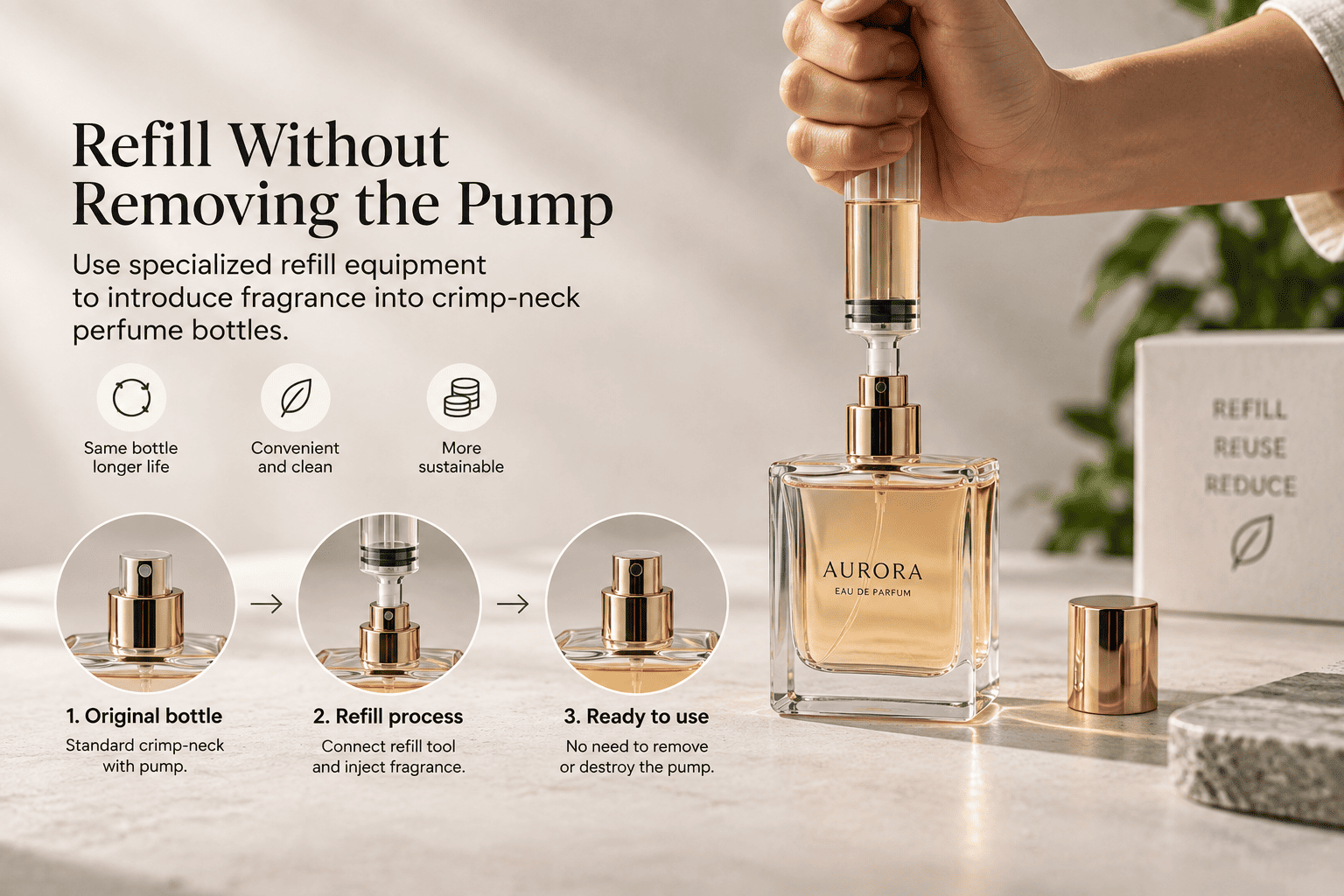
I can now use specialized refill equipment to introduce fragrance into some crimp-neck perfume bottles without removing or destroying the pump structure, which gives traditional perfume packaging another possible refill direction.
I Do Not Always Need to Remove the Crimp Pump
One interesting development we have seen is a new type of refill tool for crimp-neck perfume bottles.
Traditionally, a crimp pump is fixed tightly onto the bottle neck.
Once it has been installed, the customer cannot simply unscrew it.
This is good for sealing and appearance, but it creates a challenge for refill programs.
Now, some refill solutions can inject the liquid from outside without destroying the installed pump structure.
This changes the way I think about refill packaging.
| Bottle Neck | Refill Difficulty | Pump Removal | Best Use |
|---|---|---|---|
| Screw neck | Low | Easy | Brands focused strongly on refill |
| Traditional crimp neck | Higher | Difficult | Classic perfume packaging |
| Crimp neck with refill equipment | Medium | Not always required | Retail refill programs |
The advantage is that the brand can still use a familiar crimped perfume bottle.
The customer can also keep the original bottle for a longer period.
This can be especially useful for a perfume brand with physical stores.
A customer can bring the bottle back to the store. The staff can refill the fragrance using the correct equipment.
The brand can also turn the refill experience into part of the customer relationship.
I think this is important for niche perfume brands.
Refill is not only an environmental idea.
It can also become a reason for the customer to return to the store.
The customer may smell another fragrance, talk with the staff, or discover a new product during the refill visit.
Because of this, sustainable packaging can sometimes support the business model instead of only creating extra cost.
I still think brands need proper compatibility and operational testing before launching this type of refill program.
The pump, bottle, fragrance, refill equipment, sealing performance, and store process all need to work together.
But from a packaging design point of view, crimp bottles no longer have to be automatically excluded from every refill discussion.
5. How Can I Make the Paper Packaging More Sustainable?
The glass bottle usually receives the most attention, but the paper box can also contain unnecessary layers, coatings, inserts, printing, and decorative materials.
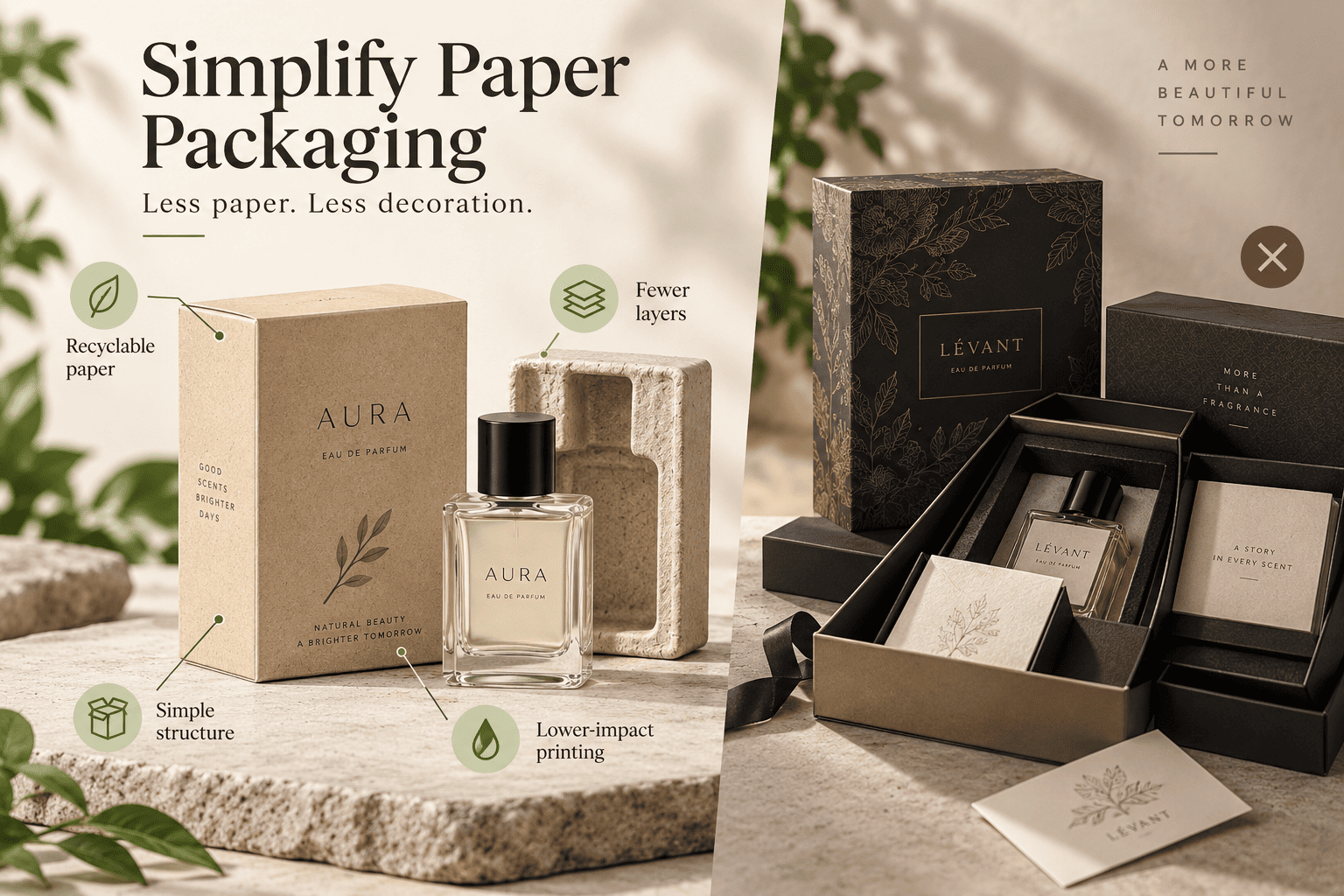
I prefer recyclable paper, simpler structural designs, fewer packaging layers, and lower-impact printing options. I try to reduce both the amount of paper and the amount of decoration instead of making an oversized box look sustainable.
I Keep the Box Simple and Let the Product Speak
When I work on the paper packaging, I follow almost the same logic as I use for the glass bottle.
I first try to reduce.
I do not immediately start by adding a new “eco-friendly” material.
I ask whether the box can be smaller.
I ask whether I need a plastic insert.
I ask whether I need several layers of paper.
I ask whether the sleeve, card, inner tray, and outer box are all necessary.
| Packaging Element | Conventional Option | Simpler Direction |
|---|---|---|
| Outer box | Oversized rigid box | Right-sized recyclable paper box |
| Inner tray | Plastic or foam | Paper-based structure |
| Sleeve | Separate printed sleeve | Remove or print directly |
| Surface decoration | Multiple coating processes | Simple printing |
| Ink | Conventional ink system | Lower-impact or biodegradable option where suitable |
I also pay attention to printing.
If the paper itself is recyclable but the package uses too many coatings, laminations, metallic films, and decorative layers, the structure can still become complicated.
For some projects, we can use more environmentally considerate ink options and reduce the total printed area.
I also like simple typography.
[A niche perfume brand][[3]] does not always need the entire box covered in graphics.
One good paper texture, one logo, one fragrance name, and one small story can sometimes create a stronger result.
I think minimal packaging also fits the way many modern niche perfume brands communicate.
The customer focuses on the scent, the bottle, and the story.
The packaging supports these elements.
It does not need to overpower them.
This can also reduce cost.
For small and medium perfume brands, that matters because sustainability needs to make commercial sense.
If an environmental packaging idea makes the packaging three times more expensive, many young brands cannot continue using it.
I prefer a solution that the brand can repeat for every production order.
6. Why Are Stock Perfume Bottles Practical for Sustainable Niche Brands?
Small perfume brands usually do not order huge quantities for every fragrance. A completely different custom mold for every scent can create large tooling costs, large MOQs, and unnecessary stock.
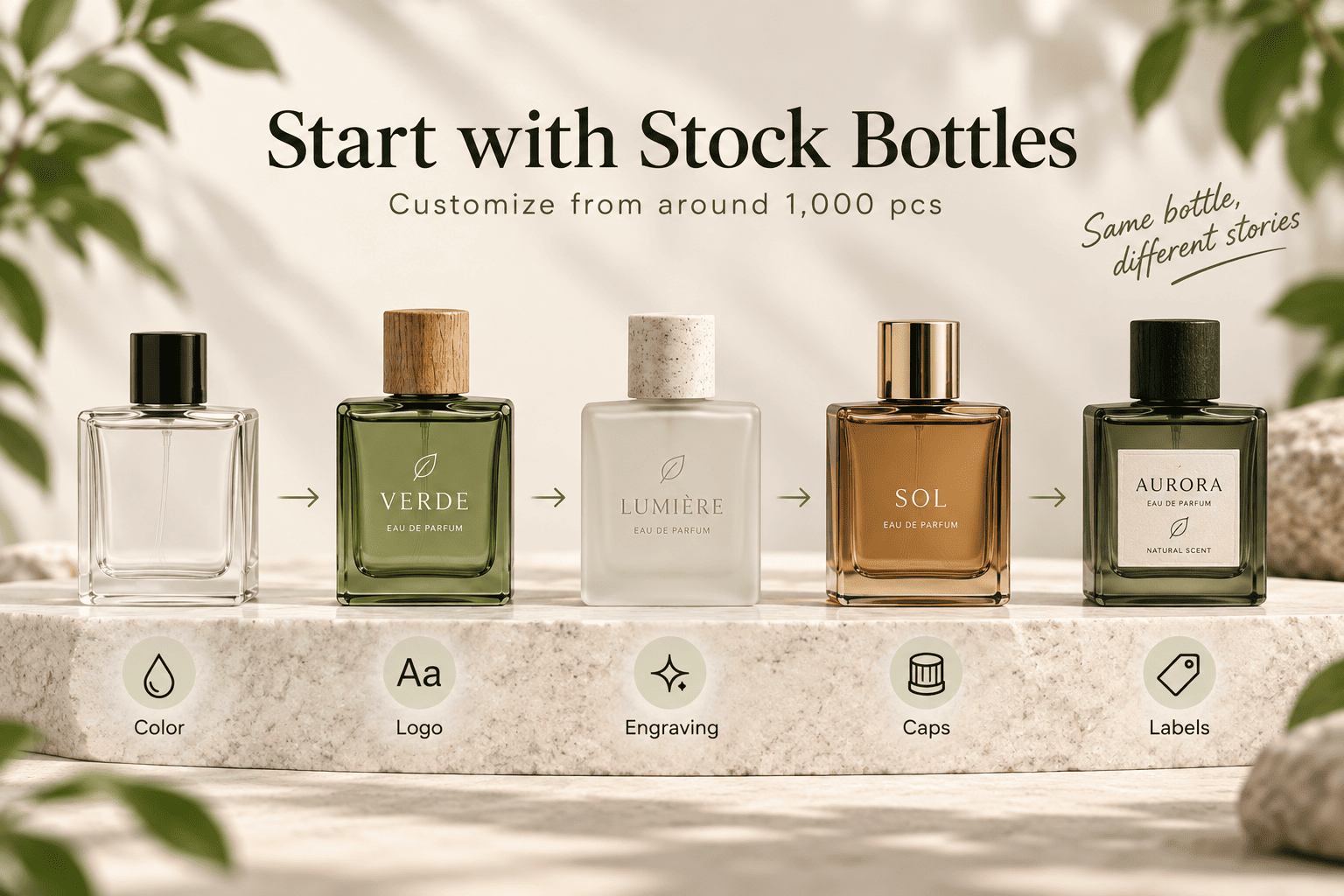
I recommend stock perfume bottles for many growing brands because they can start customization from around 1,000 pieces in suitable projects, then use color, logos, engraving, caps, and labels to create their own identity.
I Prefer Customizing an Existing Structure Before Creating a New Mold
This is one of the most important practical points for the type of customers we work with.
Many niche perfume brands have several fragrances.
A brand may have five scents, ten scents, or more.
If every fragrance needs a completely different custom glass bottle, the investment can become very high.
The brand also has to keep much more packaging stock.
For a new or growing brand, I normally suggest looking at stock bottles first.
At Hongyan Glass Bottle, we have more than 500 perfume bottle styles available in our existing range.
This allows us to start from an existing bottle and create differentiation around it.
| Customization Method | New Bottle Mold Needed? | Suitable for Smaller Orders? |
|---|---|---|
| Logo printing | No | Yes |
| Color spraying | No | Yes |
| Frosting | No | Yes |
| Laser engraving | No | Yes |
| Wooden cap engraving | No | Yes |
| Different label design | No | Yes |
| Fully custom glass shape | Yes | Usually needs more planning |
For some projects, a brand can start customization from around 1,000 pieces.
The exact MOQ depends on the bottle, decoration, cap, pump, and packaging requirements, but the general idea is very useful.
I can take a stock bottle.
I can add the brand color.
I can apply the logo.
I can select a stock wooden cap.
I can combine it with a suitable pump.
Then I can create a package that already looks like the brand without developing every component from zero.
This can reduce development time.
It can also reduce the risk of buying too much inventory.
I think inventory waste is an important part of sustainability.
If a small brand orders 20,000 custom bottles and only uses 5,000 before changing its branding, the unused 15,000 bottles are still waste even if they were made from recyclable glass.
A lower-MOQ stock solution lets the brand purchase closer to real demand.
That is often a more practical choice.
7. How Can Laser Engraving Make Perfume Packaging More Sustainable?
Brands need customization, but customization does not always require extra coatings, labels, plastic badges, or complicated chemical decoration processes.
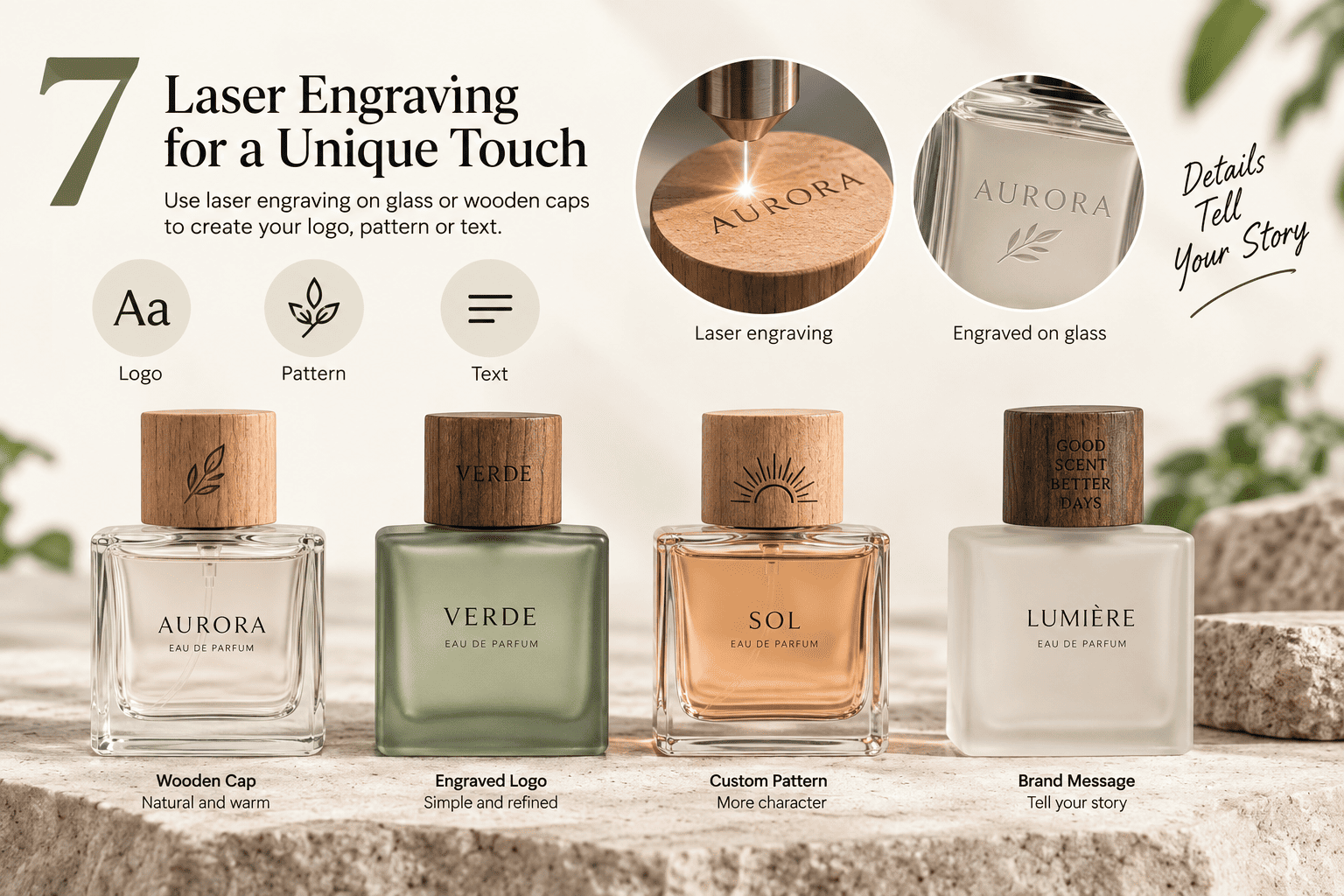
I can use laser engraving directly on suitable glass or wooden caps to create logos, patterns, text, and brand stories. This gives niche brands customization without always adding another printed or coated decorative material.
I Use the Existing Material as the Communication Surface
I think laser engraving is especially useful for niche brands.
A niche perfume usually needs a story.
The founder may want to explain where the scent idea came from.
The brand may have a symbol.
The perfume may belong to a numbered collection.
The founder may even want a short sentence on the package.
Normally, a brand may solve this by adding another label or another printed component.
I can also use the existing bottle or cap itself.
| Surface | Possible Engraving | Brand Use |
|---|---|---|
| Glass bottle | Logo | Main brand recognition |
| Glass bottle | Fragrance name | Product identification |
| Glass bottle | Pattern | Visual storytelling |
| Wooden cap | Logo | Premium detail |
| Wooden cap | Symbol | Collection identity |
| Wooden cap | Short message | Brand story |
When the glass surface is suitable, laser engraving can create permanent visual details.
A wooden cap can also be engraved directly.
I like this because the customization becomes part of the material.
We do not always need to apply an additional decorative piece.
This also works well with a natural design style.
For example, I can combine a transparent perfume bottle with a recycled-material wooden cap.
I can engrave the logo on the cap.
I can keep the glass itself clear.
I can then use a simple recyclable paper box.
The whole packaging language becomes consistent.
It looks intentional.
It does not look like the brand simply removed decoration to save money.
For a niche fragrance brand, I think that distinction is very important.
Minimal design needs to look deliberate.
The brand story, typography, proportions, glass quality, cap material, and small engraved details need to work together.
When we do this correctly, using fewer processes can actually make the perfume feel more distinctive.
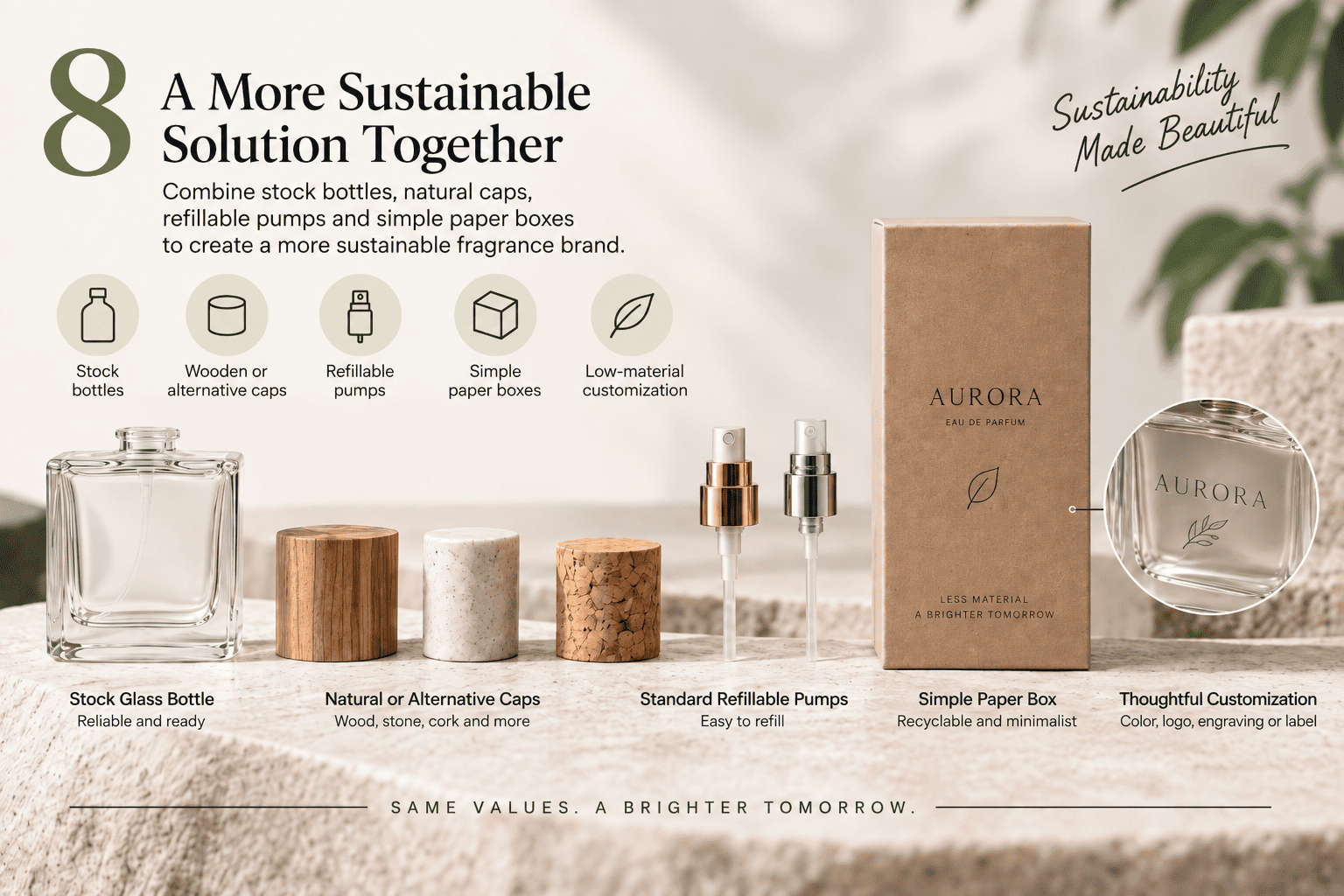
8. How Can I Build a Sustainable Packaging System Without Increasing My MOQ Too Much?
Sustainability becomes difficult when every eco-friendly idea requires a unique component and a very high MOQ. Small perfume brands need a solution that is environmentally considered and commercially realistic.
I normally combine stock glass bottles, available wooden or alternative caps, standard refillable pumps, simple paper boxes, and low-material customization. This allows a niche brand to improve sustainability without developing every component from scratch.
I Build the System Around Real Order Volume
For me, this is where all the previous ideas come together.
There are many sustainable packaging options in real production.
The challenge is not finding ideas.
The challenge is choosing the right combination for the brand's actual order volume, budget, positioning, and sales channel.
A small perfume brand may not need a revolutionary new bottle.
It may need a smarter packaging system.
For example, I could build one project like this:
| Component | Practical Choice |
|---|---|
| Bottle | Existing clear glass bottle |
| Branding | Laser engraving or simple logo decoration |
| Cap | Stock recycled-material wood cap |
| Pump | Screw-neck refillable pump |
| Box | Simple recyclable paper carton |
| Insert | Paper-based insert |
| Printing | Reduced printing with suitable lower-impact ink |
| MOQ strategy | Start with a smaller stock-based order |
This structure can already solve many problems.
The glass bottle can be reused.
The screw pump can be removed.
The pump can be replaced if it stops working.
The wooden cap can reduce the need for a plated ABS cap.
The logo can be engraved instead of adding another decorative material.
The box can use fewer materials.
The order quantity can also remain more suitable for a growing perfume brand.
I can then improve the system as the brand grows.
If sales become stable and the customer wants a truly unique glass shape, we can develop a new bottle.
We can support 3D sampling before moving into full tooling.
At that stage, we can also consider an embossed or debossed logo directly in the glass mold.
The brand does not need to do everything on day one.
I think this is especially important for niche perfume founders.
Many of our customers are building their brands through e-commerce or local distribution. They may have a strong brand idea, but they still need to control cash flow.
My mission is not to sell them the most complicated package.
I want to help them find a packaging solution that looks right, works correctly, fits their current order quantity, and gives them room to grow.
For me, that is what practical sustainable perfume packaging should look like.
It should reduce unnecessary plastic.
It should reduce unnecessary plating and chemical decoration.
It should make better use of glass.
It should use recyclable or alternative materials where they make sense.
It should support refill and longer product life.
It should also avoid forcing a small brand to purchase a huge amount of packaging that it may never use.
Conclusion
I believe sustainable perfume packaging starts with practical choices: fewer materials, reusable glass, refillable pumps, simpler decoration, recyclable paper, and packaging quantities that match real demand.
[[1]]: https://en.wikipedia.org/wiki/Sustainability "sustainability"
[[2]]: https://en.wikipedia.org/wiki/Laser_engraving "laser engraving."
[[3]]: https://nicheperfumes.net/en/our-brands/?srsltid=AfmBOooDm7-u6ITUFnYj7V3HYr2n0y1NLRlcacOM4PQWmiMoTxy2JfgJ "A niche perfume brand"