
Choosing the wrong perfume bottle size can increase inventory pressure, raise packaging costs, and make customers hesitate. I see many new fragrance brands underestimate this decision.
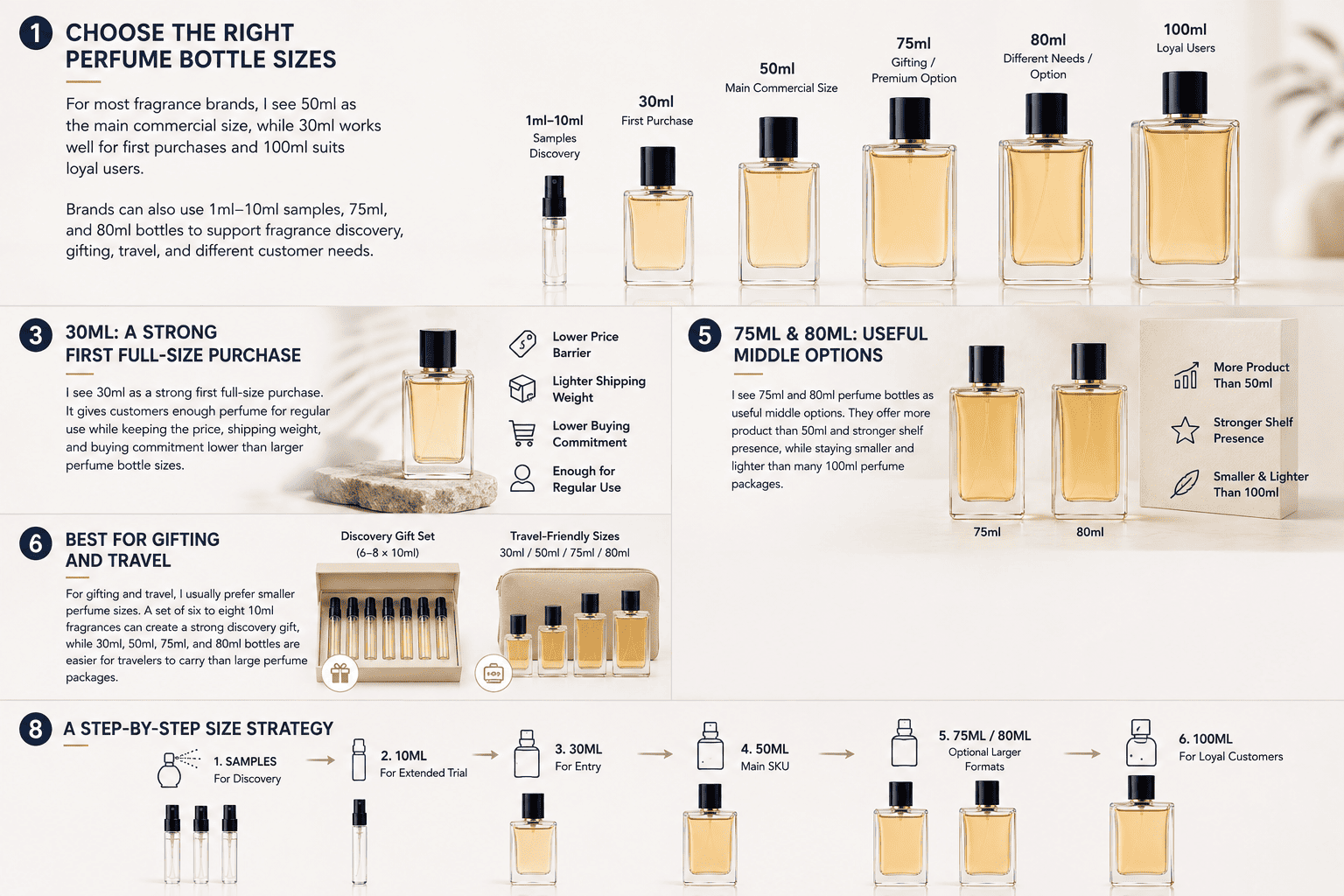
For most fragrance brands, I see 50ml as the main commercial size, while 30ml works well for first purchases and 100ml suits loyal users. Brands can also use 1ml–10ml samples, 75ml, and 80ml bottles to support fragrance discovery, gifting, travel, and different customer needs.
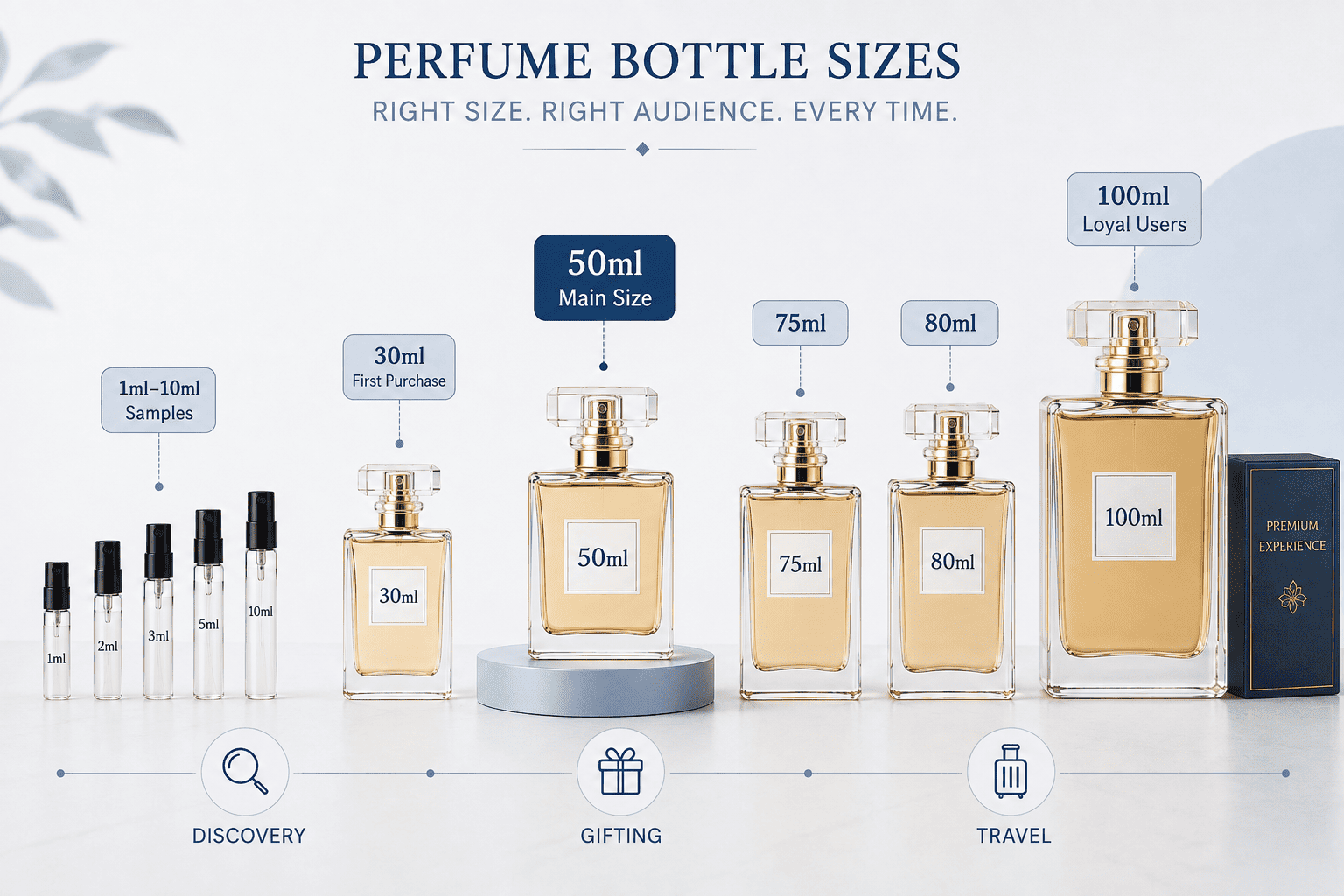
When I help a fragrance brand choose packaging, I rarely look at bottle capacity as an isolated decision.
I look at how customers discover the fragrance.
I look at how much they are willing to spend.
I look at whether they are buying for themselves, buying a gift, or carrying the perfume while traveling.
I also look at [MOQ][[1]], packaging cost, shipping weight, and how quickly the brand wants to launch.
For me, perfume bottle size should follow the customer journey.
A customer may first try a 1ml or 2ml perfume sample.
He may then buy a 10ml travel perfume.
After that, he may move to 30ml or 50ml.
When he is completely sure that he loves one fragrance, 100ml becomes much easier to sell.
This is why I do not think there is one perfect perfume bottle size for every brand.
Why Are 1ml, 2ml, 3ml, 5ml, and 10ml Perfume Bottles Important?
A customer may like your perfume story and packaging but still feel unsure about the scent. If the only choice is a large bottle, that uncertainty can stop the purchase.
Small perfume sizes such as 1ml, 2ml, 3ml, 5ml, and 10ml reduce the customer's first-purchase risk. I especially like 10ml perfume bottles because customers can wear the fragrance several times before deciding whether they want a 30ml, 50ml, or 100ml bottle.
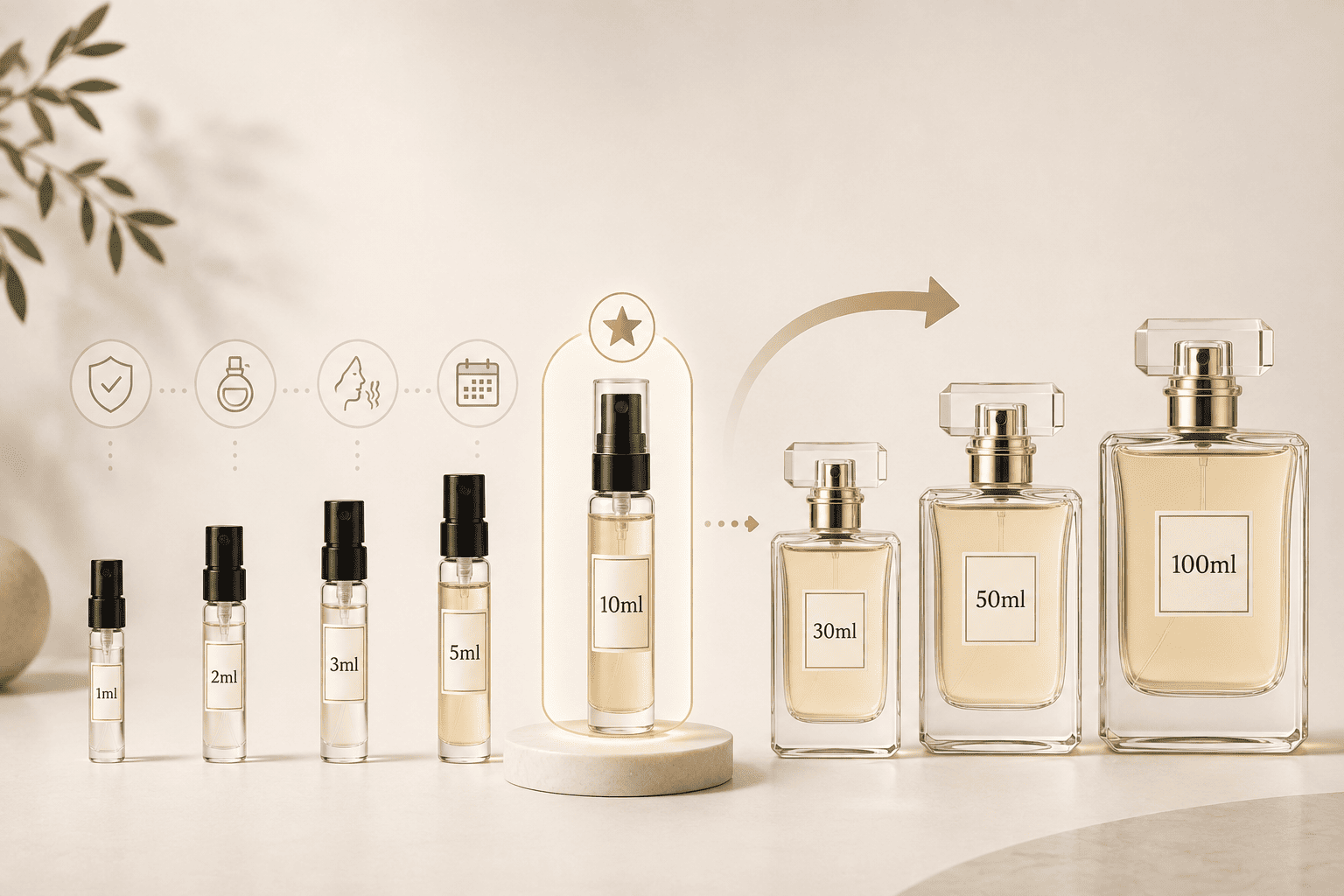
I See Small Perfume Bottles as Part of the Sales Funnel
When people discuss perfume bottle sizes, they often start directly with 30ml, 50ml, and 100ml.
I think this misses an important step.
Customers often need to discover the fragrance first.
This is especially true for e-commerce perfume brands.
A customer can read that a fragrance contains citrus, musk, amber, oud, vanilla, or woody notes.
He can read the brand story.
He can watch videos.
He can read reviews.
He still cannot smell the fragrance through the screen.
This is why perfume samples are so useful.
| Size | Common Use | My View |
|---|---|---|
| 1ml | Basic fragrance sample | Good for first discovery |
| 2ml | Standard sample | Enough for several sprays |
| 3ml | Extended testing | Better testing experience |
| 5ml | Mini perfume | Good for travel and gifting |
| 10ml | Trial and travel perfume | Strong bridge to full-size bottles |
| 30ml | Entry full-size perfume | Good first purchase |
| 50ml | Main commercial size | Best balance for many brands |
| 75ml / 80ml | Mid-large option | Good compromise |
| 100ml | Large full-size bottle | Better for loyal customers |
I especially like the 10ml size.
A 1ml sample helps customers smell a fragrance.
A 10ml perfume bottle allows them to actually live with it.
They can wear it to work.
They can use it during the evening.
They can test it in different weather.
They can see how the top notes, middle notes, and base notes develop.
This matters for [eau de parfum][[2]], cologne perfume, niche fragrances, and many other fragrance products.
A brand with several fragrances can also create a discovery set.
For example, six to eight different 10ml perfume bottles can give customers a complete fragrance experience.
Instead of choosing one scent immediately, they can try several.
Then they can decide which fragrance deserves a 30ml, 50ml, or even 100ml purchase.
Is a 30ml Perfume Bottle Better for First-Time Buyers?
A 30ml bottle gives customers a real full-size perfume experience without requiring the same commitment as 50ml or 100ml.
I see 30ml as a strong first full-size purchase. It gives customers enough perfume for regular use while keeping the price, shipping weight, and buying commitment lower than larger perfume bottle sizes.
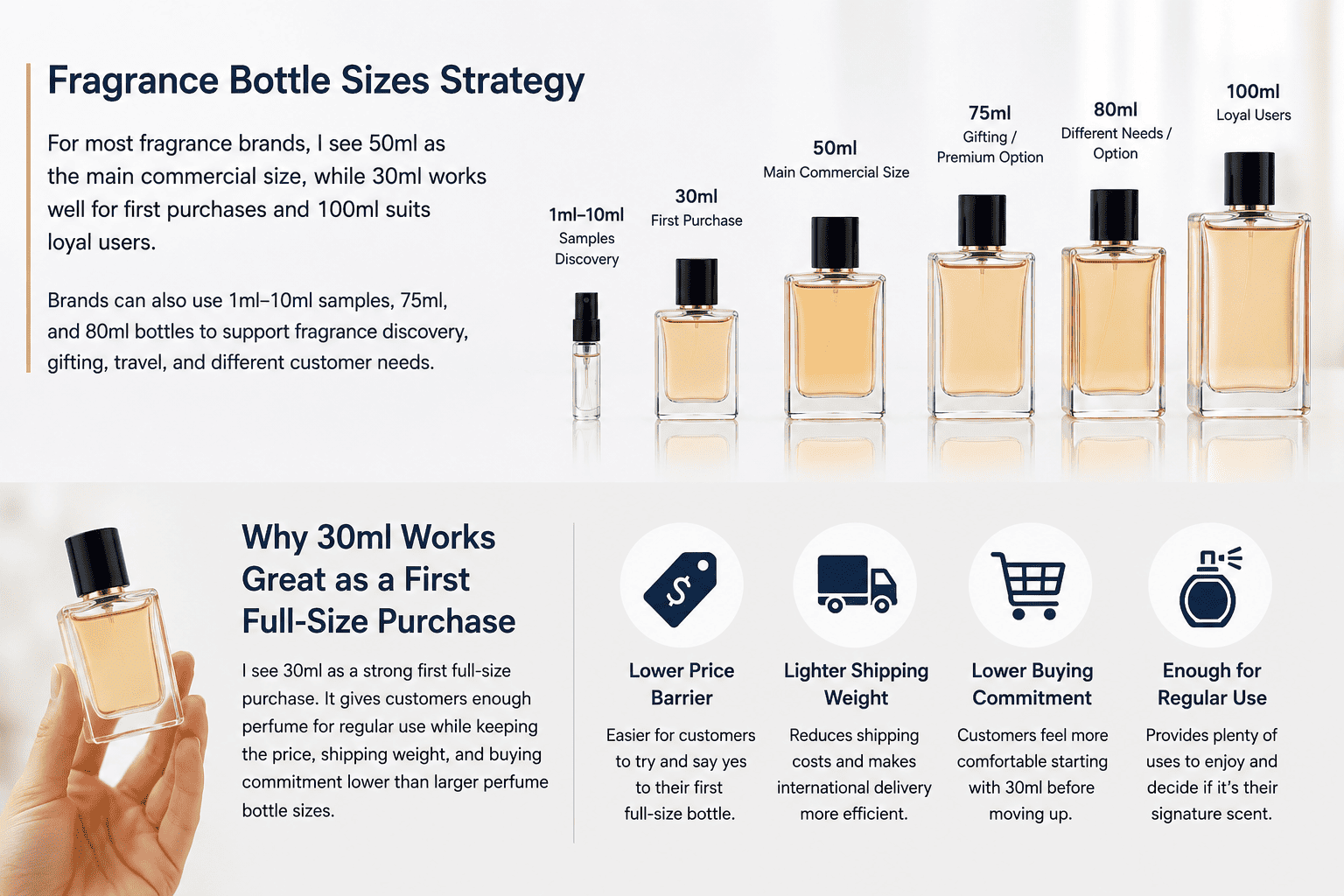
Why I Put 30ml After the Sampling Stage
I like to think about perfume sizes as steps.
The first step may be a sample.
The second step may be 10ml.
Then the customer can move to 30ml.
At this stage, the customer already has some confidence in the fragrance.
He may have tested it before.
He may have received a sample.
He may have tried it in a store.
He wants more perfume, but he may still not want to commit to a 100ml bottle.
This makes 30ml very useful.
| Factor | 30ml Performance | Why It Matters |
|---|---|---|
| First-purchase risk | Low | Easier for new customers |
| Retail price | More accessible | Good for online conversion |
| Liquid cost | Lower | Reduces product investment |
| Shipping weight | Lower | Useful for e-commerce |
| Product experience | Full-size | Feels more complete than a sample |
| Collection buying | Strong | Customers can own several scents |
I also think 30ml works well for customers who like variety.
Some customers do not want one signature fragrance.
They want one fresh fragrance for daytime.
They want another for evenings.
They may want a cologne perfume for summer and a warmer amber fragrance for winter.
For these customers, several 30ml bottles can make more sense than one large bottle.
Why Is 50ml the Most Popular Perfume Bottle Size?
Many fragrance brands need one size that feels substantial but does not create too much price pressure. In my experience, 50ml often becomes that middle point.
I see 50ml as the main perfume bottle size for many brands because it balances retail price, packaging cost, shipping weight, shelf presence, customer value, and actual usage time. It is large enough to feel premium without creating the same commitment as 100ml.
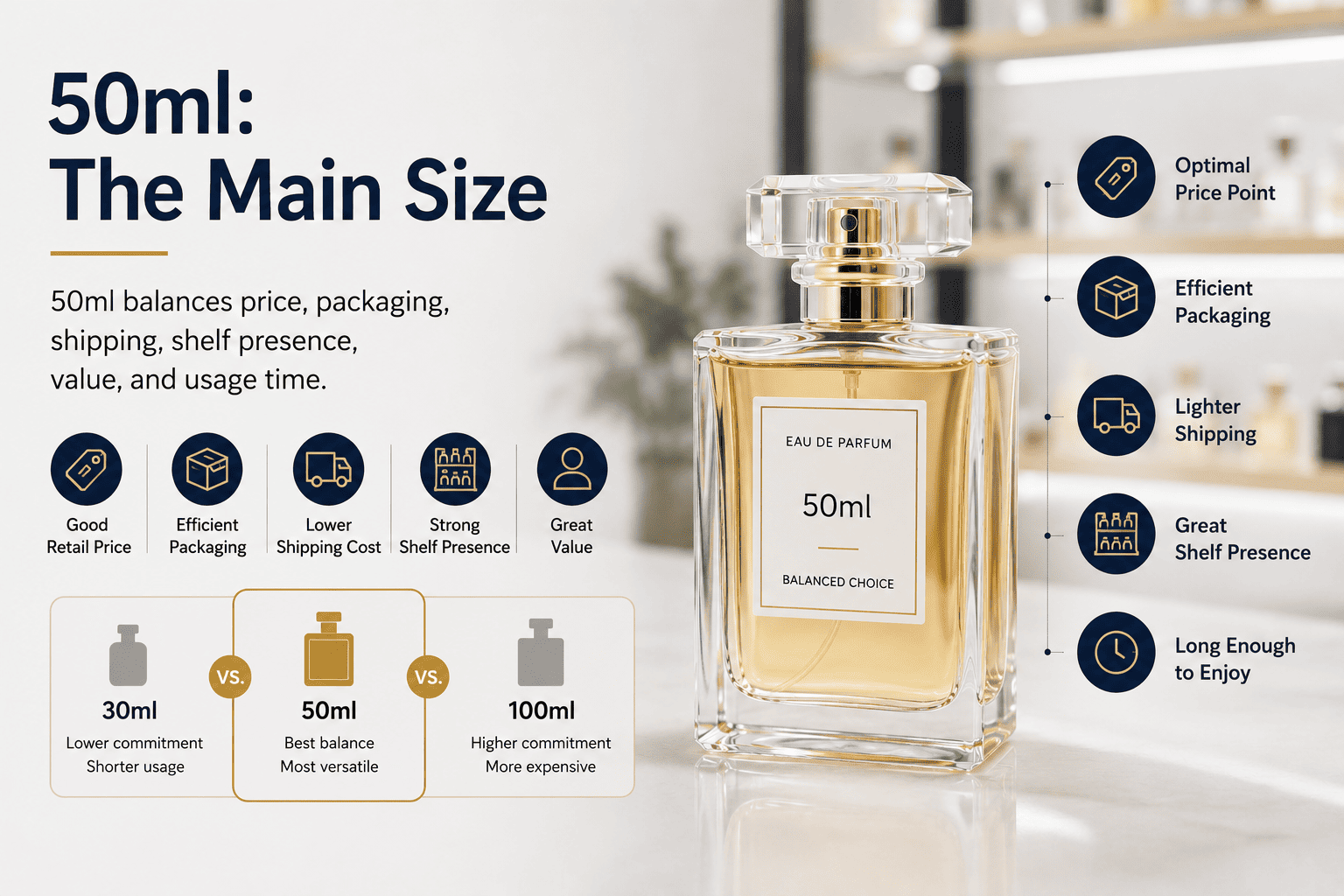
Why I Usually Treat 50ml as the Main SKU
If a customer asks me which perfume bottle size should become the main product, I often start the discussion with 50ml.
I do not say that 50ml is always correct.
I say that it gives the brand a useful balance.
A 30ml bottle can sometimes feel small.
A 100ml bottle can look impressive, but it needs more fragrance liquid.
The final retail price is also usually higher.
The 50ml bottle sits between these two.
It has enough physical presence for strong packaging design.
It also gives enough surface area for spray color, frosting, metallization, decals, printing, gold decoration, or other treatments.
| Business Factor | 30ml | 50ml | 100ml |
|---|---|---|---|
| First purchase comfort | High | High | Lower |
| Shelf presence | Medium | High | High |
| Perfume liquid investment | Low | Medium | High |
| Shipping efficiency | High | Good | Lower |
| Decoration space | Good | Very good | Very good |
| Main SKU potential | Good | Excellent | Depends on market |
| Customer commitment | Low | Medium | High |
There is also another practical reason why I like 50ml.
Fragrance can change gradually after opening because it is exposed to air, heat, light, and different storage conditions.
A customer who owns many perfumes may use each bottle very slowly.
If he buys several large 100ml bottles, some may stay open for a long time.
A 50ml bottle can be easier to finish within a reasonable period.
For me, that makes 50ml practical for both the customer and the brand.
When Should a Brand Offer 75ml or 80ml Perfume Bottles?
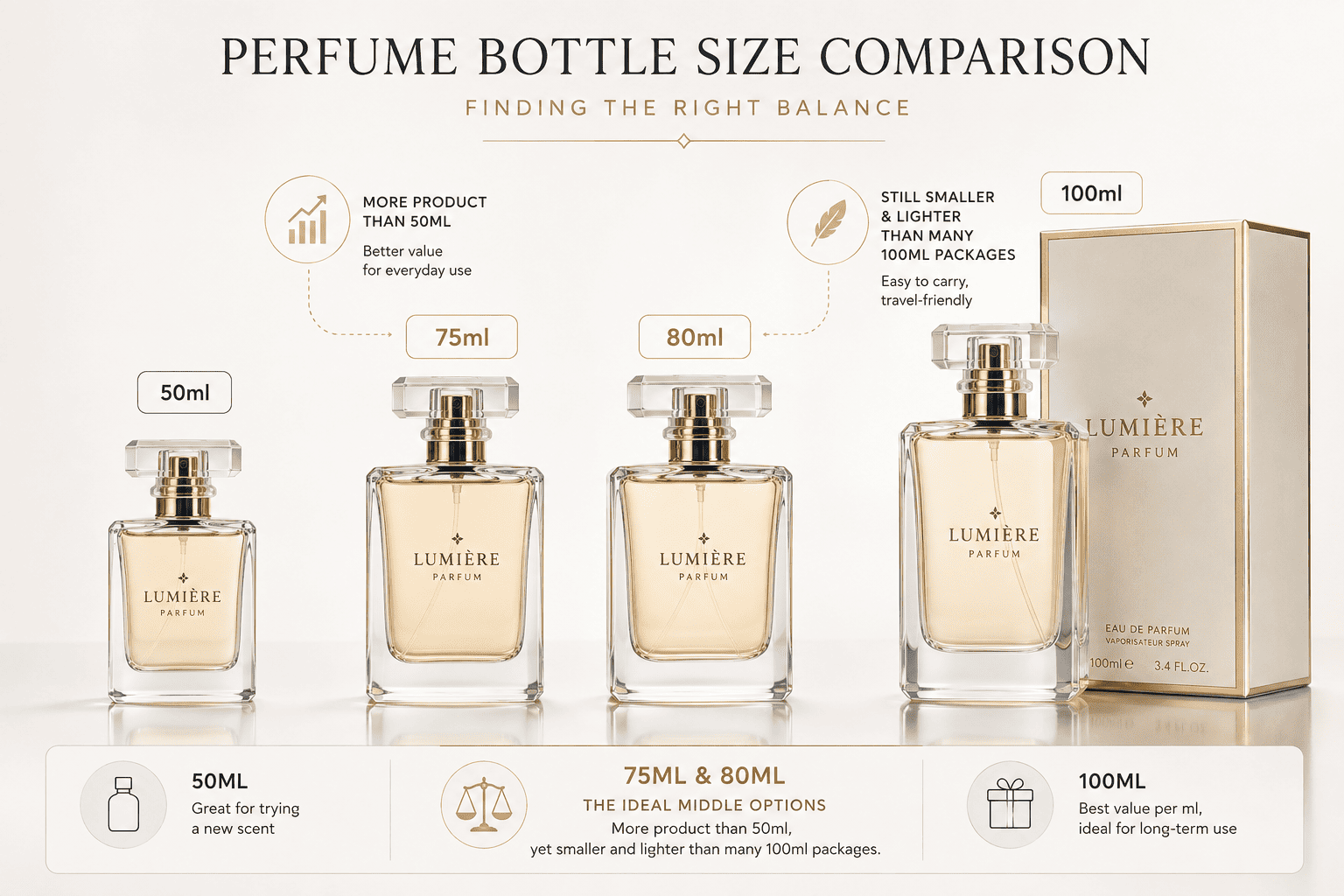
The market does not stop at 30ml, 50ml, and 100ml. Some fragrance brands use 75ml or 80ml because they want more value without moving completely into the 100ml category.
I see 75ml and 80ml perfume bottles as useful middle options. They offer more product than 50ml and stronger shelf presence, while staying smaller and lighter than many 100ml perfume packages.
Why 75ml and 80ml Can Be Smart Compromises
I do not think fragrance brands should treat 30ml, 50ml, and 100ml as fixed rules.
There are many other capacities.
75ml and 80ml are good examples.
Some brands feel that 50ml does not provide enough value for their target customer.
At the same time, they do not want to go directly to 100ml.
An 80ml perfume bottle can solve this problem.
| Size | Positioning | Customer Perception |
|---|---|---|
| 30ml | Entry size | Easy to try |
| 50ml | Core size | Balanced |
| 75ml | Mid-large size | More generous |
| 80ml | Mid-large size | Strong value |
| 100ml | Large size | Best volume value |
Bottle proportion also matters.
A fragrance bottle is not only a volume number.
The width, height, shoulder design, bottom thickness, glass weight, cap size, and decoration area all affect the final appearance.
Sometimes an 80ml perfume bottle simply has better proportions than the 100ml version.
I think brands should stay flexible.
The right size is the one that works for both the business model and the visual design.
How Do Gifting and Travel Affect Perfume Bottle Size?
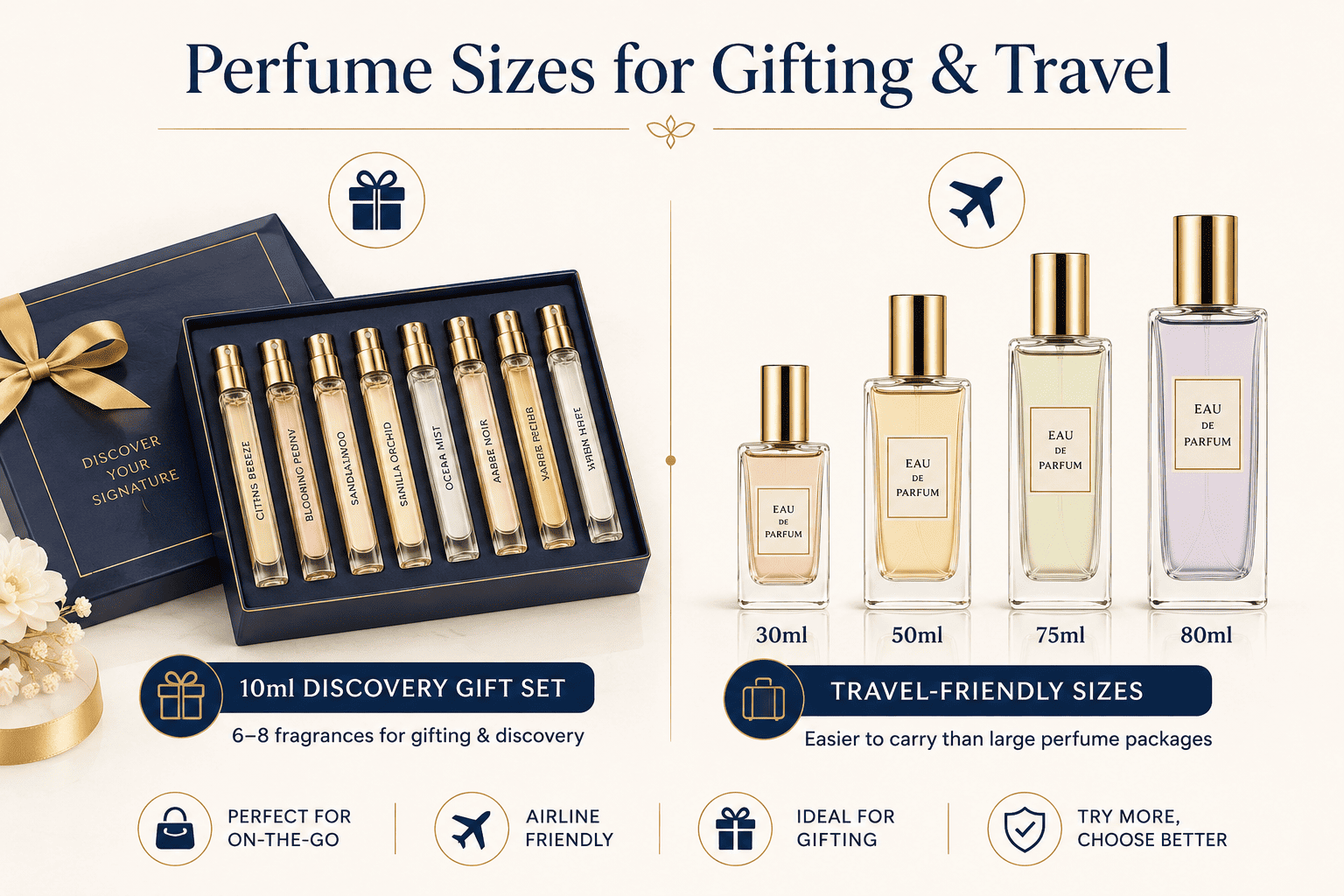
Perfume is not always bought for personal daily use. Customers may also buy fragrance as a gift, discovery set, souvenir, or travel product.
For gifting and travel, I usually prefer smaller perfume sizes. A set of six to eight 10ml fragrances can create a strong discovery gift, while 30ml, 50ml, 75ml, and 80ml bottles are easier for travelers to carry than large perfume packages.
Why I Think 10ml Works Very Well for Gift Sets
I think 10ml has a special role in perfume packaging.
It is small enough to create a set.
It is large enough to feel more valuable than a basic sample.
For example, a brand can prepare six or eight different 10ml fragrances in one gift box.
This can work very well for holiday gifts, wedding favors, corporate gifts, souvenirs, or fragrance discovery collections.
The customer gets variety.
The brand gets a chance to introduce more scents.
| Gift Format | Bottle Size | Main Benefit |
|---|---|---|
| Basic sample set | 1ml–3ml | Low-cost discovery |
| Premium sample set | 5ml | Better presentation |
| Discovery gift box | 6–8 × 10ml | Variety and gift value |
| Travel set | 3–5 × 10ml | Easy to carry |
| Small gift | 30ml | Full-product feeling |
| Main fragrance gift | 50ml | Balanced presentation |
| Loyal-user gift | 75ml–100ml | Higher volume |
I also think travel affects customer decisions.
Many travelers prefer smaller perfume packages because they are easier to pack.
Air travel also makes customers more aware of liquid container size in cabin baggage.
This can make 10ml, 30ml, 50ml, 75ml, and 80ml formats more attractive.
I do not choose 80ml only because of travel.
I look at the total customer experience.
An 80ml bottle gives more perfume than 50ml.
It looks more substantial.
It still avoids some of the weight and size of a larger 100ml package.
This can make it a useful compromise.
When Should Customers Choose a 100ml Perfume Bottle?
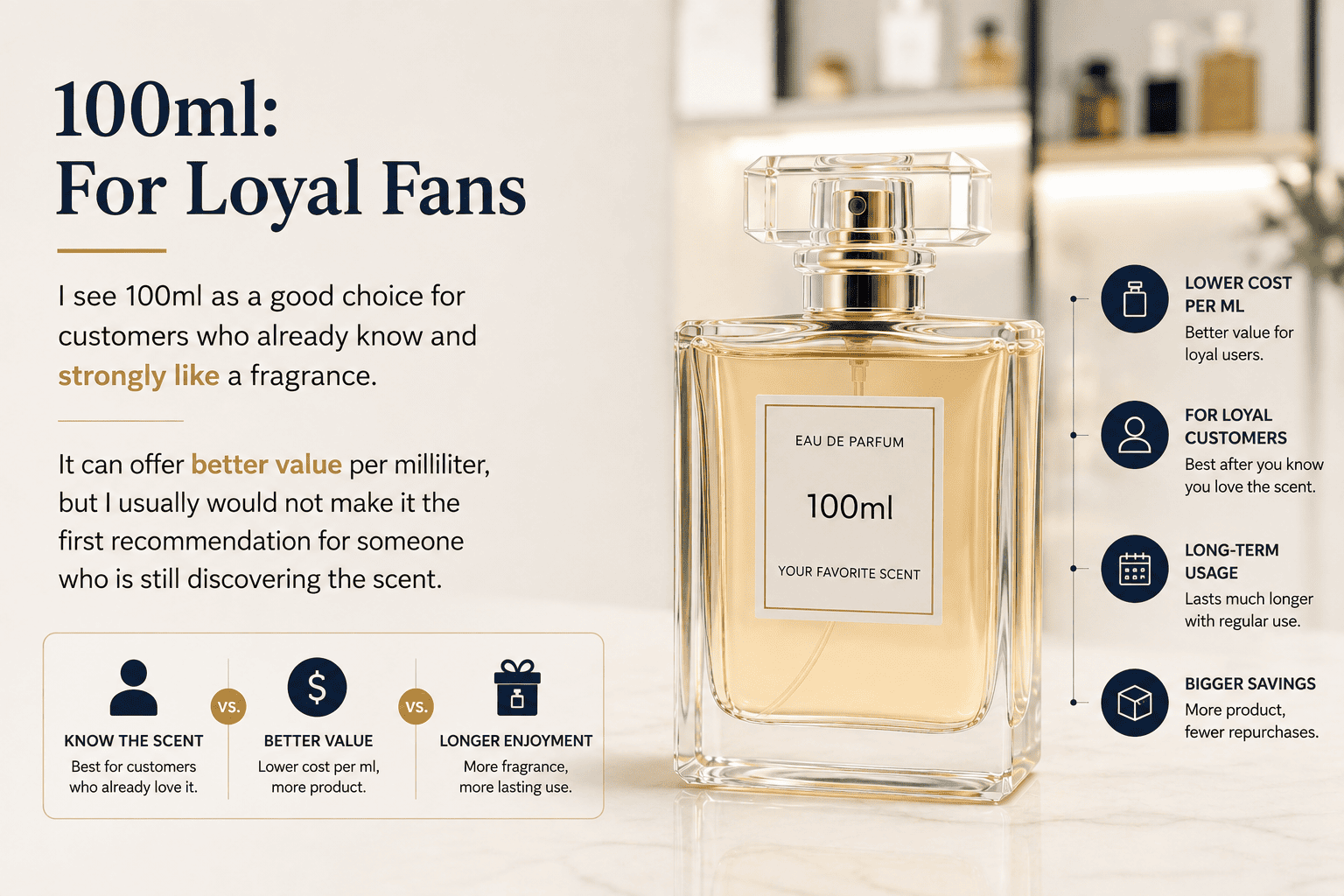
A 100ml perfume bottle gives the strongest volume value, but it is not always the best first purchase.
I see 100ml as a good choice for customers who already know and strongly like a fragrance. It can offer better value per milliliter, but I usually would not make it the first recommendation for someone who is still discovering the scent.
I See 100ml as a Loyalty Size
If somebody already knows that a fragrance works for him, the buying decision changes.
He does not need to test it.
He already likes it.
He may use it every day.
In this situation, 100ml can make sense.
The customer gets more product.
The cost per milliliter is often more attractive.
This is why I see 100ml as a loyalty size.
| Customer Situation | Size I Would Consider |
|---|---|
| Never smelled the fragrance | 1ml–5ml |
| Wants a longer test | 10ml |
| Likes the scent but is still exploring | 30ml |
| Regular fragrance user | 50ml |
| Wants more volume | 75ml / 80ml |
| Strongly loves one fragrance | 100ml |
| Uses the same perfume daily | 100ml |
I do not think every fragrance brand should push first-time customers toward 100ml.
A customer may later discover that he does not like the fragrance as much as expected.
He may also own many perfumes and use each one slowly.
Selling the right size can create a better long-term relationship.
How Should Fragrance Brands Build a Perfume Bottle Size Strategy?
Offering every possible capacity looks professional, but too many SKUs can quickly increase inventory and [packaging complexity][[3]].
I prefer a step-by-step size strategy: samples for discovery, 10ml for extended trial, 30ml for entry, 50ml as the main SKU, 75ml or 80ml as optional larger formats, and 100ml for loyal customers.
I Would Give Every Bottle Size One Clear Job
I do not think every size needs to do the same job.
I would give each capacity a purpose.
| Stage | Bottle Size | Main Purpose |
|---|---|---|
| Discovery | 1ml / 2ml / 3ml | Test the fragrance |
| Extended trial | 5ml / 10ml | Wear the fragrance |
| First full-size purchase | 30ml | Lower commitment |
| Main purchase | 50ml | Best overall balance |
| Larger option | 75ml / 80ml | More value |
| Loyal customer | 100ml | Strong volume value |
This structure is especially useful for e-commerce fragrance brands.
The customer does not need to jump directly from no experience to a large bottle.
He can gradually increase his commitment.
This also helps brands understand customer demand.
If customers repeatedly buy one fragrance in 10ml and later move to 50ml, the brand gets useful sales data.
That data can guide future production.
How Does MOQ Work for Custom Perfume Glass Bottles?
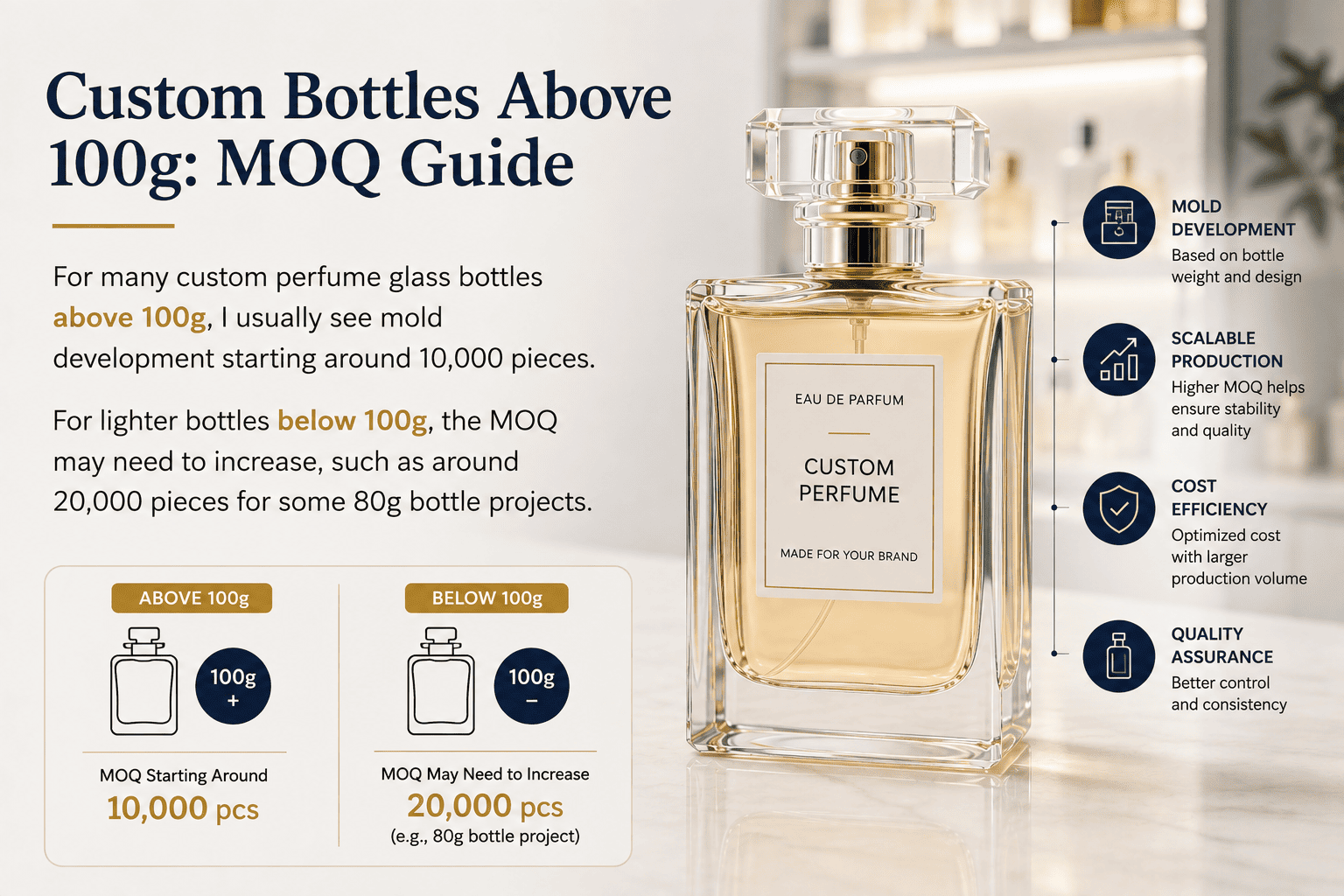
Custom perfume bottle MOQ is not decided only by capacity. Bottle weight, mold changing, machine setup, and production efficiency can all affect the minimum quantity.
For many custom perfume glass bottles above 100g, I usually see mold development starting around 10,000 pieces. For lighter bottles below 100g, the MOQ may need to increase, such as around 20,000 pieces for some 80g bottle projects.
Why Custom Bottle MOQ Changes with Bottle Weight
When I talk about custom perfume bottle MOQ, I also look at bottle weight.
For many bottles above 100g, around 10,000 pieces can be a practical starting point for custom mold production.
At this stage, the bottle shape can be customized.
The logo can also be built directly into the mold.
This allows the logo to become part of the glass structure.
When the bottle is lighter, the required quantity may increase.
For example, some 80g bottle projects may need around 20,000 pieces.
The reason is production efficiency.
Glass production machines need time and material when changing molds.
The machine needs adjustment.
The forming process needs to stabilize.
The factory also needs to inspect the neck finish, bottle weight, and production quality.
If the production run is too small, the loss from changing molds can become too high.
| Bottle Weight | Typical MOQ I See | Main Reason |
|---|---|---|
| Above 100g | Around 10,000 pcs | Suitable for many custom runs |
| Around 80g | Around 20,000 pcs | Higher volume supports machine efficiency |
| Below 100g | Usually higher | Depends on production setup |
Sometimes a supplier may say that 5,000 pieces are possible.
This can happen.
However, I would ask how that quantity is being achieved.
In some situations, the supplier may be waiting for another customer who wants the same or a very similar bottle.
The factory can combine the demand and arrange production when the mold goes onto the machine.
This can reduce the minimum quantity for one customer.
The trade-off is timing.
The buyer may need to wait until the right production opportunity appears.
This is why I think buyers should understand whether a low MOQ means an independent production run or a combined production arrangement.
Does Custom Perfume Packaging Always Need a New Glass Mold?
Some fragrance brands think customization means creating a bottle shape that nobody has ever seen before. I do not think this is necessary.
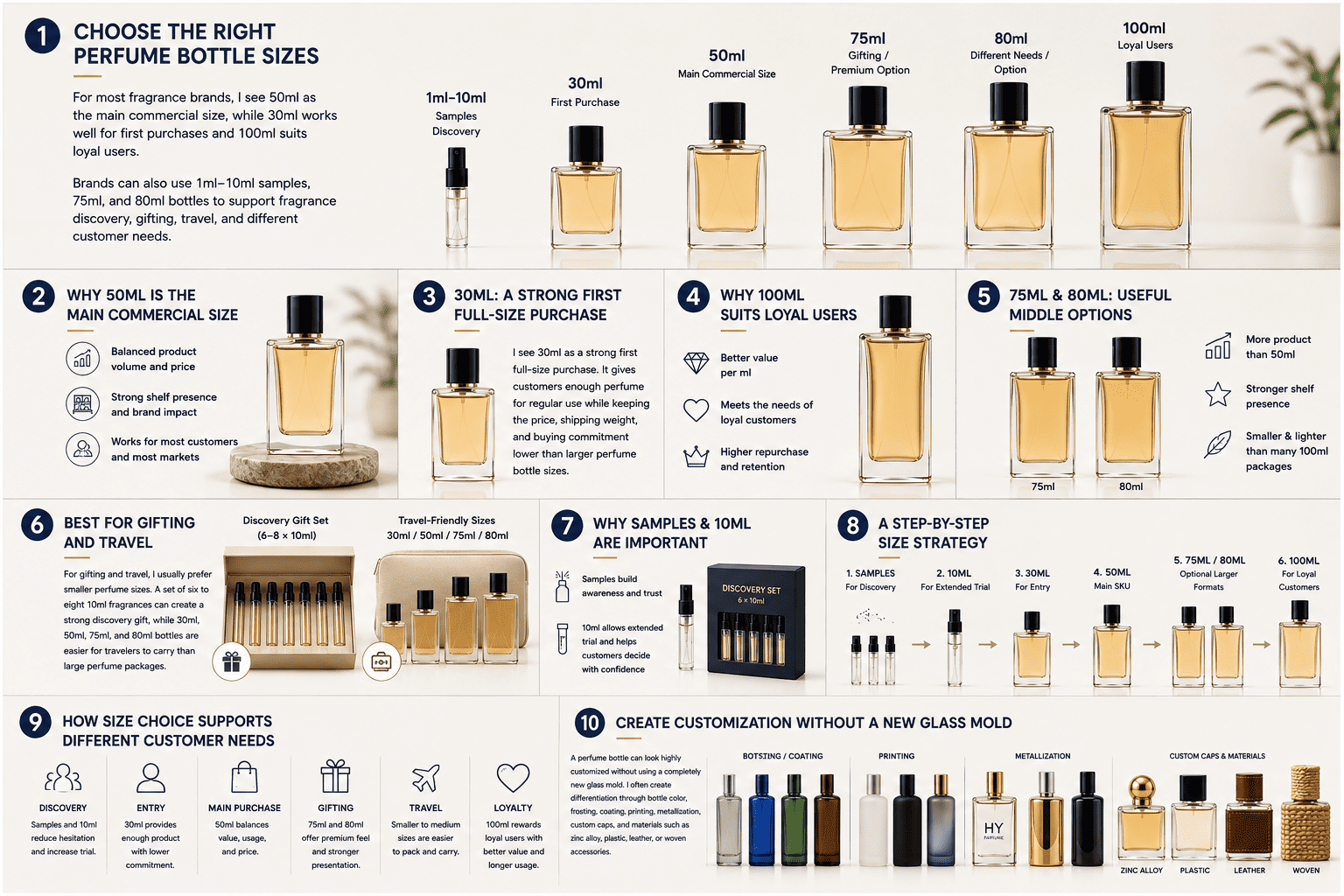
A perfume bottle can look highly customized without using a completely new glass mold. I often create differentiation through bottle color, frosting, coating, printing, metallization, custom caps, and materials such as zinc alloy, plastic, leather, or woven accessories.
I Prefer to Build Uniqueness Around the Whole Packaging System
The glass bottle is only one part of the finished perfume package.
The customer also sees the cap.
He sees the collar.
He sees the color.
He sees the surface texture.
He sees the logo.
He sees the box.
He may also see metal, leather, plastic, or woven decorative elements.
All of these parts influence how the perfume feels.
| Customization Method | What It Changes | My View |
|---|---|---|
| Spray color | Brand color | Simple and effective |
| Frosting | Surface texture | Good for premium styles |
| Metallization | Reflective appearance | Strong shelf impact |
| Decals and printing | Graphics and logo | Flexible |
| Embossed logo | Glass structure | Strong custom identity |
| Custom cap | Bottle personality | Very important |
| Zinc alloy accessories | Weight and premium feeling | Strong visual impact |
| Plastic accessories | Shape and color freedom | Flexible |
| Leather details | Texture and story | Good for niche brands |
| Woven or rattan parts | Natural feeling | Very distinctive |
A standard rectangular bottle can look completely different after a custom color, a heavy zinc alloy cap, leather decoration, or a special surface texture.
The mold may stay the same.
The customer perception can change completely.
I think this is often a smarter strategy for small and medium fragrance brands.
The brand does not always need to pay for a completely new bottle mold.
It can spend more of its budget on the parts customers actually notice.
For me, good customization is not about making the most complicated bottle.
It is about making the package recognizable.
How Should a Fragrance Brand Start a Custom Perfume Bottle Project?
Many buyers start by asking for a completely new mold. I usually suggest starting with a much simpler step.
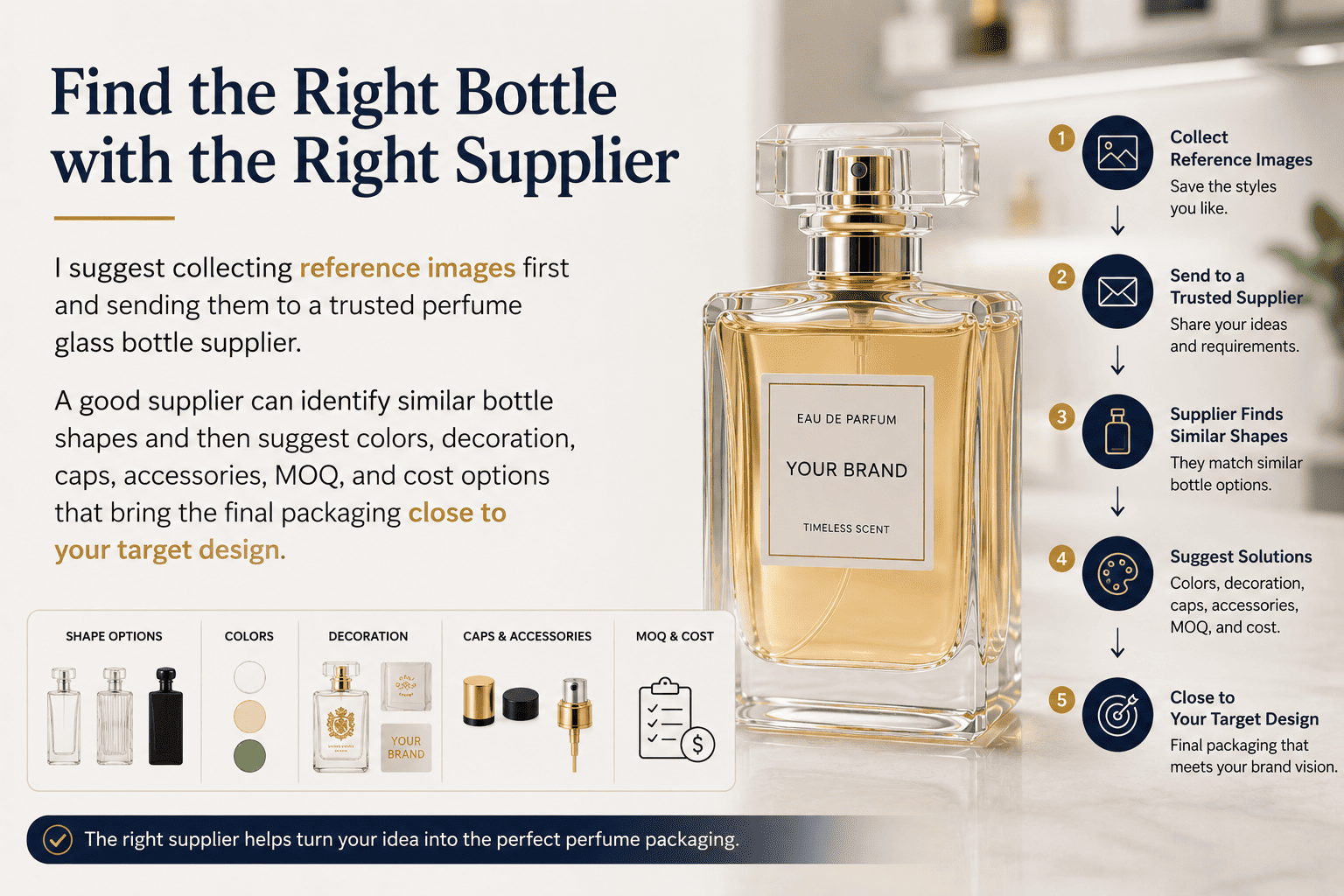
I suggest collecting reference images first and sending them to a trusted perfume glass bottle supplier. A good supplier can identify similar bottle shapes and then suggest colors, decoration, caps, accessories, MOQ, and cost options that bring the final packaging close to your target design.
Start with References, Not with a Mold
The first thing I suggest is finding reference images.
These images do not need to show the exact bottle you want.
They can show a shape.
They can show a color.
They can show a cap.
They can show a texture.
They can even come from jewelry, fashion, architecture, or other packaging.
Then send these references to a supplier you trust.
A good supplier should not only tell you whether the exact bottle can be produced.
The supplier should help you find the most practical route.
For example, there may already be an existing perfume glass bottle with a similar shoulder, base, or overall proportion.
If the existing bottle already gives you 70% or 80% of the look, I think it is worth considering.
Then we can change the remaining part through decoration.
| Step | What I Suggest | Why It Helps |
|---|---|---|
| 1 | Collect reference images | Clarifies the design direction |
| 2 | Send them to a trusted supplier | Lets the supplier understand the target |
| 3 | Search similar existing bottles | Can avoid unnecessary mold costs |
| 4 | Compare colors and finishes | Creates visual differentiation |
| 5 | Review accessories | Adds stronger brand identity |
| 6 | Confirm MOQ and budget | Keeps the project realistic |
| 7 | Consider a new mold if needed | Reduces development risk |
I think the supplier should build a solution around the brand's real situation.
The brand may have a limited budget.
It may only accept a certain MOQ.
It may need to launch quickly.
It may want a premium look but does not need a completely exclusive glass shape.
These factors matter.
Newly Developed Bottle Models Can Be a Good Middle Option
Glass bottle suppliers also regularly develop new bottle models.
These designs may already have molds available, but they may still be relatively new in the market.
I think this can be a useful middle solution.
The brand gets a fresher bottle.
It avoids the full cost of mold development.
The MOQ can be easier to manage.
The launch time can also be shorter.
Then the brand can add its own color, frosting, printing, custom cap, or accessories.
This lowers several risks at the same time.
It lowers MOQ pressure.
It lowers trial-and-error cost.
It reduces mold development time.
It also reduces the number of unknown problems before launch.
For me, this is how a good packaging solution should work.
We reduce uncontrolled risk step by step.
How Can Hongyan Support Different Perfume Bottle Sizes and Custom Projects?
After bottle size, MOQ, decoration, and [mold development][[4]] are considered, the next question is whether one supplier can help manage these requirements together.
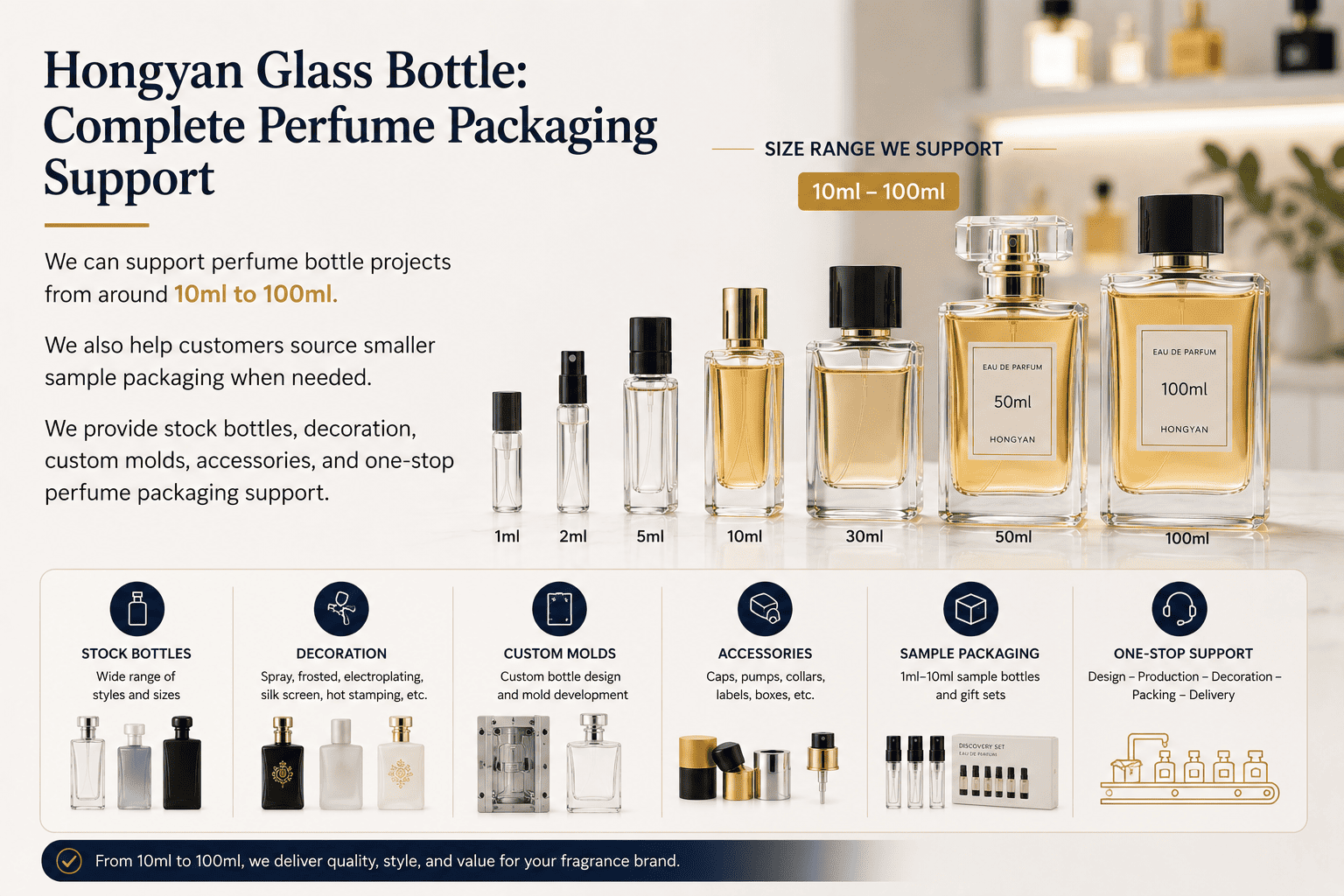
At Hongyan Glass Bottle, we can support perfume bottle projects from around 10ml to 100ml. We also help customers source smaller sample packaging when needed, while providing stock bottles, decoration, custom molds, accessories, and one-stop perfume packaging support.
I Want Hongyan to Work as a Packaging Solution Provider
At Hongyan, we do not want to only sell one glass bottle.
We want to help fragrance brands solve the complete packaging problem.
We can support many perfume glass bottle capacities from around 10ml to 100ml.
This can include 10ml travel perfume bottles, 30ml entry bottles, 50ml main products, 75ml or 80ml options, and 100ml bottles.
| Requirement | How We Can Support |
|---|---|
| 10ml perfume bottle | Travel and trial packaging |
| 30ml perfume bottle | Entry full-size products |
| 50ml perfume bottle | Main commercial size |
| 75ml / 80ml bottle | Mid-large options |
| 100ml perfume bottle | Large full-size products |
| Stock perfume bottles | More than 500 existing options |
| Surface treatment | Spray color, frosting, metallization and more |
| Decoration | Printing, decals and related processes |
| Custom bottle development | Mold development and 3D sampling |
| Accessories | Caps, collars and decorative materials |
| Small sample packaging | Sourcing support when required |
Some brands may also need very small sample bottles or packaging that is outside our normal glass production range.
In these cases, we can use our supplier network and outsourcing resources to help solve the sourcing problem.
I think this matters because fragrance brands often need more than one item.
They may need a glass bottle.
They may need a pump.
They may need a cap.
They may need a collar.
They may need a gift box.
They may need small perfume samples.
They may also need custom decoration.
Managing many suppliers can become difficult.
The colors may not match.
The delivery dates may be different.
The MOQ may be different.
The components may not fit each other correctly.
This is why I prefer to look at the whole packaging project.
You Do Not Need to Have the Complete Solution Before Contacting Us
I also want fragrance brands to know that they do not need to prepare a perfect technical drawing before speaking with us.
You can start with reference images.
You can tell us the bottle size you want.
You can tell us your estimated quantity.
You can tell us your target cost.
You can tell us which visual style you want to achieve.
Then we can look at the available options.
We may recommend an existing bottle.
We may suggest a newly developed bottle model.
We may change the color.
We may add frosting or metallization.
We may suggest another cap.
We may use zinc alloy, plastic, leather, or woven accessories.
If these options still cannot achieve your idea, we can discuss a custom mold.
For me, this is what a perfume packaging supplier should do.
A good supplier should not only ask, “How many bottles do you want?”
The supplier should ask, “What are you trying to achieve, and what is the most practical way to achieve it?”
Conclusion
I see perfume bottle size as part of the whole brand strategy. The right solution should balance customer behavior, design, MOQ, cost, gifting, travel, and long-term sales.
[[1]]: https://www.netsuite.com/portal/resource/articles/inventory-management/minimum-order-quantity-moq.shtml "MOQ"
[[2]]: https://www.merriam-webster.com/dictionary/eau%20de%20parfum "eau de parfum"
[[3]]: https://boulderpackagetest.com/?gad_source=1&gad_campaignid=23947977770&gbraid=0AAAAAC0ovQBqGtxV5aIHVrIRHRuDwipNA&gclid=CjwKCAjwyuDTBhB-EiwANCQhLB_Yv6_mlsxR0VeosbVz6Gk9lqhvywO4M1AVBJud1HlXPR2PvjzwLBoCgzkQAvD_BwE "packaging complexity"
[[4]]: https://mirmoulds.com/usa-injection-mold-manufacturer/?gad_source=1&gad_campaignid=23991962847&gbraid=0AAAAADnfbi6t-7LvwTqp8QL5-d-ZAl_c1&gclid=CjwKCAjwyuDTBhB-EiwANCQhLFU2qVD8KG6kFk4gm4l9q1lkadzQPrjpw7z0-JSF6ocbumg1vWez8hoCjrgQAvD_BwE "mold development"