A beautiful perfume bottle idea can look perfect on a screen, but some designs become expensive, unstable, or even impossible when they enter real production.
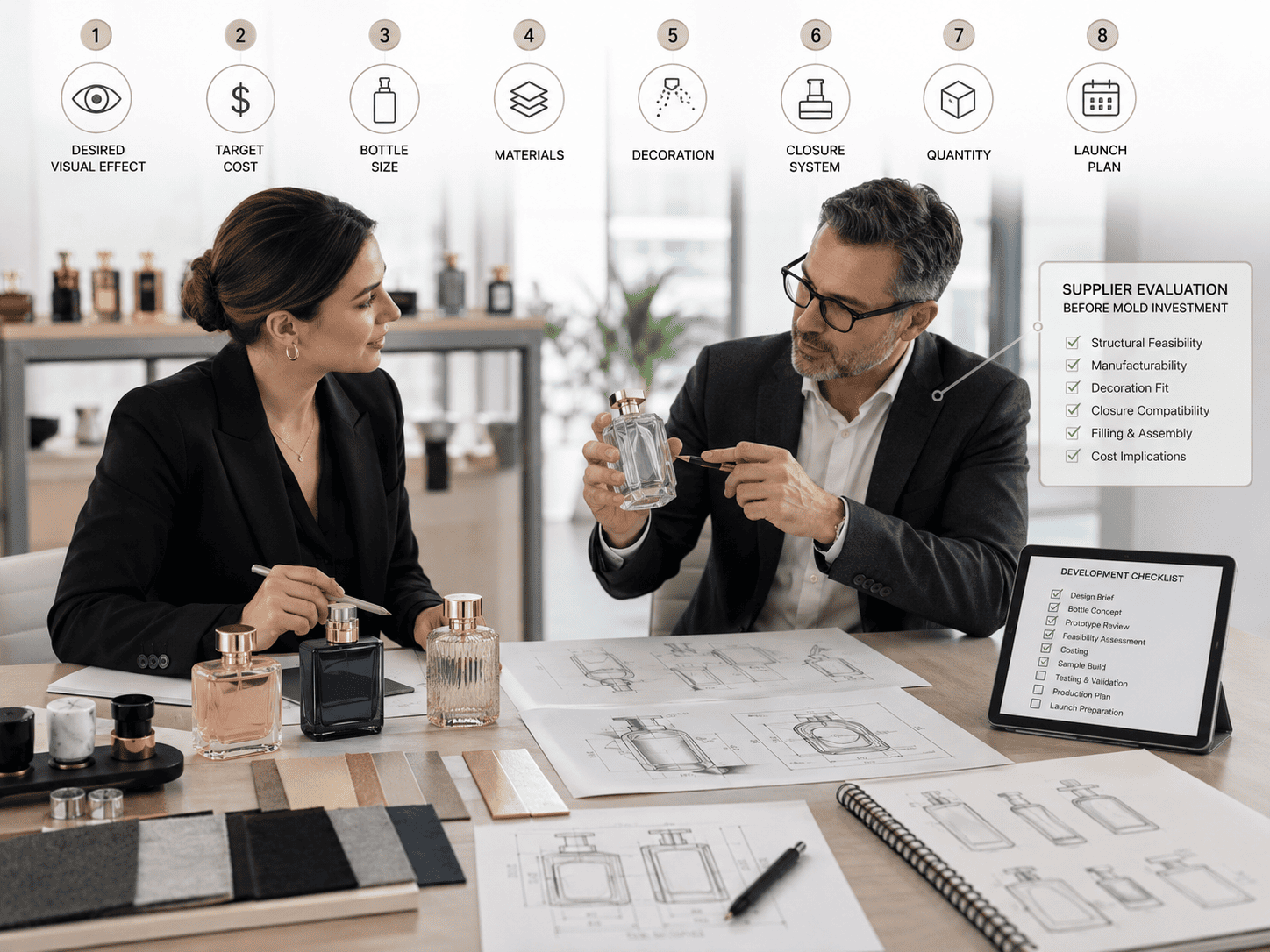
When I develop a perfume bottle, I tell my supplier the visual effect I want, target cost, bottle size, materials, decoration, closure system, quantity, and launch plan. I also ask the supplier to judge whether the concept is practical before I invest in molds or special components.
In our daily work, I have found that the most useful conversation is often not about one exact material or one exact bottle shape. I first need to explain the result I want. Then the supplier can suggest a practical way to achieve that result.
This is becoming even more important now because many perfume founders use AI-generated images during the early design stage. I actually think this is useful. AI can help a founder explain a [visual idea][1] much faster. At the same time, an attractive AI image does not automatically mean the package can be mass-produced.
That is why I prefer to treat the image as the starting point of development, not the final production instruction.
Should I Send AI-Generated Perfume Bottle Images to My Supplier?
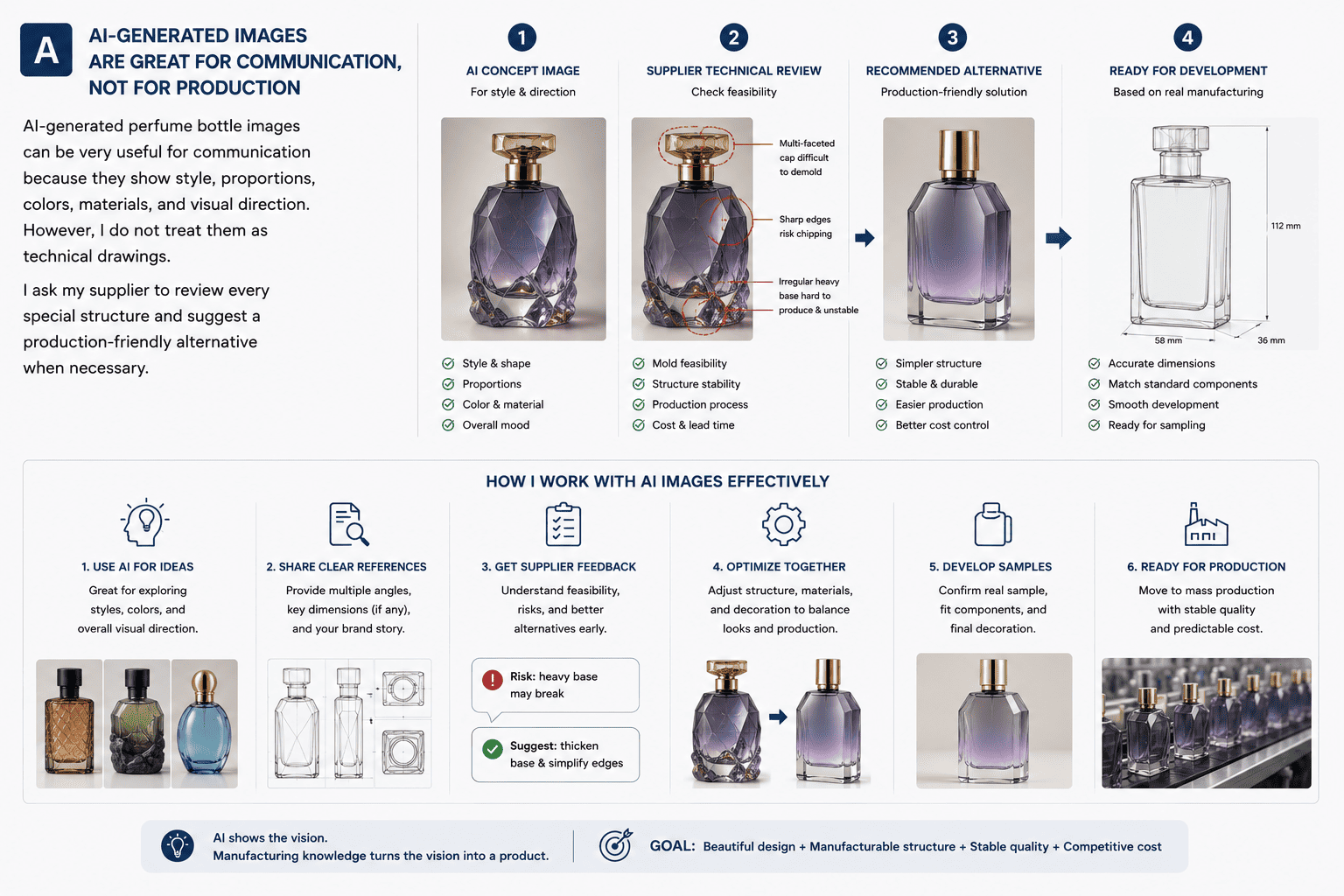
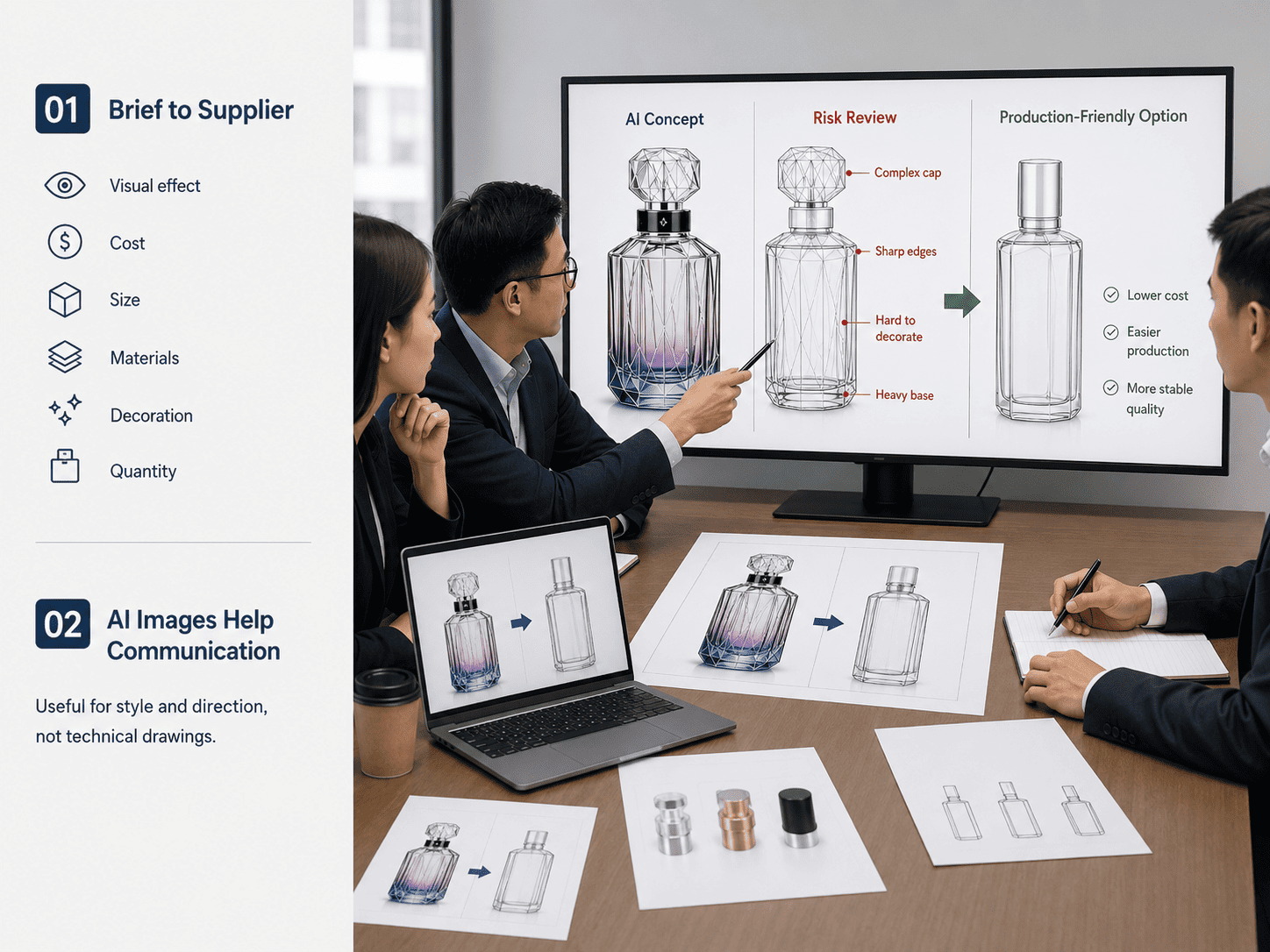
AI-generated perfume bottle images can be very useful for communication because they show style, proportions, colors, materials, and visual direction. However, I do not treat them as technical drawings. I ask my supplier to review every special structure and suggest a production-friendly alternative when necessary.
I Use AI Images to Explain the Effect, Not to Define the Production Method
We have already received many inquiries from customers who send us AI-generated perfume bottle pictures.
Some of these images are very impressive.
The bottle may have a strange geometric bottom. It may combine glass, metal, stone, and other materials. It may have a large decorative structure attached to the base. The image can look very premium.
I like these references because they make the customer's idea easier to understand.
Still, I always separate the design effect from the production solution.
An AI image can create a shape without thinking about weight, tolerance, filling, assembly, transportation, temperature change, or mass-production consistency. A real packaging project has to consider all of these points.
For example, we once discussed concepts where the bottom of the perfume bottle had a thick, irregular decorative base. The visual effect looked similar to concrete or cement.
It looked strong and artistic in the image.
In production, the idea created several problems.
First, cement is heavy. A perfume glass bottle is already a relatively heavy package. If I add a thick cement base, the total weight increases quickly. This affects shipping cost and customer handling.
Second, I need to attach the cement part to the glass bottle. It is difficult to guarantee that two different materials will remain perfectly bonded during filling, transportation, and long-term use.
Third, the additional base can create problems during filling and packing. If the bottom is irregular, the bottle may not sit correctly on some production lines.
Fourth, different materials react differently to temperature. Expansion and contraction can place stress on glue, glass, or the decorative component. This may create cracks, separation, or packaging damage.
So I would not simply tell the customer, "This design cannot be made."
I would ask a different question:
What effect are you trying to achieve?
If the customer wants a strong industrial or architectural feeling, I may suggest a metal plate, metal shell, coated component, resin part, or another lighter material.
| AI Design Idea | Possible Production Problem | Alternative I May Suggest |
|---|---|---|
| Thick cement bottle base | Heavy and difficult to bond | Metal decorative plate |
| Irregular stone shell | Hard to control dimensions | Resin or molded plastic |
| Large attached bottom structure | May affect filling | Smaller decorative insert |
| Mixed rigid materials | Different thermal expansion | One stable molded component |
| Very complex unsupported shape | Difficult for glass molding | Simplified glass structure |
| Heavy external decoration | Higher freight and breakage risk | Thin metal or coated component |
I think this is one of the biggest values a good packaging supplier should provide.
I do not only reproduce a picture.
I help turn the picture into something that can actually be manufactured.
What Visual Effect Should I Describe to My Glass Bottle Supplier?
I find that customers get better results when they tell me what they want the bottle to feel like, not only which process they think they need. If I understand the target effect, I can recommend glass structure, coating, [metallization][2], frosting, printing, and accessories that fit the goal.
I Ask Customers to Describe the Feeling First
During development, I often hear requests such as:
"I want it to look more premium."
"I want more metallic feeling."
"I want it to feel modern."
"I want the bottle to look mysterious."
"I want something customers have not seen before."
These descriptions may sound less technical, but they are actually very useful.
They tell me what the brand wants the customer to feel.
From there, I can work backwards and choose a practical production process.
For example, if a customer wants the bottle to have a luxury metallic look, I may suggest metallization.
Gold metallization can create a strong luxury appearance.
Silver metallization can create a cleaner and more modern effect.
I can also combine metallic treatment with another process.
For example, I can add a gradient spray over part of the bottle. I can combine transparent color with metallic areas. I can use frosting on one section and a brighter surface on another section.
This creates visual depth without requiring a highly unusual glass mold.
I Prefer Effect-Based Communication
I think this approach saves a lot of development time.
A founder may ask me for one material because they saw it in an AI image or another package. But that material may not be the best way to achieve the same visual result.
If I know the result, I have more options.
| Desired Effect | Processes I May Consider |
|---|---|
| Luxury metallic | Gold or silver metallization |
| Soft premium | Frosting with simple printing |
| Dark mysterious | Gradient spray with dark tones |
| Modern clean | Clear glass with metallic accessories |
| Artistic | Partial coating and special logo placement |
| Vintage luxury | Gold decoration with warm colors |
| Strong shelf impact | High-contrast gradient or metallic finish |
| Minimal luxury | Heavy clear glass with simple decoration |
This is why I encourage customers to send mood boards, AI images, competitor references, color ideas, and even fashion or architecture references.
I do not need every reference to be a perfume bottle.
I need to understand the visual language.
Once I understand that, I can translate it into a packaging solution.
Do I Really Need a Custom-Shaped Perfume Bottle?
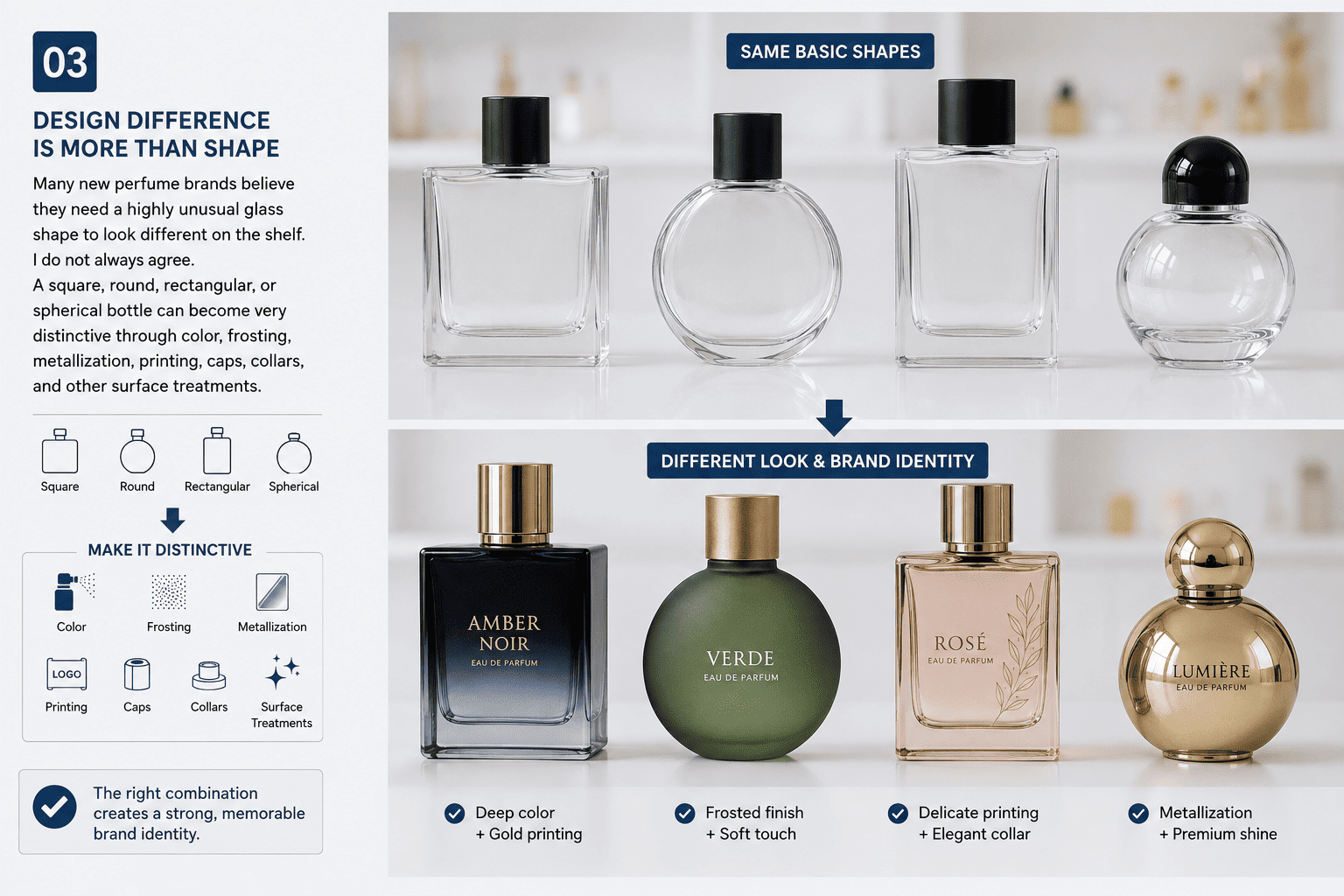
Many new perfume brands believe they need a highly unusual glass shape to look different on the shelf. I do not always agree. A square, round, rectangular, or spherical bottle can become very distinctive through color, frosting, metallization, printing, caps, collars, and other surface treatments.
I See Many Brands Focus Too Much on Shape
This is a common misunderstanding I see during perfume bottle development.
A customer wants the packaging to look different.
Then the first idea is often:
"I need a strange bottle shape."
I understand why.
Shape is easy to notice in a rendering.
A twisted bottle, asymmetric bottle, sculptural bottle, or very irregular bottle can look impressive.
But a special shape also creates more questions.
Can the glass factory make it consistently?
Will the bottle stand securely?
Can the decoration be applied evenly?
Can the filling line handle it?
Will the cap still look balanced?
Does it require a completely new mold?
What is the minimum order quantity?
How many bottles can fit in one carton?
How much will freight increase?
These questions matter, especially for a small or growing perfume brand.
I Can Make a Standard Bottle Look Very Different
A normal square perfume bottle does not need to look boring.
I can spray it in a gradient color.
I can frost only part of the surface.
I can add gold or silver metallization.
I can create a two-tone appearance.
I can use a unique cap.
I can change the collar color.
I can add screen printing, hot stamping, decal, or a metal logo plate.
A round bottle also gives me many options.
A spherical bottle can look playful, artistic, futuristic, or luxurious depending on the finish.
The glass shape is only one layer of the package.
| Bottle Base Shape | Decoration Direction | Possible Brand Feeling |
|---|---|---|
| Square | Gradient + gold logo | Modern luxury |
| Rectangle | Frosting + black printing | Minimal and premium |
| Round | Metallic coating | Clean and high-end |
| Sphere | Transparent color gradient | Artistic and young |
| Thick-bottom square | Clear glass + metal cap | Heavy luxury |
| Standard stock bottle | Custom spray + unique cap | Distinctive with lower risk |
For many customers, I would rather spend the budget on decoration, cap design, branding, and presentation than spend everything on a complicated glass mold.
This is especially true when the brand is still testing the market.
A unique glass mold can be valuable when the shape is a core part of the brand identity. But I do not think custom molding should be the automatic first choice.
What Basic Bottle Information Should I Give My Supplier?
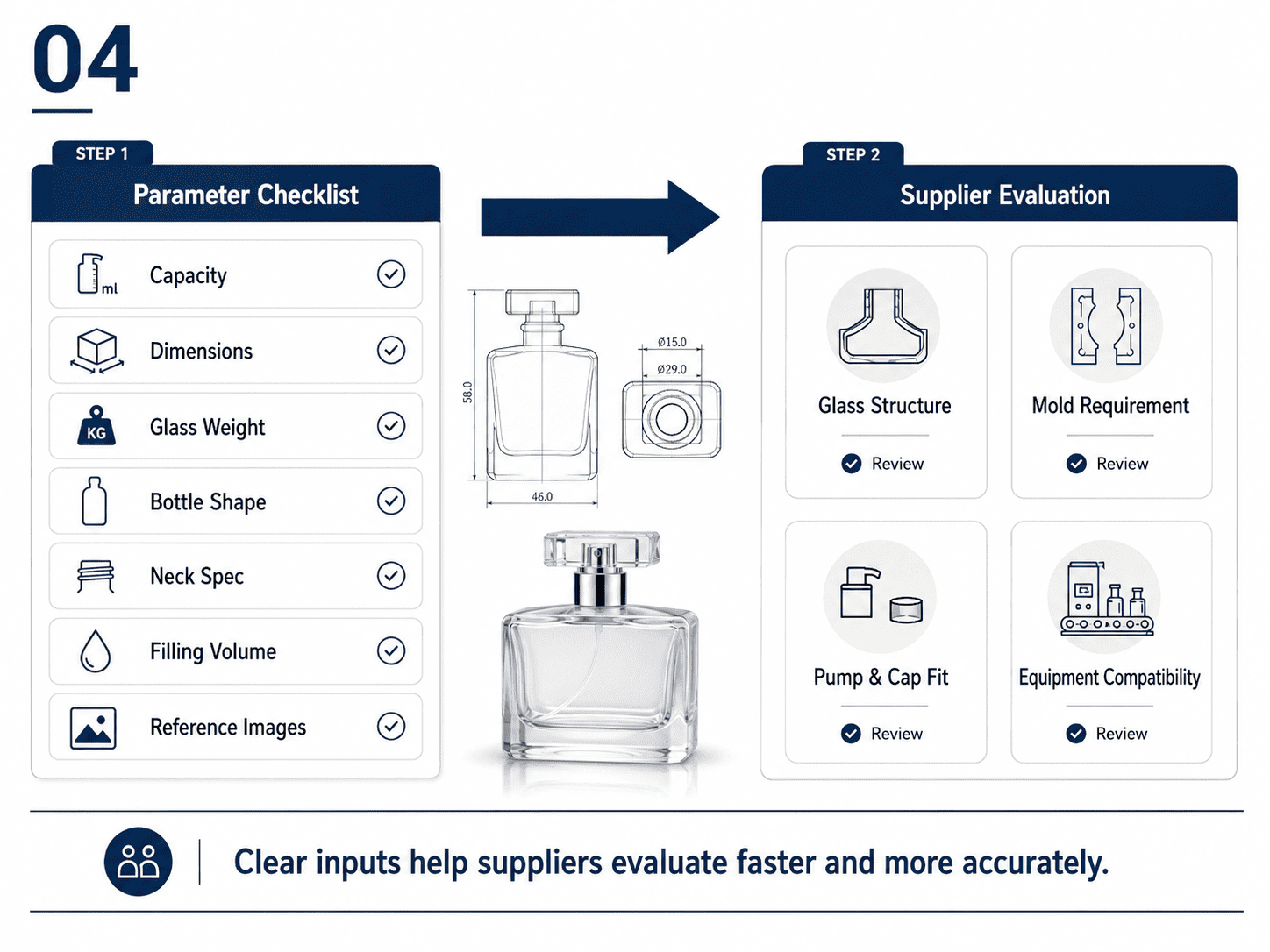
Once the visual direction is clear, I still need to give the factory basic technical information. A beautiful concept alone does not tell the glass manufacturer how large, heavy, or functional the final bottle should be.
I normally provide capacity, approximate dimensions, target glass weight, bottle shape, neck specification, filling volume, and reference images. These details allow my supplier to evaluate the glass structure, estimate mold requirements, and check whether standard perfume pumps, caps, and production equipment can work with the bottle.
I Start With Capacity and Proportions
A customer may tell me, "I want a 50 ml perfume bottle."
That gives me a starting point.
It does not define the bottle.
A 50 ml bottle can be tall and thin.
It can be short and wide.
It can have a very thick bottom.
It can have heavier glass to create a luxury feeling.
So I normally ask for target dimensions as well.
If the customer has a physical bottle, I can use that bottle as a reference.
If the customer only has an AI image, rendering, or sketch, we can first estimate the dimensions and then create a technical drawing.
| Information | Example | Why I Need It |
|---|---|---|
| Filling capacity | 50 ml | Defines the product volume |
| Brimful capacity | Around 60 ml | Helps calculate internal space |
| Height | 90 mm | Defines overall proportion |
| Width | 55 mm | Affects shape and carton |
| Depth | 30 mm | Affects stability |
| Glass weight | 180 g | Affects feel and freight |
| Neck type | Standard perfume neck | Determines pump compatibility |
| Target style | Heavy luxury | Guides glass distribution |
I also want to know whether the customer wants a visually heavy bottle or a lightweight bottle.
This changes both the appearance and the cost.
For an e-commerce perfume brand, I may pay more attention to shipping weight.
For a luxury retail brand, a heavier base may be worth the extra cost.
What Bottle Neck and Pump Information Should I Confirm?
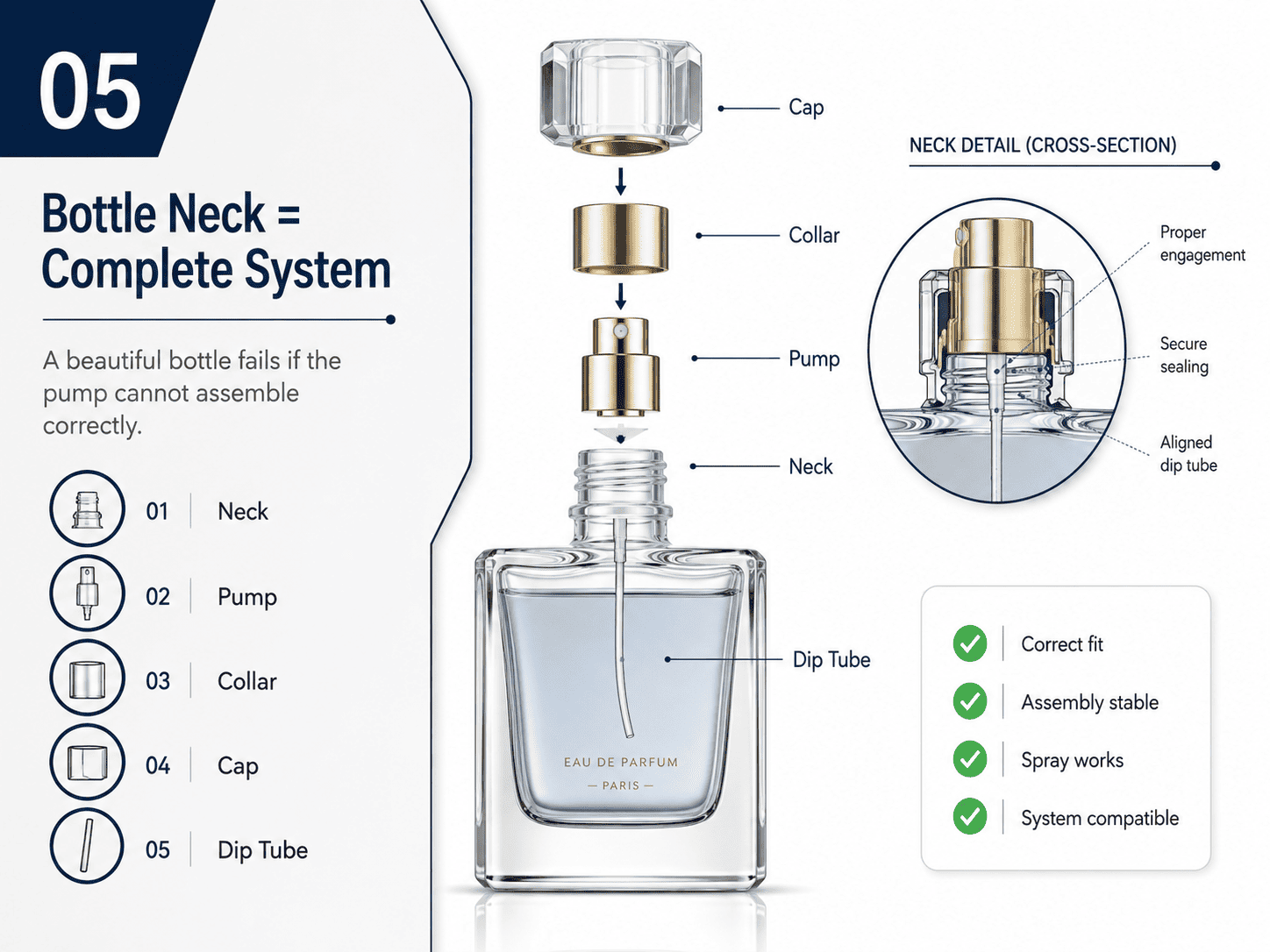
I consider the [bottle neck][3] one of the most important technical details because a beautiful perfume bottle is useless if the pump cannot be assembled correctly. I confirm the neck, pump, collar, cap, and dip tube as one complete system.
I Develop the Bottle and Closure Together
The customer sees one complete perfume package.
The factory often produces several separate components.
This difference creates risk.
The glass bottle supplier makes the bottle.
Another supplier may make the pump.
Another factory may make the cap.
The collar may come from another production line.
But all of these parts have to fit together.
I therefore prefer to confirm the system early.
I ask about the bottle neck.
I ask which pump will be used.
I confirm the collar size.
I check the inner structure of the cap.
I also check the final assembled height.
| Component | What I Check | Possible Problem |
|---|---|---|
| Bottle neck | Specification and dimensions | Pump does not fit |
| Pump | Crimp size and output | Leakage or poor spray |
| Collar | Diameter and height | Visible gap |
| Cap | Inner structure | Cap becomes loose |
| Dip tube | Length | Perfume remains in bottle |
| Bottle shoulder | Clearance | Cap touches the glass |
This is another reason why I do not want to finalize a glass bottle only from an AI rendering.
The rendering may show a perfect cap and bottle relationship.
The production version needs internal engineering.
What Decoration Information Should I Give My Supplier?
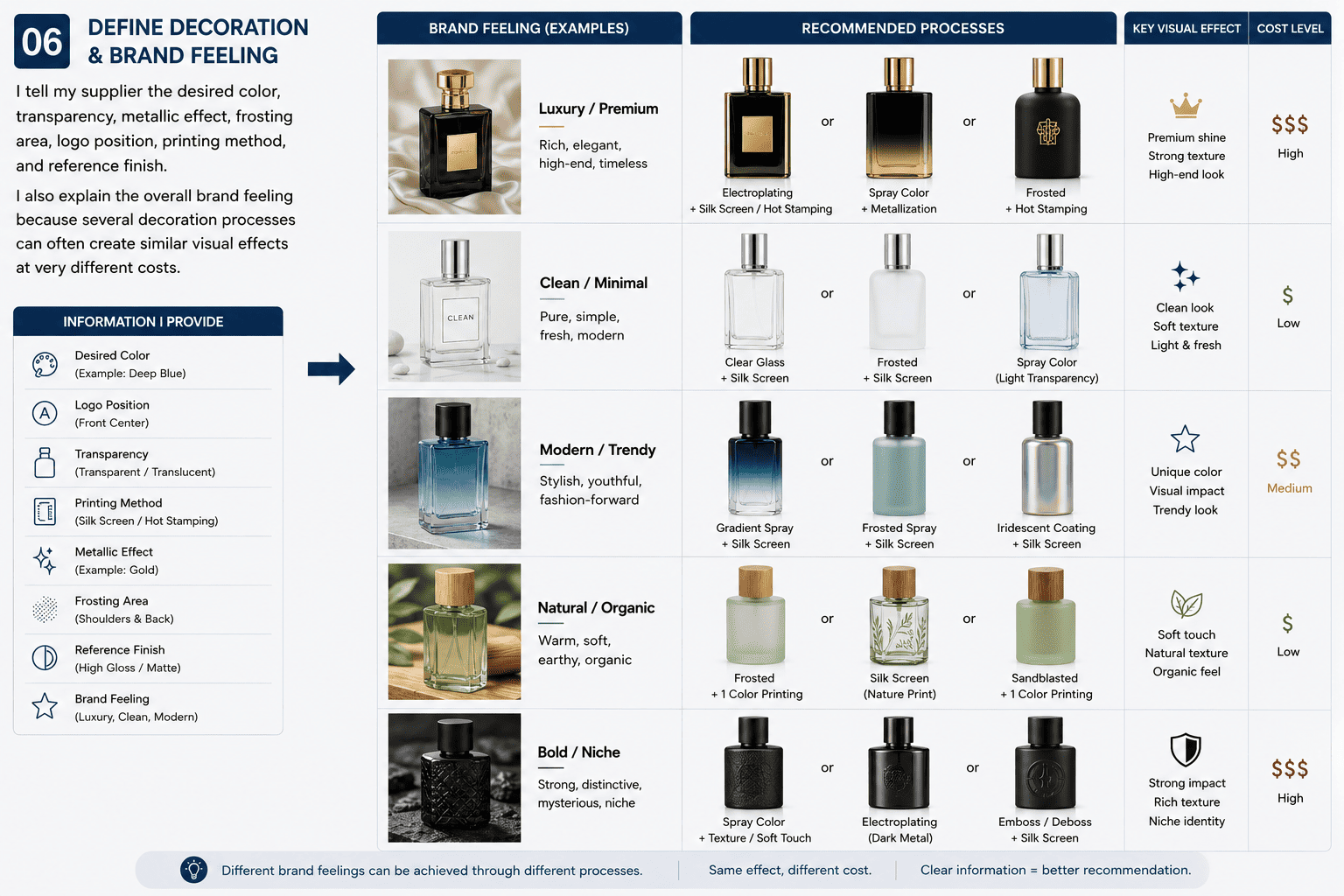
Decoration is one of the easiest ways for me to turn a standard bottle into a unique perfume package. I therefore discuss decoration early instead of waiting until the glass structure is finished.
I tell my supplier the desired color, transparency, metallic effect, frosting area, logo position, printing method, and reference finish. I also explain the overall brand feeling because several decoration processes can often create similar visual effects at very different costs.
I Often Combine Several Simple Processes
I do not always need one complicated process.
Sometimes two simple processes create a much better result.
For example, a customer may want a bottle that feels metallic but still has color variation.
I can start with a gold or silver metallic effect.
Then I can add a gradient color.
The result can look much more special than a plain gold bottle.
I can also combine frosting with printing.
I can combine transparent color with a metallic cap.
I can use a simple clear glass bottle and make the cap the main visual feature.
This gives the brand many ways to control cost.
| Process | Visual Effect | Development Point |
|---|---|---|
| Spray coating | Custom color | Confirm reference color |
| Gradient spray | More visual depth | Confirm transition area |
| Frosting | Soft matte appearance | Confirm full or partial area |
| Gold metallization | Luxury metallic effect | Confirm brightness |
| Silver metallization | Modern metallic effect | Confirm reflection |
| Screen printing | Clean logo | Confirm artwork and position |
| Hot stamping | Metallic logo | Confirm foil and surface |
| Metal plate | Strong decorative detail | Confirm attachment method |
I think the customer should focus first on the effect.
Then I can help choose the process.
How Should I Balance Design, Cost, and Production Risk?
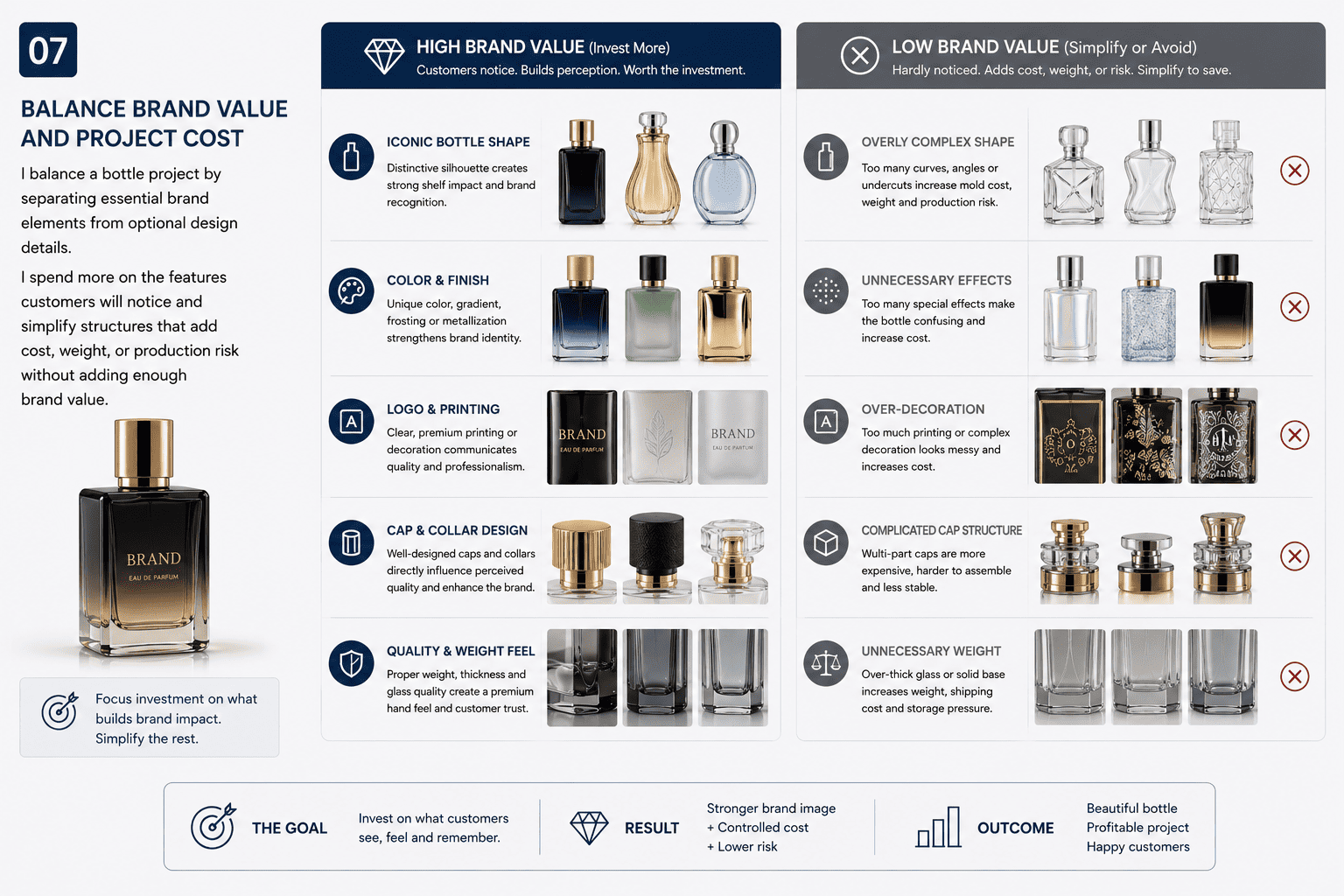
A perfume bottle project is not successful only because the sample looks beautiful. I also need to consider MOQ, assembly, freight, breakage, filling, repeat orders, and whether the brand can continue buying the same package.
I balance a bottle project by separating essential brand elements from optional design details. I spend more on the features customers will notice and simplify structures that add cost, weight, or production risk without adding enough brand value.
I Think About the Brand Stage
A new perfume brand usually has limited cash.
The founder needs to pay for fragrance.
The founder needs bottles.
They also need pumps, caps, boxes, labels, freight, photography, marketing, and inventory.
If most of the budget is spent on an unusual glass mold, the rest of the business may become more difficult.
This is why I often suggest starting from our existing bottle range.
At Hongyan Glass Bottle, we can offer more than 500 stock perfume glass bottle styles. We can then customize the appearance through spraying, frosting, metallization, decals, printing, caps, and other processes.
This gives the brand more room to create an identity without taking on too much development risk.
If the sales volume grows later, we can develop a completely new bottle.
| Brand Situation | Direction I Usually Consider |
|---|---|
| Testing a new fragrance | Stock bottle |
| Lower starting quantity | Stock bottle + decoration |
| Limited development budget | Standard glass + custom surface |
| Strong exclusive design | Custom mold |
| Large repeat volume | Custom structure becomes more practical |
| Short launch schedule | Existing bottle system |
| AI concept needs testing | 3D sample before tooling |
I do not think a smaller budget means the bottle has to look cheap.
It means I need to use the budget carefully.
Why Should I Make a 3D Sample Before Opening a Glass Mold?
When the design contains unusual proportions or AI-generated elements, I prefer to test the idea in 3D before paying for the final glass mold. This gives me a physical object that I can hold, compare, assemble, and revise.
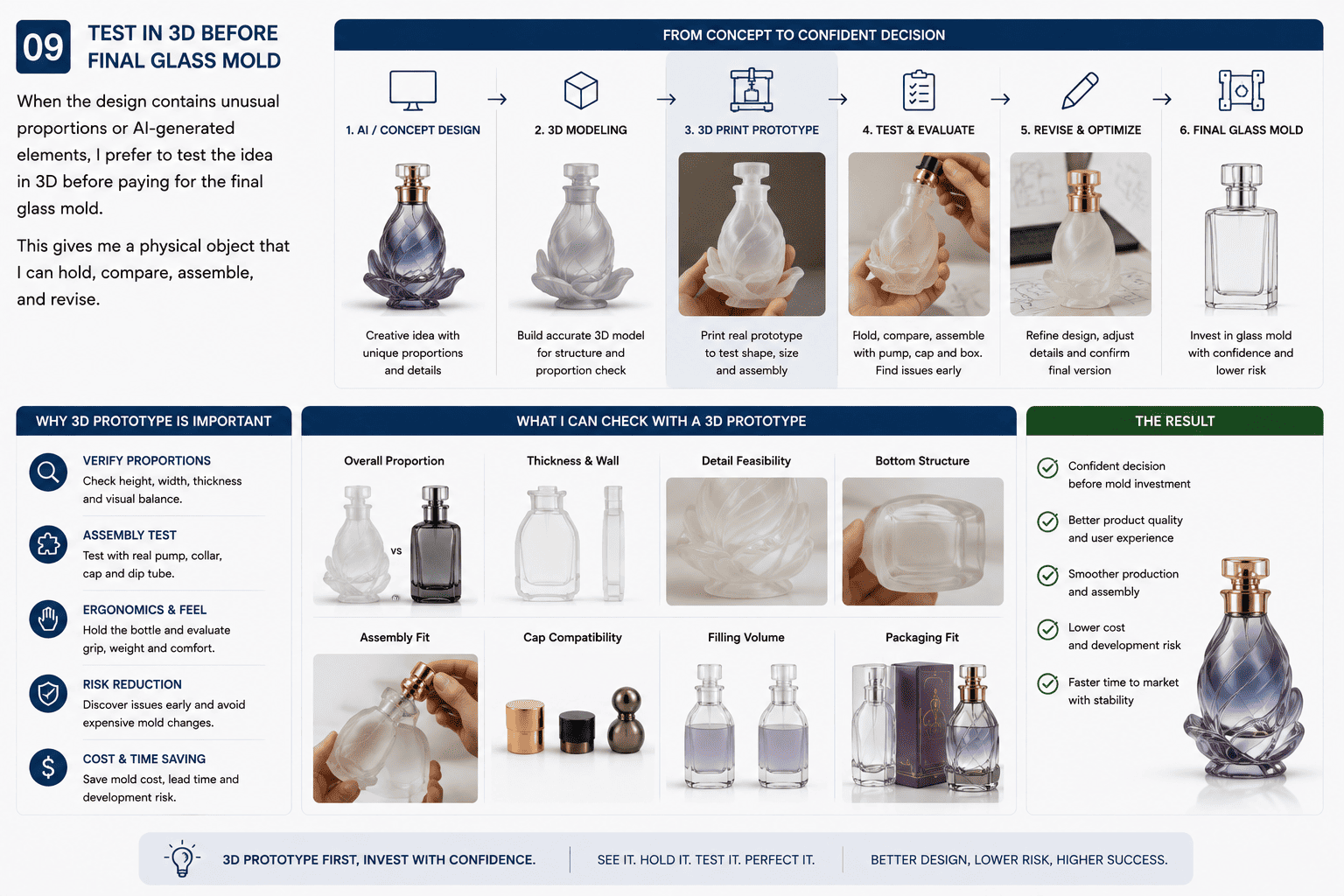
I Use the Prototype to Find Problems Early
A screen can hide many problems.
A bottle may look elegant in a rendering but feel too wide in my hand.
A cap may look balanced in the image but become too large when I see the real proportions.
A decorative bottom may look interesting but make the bottle unstable.
A logo may look large enough on the screen but appear too small on the actual bottle.
A 3D sample helps me notice these issues before tooling.
I can also use it to discuss alternative materials.
If the AI concept shows a cement-like base, I can make a prototype with a similar visual structure first.
Then I can decide whether I need metal, plastic, resin, or another practical component.
| What I Test | Why It Matters |
|---|---|
| Overall proportion | Confirms visual balance |
| Bottle and cap ratio | Prevents oversized accessories |
| Hand feel | Important for customer experience |
| Stability | Prevents tipping |
| Decorative component size | Controls weight |
| Logo position | Improves brand presentation |
| Box fit | Prevents packaging redesign |
| Assembly concept | Finds structural problems early |
I see 3D sampling as an inexpensive place to make mistakes.
I would rather change the prototype several times than change a finished glass mold.
What Should I Confirm Before Paying for a Custom Bottle Mold?
Before I approve tooling, I want the design to move from an attractive concept into a clear production specification. At this stage, I confirm dimensions, capacity, neck, weight, structure, decoration compatibility, accessories, mold terms, and remaining risks.
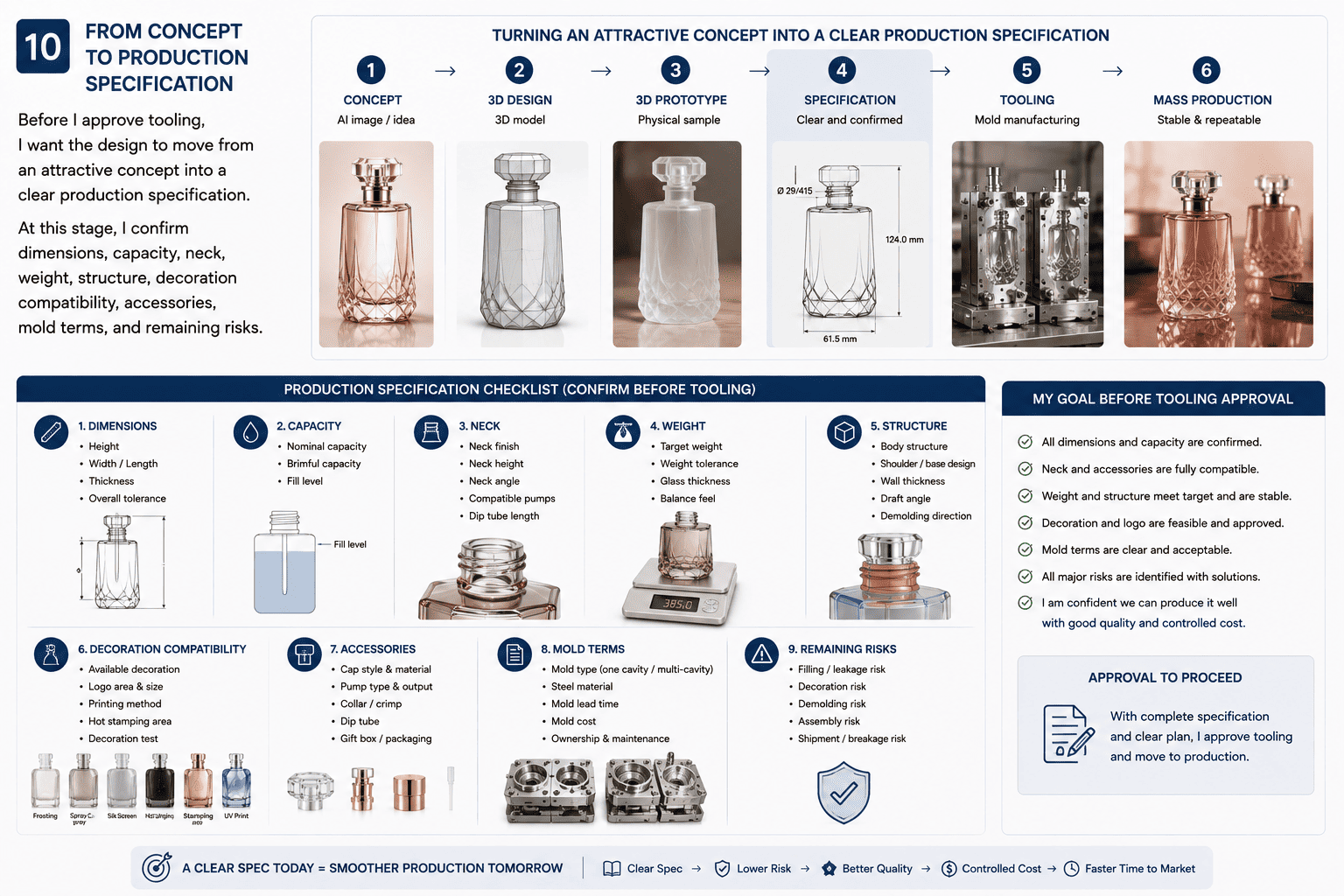
I Ask the Supplier to Challenge the Design
I do not want my supplier to agree with every idea I send.
I want the supplier to tell me where the design may fail.
If a component is too heavy, I want to know.
If the decoration area is difficult to spray, I want to know.
If the bottle bottom is too complicated, I want to know.
If the cap structure is unstable, I want to know.
A supplier who identifies these problems before tooling can save me a lot of money.
| Final Check | Question I Ask |
|---|---|
| Glass structure | Can this be mass-produced consistently? |
| Capacity | Is the filling volume correct? |
| Neck | Does it match the selected pump? |
| Decoration | Can the surface treatment work on this shape? |
| Attached components | Are they secure enough? |
| Filling | Can the bottle run on the customer's filling process? |
| Packing | Can the bottle be protected efficiently? |
| Weight | Is the final package too heavy? |
| Mold | Who owns and stores the tooling? |
| MOQ | Does the quantity fit the brand plan? |
For me, this stage is not only about checking measurements.
It is about checking whether the complete idea makes business sense.
Conclusion
I get better perfume packaging when I explain the desired effect first, then work with my supplier to turn creative ideas into practical, stable, and cost-effective production solutions.