
A beautiful perfume bottle can still feel cheap when the cap is too light, scratches easily, fits poorly, or does not match the brand position.
Perfume bottle caps can be made from plastic, aluminum, zinc alloy, glass, wood, cement, stone, crystal, ceramic, and mixed materials. The right choice depends on weight, appearance, cost, consistency, customization, and target market.
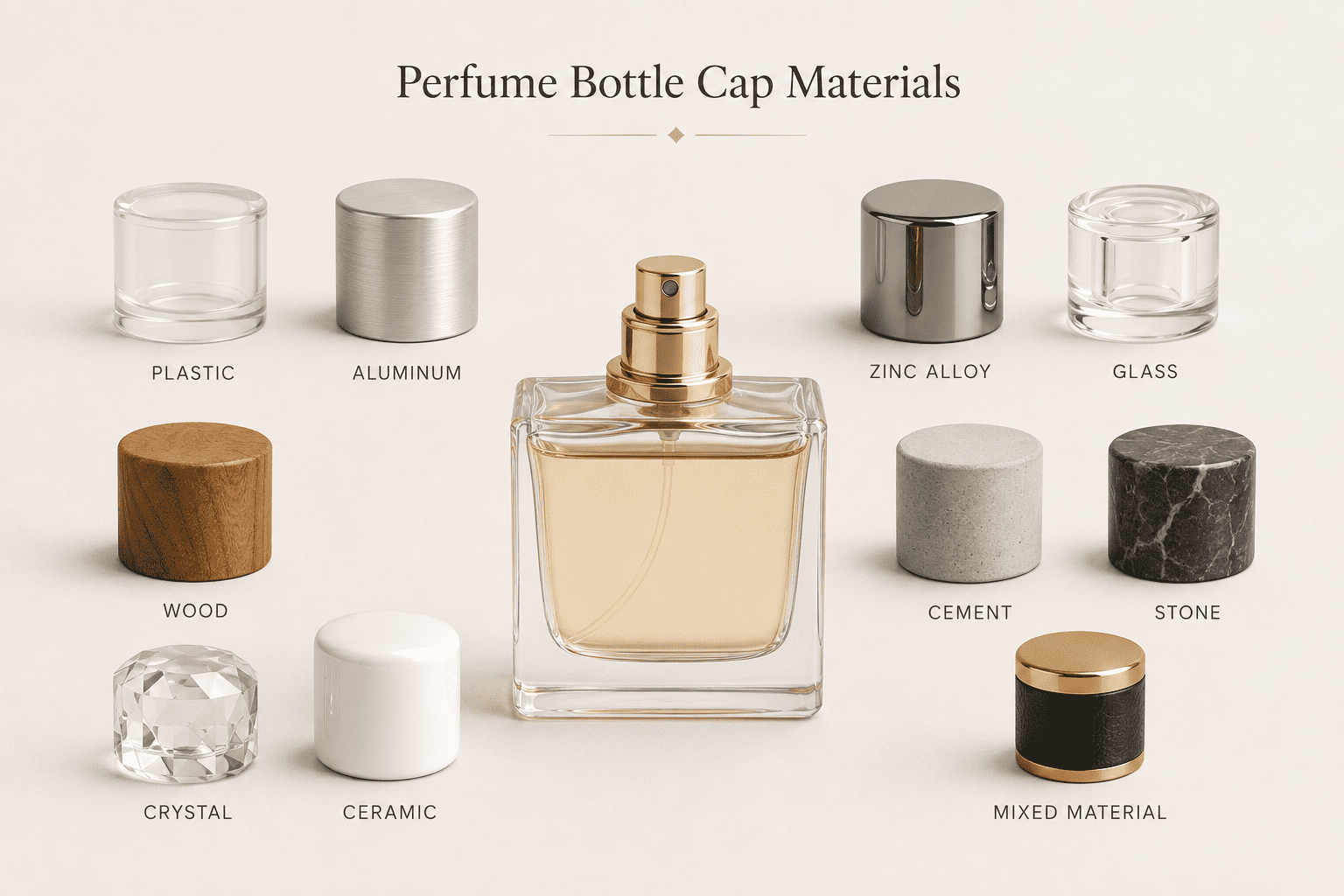
When a new perfume brand chooses packaging, the glass bottle usually gets most of the attention. The founder may spend a lot of time choosing the bottle shape, color, logo, and decoration.
However, the cap also has a strong effect on the final customer experience.
The customer normally touches the cap before spraying the perfume. The cap affects the bottle balance, opening feeling, sound, weight, and perceived value.
A [thick-bottom glass bottle ][[1]]often feels more premium than a thin-bottom bottle. A heavy perfume cap can create a similar feeling. When customers hold a solid cap in their hands, they may connect that weight with quality and luxury.
However, weight is only one factor.
I also check the cap material, surface treatment, internal structure, fitting method, batch consistency, cost, minimum order quantity, and shipping risk.
What Are the Main Perfume Bottle Cap Materials?
Perfume caps can use one material or several materials together. The visible outer shell creates the appearance, while the inner insert controls how the cap fits the pump.
The main perfume cap materials include plastic, aluminum, zinc alloy, glass, wood, cement, natural stone, crystal, ceramic, leather, fabric, and resin. Many caps combine an outer shell with a plastic insert.
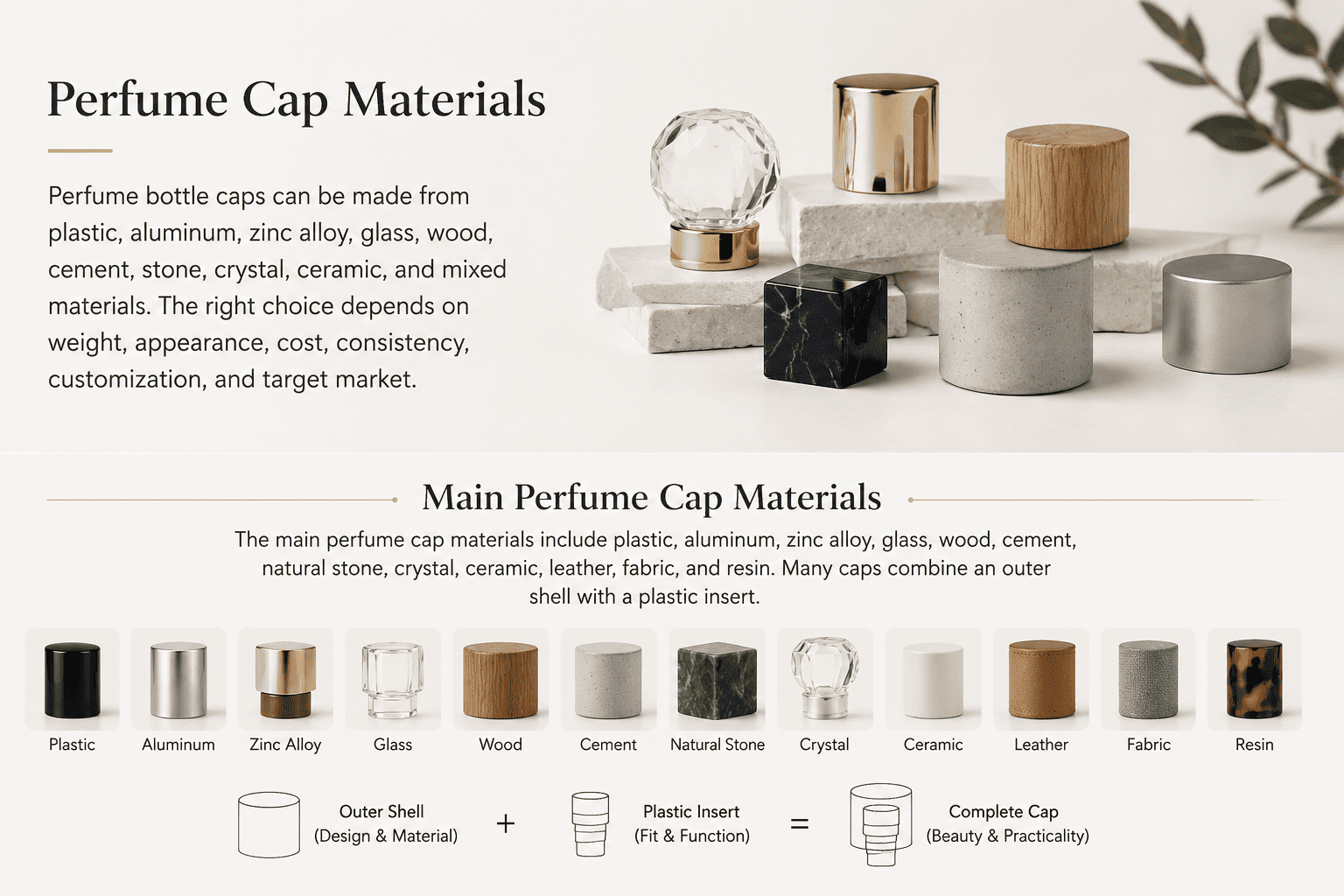
Why a Perfume Cap Often Uses Several Parts
Many customers think a cap is made from one solid material.
In reality, most perfume caps include at least two parts.
The outer shell creates the visual effect. It may be plastic, aluminum, zinc alloy, glass, wood, stone, or another decorative material.
The inner insert creates the connection with the spray pump or collar. It is usually made from plastic because plastic can provide controlled friction and stable dimensions.
For example, a zinc alloy cap often uses a plastic inner insert. A glass or wooden cap also normally needs an insert.
| Cap component | Main purpose | Common material |
|---|---|---|
| Outer shell | Appearance, shape, and weight | Plastic, metal, glass, wood, stone |
| Inner insert | Controls fitting | PP, PE, or ABS |
| Magnet | Creates magnetic closure | Magnetic metal |
| Weight block | Increases hand feeling | Metal or dense material |
| Decorative top | Adds visual detail | Resin, metal, stone, crystal |
| Surface layer | Changes color and texture | Paint, plating, leather, fabric |
The cap material is only one part of quality.
A cap can use an expensive material and still perform poorly when the insert is loose, the plating is uneven, or the dimensions do not match the pump.
I always test the cap with the final bottle, pump, and collar.
Are Plastic Perfume Caps Suitable for New Brands?
Plastic caps are one of the most practical choices for new perfume brands. They provide flexible shapes, colors, and surface treatments at a more manageable cost.
Plastic perfume caps are lightweight, affordable, and easy to customize. PP and ABS are common options, while acrylic and Surlyn provide clearer and more decorative effects.
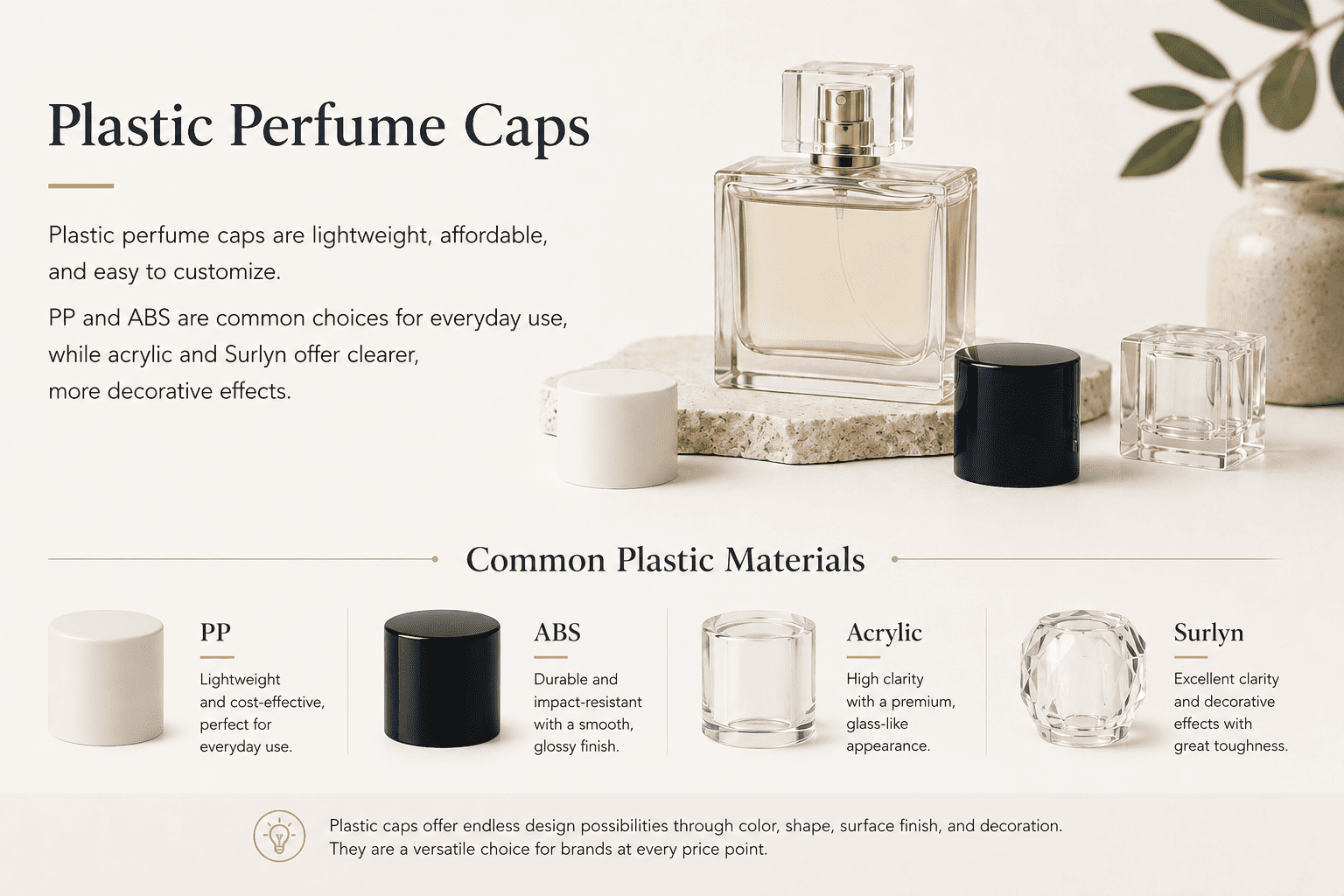
PP Perfume Caps
PP means polypropylene.
It is light, flexible, and cost-effective. It is often used for simple outer caps and internal inserts.
PP works well for entry-level perfume products, body sprays, promotional packaging, and projects with strict cost control.
However, PP normally feels softer and lighter than ABS. It may not create a strong luxury feeling without additional decoration.
ABS Perfume Caps
ABS is one of the most common plastic materials for decorative perfume caps.
It is harder and more rigid than PP. It can support detailed molds and smooth surfaces.
ABS can also use many surface treatments:
- Color coating
- UV coating
- Vacuum metallization
- Electroplating
- Matte finishing
- Glossy finishing
- Soft-touch coating
A well-made plated ABS cap can look similar to metal.
For many new perfume brands, ABS offers a useful balance between cost, shape flexibility, and appearance.
However, low-quality plating may peel, scratch, or show uneven color.
Acrylic Perfume Caps
Acrylic creates a clear and glass-like appearance.
It works well for transparent, colorful, crystal-style, and decorative caps.
Acrylic can create a strong visual effect, but it may scratch during assembly or transport.
Thick acrylic parts also add weight, although they still feel different from metal or natural crystal.
Surlyn Perfume Caps
[Surlyn][[3]] is often used for clear luxury-style caps.
It has strong clarity and impact resistance. It can create a thick crystal-like appearance without using real crystal.
Surlyn caps can be transparent, colored, faceted, or combined with metal details.
They usually cost more than standard PP or ABS caps.
| Plastic material | Appearance | Weight | Cost level | Best use |
|---|---|---|---|---|
| PP | Simple and practical | Very light | Low | Basic perfume packaging |
| ABS | Smooth and flexible | Light | Low to medium | New perfume brands |
| Acrylic | Clear and decorative | Light to medium | Medium | Colorful or artistic products |
| Surlyn | Crystal-like and premium | Medium | Medium to high | Luxury transparent caps |
Why Plastic Sometimes Feels Cheap
Plastic does not automatically mean low quality.
However, a plastic cap may feel cheap when the wall is thin, the cap is too light, the mold line is visible, or the coating is weak.
The customer notices the difference when removing the cap.
A lightweight cap does not create the same solid feeling as zinc alloy, cement, glass, stone, or crystal.
Brands can improve a plastic cap by using thicker walls, better coatings, internal weights, and cleaner mold details.
When Should a Brand Choose an Aluminum Perfume Cap?
Aluminum creates a clean metallic appearance without the high weight of zinc alloy.
Aluminum perfume caps are lightweight, metallic, and suitable for brushing, polishing, anodizing, coloring, laser engraving, and printed decoration.
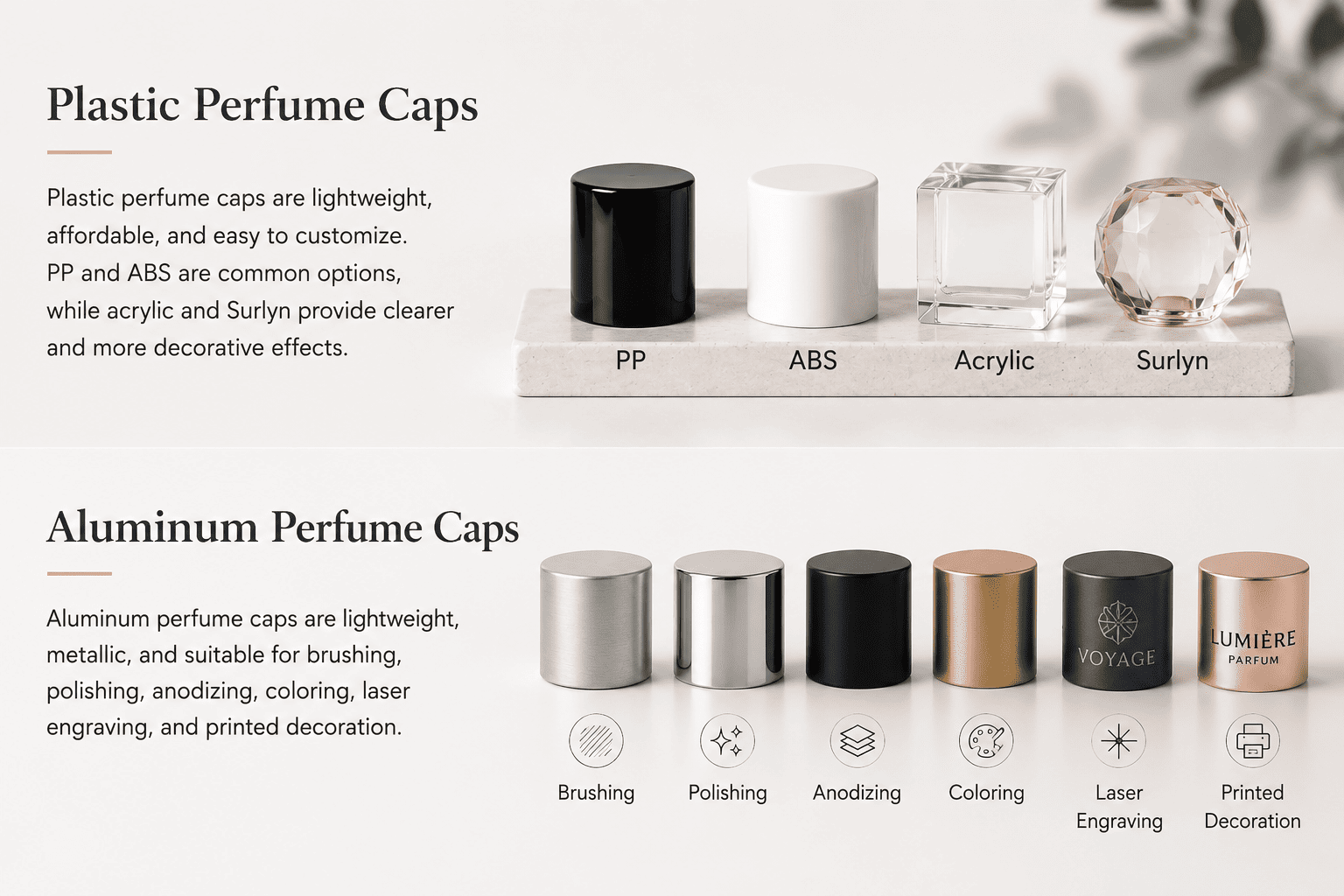
How Aluminum Caps Are Made
Many aluminum caps are not made from one solid aluminum block.
They often use a thin aluminum outer shell with a plastic inner insert.
The aluminum shell creates the metallic surface. The insert controls the fitting.
This structure helps reduce cost and weight.
Common Aluminum Finishes
Aluminum can create several effects:
- Bright silver
- Matte silver
- Brushed silver
- Gold
- Rose gold
- Black
- Colored anodizing
- Printed logos
- Laser engraving
Brushed aluminum gives a modern and technical feeling.
Polished aluminum creates more shine.
Matte aluminum works well for niche and minimalist perfume brands.
Advantages and Limits of Aluminum
Aluminum looks more premium than basic plastic. It also has a natural metallic surface.
The material is light, so it helps control shipping weight.
However, the outer shell can dent when it is too thin. The edges also need careful finishing.
Gold aluminum caps may show small color differences between batches. The brand should approve the cap color together with the pump collar and bottle decoration.
| Feature | Aluminum performance |
|---|---|
| Weight | Light |
| Metallic appearance | Strong |
| Color options | Good |
| Detailed sculptural shapes | Limited |
| Dent resistance | Medium |
| Cost | Medium |
I often recommend aluminum to new brands that want a premium metallic appearance without the cost and weight of zinc alloy.
Why Is Zinc Alloy Common in Premium Perfume Caps?
Zinc alloy is one of the most practical premium cap materials because it combines weight, shape flexibility, batch consistency, and manageable cost.
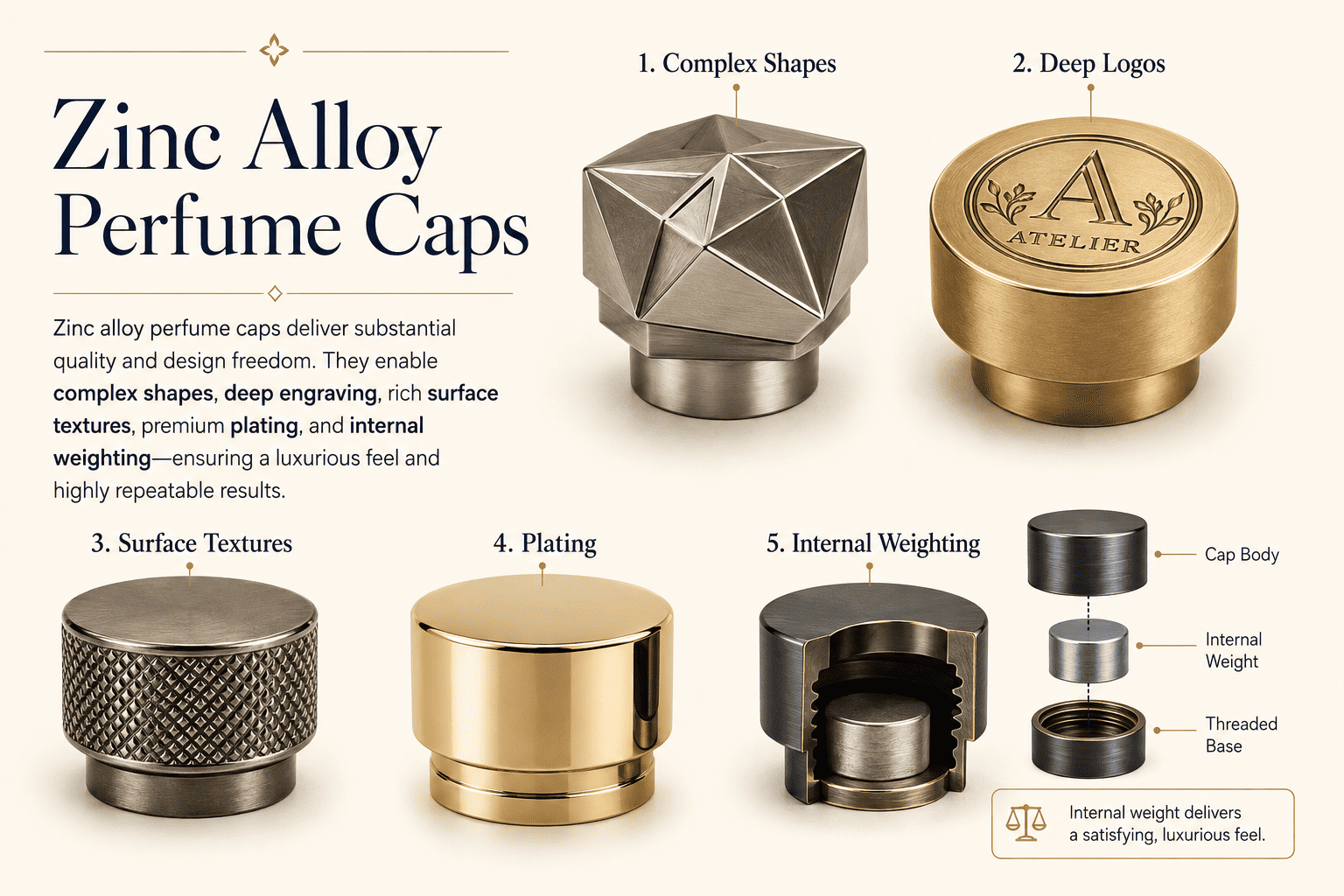
Zinc alloy perfume caps can create heavy, detailed, and highly repeatable designs. They support complex shapes, deep logos, surface textures, plating, and internal weighting.
Zinc Alloy Creates a Heavy Feeling
Many customers connect weight with quality.
A zinc alloy cap feels solid when the customer removes it from the bottle.
This physical feeling can support a luxury product position.
A zinc alloy cap can also include extra material inside the structure. The factory may add a weight block between the outer shell and the inner insert.
This gives the cap more weight without making the visible wall extremely thick.
Zinc Alloy Has Strong Shape Flexibility
[Zinc alloy][[2]] is highly moldable.
It can create:
- Geometric shapes
- Animal figures
- Architectural designs
- Deep logos
- Raised patterns
- Textured surfaces
- Sculptural caps
This makes it suitable when the cap is a key part of the brand identity.
Zinc Alloy Offers Better Batch Consistency
Natural materials often vary between pieces.
Zinc alloy is easier to control in commercial production. The factory can make the dimensions, shape, surface, and weight more consistent.
This makes quality inspection easier.
The same batch can look very close across thousands of pieces.
Zinc Alloy Surface Treatments
Common zinc alloy finishes include:
- Bright gold
- Antique gold
- Silver
- Rose gold
- Gunmetal
- Black nickel
- Matte metal
- Painted colors
The plating quality is important.
Poor plating may show black spots, uneven color, peeling, or weak corrosion resistance.
| Zinc alloy advantage | Zinc alloy limitation |
|---|---|
| Strong premium weight | Higher cost than plastic |
| Detailed custom shapes | Custom molds may be needed |
| High batch consistency | More quality control than basic plastic |
| Many plating options | Plating can scratch |
| Suitable for mass production | Higher shipping weight |
For many premium brands, zinc alloy is a practical choice because its cost is easier to accept than natural crystal or custom stone.
Can Glass Perfume Caps Create a Crystal-Like Effect?
Glass caps can create a transparent, bright, and premium appearance at a more practical cost than natural crystal.
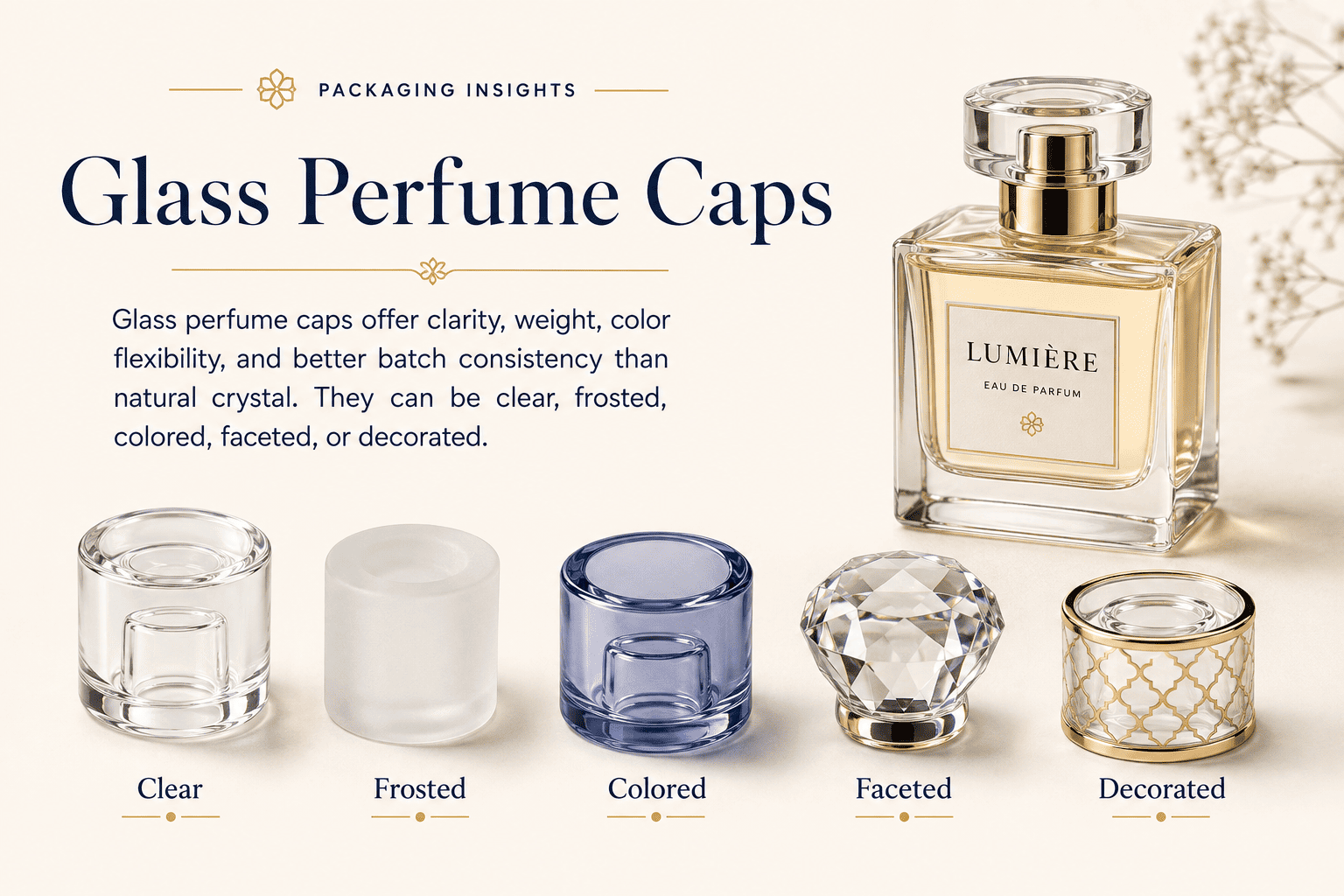
Glass perfume caps offer clarity, weight, color flexibility, and better batch consistency than natural crystal. They can be clear, frosted, colored, faceted, or decorated.
Why Brands Choose Glass Caps
Glass can create a transparent luxury effect.
From a distance, a faceted glass cap may look similar to crystal.
It can reflect light and connect visually with the perfume bottle.
Glass is also easier to reproduce than natural stone or raw crystal. The factory can control the shape, color, and dimensions more consistently.
Glass Cap Decoration Options
Glass caps can use:
- Transparent color
- Frosting
- Spray coating
- Faceted surfaces
- Printing
- Decals
- Metal decorations
A clear glass cap can create a clean and bright feeling.
A frosted glass cap feels softer and more modern.
A colored glass cap can support the fragrance identity.
Main Risks of Glass Caps
Glass can break after impact.
A heavy glass cap can also place more force on the pump and neck during transportation.
Glass normally needs a plastic inner insert because the glass itself cannot provide stable friction with the pump collar.
| Glass cap advantage | Glass cap limitation |
|---|---|
| Clear and premium appearance | Breakage risk |
| Better consistency than natural crystal | Heavier than plastic |
| More affordable than many crystal caps | Needs protective packaging |
| Good color and decoration options | Needs an inner insert |
Glass is a good option when a brand wants transparency and weight but cannot support the cost and natural variation of real crystal.
Are Wooden Perfume Caps a Good Choice?
Wooden caps create a natural, warm, and handmade feeling.
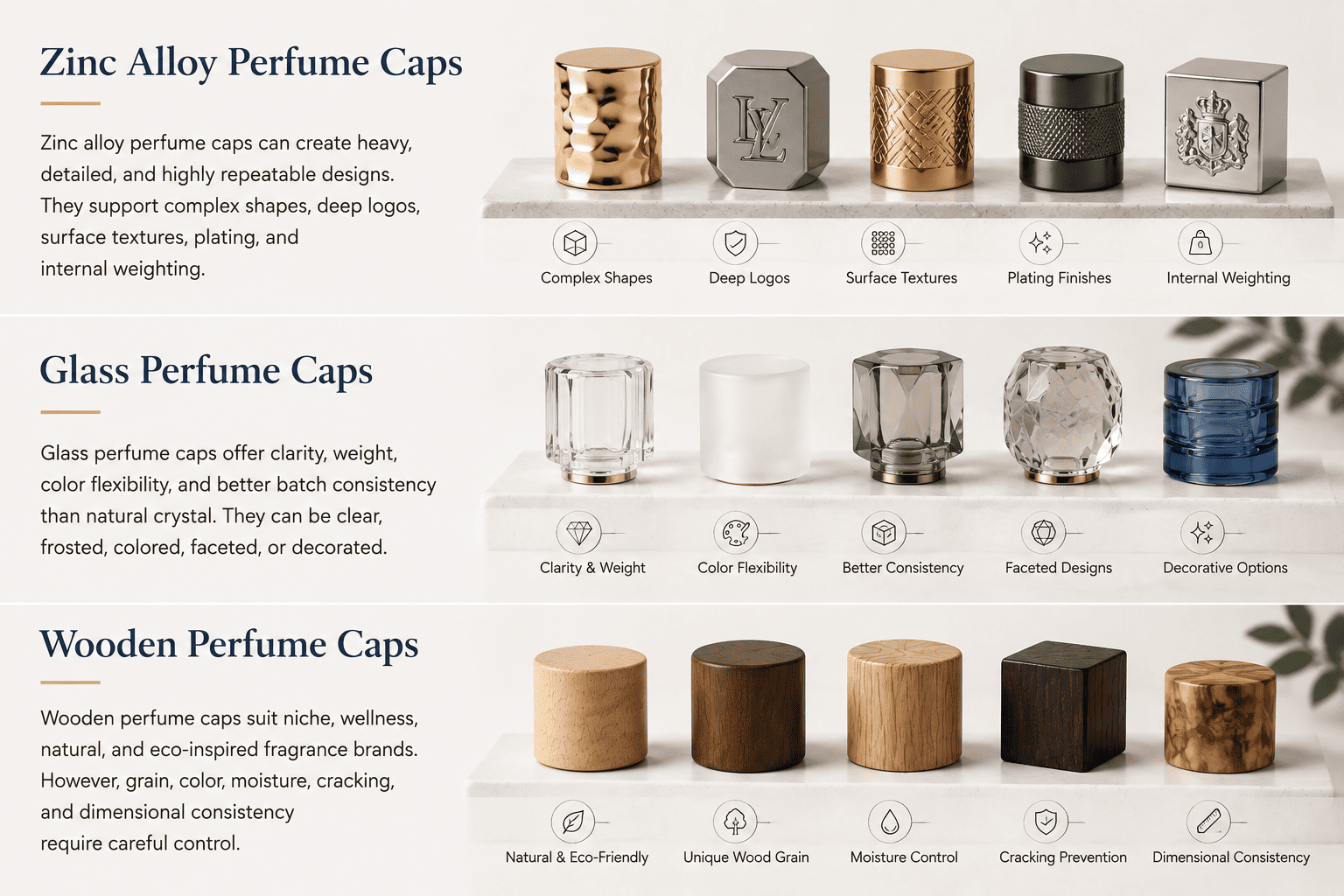
Wooden perfume caps suit niche, wellness, natural, and eco-inspired fragrance brands. However, grain, color, moisture, cracking, and dimensional consistency require careful control.
Every Wooden Cap Is Slightly Different
Wood is a natural material.
The grain, color, lines, and small marks can vary between pieces.
Some niche brands like this difference because it makes the packaging feel more authentic.
Other brands need every cap to look almost identical. In this case, wood creates more quality control challenges.
Wood Type Changes the Brand Feeling
Light wood can feel clean and modern.
Dark wood can feel warm, masculine, or luxurious.
Bamboo can support a natural or eco-focused brand story.
The final effect also depends on polishing, oiling, coating, staining, and painting.
Wooden Caps Need Inner Inserts
Wood can expand or shrink slightly when temperature and humidity change.
For this reason, the wooden shell normally needs a plastic insert.
The insert controls the fit and protects the daily opening experience.
| Wood issue | Possible result |
|---|---|
| Uneven grain | Different appearance |
| High moisture | Swelling |
| Low moisture | Cracking |
| Poor coating | Staining or odor absorption |
| Weak insert assembly | Loose cap |
I recommend wooden caps when natural variation supports the brand story.
How Do Cement Caps Support an Industrial Brand Style?
Cement caps have become more visible in niche perfume packaging because they create a raw, cold, and architectural feeling.
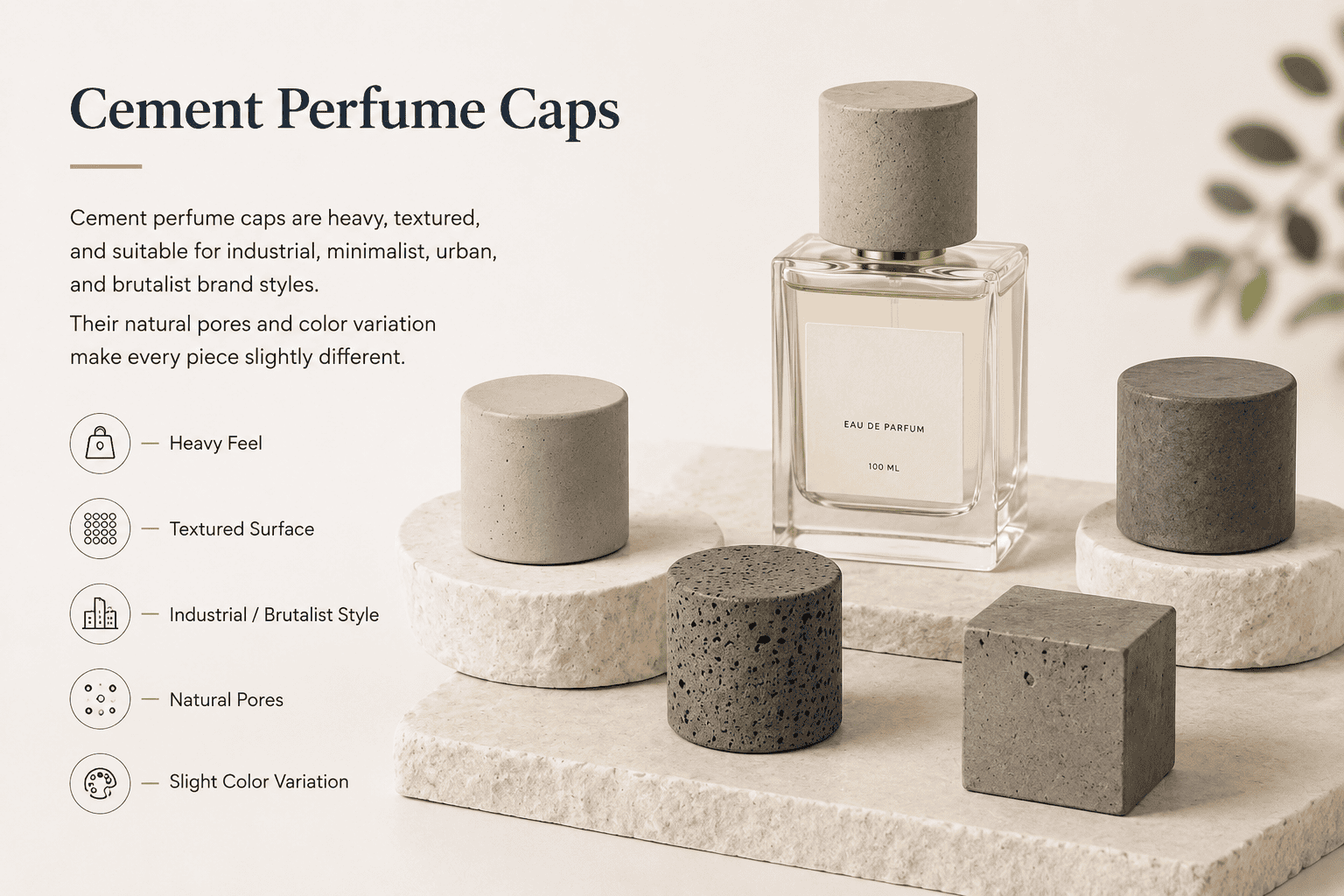
Cement perfume caps are heavy, textured, and suitable for industrial, minimalist, urban, and brutalist brand styles. Their natural pores and color variation make every piece slightly different.
Cement Creates a Strong Visual Identity
A cement cap can support themes such as:
- Modern architecture
- Urban environments
- Concrete buildings
- Industrial design
- Minimalism
- Brutalist art
The raw surface creates depth.
Small pores and slight color differences make the cap look less like a standard molded plastic component.
Cement Feels Very Heavy
Cement caps normally feel substantial in the hand.
This weight can increase the perceived value of the perfume.
The effect is similar to thick-bottom glass. Customers often connect the physical weight with luxury.
However, a very heavy cap needs a suitable bottle.
A small or thin bottle may feel unbalanced.
Cement Requires Careful Production Control
Cement can chip when the edge is too thin.
It may also show pores, marks, and surface variation.
The cement outer shell normally needs a plastic inner insert.
The final packaging also needs enough protection during transportation.
| Cement cap feature | Effect |
|---|---|
| Heavy weight | Strong hand feeling |
| Raw texture | Industrial visual style |
| Small pores | Natural surface depth |
| Color variation | Each piece looks slightly different |
| Brittle edges | Higher transport risk |
| Inner insert | Stable fitting |
I recommend cement caps for niche brands that accept natural variation as part of the design.
Can Natural Stone and Volcanic Stone Be Used for Perfume Caps?
Natural stone creates a highly distinctive and collectible feeling. However, it is difficult to reproduce in a perfectly consistent way.
Natural stone and volcanic stone caps provide weight, texture, and one-of-a-kind patterns. They suit limited editions and niche brands, but they cost more and are harder to standardize for large production.
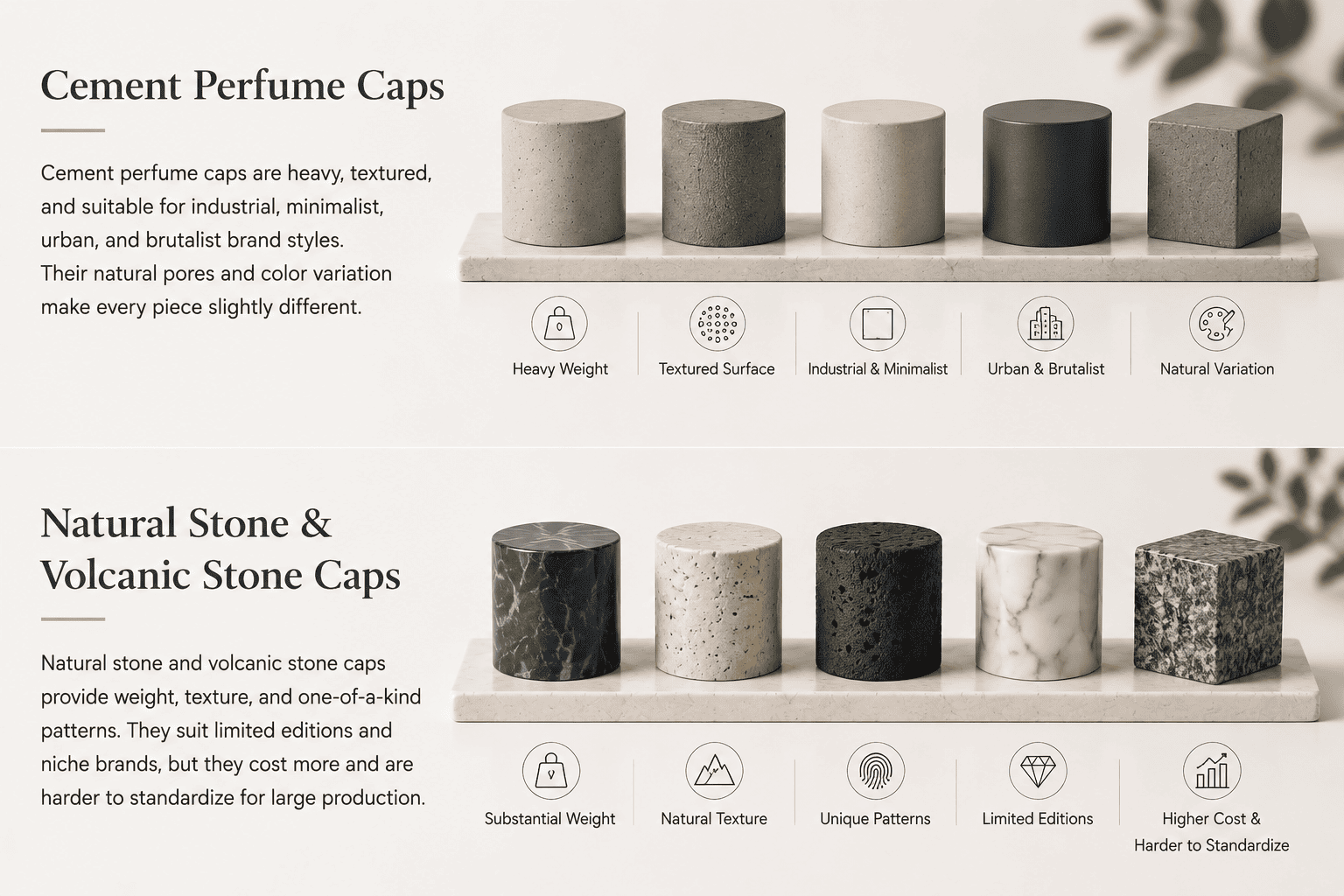
Natural Stone Caps
Natural stone may show different colors, grains, mineral lines, and surface patterns.
Two caps may look similar, but they will rarely look exactly the same.
Some niche brands see this variation as a benefit.
Each cap becomes an individual object.
This approach can support luxury, spiritual, natural, geological, and artistic perfume concepts.
However, the raw material is not fully predictable.
Cutting, drilling, polishing, and assembly also require more manual work.
Some stones may crack during processing.
Volcanic Stone Caps
[Volcanic stone][[4]] has many small pores.
This surface creates a raw, natural, and primitive feeling.
It works well for fragrance concepts connected with:
- Earth
- Fire
- Smoke
- Minerals
- Islands
- Nature
The porous surface may collect dust or absorb liquid when it is not treated correctly.
The manufacturer may need to seal the surface.
However, the coating should not remove the natural texture.
| Stone material | Visual feeling | Batch consistency | Cost level |
|---|---|---|---|
| Natural polished stone | Organic and luxurious | Low | High |
| Marble-like stone | Elegant and decorative | Medium to low | High |
| Volcanic stone | Raw and textured | Low | Medium to high |
| Artificial stone | More controlled | Medium to high | Medium |
Natural stone is better for smaller collections than for large commercial programs that require identical caps.
Are Crystal and Raw Crystal Caps Suitable for Perfume?
Crystal can make perfume packaging look like jewelry.
Crystal perfume caps are heavy, reflective, and visually luxurious. Polished crystal offers more control, while raw crystal creates unique shapes that cannot be identical across the full batch.
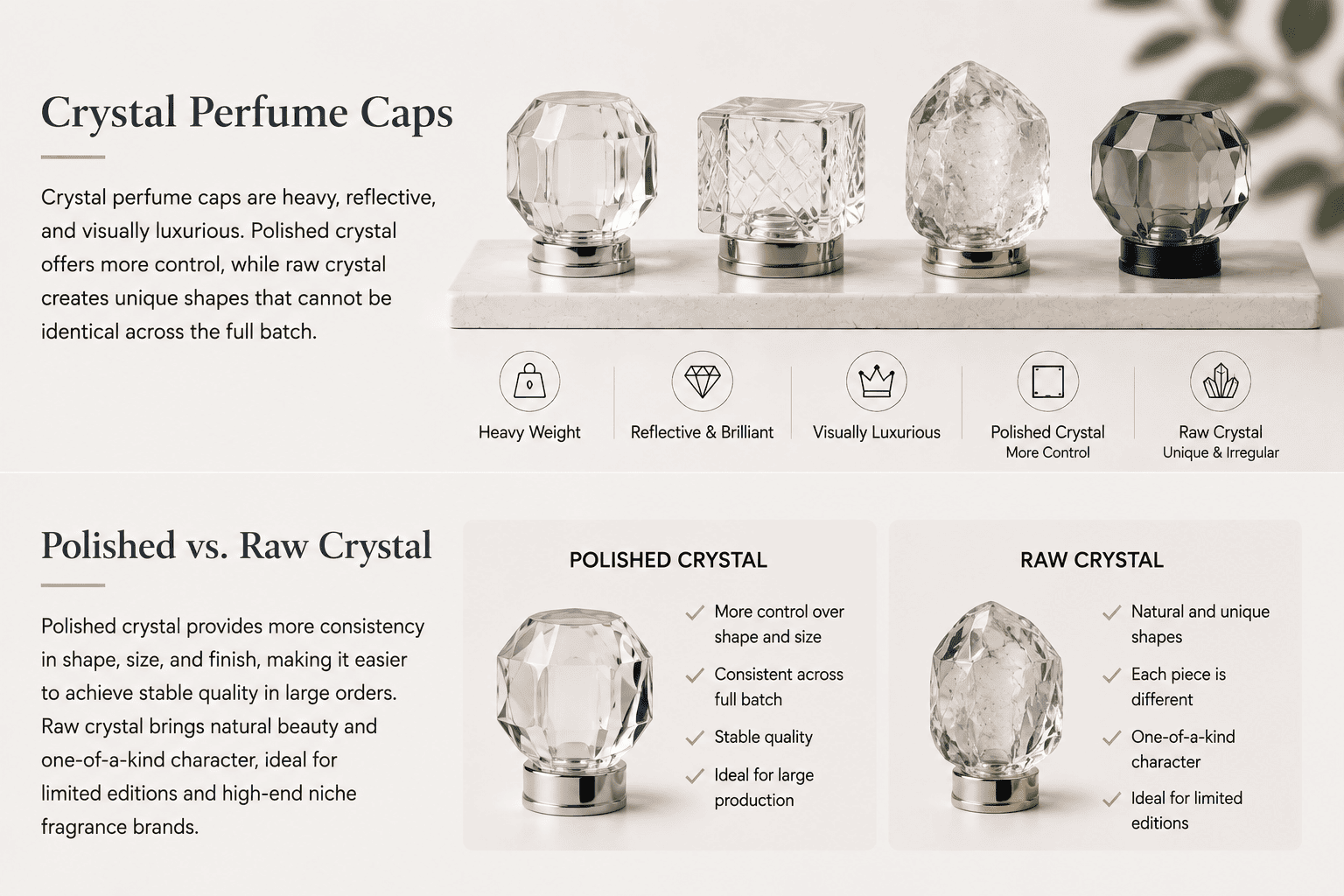
Polished Crystal Caps
Polished crystal can reflect light and create a bright premium effect.
It can be cut into controlled shapes.
However, the material and processing costs are high.
The cap also needs careful assembly and protective packaging.
Raw Crystal Caps
Raw crystal has irregular edges, natural color changes, mineral lines, and different levels of transparency.
This makes every cap unique.
Some small niche brands like this result because it supports a strong artistic story.
However, raw crystal is difficult to use for large commercial production.
The shape, size, color, transparency, and weight may vary.
| Crystal type | Appearance | Consistency | Suitable market |
|---|---|---|---|
| Polished crystal | Bright and jewelry-like | Medium | Luxury perfume |
| Cut crystal | Geometric and reflective | Medium to high | Premium collections |
| Raw crystal | Natural and unique | Very low | Limited niche editions |
| Glass imitation | Clear and controlled | High | Cost-conscious premium brands |
A brand must decide whether it values consistency or individuality.
Raw crystal is not a defect-free commercial material. Its natural differences are part of its value.
Can Ceramic, Leather, Fabric, and Resin Caps Work for Perfume?
Less common materials can create strong differentiation, but they usually need more assembly and quality control.
Ceramic, leather-covered, fabric-covered, and resin caps can create artistic or cultural packaging. However, they often involve more manual work, more variation, and higher development costs.
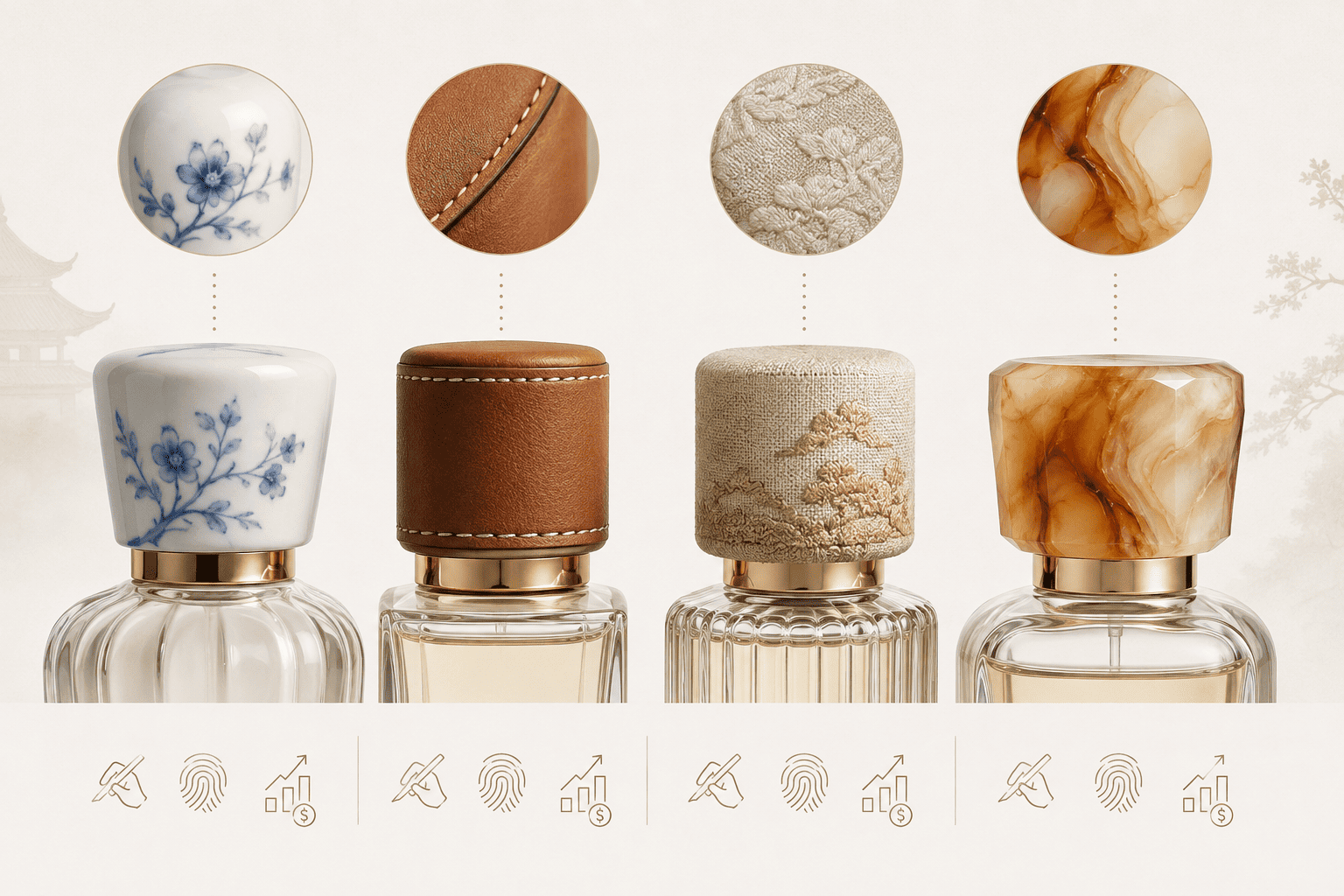
Ceramic Caps
Ceramic can create an artistic and handmade feeling.
It supports glazing, painting, decals, and sculptural forms.
However, ceramic can break after impact.
The size may also change slightly during firing.
A ceramic outer shell normally needs an insert.
Leather-Covered Caps
Leather can cover a plastic, aluminum, or zinc alloy base.
It creates a warm and premium touch.
Leather works well for fashion, travel, equestrian, vintage, and handmade brand stories.
However, the color, grain, stitching, glue, and edges need careful control.
Fabric-Covered Caps
Fabric can create a soft and decorative appearance.
Brands may use velvet, woven textile, printed fabric, or embroidered material.
However, fabric can collect dust, absorb stains, and show glue marks.
Resin Caps
Resin supports many colors, transparent effects, embedded decorations, and artistic shapes.
It can create flower, stone, marble, or sculptural effects.
Poor resin may yellow, crack, or create an unwanted smell.
| Material | Brand feeling | Main risk |
|---|---|---|
| Ceramic | Artistic and handmade | Breakage |
| Leather | Warm and premium | Surface variation |
| Fabric | Soft and cultural | Dust and staining |
| Resin | Creative and colorful | Yellowing or cracking |
These materials work best when they support a clear brand story.
How Do Perfume Cap Closure Structures Affect User Experience?
The material controls the appearance, but the inner structure controls how the cap opens and closes.
Perfume caps commonly use friction-fit, snap-on, and magnetic systems. Each closure creates a different opening force, sound, cost, and user experience.
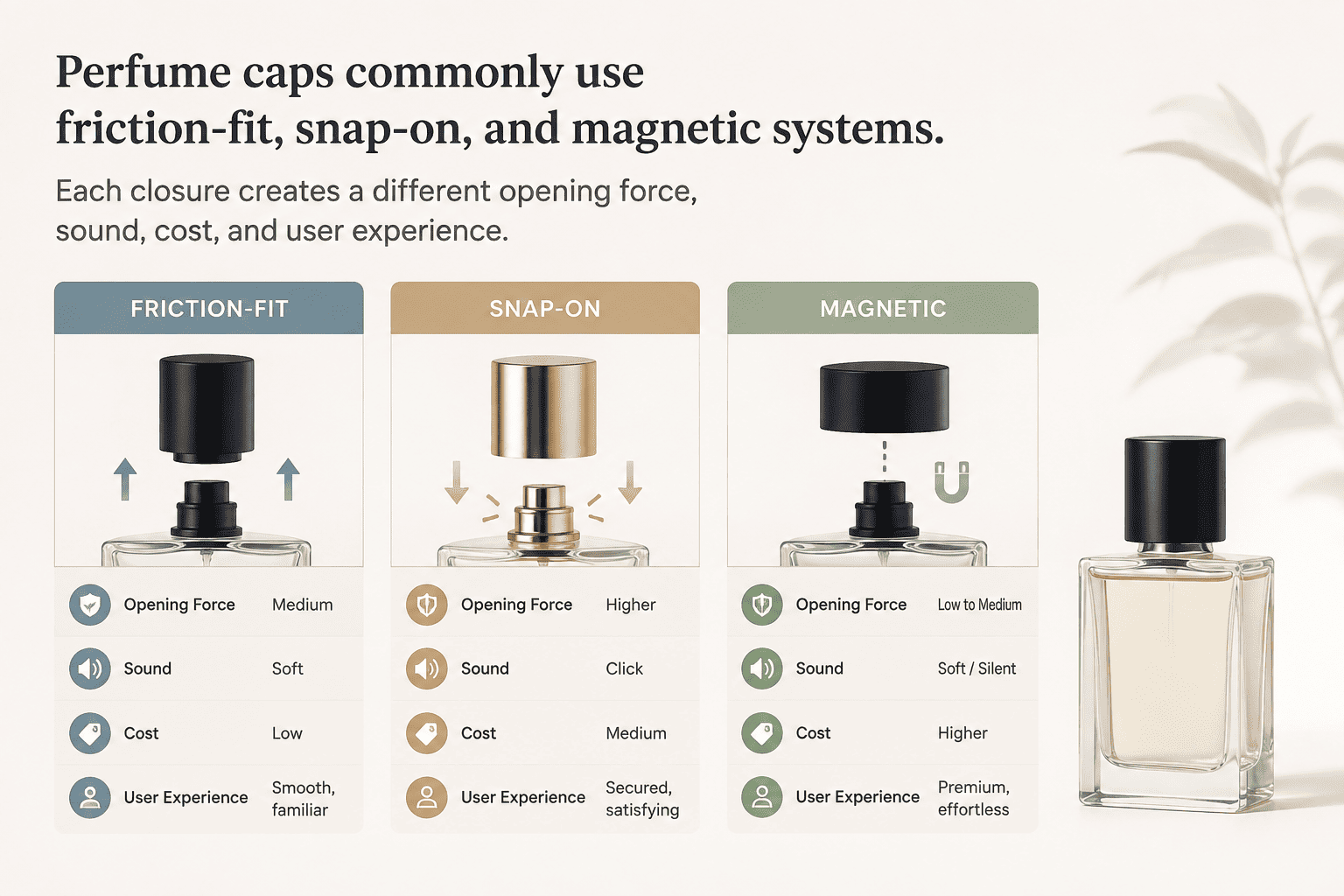
Friction-Fit Caps
A friction-fit cap uses contact between the insert and pump collar.
The user presses the cap down and pulls it upward.
The fitting force must be balanced.
A loose cap may fall off during transport.
A tight cap may be difficult to remove.
Snap-On Caps
A snap-on cap creates a clearer locking point.
The user may hear or feel a click.
This can make the cap feel secure.
However, the dimensions must be accurate.
Magnetic Caps
Magnetic caps have become common in premium packaging.
Magnets guide the cap into position.
This creates a smooth and satisfying closing action.
However, the magnet strength, direction, position, and assembly must be controlled.
| Closure system | User feeling | Cost level | Main concern |
|---|---|---|---|
| Friction-fit | Simple and smooth | Low | Too loose or tight |
| Snap-on | Clear click | Low to medium | Dimensional accuracy |
| Magnetic | Premium and guided | Medium to high | Magnet alignment |
A heavy zinc alloy, cement, stone, or crystal cap may need a stronger insert or magnet.
The cap weight and closure structure must be tested together.
How Do Cap Materials Affect Cost and Commercial Scalability?
Cap cost depends on material, tooling, finishing, assembly, inserts, magnets, packaging, and quality control.
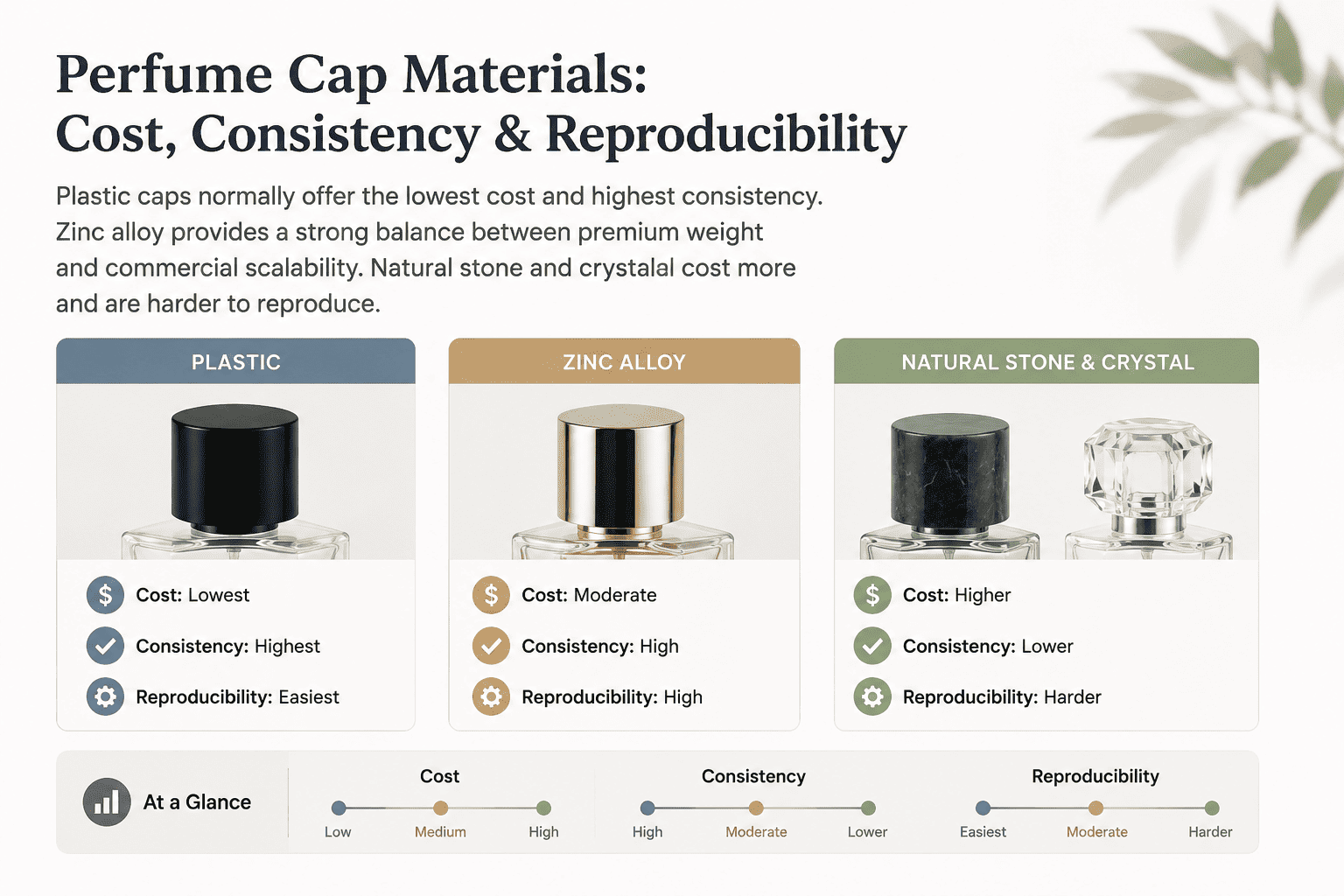
Plastic caps normally offer the lowest cost and highest consistency. Zinc alloy provides a strong balance between premium weight and commercial scalability. Natural stone and crystal cost more and are harder to reproduce.
Plastic Offers the Lowest Starting Cost
Standard plastic caps are normally the most affordable.
A brand can use an existing mold and change the color, coating, or logo.
This reduces development risk.
Aluminum Sits in the Middle Range
Aluminum normally costs more than basic plastic.
However, it offers a real metallic appearance and lower weight than zinc alloy.
Zinc Alloy Balances Cost and Premium Quality
Zinc alloy costs more than plastic and aluminum.
However, it offers weight, shape flexibility, and batch consistency.
For many premium commercial projects, zinc alloy is easier to manage than stone, cement, or crystal.
Natural Materials Cost More
Stone, crystal, and some wooden caps require more manual processing.
They also create more rejected pieces and stronger packaging needs.
| Material | Cost level | Batch consistency | Mass production suitability |
|---|---|---|---|
| PP | Low | High | Very high |
| ABS | Low to medium | High | Very high |
| Aluminum | Medium | High | High |
| Glass | Medium | High | High |
| Zinc alloy | Medium to high | High | High |
| Wood | Medium | Medium | Medium to high |
| Cement | Medium to high | Medium to low | Medium |
| Natural stone | High | Low | Low to medium |
| Crystal | High | Low to medium | Low to medium |
| Raw crystal | High | Very low | Low |
A new brand should not compare only the cap unit price.
The total cost also includes shipping, inner packaging, rejected parts, assembly, and testing.
How Should a New Perfume Brand Choose the Right Cap Material?
The correct cap should support the bottle, target customer, retail price, brand story, order quantity, and shipping method.
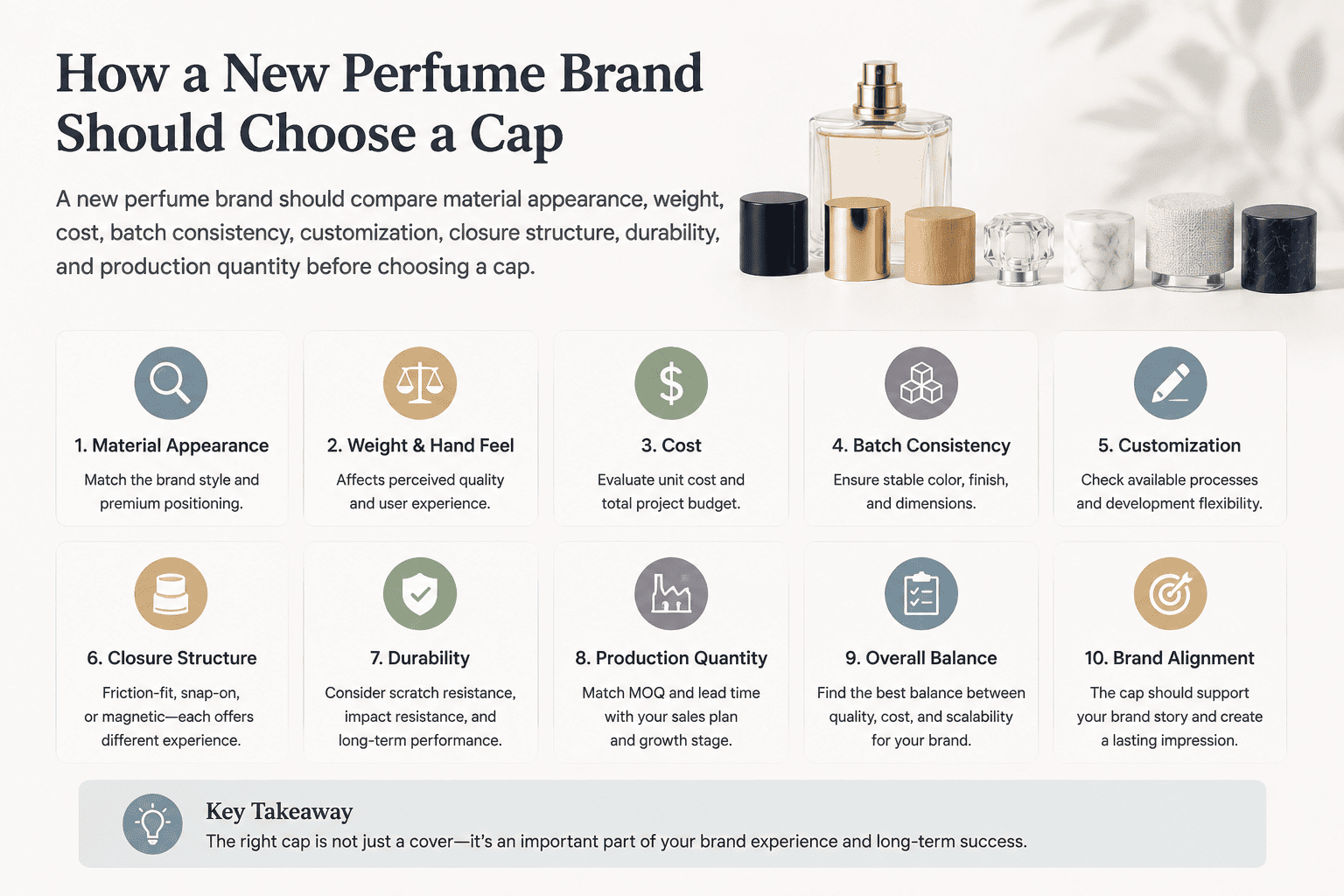
A new perfume brand should compare material appearance, weight, cost, batch consistency, customization, closure structure, durability, and production quantity before choosing a cap.
Start With the Brand Position
I first ask what the brand wants the customer to feel.
| Brand position | Suitable cap material |
|---|---|
| Affordable and modern | PP or ABS |
| Clean and premium | Aluminum |
| Heavy and luxurious | Zinc alloy |
| Transparent and bright | Glass, acrylic, or Surlyn |
| Natural and warm | Wood |
| Industrial and cold | Cement |
| Geological and artistic | Stone or volcanic stone |
| Luxury limited edition | Crystal or ceramic |
Decide Between Consistency and Individuality
A commercial perfume line usually needs stable dimensions, color, shape, and fitting.
Plastic, aluminum, zinc alloy, and glass are easier to control.
A niche limited edition may accept natural differences.
Cement, raw crystal, volcanic stone, and natural stone can then become part of the story.
Match the Cap With the Bottle Weight
A heavy cap may feel unbalanced on a small bottle.
A light plastic cap may feel weak on a thick luxury bottle.
The cap diameter, height, and weight should match the bottle proportion.
Match the Cap With the Retail Price
The packaging cost must support the final selling price.
A new brand should not spend the full budget on a stone or crystal cap and then reduce the quality of the pump, box, or decoration.
The most expensive cap is not always the best cap.
Consider Ecommerce Shipping
Many new perfume brands sell online.
Heavy caps increase shipping costs.
Glass, crystal, stone, cement, and ceramic need stronger inner packaging.
The cap must also stay attached during transport.
Consider Future Product Lines
A brand may launch several fragrances.
Using the same cap shape with different colors can create a consistent product family.
This also reduces tooling and development costs.
What Tests Should a Brand Complete Before Approving a Cap?
A cap should not be approved from a photo alone.
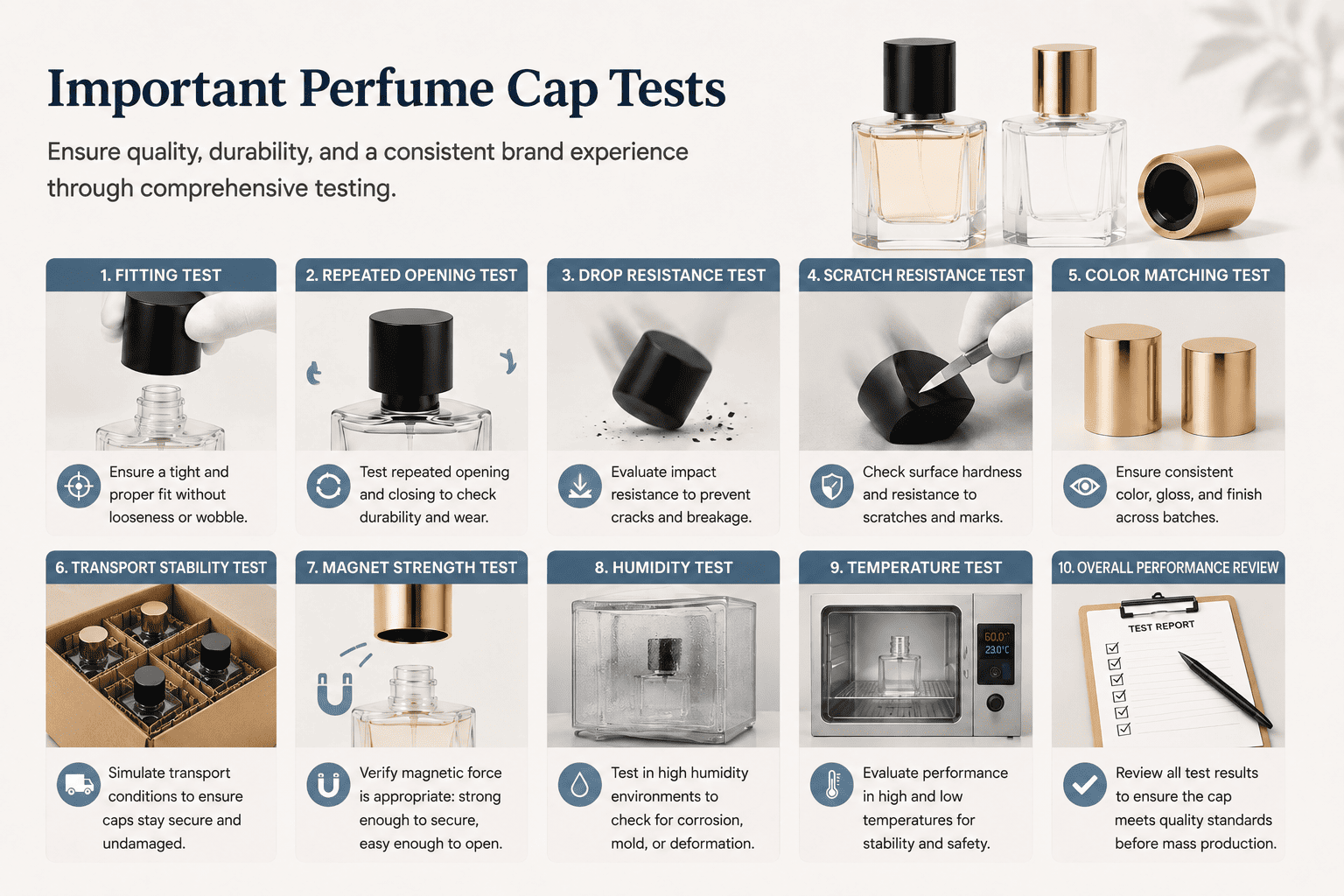
Important perfume cap tests include fitting, repeated opening, drop resistance, scratch resistance, color matching, transport stability, magnet strength, humidity, and temperature testing.
Fitting Test
I test the cap with the final pump and collar.
I check whether the cap is loose or tight.
I also test repeated opening because the fitting may change after use.
Drop Test
The full bottle and cap should be tested together.
A heavy cap can create more impact on the neck and pump.
Glass, crystal, stone, cement, and ceramic may crack or chip.
Scratch Test
Plated, painted, transparent, and polished surfaces may scratch during assembly and shipping.
The inner packaging should prevent contact between the cap and other hard surfaces.
Color Matching Test
Gold can look different on aluminum, zinc alloy, plastic, and glass.
I recommend checking all matching components under the same lighting.
Magnet Test
For magnetic caps, I check the magnet strength, direction, alignment, and repeated use.
Temperature and Humidity Tests
Wood, leather, glue, fabric, paint, cement, and natural materials may react to heat and humidity.
| Test | Main purpose |
|---|---|
| Fit test | Controls opening force |
| Repeated opening | Checks long-term stability |
| Drop test | Checks breakage and deformation |
| Scratch test | Checks surface durability |
| Color test | Confirms component matching |
| Magnet test | Confirms strength and alignment |
| Heat test | Checks material change |
| Humidity test | Checks wood, glue, and fabric |
| Transport test | Checks movement and damage |
Testing is especially important for new brands because packaging failures can create complaints, replacements, and negative reviews.
Should a New Brand Choose a Standard or Custom Perfume Cap?
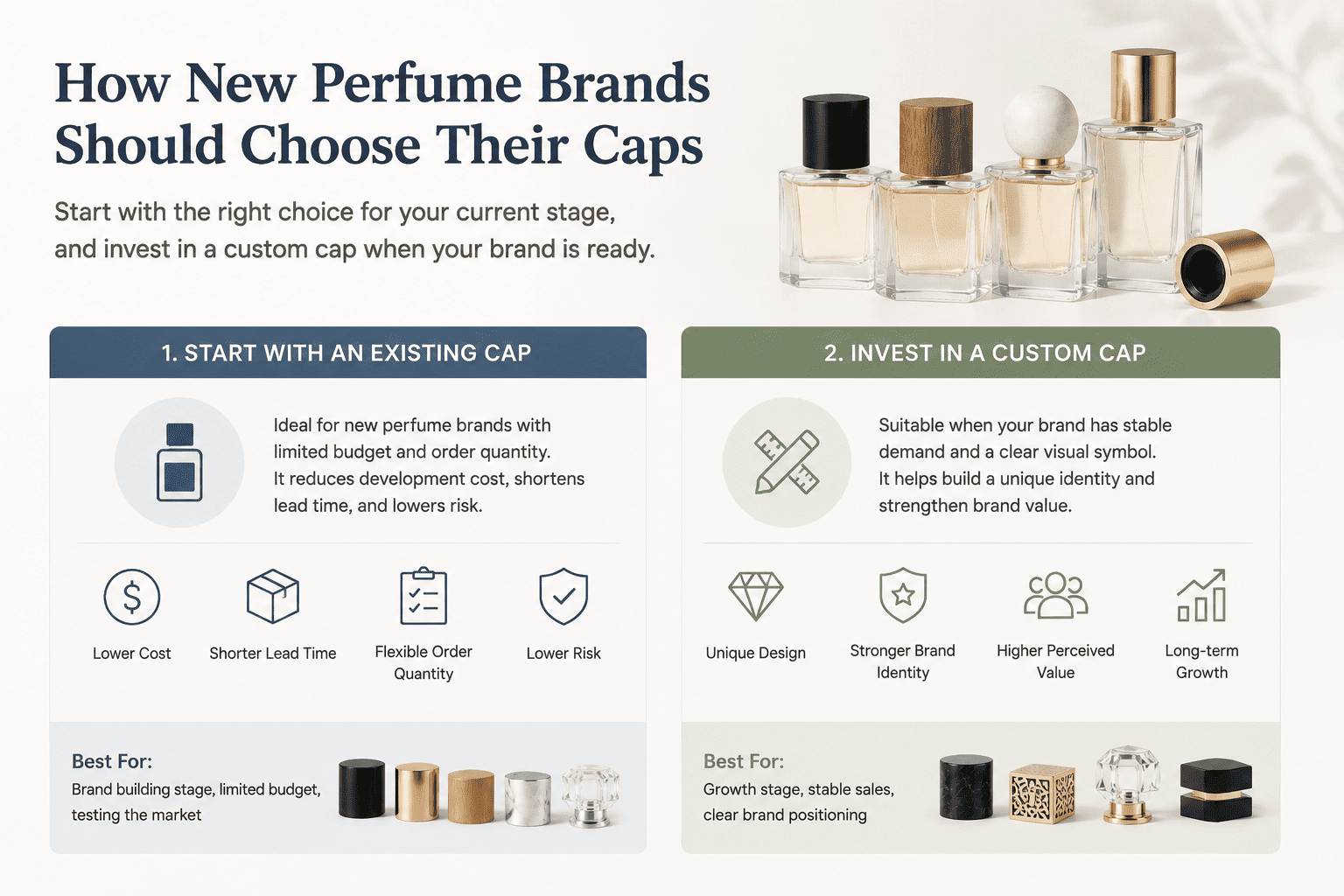
A standard cap reduces cost and launch risk. A custom cap creates stronger identity but requires more investment and testing.
New perfume brands should normally start with an existing cap when budget and order quantity are limited. A custom cap is more suitable when the brand has stable demand and a clear visual symbol.
When I Recommend a Standard Cap
I recommend an existing cap when the brand needs:
- Lower minimum order quantity
- Faster production
- Lower tooling cost
- Stable fitting
- Market testing
- More budget for marketing
A standard cap can still be customized through color, plating, printing, engraving, or surface decoration.
When I Recommend a Custom Cap
A custom cap is more suitable when the brand wants:
- A private shape
- A logo built into the cap
- A special brand symbol
- A stronger luxury position
- Long-term product recognition
The brand should prepare time for mold development, sampling, fitting, color approval, and transport testing.
A Semi-Custom Cap Is Often a Good Choice
A semi-custom cap uses an existing inner structure with a custom outer shell or decoration.
Examples include:
- A standard insert with a zinc alloy shell
- A standard cap with a leather wrap
- An aluminum cap with laser engraving
- A plastic cap with internal weighting
- A standard glass cap with a custom metal top
| Brand situation | Recommended cap strategy |
|---|---|
| First perfume launch | Standard plastic or aluminum cap |
| Small test order | Standard cap with custom color |
| Premium launch | Aluminum, glass, or zinc alloy |
| Natural niche brand | Wood or stone-look material |
| Industrial niche brand | Cement or dark zinc alloy |
| Stable luxury brand | Custom zinc alloy or glass cap |
| Limited edition | Crystal, stone, ceramic, or mixed material |
I believe a new perfume brand should protect its cash flow.
The cap should support the product and brand story. It should not consume the full packaging budget before the perfume reaches the market.
Conclusion
I choose perfume cap materials by balancing weight, appearance, cost, consistency, fitting, production scale, shipping risk, and the customer’s final experience.
[[1]]: https://www.bulkperfumebottles.com/1/6-oz-5ml-to-1-oz-30ml/1/2-oz-15ml-deluxe-cylinder-glass-bottle-heavy-base-bottom/?srsltid=AfmBOoo4jBKOY5yQPBMK-peuJboOZY-h6xjD5R31C3G_H9jvmuG8q6XS "thick-bottom glass bottle "
[[2]]: https://www.ck12.org/flexi/physical-science/alloys/what-is-a-zinc-alloy/ "Zinc alloy"
[[3]]: https://www.curbellplastics.com/materials/plastics/surlyn/?srsltid=AfmBOoq1cJ0Oho-nezHW57nlYOfUcyYkm_FFvHDT53CyvBvZBg6Akvq7 "Surlyn"
[[4]]: https://en.wikipedia.org/wiki/Volcanic_rock "Volcanic stone"