A perfume bottle can look perfect in a sample but fail in mass production. One bad bulk order can cause leakage, breakage, delays, and customer complaints.
I find a reliable perfume bottle manufacturer by checking factory capability, quality control, customization flexibility, MOQ, communication efficiency, and the supplier’s willingness to solve small production details with me.
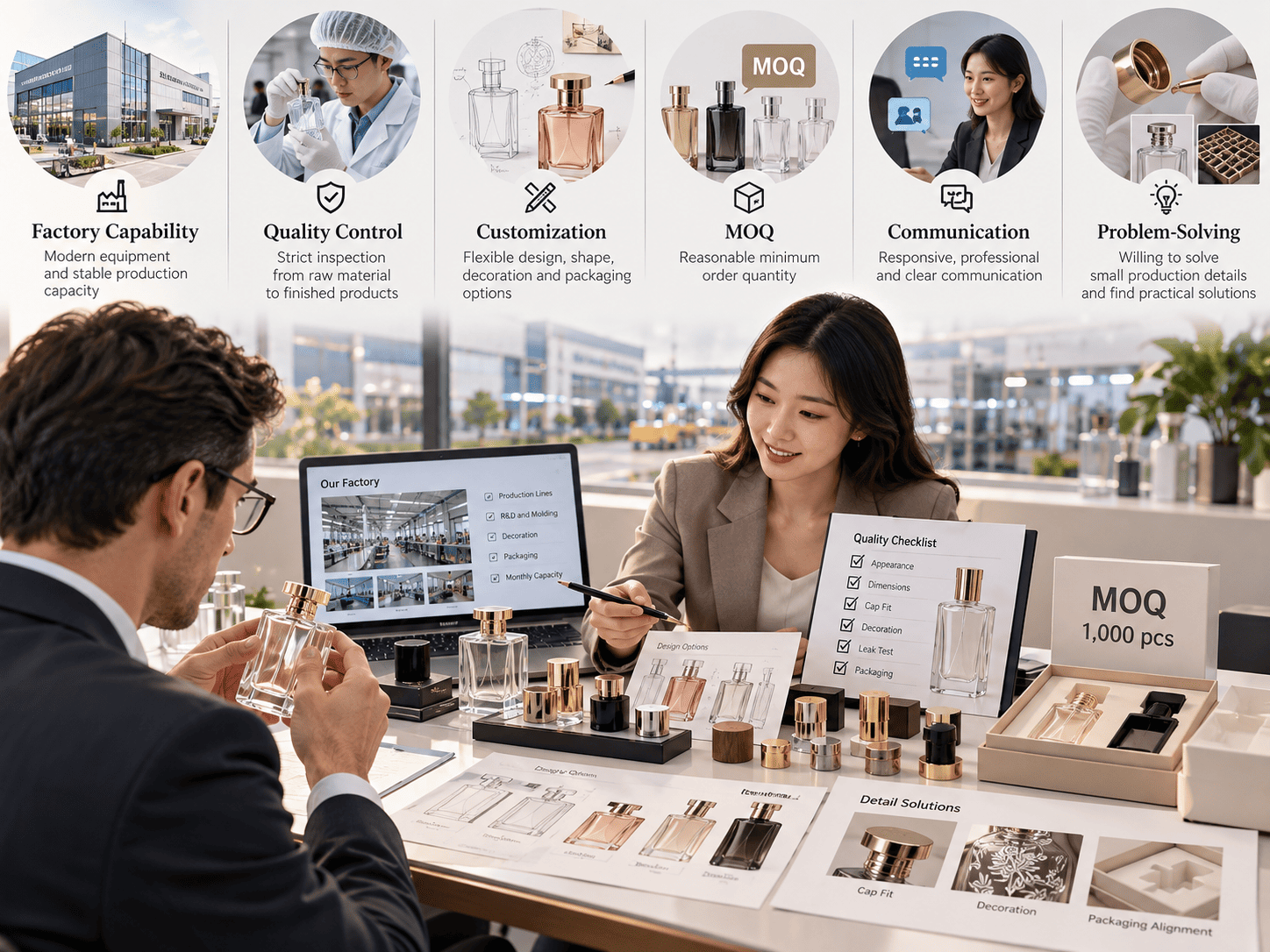
When I source packaging for a niche perfume brand, I do not only ask whether a supplier can make the bottle. I ask whether the supplier is a good match for the size and working style of the brand.
This difference matters.
A factory may be very strong when producing 100,000 standard bottles. The same factory may not be suitable for a niche perfume brand that needs 3,000 bottles, a custom cap, several rounds of color adjustment, and frequent communication.
For me, supplier reliability is not only about production capacity. It is also about matching.
What Should I Check Before Choosing a Perfume Bottle Manufacturer?
A professional website can make almost any supplier look experienced. I need to check what the company can actually produce and how willing the team is to cooperate with my project.
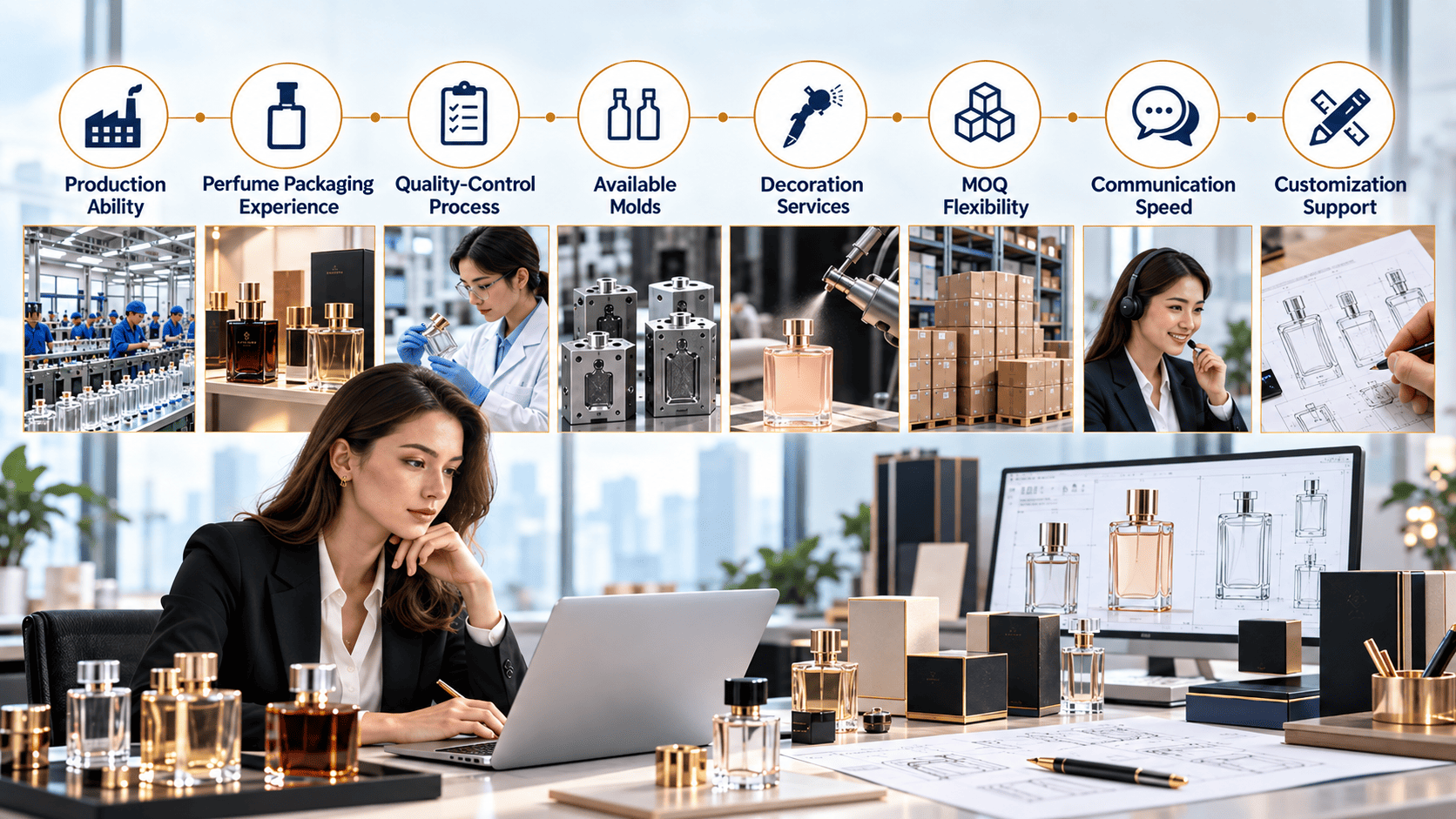
I check a perfume bottle manufacturer’s production ability, perfume packaging experience, quality-control process, available molds, decoration services, MOQ flexibility, communication speed, and willingness to support customization.
I usually start by understanding what the supplier does directly.
Some companies manufacture glass bottles. Some mainly provide decoration. Some work as packaging companies and coordinate glass bottles, caps, sprayers, collars, and boxes from different factories.
I do not think one model is automatically better than another.
I care about who takes responsibility for the finished package.
I Look at Supplier Capability and Supplier Matching Separately
From my experience, this is especially important for small niche perfume brands.
A supplier can have excellent production capability but still be the wrong supplier for a small brand.
If I need 3,000 units and the factory is only comfortable with orders above 50,000 units, there will usually be problems later. The factory may accept my order, but my project may never become a priority.
That affects everything.
It can affect sample speed.
It can affect how quickly someone answers my questions.
It can affect whether the supplier is willing to adjust a small detail.
It can even affect whether someone wants to help me reduce the MOQ of one component.
This is why I always look at the matching level between the brand and the supply chain.
| Area | What I Check | Why It Matters |
|---|---|---|
| Order size | Is my quantity normal for this supplier? | Small orders need enough attention |
| MOQ | Can the supplier reduce MOQ when possible? | Protects cash flow |
| Customization | Can they support special finishes and components? | Helps niche brands create identity |
| Communication | How fast can the team respond? | Small details need fast decisions |
| Sampling | Are they willing to make several adjustments? | Custom projects rarely finish in one round |
| Components | Can they coordinate bottle, pump, cap, and box? | Reduces compatibility problems |
| QC | Will they discuss detailed quality requirements? | Important for non-standard products |
| Packing | Will they improve packing for my actual shipment? | Protects goods and shipping cost |
For a small fragrance brand, I often value cooperation more than factory size.
I want a supplier that is willing to work through details with me.
That willingness becomes very clear once the project becomes difficult.
How Can I Verify the Quality of Perfume Bottles Before a Bulk Order?
A sample may look good, but bulk production can still have variation. I need to define quality standards before production starts.
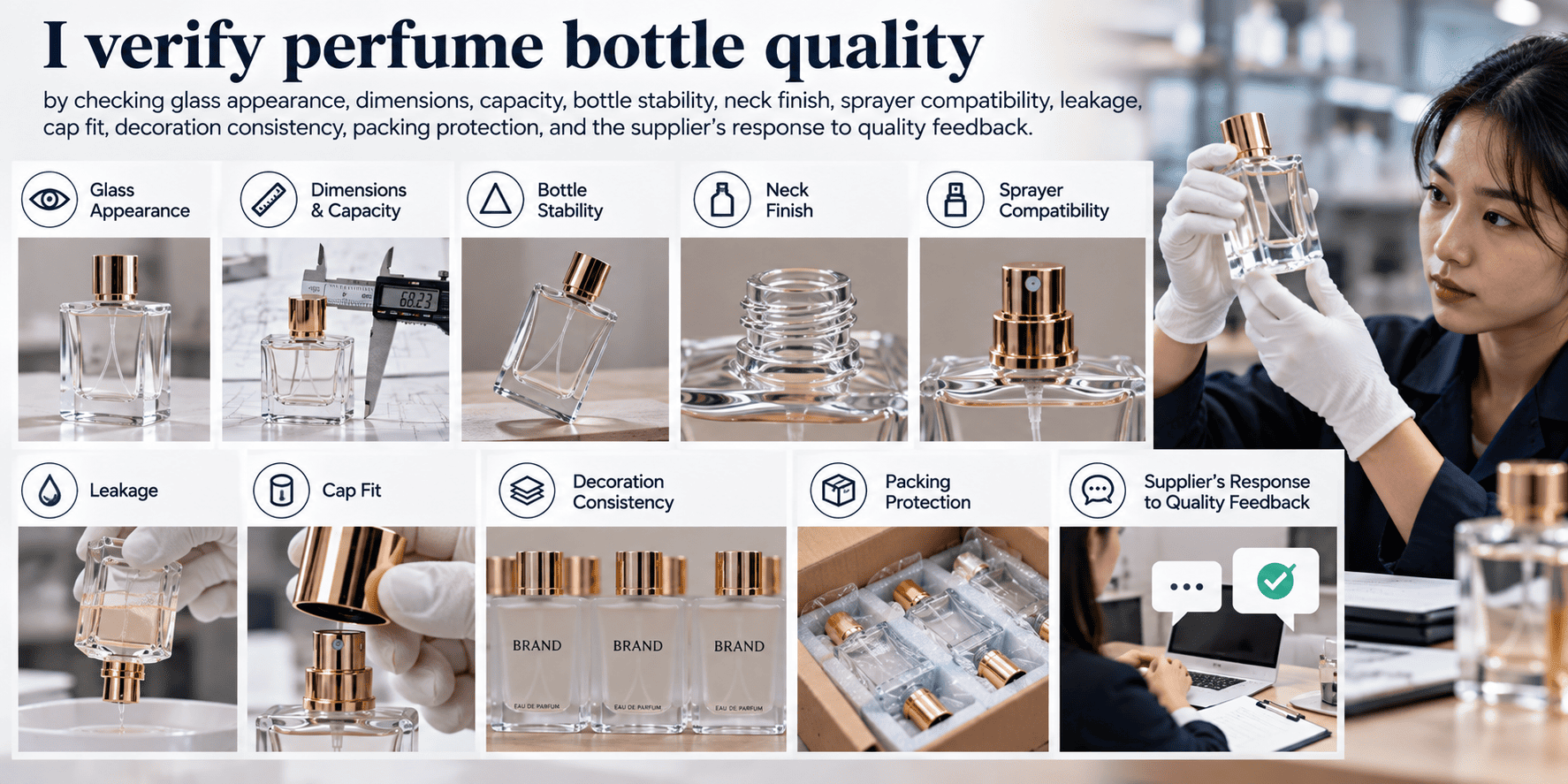
I verify perfume bottle quality by checking glass appearance, dimensions, capacity, bottle stability, neck finish, sprayer compatibility, leakage, cap fit, decoration consistency, packing protection, and the supplier’s response to quality feedback.
I always prefer to confirm quality requirements before placing the full order.
This reduces misunderstandings later.
For example, one buyer may accept small glass bubbles. Another buyer may reject them because the brand is positioned as a luxury fragrance.
Neither standard is automatically wrong.
The important point is that both sides agree before production.
I Test More Than the Glass Bottle
The bottle is only one part of the perfume package.
I test the full set.
That includes the bottle, pump, collar, cap, decoration, inner tray, and sometimes even the final carton.
I usually focus on these checks:
| QC Item | What I Look For |
|---|---|
| Glass surface | Bubbles, scratches, stones, lines |
| Bottle shape | Distortion or uneven walls |
| Bottle base | Stable placement on a flat surface |
| Capacity | Correct filling volume |
| Neck finish | Correct dimensions |
| Pump fit | Secure assembly |
| Spray pattern | Fine and even mist |
| Leakage | No leaking after assembly |
| Cap fit | Correct tightness |
| Coating | Even color |
| Printing | Correct position and adhesion |
| Inner tray | Flat and stable |
| Carton | Enough protection with reasonable space use |
I also keep an approved sample.
Many buyers call this the golden sample.
I use this sample as the reference for production.
However, I have also learned that standard QC is not enough when I work on unusual components.
Difficult Products Need Much More Human Communication
A good example is a cement perfume cap.
A cement cap looks simple from a distance.
In reality, it can require much more communication than a standard plastic or metal cap.
Each cap may have a slightly different texture.
The surface pattern may not be exactly the same.
The color may have small variations.
The edge may need adjustment.
The inner fitting also needs to work correctly with the bottle.
When I develop this kind of product, I cannot only send a specification sheet and wait for mass production.
I need continuous feedback.
Sometimes I need the supplier to send photos of several pieces.
Sometimes I need to compare different textures.
Sometimes we need to decide which type of variation is acceptable.
Sometimes one small production detail needs to be discussed piece by piece.
This process requires a supplier that is willing to communicate.
That is why I see communication efficiency as part of quality control.
If the supplier takes two or three days to answer every small question, a difficult custom project can become very slow.
If the supplier answers quickly and gives me clear production feedback, I can make decisions much faster.
For niche perfume packaging, this difference is very important.
Should I Choose Stock Perfume Bottles or Custom Perfume Bottles?
Many new perfume brands think custom glass is the only way to look unique. I do not believe this is always necessary.
I choose stock perfume bottles when I want lower MOQ, faster delivery, and lower development cost. I choose custom perfume bottles when the bottle shape is central to the brand and the expected sales volume can support tooling and higher production commitments.
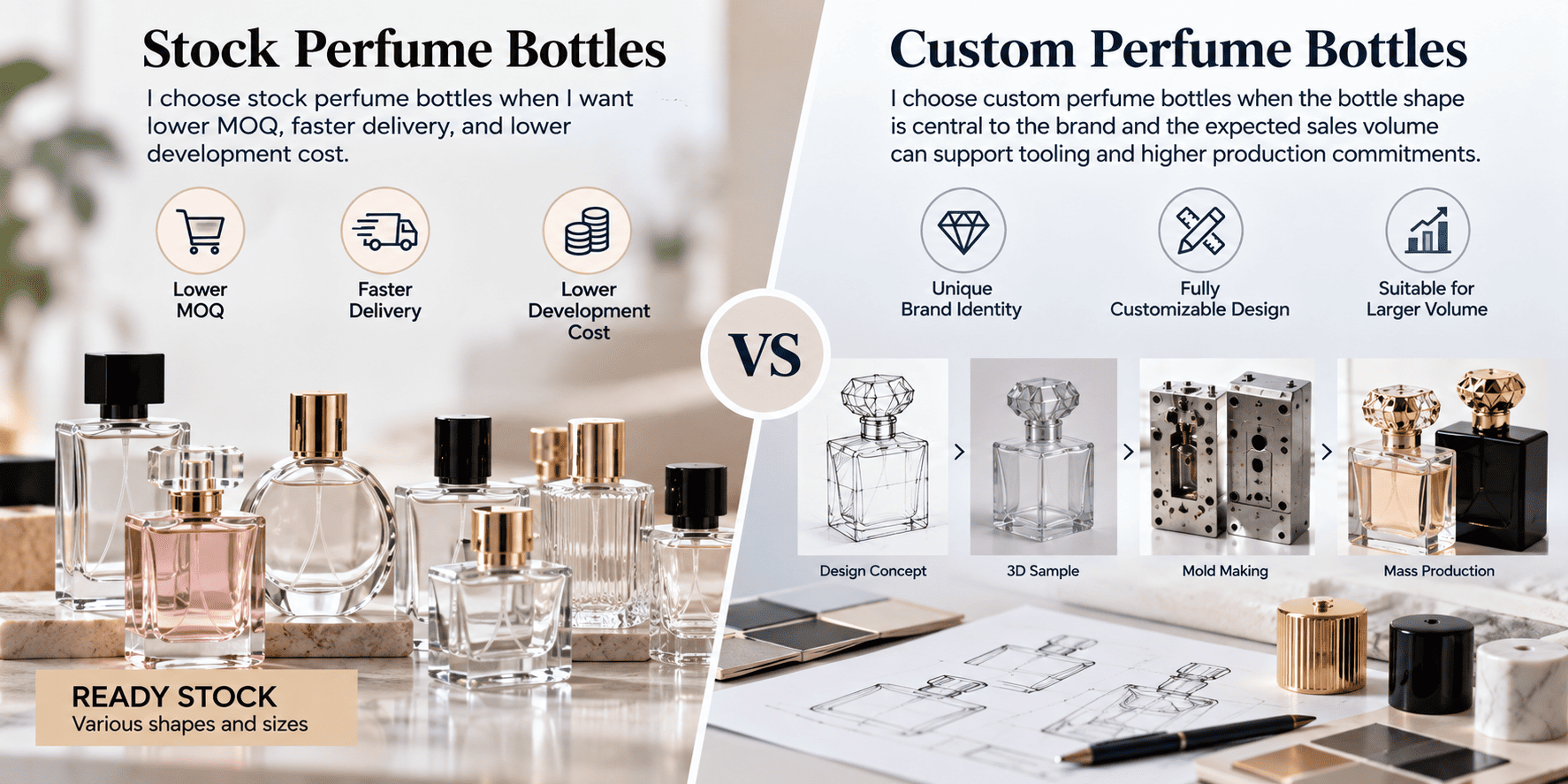
For many small and medium fragrance brands, I prefer starting from an existing bottle.
I can still create a distinctive final product.
I Use Decoration to Create Brand Identity
A stock bottle does not need to look like everybody else’s bottle.
I can change the entire feeling of the package through decoration and accessories.
For example, I can use:
- spray coloring;
- frosting;
- silk-screen printing;
- hot stamping;
- decals;
- metallization;
- custom collars;
- custom caps;
- special materials such as wood or cement;
- custom boxes.
These options can create many different looks from the same glass shape.
| Packaging Route | Development Cost | MOQ | Speed | Customization Difficulty |
|---|---|---|---|---|
| Clear stock bottle | Low | Low | Fast | Low |
| Stock bottle + logo | Low | Low | Fast | Low |
| Stock bottle + decoration | Medium | Medium | Medium | Medium |
| Stock bottle + custom cap | Medium | Medium | Medium | High |
| Stock bottle + special handmade cap | Medium to High | Medium | Slower | Very High |
| Fully custom glass mold | High | High | Slow | Very High |
For a niche fragrance brand, I usually do not recommend adding complexity only for the sake of being different.
Every custom element creates another supply-chain problem to manage.
A special cap may need its own MOQ.
A custom coating may need another MOQ.
A special collar may need tooling.
A handmade cement cap may need much more manual QC.
The question I ask is not only, “Can we make it?”
I also ask, “Can we manage it reliably at this order size?”
That question has saved me from many unnecessary problems.
At Hongyan Glass Bottle, we offer more than 500 existing perfume bottle styles. This gives me more choices before I recommend a completely new glass mold.
I can use an existing bottle and put more budget into the details that customers can see and feel.
If the brand grows later, we can move into deeper customization.
I think this is a more practical path for many niche perfume brands.
How Should I Compare Prices From Different Perfume Bottle Suppliers?
A cheap quotation can become expensive once decoration, caps, pumps, packing, and communication costs are added. I need to compare the complete supply solution.
I compare suppliers using the same product specifications, but I also compare MOQ flexibility, customization support, communication efficiency, packing solutions, and willingness to solve unexpected problems.
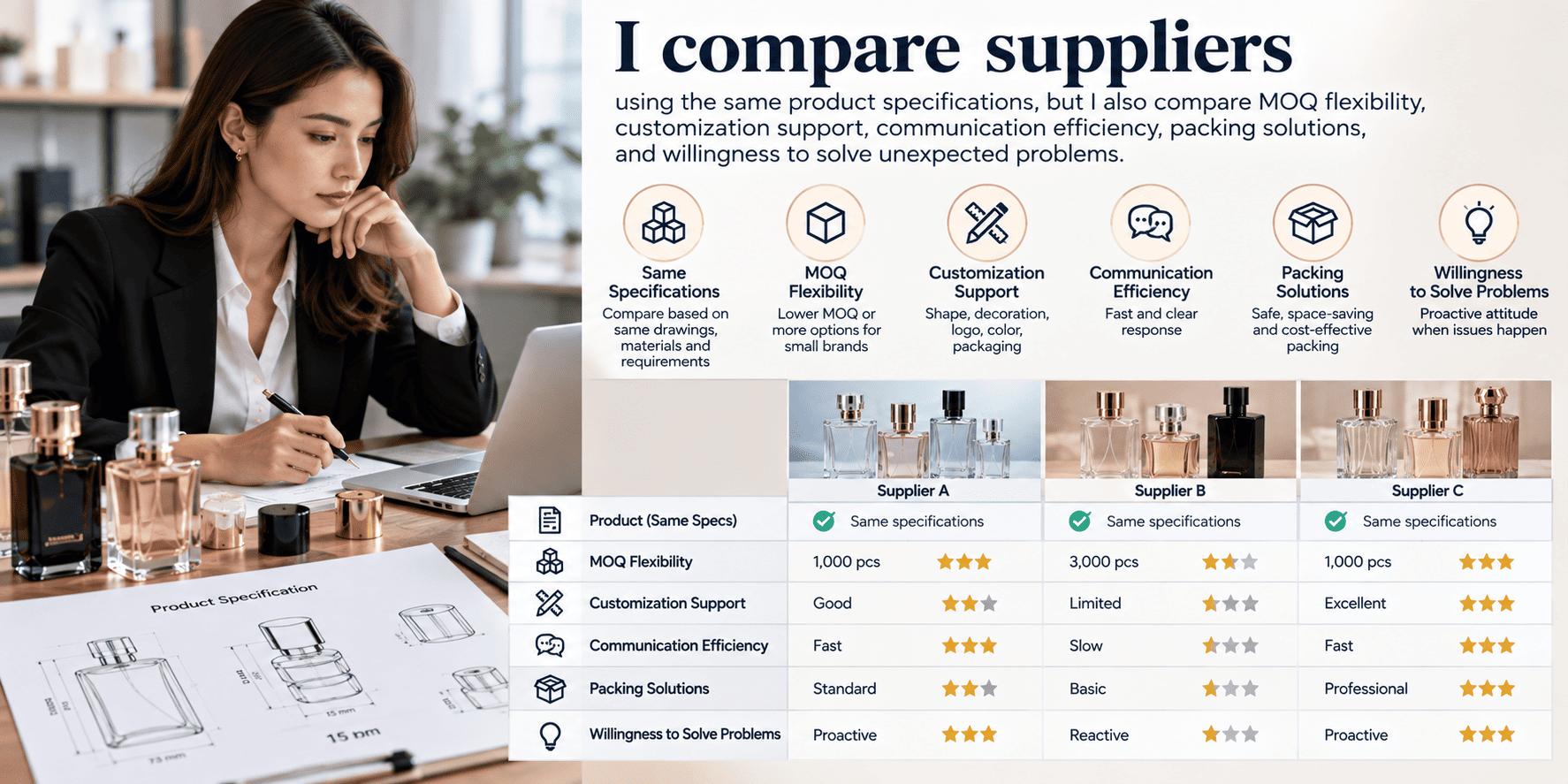
When buyers send different information to different suppliers, quotations become difficult to compare.
One supplier may quote only the bottle.
Another supplier may include the pump and cap.
Another supplier may include decoration.
The cheapest number may not represent the cheapest final package.
I Compare the Hidden Cost of Cooperation
For niche perfume brands, I think this is one of the most overlooked parts of sourcing.
Imagine that Supplier A is $0.08 cheaper per set.
Supplier B replies faster, accepts a smaller MOQ, helps adjust the cap, improves the inner tray, and sends production photos before I ask.
The second supplier may actually save me much more money.
My team spends less time chasing updates.
I have fewer sample rounds.
I reduce the chance of rework.
I may also hold less inventory.
This is why I do not only compare unit prices.
| Factor | Supplier A | Supplier B | What I Consider |
|---|---|---|---|
| Bottle price | Lower | Slightly higher | Direct cost |
| MOQ | 10,000 | 3,000 | Inventory risk |
| Custom support | Limited | Flexible | Brand differentiation |
| Reply speed | Slow | Fast | Project efficiency |
| Sample changes | Difficult | Supported | Development risk |
| Packing improvement | Standard only | Adjustable | Shipping efficiency |
| Component coordination | Limited | Strong | Compatibility risk |
For a large brand, a few cents per unit may become very important.
For a small niche brand, MOQ and flexibility may be more important.
If I save $500 on unit cost but need to buy $10,000 of extra inventory, I have not really saved money.
This is why the right supplier depends on the business stage.
What Are the Warning Signs of an Unreliable Perfume Bottle Supplier?
Most serious sourcing problems show warning signs early. I pay attention to communication, samples, technical details, and the supplier’s willingness to cooperate.
I become cautious when a supplier gives unclear specifications, avoids samples, responds slowly to technical questions, refuses small adjustments, pushes high MOQs without options, or does not care about packing and production details.
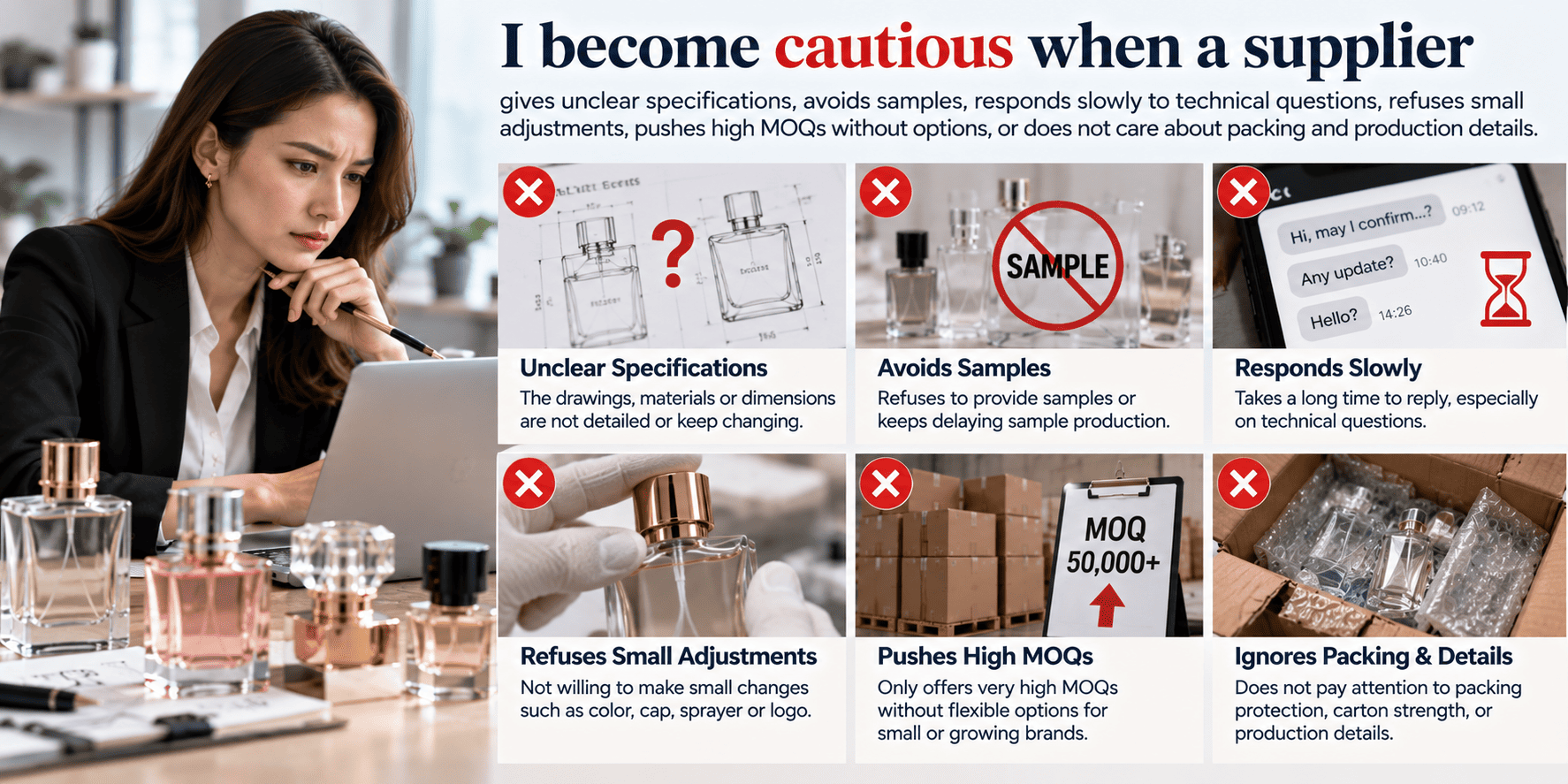
I do not expect manufacturing to be perfect.
Problems can happen.
I care more about whether the supplier wants to solve them with me.
I Watch the Supplier’s Attitude Toward Small Details
This is something I have learned after working with many perfume packaging projects.
Small details are often where I can see the real cooperation level.
For example, I may ask whether we can reduce the MOQ of a custom cap.
The answer may be no.
That is fine.
However, a cooperative supplier may explain why and offer another solution.
They may suggest a stock cap.
They may suggest another material.
They may combine production with another order.
They may change the finishing process to reduce the minimum quantity.
The final answer is not always yes.
The important part is whether the supplier tries to find a workable path.
I see the same thing in packaging.
Many people think packaging means putting bottles into a box.
I look at much smaller details.
For example, I may check the flatness of the inner tray.
If the tray is not flat, the bottles may tilt.
I may check how much empty space remains inside the master carton.
If there is too much unused space, I pay more for transportation.
If the packaging is too tight, I may increase breakage risk.
The supplier needs to balance both sides.
| Small Detail | What It Tells Me |
|---|---|
| MOQ negotiation | Willingness to support a growing brand |
| Sample revision | Patience with customization |
| Fast technical replies | Communication efficiency |
| Production photos | Transparency |
| Tray flatness | Attention to packing quality |
| Carton space use | Awareness of freight cost |
| Component testing | Responsibility for final performance |
| Alternative suggestions | Problem-solving ability |
I believe these details show much more than a factory introduction.
A supplier may tell me that customer service is important.
I prefer to see it in the way they deal with one small tray, one special cap, or one MOQ problem.
What Questions Should I Ask a Perfume Bottle Manufacturer Before Ordering?
Good sourcing depends on good questions. For a niche perfume brand, I also need to know how much flexibility the supplier can give me.
Before I order perfume bottles, I ask about MOQ, customization, samples, QC, lead time, component compatibility, packing, communication workflow, and how the supplier handles special requests or production changes.
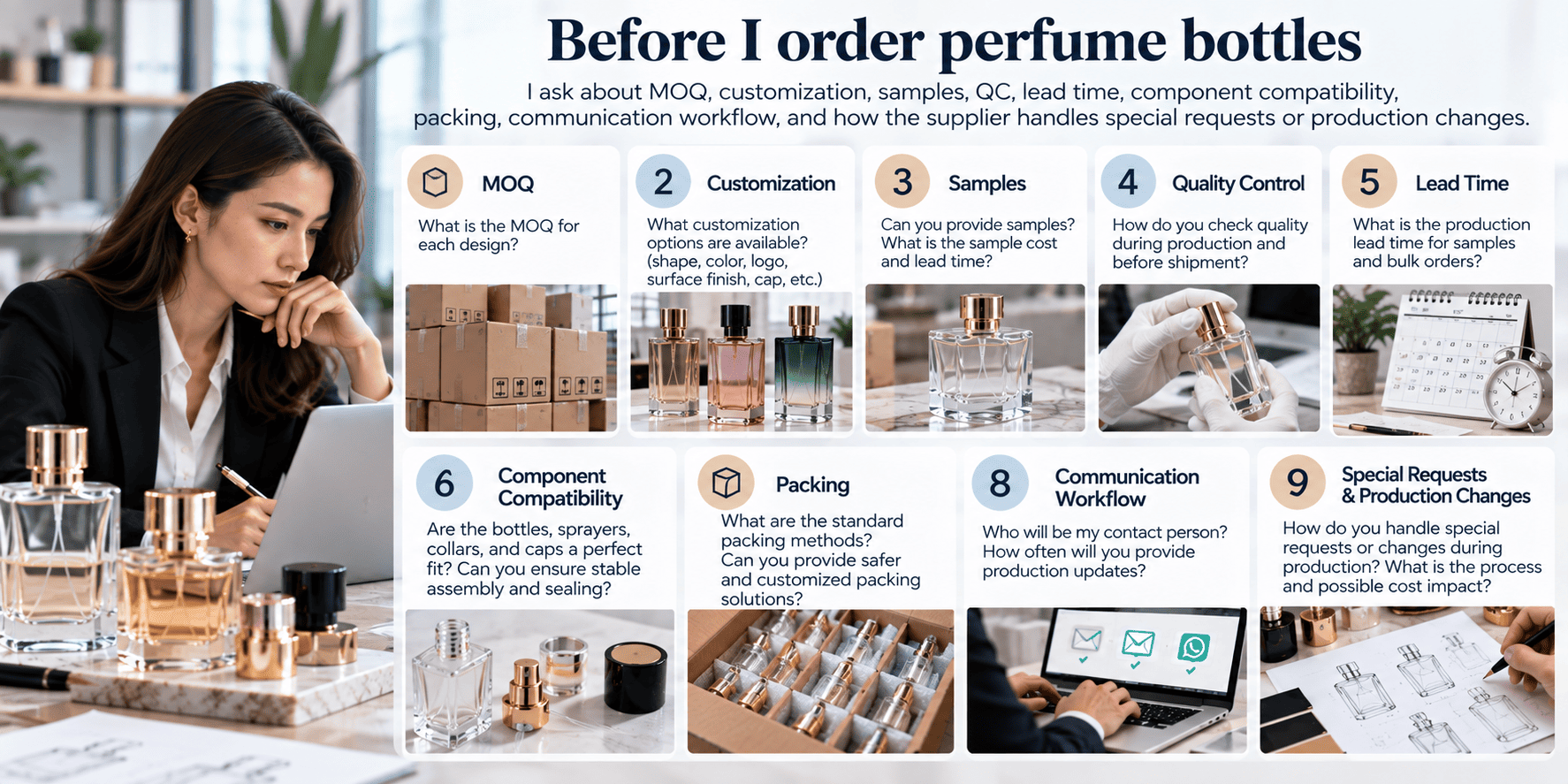
I usually prepare my questions before contacting a new supplier.
This saves time and makes the conversation more professional.
I Ask Questions About Both Product and Cooperation
These are some of the questions I normally use:
| Topic | Question |
|---|---|
| Bottle | Is this bottle already in production? |
| MOQ | Can you support a lower MOQ for my first order? |
| Decoration | What is the MOQ for each finishing process? |
| Cap | Can you support a custom material or shape? |
| Sampling | How many sample adjustments can we make? |
| Communication | Who follows the technical details with me? |
| QC | How do you manage non-standard products? |
| Variation | What differences should I expect in handmade parts? |
| Packing | Can the tray and carton structure be adjusted? |
| Freight | Can packing space be optimized? |
| Updates | Can you send photos during production? |
| Problems | How do you handle changes after sampling? |
| Repeat order | Can you reproduce the same specifications later? |
I also look at how the supplier reacts to these questions.
A supplier that works well with niche perfume brands usually understands why I ask them.
They know that my first order may be small.
They also understand that I still care deeply about the details because those details represent my brand.
This is where I often see a major difference between large-volume manufacturing and niche-brand supply chains.
A niche brand may order fewer pieces.
However, each piece may require more attention.
The brand may have more unusual ideas.
The packaging may use more special materials.
The founder may personally check every detail.
The supplier needs to be comfortable with this working style.
How Can a Small Niche Perfume Brand Reduce Risk When Buying Bottles in Bulk?
Small fragrance brands cannot afford large packaging mistakes. I prefer to reduce risk through better supplier matching instead of simply pushing every supplier for a lower price.
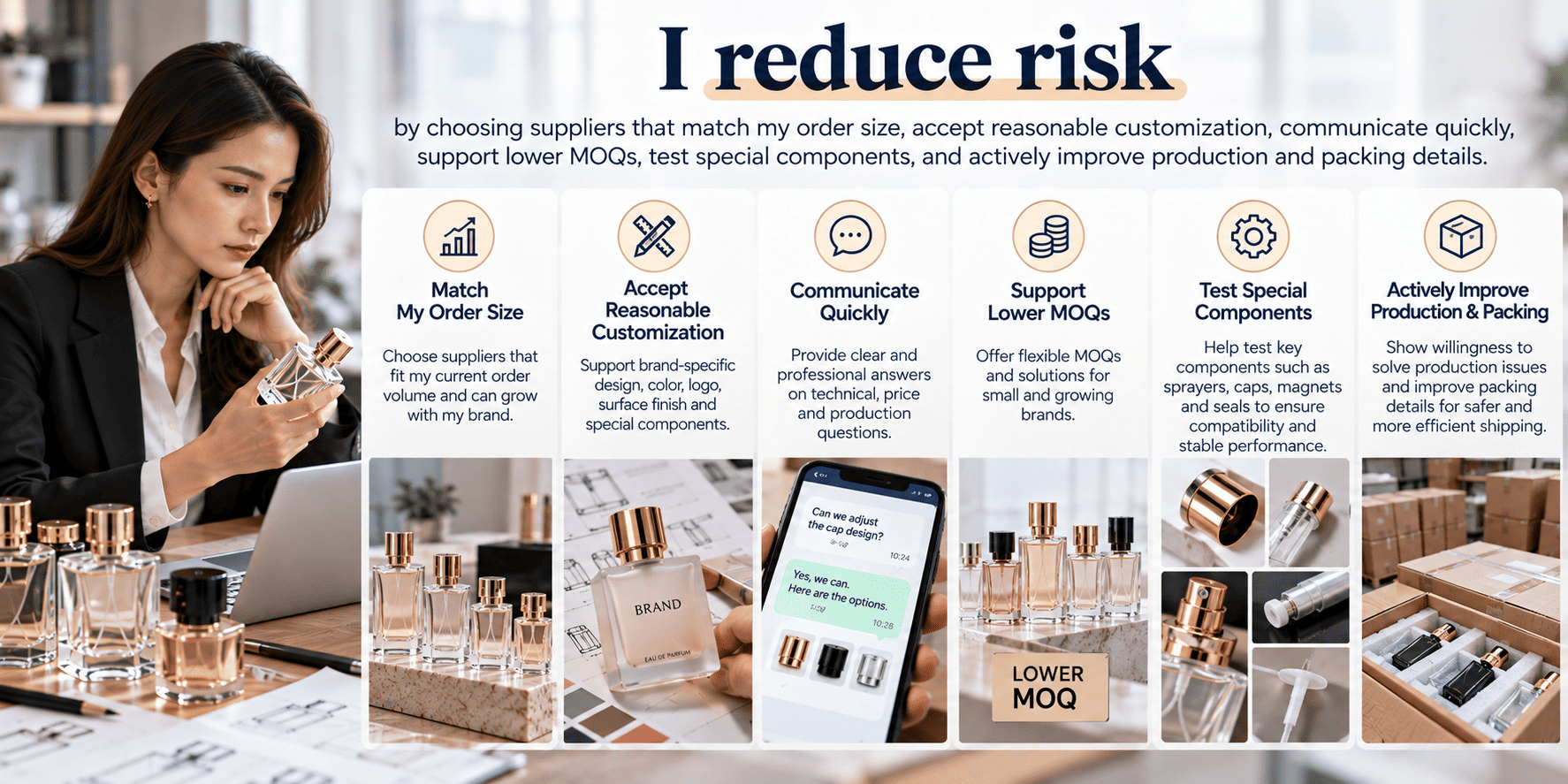
I reduce risk by choosing suppliers that match my order size, accept reasonable customization, communicate quickly, support lower MOQs, test special components, and actively improve production and packing details.
This is one of the strongest lessons I have learned from working with small fragrance brands.
The best supply chain is not always the biggest supply chain.
The best supply chain is the one that matches the project.
I Look for a Supplier That Wants to Grow With the Brand
A niche fragrance brand may start with 2,000 or 3,000 pieces.
The founder may want a special bottle color.
They may want a cement cap.
They may want a different logo position.
They may need the inner tray changed after the first test.
They may also change the order quantity after seeing customer demand.
This type of project needs flexibility.
It also needs a lot of communication.
I have found that willingness matters almost as much as technical ability.
A supplier may know how to make a cement cap.
However, if the team does not want to spend time comparing texture differences, answering questions, and adjusting individual problems, the project can still fail.
A supplier may know how to make a good carton.
However, if nobody wants to improve tray flatness or reduce empty carton space, the final packaging may still create unnecessary cost.
For me, cooperation willingness appears in very practical places.
It appears when a supplier helps me reduce MOQ.
It appears when they suggest a different production process because my volume is small.
It appears when they send me a photo immediately after seeing an unusual texture.
It appears when they stop production for a small confirmation instead of guessing.
It appears when they redesign a tray to hold the bottle more securely.
It appears when they reduce wasted space inside the carton.
These things may look small.
For a niche perfume brand, they are not small.
They directly affect cash flow, launch timing, product quality, and customer experience.
At Hongyan Glass Bottle, our goal is to provide practical packaging solutions for small and medium perfume brands.
We offer more than 500 perfume bottle styles, so I can often start with an existing bottle instead of forcing a new brand into an expensive custom mold.
We can also support spray coloring, frosting, gold finishes, decals, printing, custom accessories, and complete perfume packaging solutions.
When a brand needs a completely new bottle, we can also support 3D sampling before moving deeper into production.
I do not think every niche brand needs the most complicated packaging.
I think every niche brand needs a supply chain that fits its current stage.
That matching level is one of the first things I look at when I decide whether a supplier is truly reliable.
Conclusion
I choose suppliers that match my volume, customization needs, and working style. For niche perfume brands, reliable production depends on flexibility, fast communication, and willingness to solve details together.