
A magnetic cap gives a perfume bottle a clean click and a more premium feeling. But I have found that the real challenge is not the magnet itself. The challenge is making the cap, inner insert, pump, bottle, and filling process work together.
A magnetic perfume cap uses magnetic components inside the cap and its matching inner structure to pull the cap into position. It improves the closing experience and keeps the package complete, but it does not replace the perfume pump and gasket as the main sealing system.
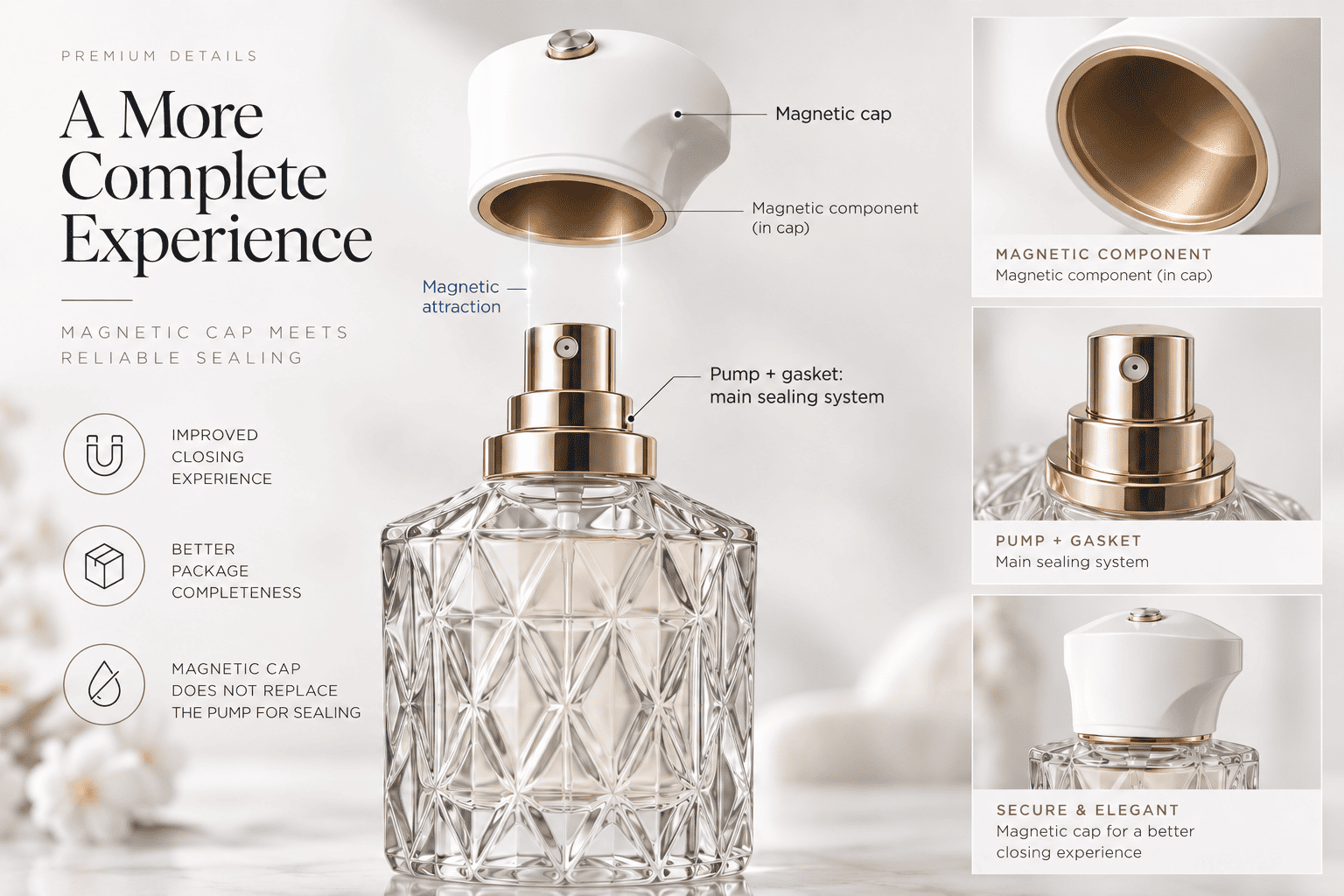
When I work on perfume packaging projects, I often see customers focus first on the click. I understand why. The click is the part the consumer can feel immediately.
However, I usually look at several other details before I decide whether a [magnetic cap][[1]] is suitable for a perfume bottle.
The position of the magnetic ring matters. The filling process matters. The weight of the full bottle matters. The inner insert matters. The MOQ and tooling cost also matter.
Below are five practical points I normally consider when developing a magnetic perfume cap.
1. What Does a Magnetic Perfume Cap Actually Do?
A magnetic cap can make the closing action feel much smoother, but I do not treat it as the main sealing part of a perfume package.
The main job of a magnetic cap is to guide and hold the cap in the closed position. The perfume itself is normally sealed by the pump, gasket, crimping structure, and bottle neck. The magnet mainly improves the user experience.
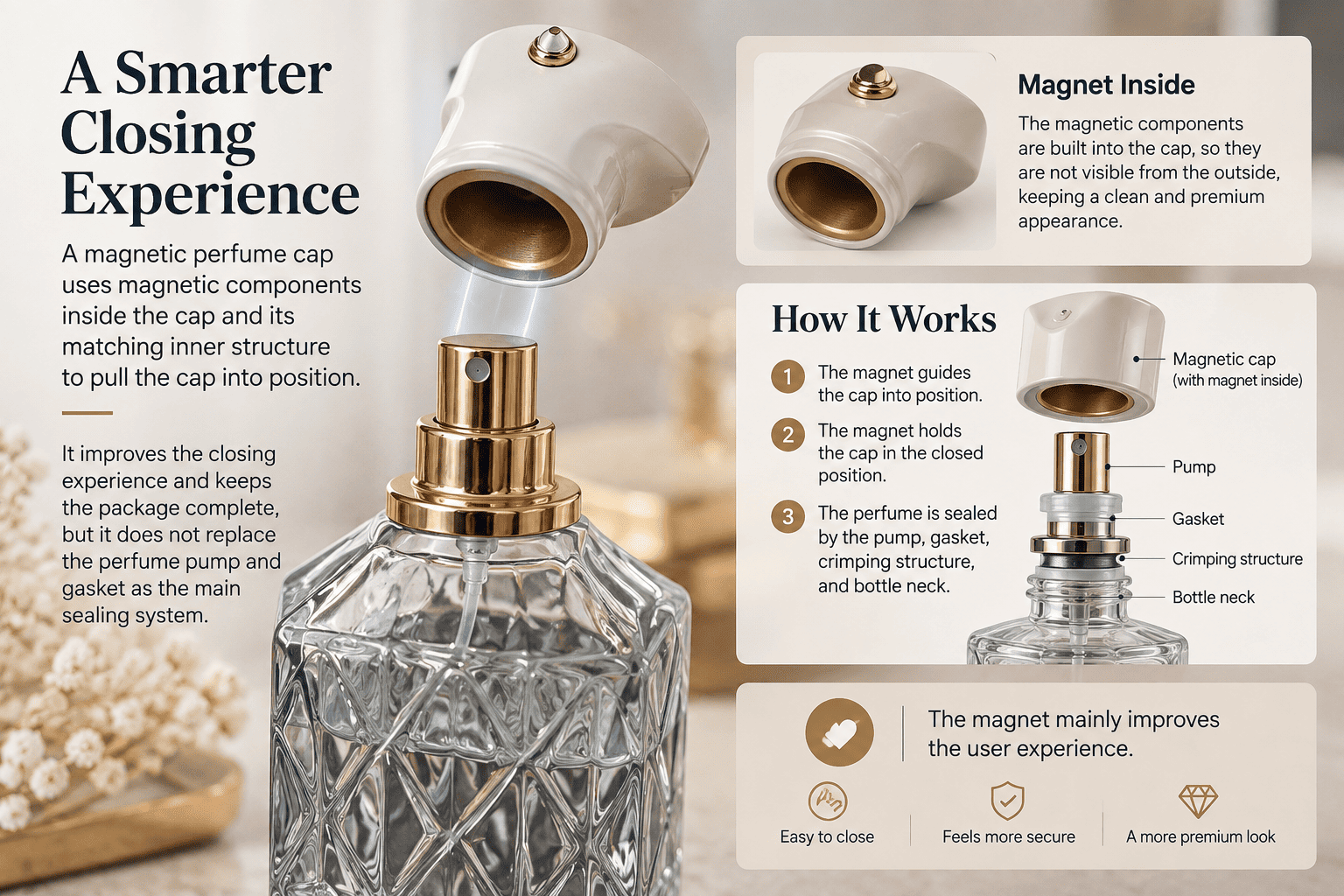
The magnet improves the experience, not the perfume seal
This is one of the first things I explain when a customer asks me whether a magnetic cap is "better."
It can be better from the user's point of view.
When the customer finishes spraying the perfume and moves the cap toward the bottle, the cap can be pulled automatically into position. The consumer hears a clean click. The bottle feels complete again.
That small action can make the packaging feel more refined.
But the magnet does not normally improve the actual perfume sealing performance very much.
The perfume is still sealed below the cap.
In a common perfume package, I usually look at these parts:
| Component | Main Function |
|---|---|
| Glass bottle neck | Supports the pump and closure system |
| Gasket | Helps prevent liquid leakage |
| Perfume pump | Controls spraying and helps seal the product |
| Crimp or screw structure | Fixes the pump onto the bottle |
| Magnetic cap | Covers the pump and improves the closing experience |
For this reason, I do not recommend choosing a magnetic cap because someone says it can make the perfume "more sealed."
I choose it when the brand wants a better packaging interaction.
It gives the consumer a clear feeling that the bottle is closed.
It also helps keep the complete perfume package in a relatively closed and unopened-looking state when the customer is not using it.
This difference is important.
I have seen buyers spend a lot of time discussing magnet strength while paying much less attention to the pump and neck fit. I think that order should be reversed.
I first make sure the bottle and pump can properly hold the fragrance.
Then I develop the cap around that system.
This approach is especially important when alcohol-based perfume is involved. A nice magnetic click cannot correct a poor crimp, an incorrect gasket, or a badly matched bottle neck.
So I see the magnetic cap as the final user-facing part of the closure system, not the part that actually protects the perfume from leaking.
2. Why Must the Magnetic Ring Inside the Cap Match the Inner Insert?
The magnetic parts inside the cap and inner insert cannot be installed randomly. Their position and magnetic direction need to match correctly.
A magnetic cap normally has a magnetic component inside the cap and a corresponding magnetic ring in the inner insert or collar area. Their position and polarity must match. If the magnetic ring is installed incorrectly, the cap may sit crooked or fail to align properly.
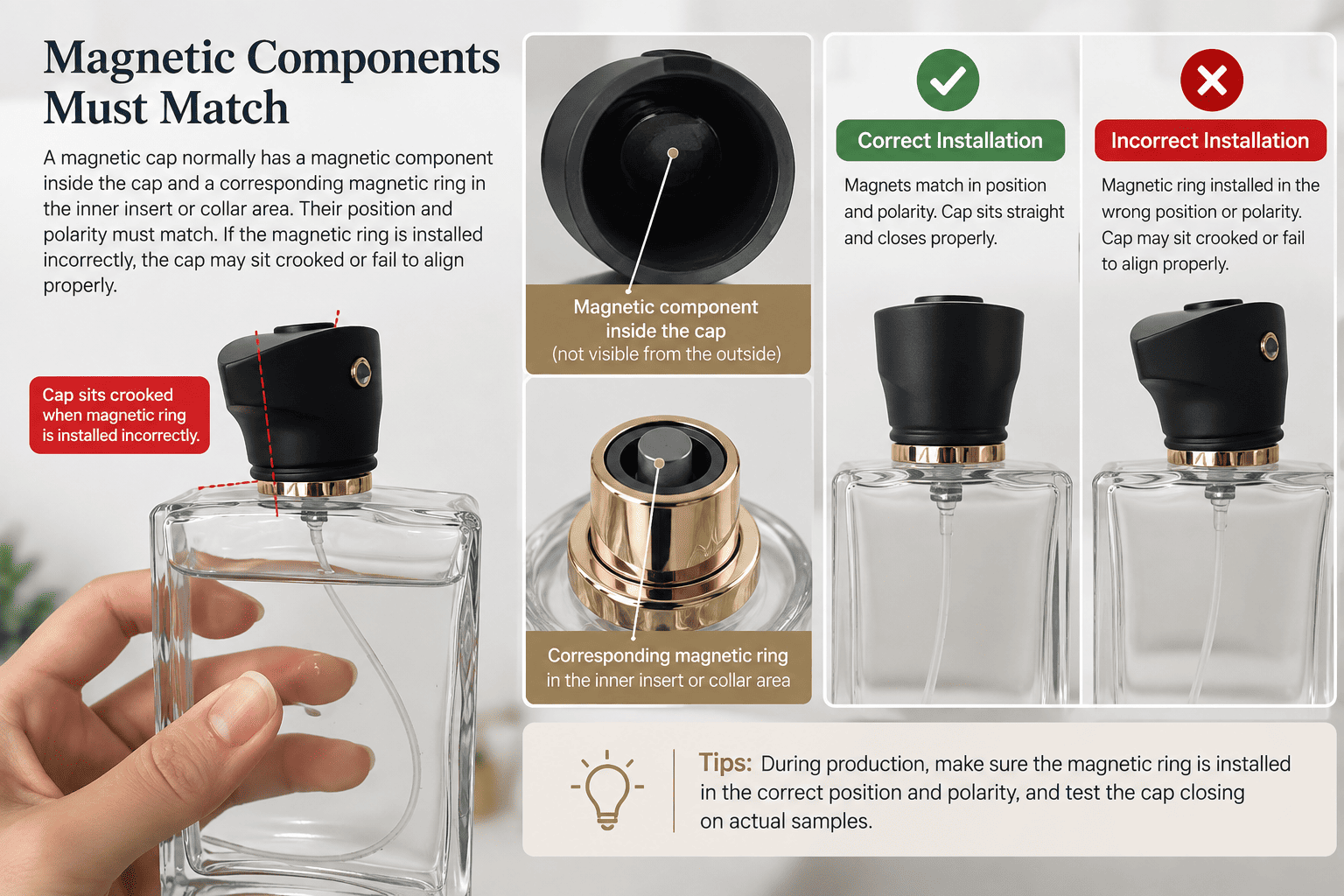
I treat the cap and inner insert as one matched system
A magnetic cap looks simple from the outside.
Inside, it is usually more complicated.
There is normally an inner structure inside the perfume cap. Depending on the design, there can also be a magnetic ring positioned around the lower inner insert or collar structure.
The magnetic parts need to attract each other when the cap approaches the bottle.
This is why I consider the inner insert and cap to have a one-to-one relationship.
In production, I have found that the direction of the magnetic component is especially important.
If one magnetic ring is installed in the wrong direction, the cap can behave differently from the approved sample.
Sometimes the cap does not sit perfectly straight.
Sometimes one side is pulled more strongly.
Sometimes the cap looks slightly tilted after it closes.
A small mistake inside the cap can therefore become a visible packaging problem.
| Assembly Point | What I Check |
|---|---|
| Magnet position | Is it centered correctly? |
| Magnet direction | Is the magnetic polarity correct? |
| Inner insert position | Is it installed at the right height? |
| Cap position | Does the cap sit level? |
| Logo direction | Does the logo stop in the expected position? |
This issue becomes even more important when the cap is not symmetrical.
For a round cap without a directional logo, a small rotational difference may not be visible.
But imagine that the cap has a square shape, a metal logo plate, or a decorative element on the front.
Now the final position becomes part of the design.
If the magnetic structure does not guide the cap into the correct position, the customer may see the logo facing sideways every time the bottle is closed.
That is why I always prefer to check the actual assembled sample.
I do not only check the drawing.
I close the cap many times. I rotate it. I test how it approaches the bottle from different angles.
A magnetic closure has to work consistently, not just once.
3. Why Should You Consider Perfume Filling When Choosing a Magnetic Cap?
One common mistake is testing the magnetic cap only on an empty perfume bottle. I prefer to test the complete package after filling.
Perfume filling changes the total bottle weight and may also affect the final position of the pump, collar, and inner insert. A magnetic cap should therefore be tested on a fully assembled and filled bottle, not only on an empty packaging sample.
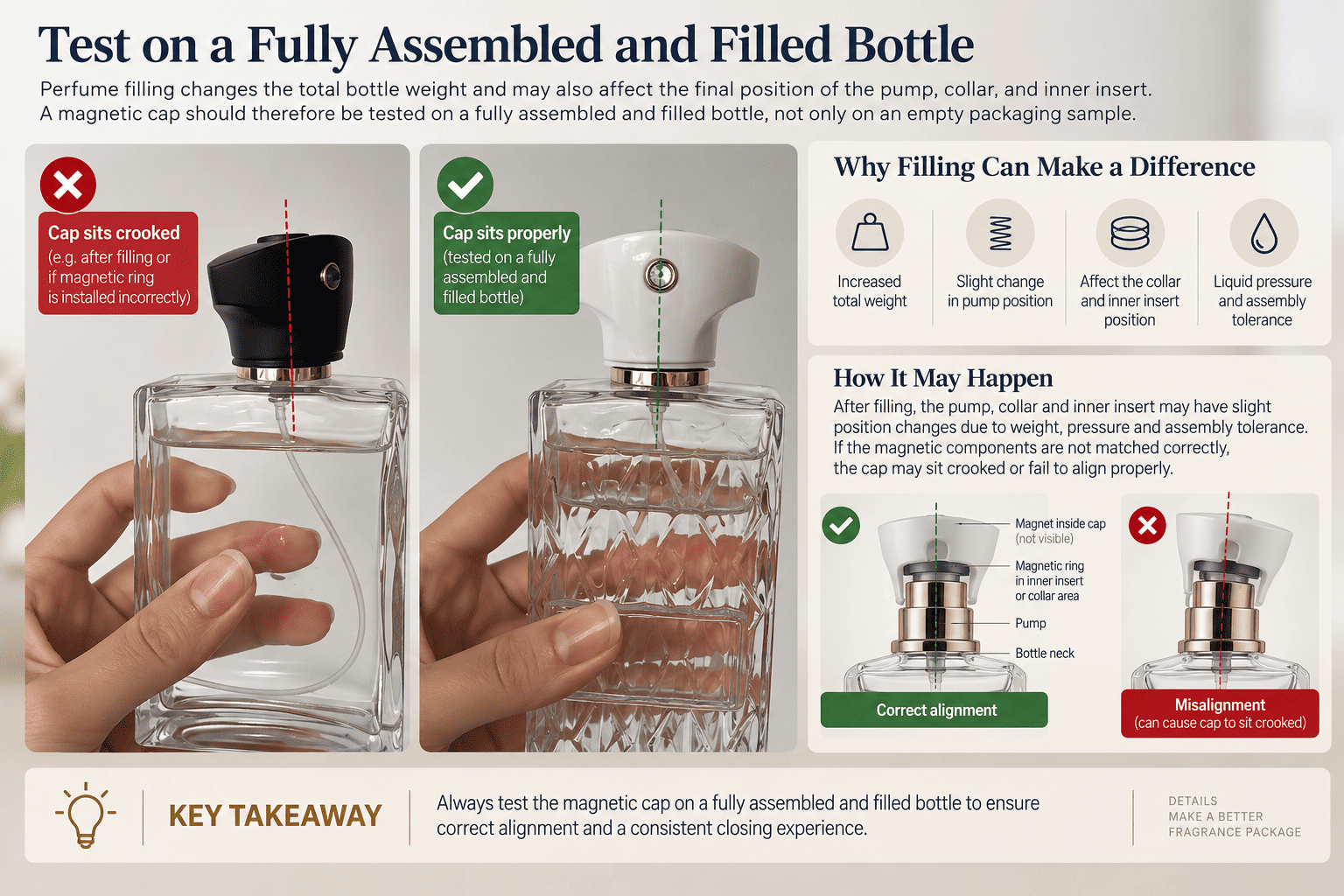
The final product is different from an empty packaging sample
When I receive a new packaging project, the first samples are normally empty.
An empty glass perfume bottle can make a magnetic cap look very strong.
But the customer is not going to sell an empty bottle.
A 100 ml perfume bottle becomes much heavier after it is filled with fragrance.
The spray pump is also crimped or assembled onto the bottle during the filling process.
The final position of the pump, collar, and decorative parts can be slightly different from what we see during the early sample stage.
This is why I always think about the filling stage when working on a magnetic cap.
There are several things I want to know.
| Test After Filling | Why It Matters |
|---|---|
| Pump installation height | Affects the cap position |
| Collar level | A tilted collar can make the cap look tilted |
| Full bottle weight | Tests real magnetic holding force |
| Cap clearance | Prevents contact or scratching |
| Magnet alignment | Confirms final assembly is correct |
| Leak test | Confirms the real sealing system works |
The filling factory is also part of this system.
For example, if the perfume pump uses a crimp structure, the crimping machine needs to fix the pump at the correct height and position.
If the outer collar or inner structure changes during assembly, the cap can close differently.
This is why I do not like to develop the glass bottle, pump, and magnetic cap as three independent parts.
I prefer to consider them as one packaging system.
I also recommend doing a final trial with the real fragrance or another suitable alcohol-based test liquid.
The bottle should be filled to the expected weight.
Then I test the cap again.
This gives a much more realistic result.
For new perfume brands, this step may look unnecessary because the empty sample already works.
But fixing a cap alignment issue after 10,000 pieces have been produced is much more expensive than finding the problem during the sample stage.
4. How Strong Should the Magnetic Force Be?
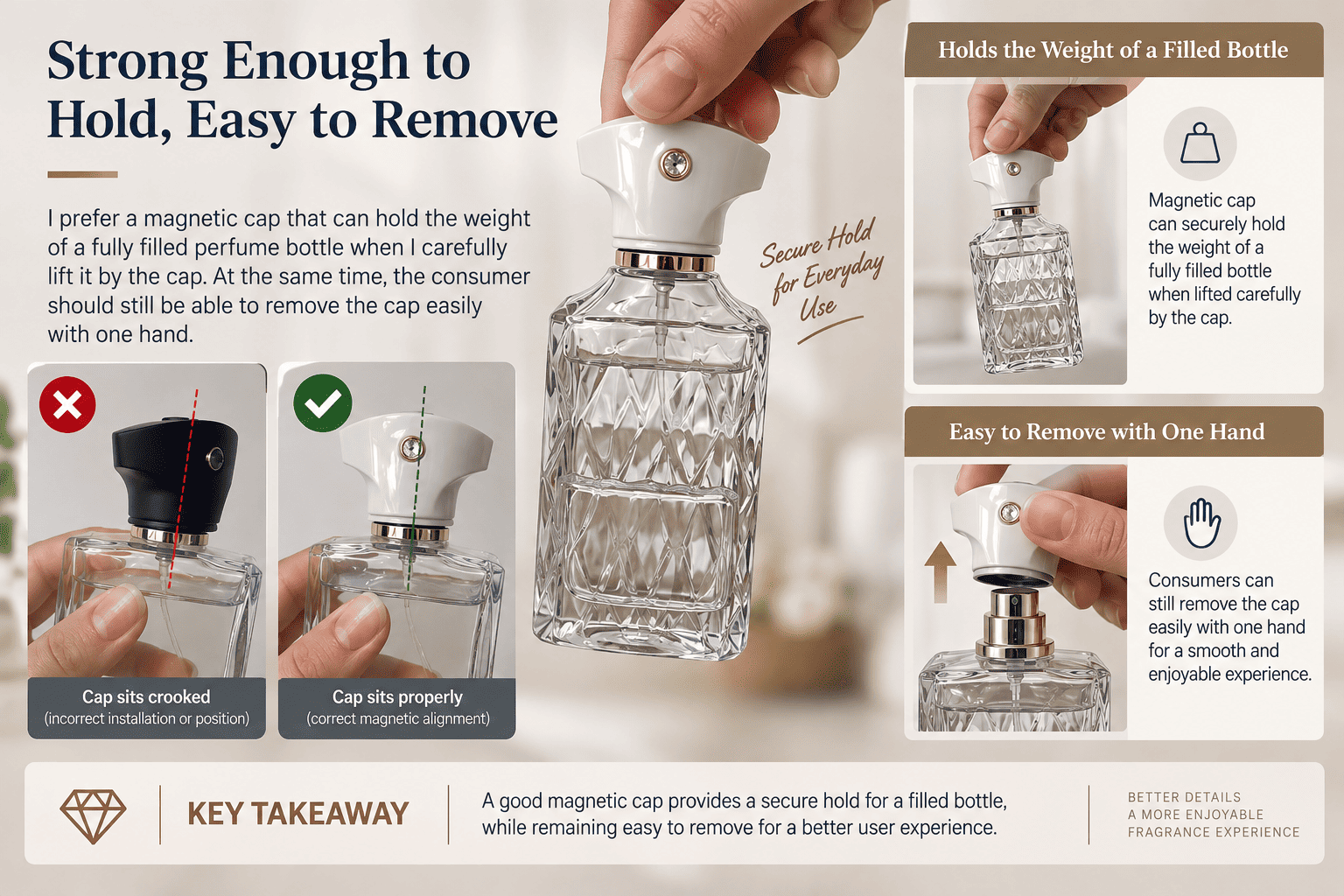
A good magnetic cap needs enough force to support the finished bottle, but it should still be comfortable to open.
I prefer a magnetic cap that can hold the weight of a fully filled perfume bottle when I carefully lift it by the cap. At the same time, the consumer should still be able to remove the cap easily with one hand.
I test magnetic force with the real bottle weight
There is a simple test I often use.
I fill the bottle to its normal weight.
Then I close the magnetic cap.
After that, I carefully lift the bottle by holding only the cap.
The magnetic force should be strong enough to keep the bottle attached.
This test is simple, but it tells me much more than testing an empty bottle.
A thick glass perfume bottle can already be quite heavy. After adding 50 ml or 100 ml of fragrance, the complete package may be much heavier than customers expect.
If the magnetic force is too weak, the bottle may separate from the cap.
That is not the experience a brand wants.
However, I also do not want the magnet to be unnecessarily strong.
If the consumer needs two hands and a lot of force to remove the cap, we have created another problem.
The ideal magnetic force is therefore a balance.
I want these three things at the same time:
- The cap should attach clearly when it gets close to the bottle.
- The magnetic force should support the finished package securely.
- The cap should still be easy to remove with one hand.
There is also a very easy way to show whether a cap is truly magnetic.
Place the cap on a flat table.
Turn the glass bottle upside down.
Then slowly move the bottle neck toward the cap.
Before the bottle physically touches the cap, the magnetic force should pull the cap up from the table.
It will attach itself to the bottle.
I like this test because the customer can actually see the magnetic force working.
| Magnetic Force | Possible Result |
|---|---|
| Too weak | Cap can fall away from the bottle |
| Correct | Secure close, clear click, easy opening |
| Too strong | Cap becomes difficult to remove |
I also recommend repeating the test across several samples.
One perfect sample does not prove that the production batch will be consistent.
The real goal is stable magnetic force across mass production.
5. What Should You Know About MOQ, Materials, and Molds Before Customizing?
A fully customized magnetic cap usually requires a much larger order than using a stock cap.
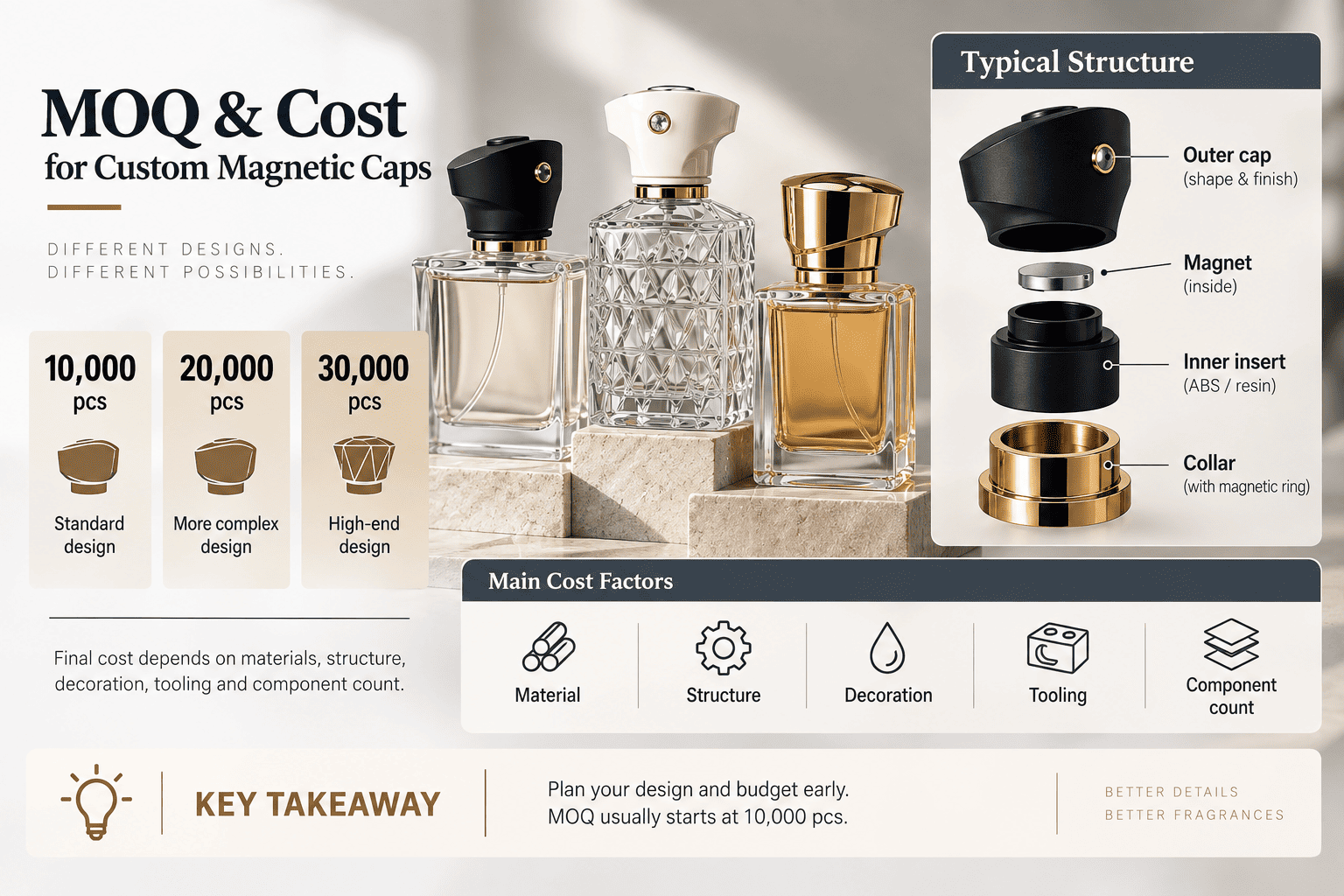
From my experience, custom magnetic caps generally start at around 10,000 pieces. More complex designs may require 20,000 or even 30,000 pieces. The final cost depends on materials, structure, decoration, tooling, and the number of components.
A custom magnetic cap is not just one cap and one mold
This is one of the biggest differences between choosing a stock magnetic cap and developing a new one.
If I already have a stock magnetic cap, the customer may only need to change the color, logo, finish, or decoration.
That is relatively simple.
When the customer asks for a completely new cap shape, we enter a different project.
For most custom magnetic cap projects I work with, the [MOQ][[2]] generally starts from about 10,000 pieces.
If the construction is complicated, the MOQ may increase to 20,000 or 30,000 pieces.
The exact quantity depends on the design and manufacturing process.
The unit price also changes according to several factors.
| Cost Factor | How It Affects the Project |
|---|---|
| Cap shape | Complex shapes need more tooling |
| Metal parts | Aluminum or other metals increase material and finishing cost |
| Inner plastic parts | ABS, K-resin, or similar materials need separate molding |
| Magnetic structure | Requires correct magnet placement |
| Surface finish | Plating, anodizing, painting, and other finishes add cost |
| Decoration | Gems, badges, inserts, and separate pieces add tooling |
| Assembly | More components mean more assembly steps |
The outside cap can use materials such as aluminum or other metals.
The inner structure may use [ABS][[3]], K-resin, or other plastics that are easier to shape and mold.
The materials depend on the appearance, weight, structure, and target price.
Another point that surprises some buyers is the number of molds.
For a custom perfume cap, I normally do not think in terms of "one cap, one mold."
A cap can require around three molds for its basic structure.
For example, we may need separate molds for the outer cap, inner cap or insert, and another supporting or connecting component.
Then the design may add more.
If the top of the cap has a gemstone-like decoration, a metal piece, a logo plate, or another decorative component, that part may need its own mold or tooling.
This means a cap that looks simple from the outside can involve several separate components during manufacturing.
Why I recommend stock magnetic caps for many new brands
This is also why I often recommend that a growing perfume brand start by checking our existing magnetic caps.
If an existing structure is suitable, we can often change the visual identity without developing the entire closure again.
For example, we may customize:
- color,
- logo,
- metal finish,
- plating,
- engraving,
- printing,
- or decorative details.
The investment is much lower.
When sales become stable and the brand is ordering larger quantities, a completely custom magnetic cap becomes easier to justify.
For me, the decision is not simply:
"Do you want a magnetic cap?"
The better questions are:
Do you need a new structure? What is your target quantity? How many components are in the design? How many molds will we need?
These questions have a much bigger effect on the final cost than the magnet itself.
Conclusion
A good magnetic cap is more than a satisfying click. I always check the magnet, inner structure, filling process, full-bottle weight, materials, tooling, and production quantity together.
[[1]]: https://www.hsmagnets.com/blog/about-magnetic-perfume-cap/ "magnetic cap"
[[2]]: https://www.netsuite.com/portal/resource/articles/inventory-management/minimum-order-quantity-moq.shtml "MOQ"
[[3]]: https://www.protolabs.com/materials/abs/ "ABS"