
A perfume bottle can look perfect but still fail after filling. Poor sealing may cause leakage, alcohol loss, scent changes, and customer complaints months later.
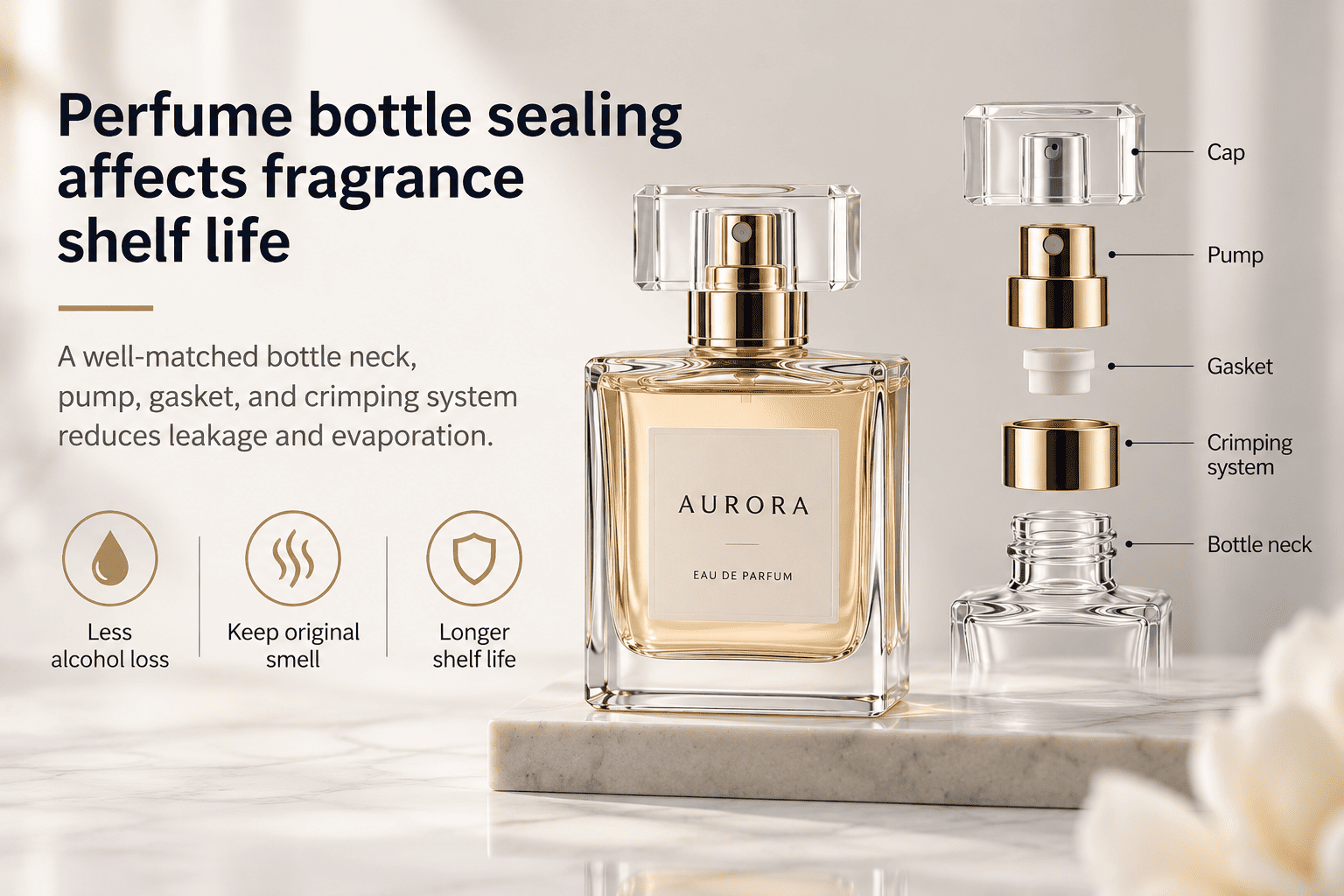
Perfume bottle sealing affects fragrance shelf life because the closure controls leakage and long-term evaporation. A well-matched bottle neck, pump, gasket, and crimping system can reduce alcohol loss and help the fragrance keep its original concentration, smell, and appearance for longer.
In my work with perfume packaging, I see many brands focus first on bottle shape, glass weight, cap style, and decoration. I understand this because these details affect how customers see the brand. But I always pay close attention to the sealing system as well.
A perfume bottle is not only a piece of glass.
I see it as a complete packaging system.
The bottle neck, spray pump, gasket, aluminum collar, crimping tool, filling process, cleaning process, fragrance formula, and storage condition can all affect the final shelf life.
Why Does Perfume Bottle Sealing Matter for Shelf Life?
A sealing problem is not always obvious on the first day. A bottle can look normal after filling while alcohol slowly escapes over several months.
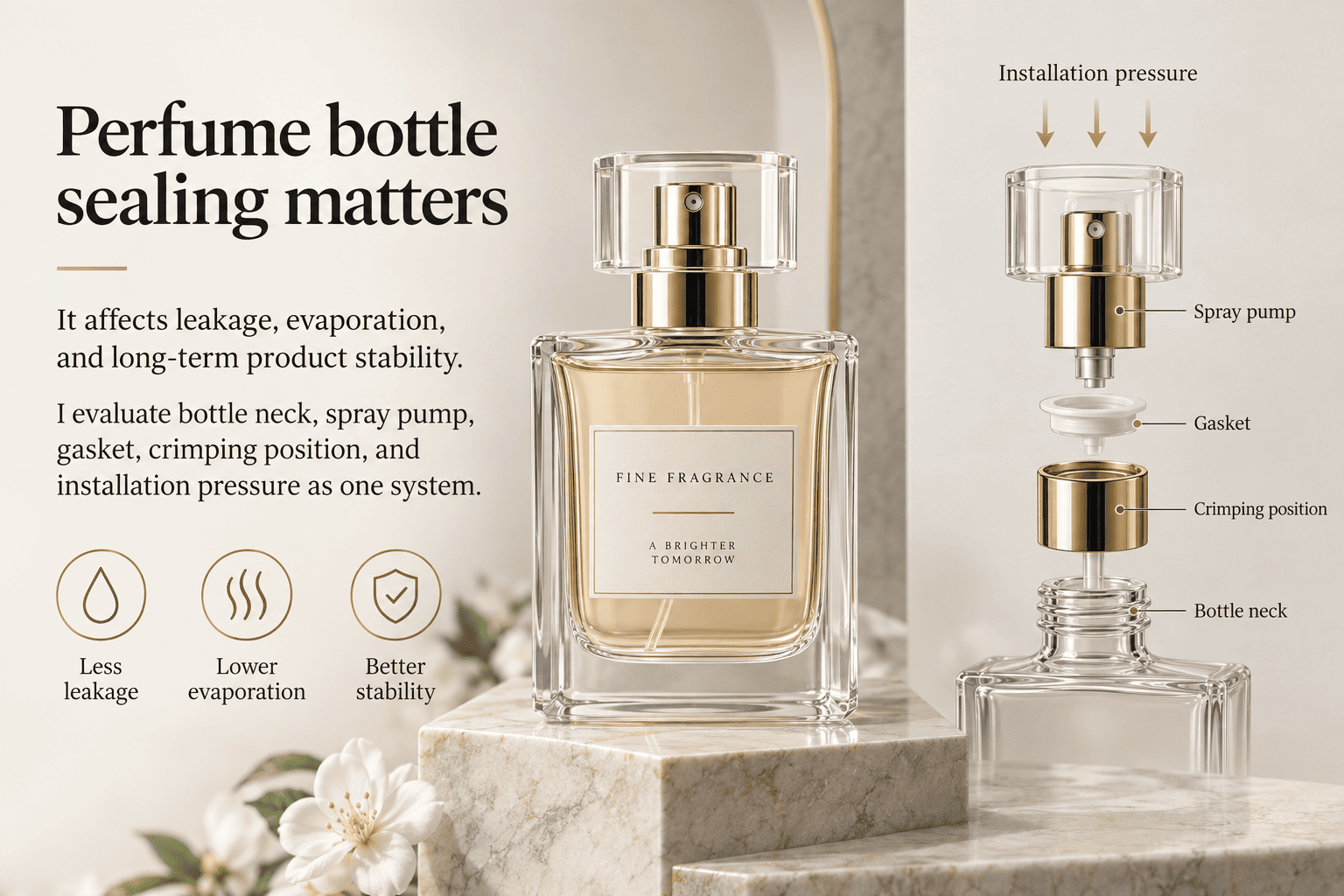
Perfume bottle sealing matters because it affects leakage, evaporation, and long-term product stability. I usually evaluate the bottle neck, spray pump, gasket, crimping position, and installation pressure together instead of judging each component alone.
I Treat the Bottle, Pump, and Closure as One System
When a customer asks me whether a perfume bottle is [leak-proof][[1]], I do not only look at the glass bottle.
I need to check the complete closure.
A normal crimp perfume bottle usually includes:
- Glass bottle neck
- Spray pump
- Gasket
- Aluminum collar
- Actuator
- Dip tube
- Cap
Each part affects the final result.
The bottle neck has a dimensional tolerance.
The pump also has its own tolerance.
The gasket needs enough compression.
The aluminum collar needs to lock at the correct position.
If one part is not right, the whole sealing system can become unstable.
I have seen customers install a pump that looked normal, but they could still rotate or move it by hand.
For me, this is already a warning sign.
A properly installed crimp pump should feel stable.
If the customer can easily move the pump after installation, I would immediately check the crimping setting, bottle-neck dimensions, and pump dimensions.
| Part | What I Check | Possible Risk |
|---|---|---|
| Bottle neck | Diameter, height, tolerance | Poor pump fit |
| Spray pump | Pump dimensions | Loose or unstable closure |
| Gasket | Compression and material | Leakage or compatibility problem |
| Aluminum collar | Crimp position | Weak sealing |
| Crimping tool | Chuck height and pressure | Crimp too high or too low |
| Filling line | Installation consistency | Different results between bottles |
I do not think a nominal neck size alone is enough.
Two components can both say they use the same standard size and still perform differently in real production.
That is why I prefer testing the actual bottle and actual pump together.
Can a Vacuum Test Prove That a Perfume Bottle Will Not Evaporate?
A vacuum test is very useful, but I do not use it as the only proof of long-term sealing.
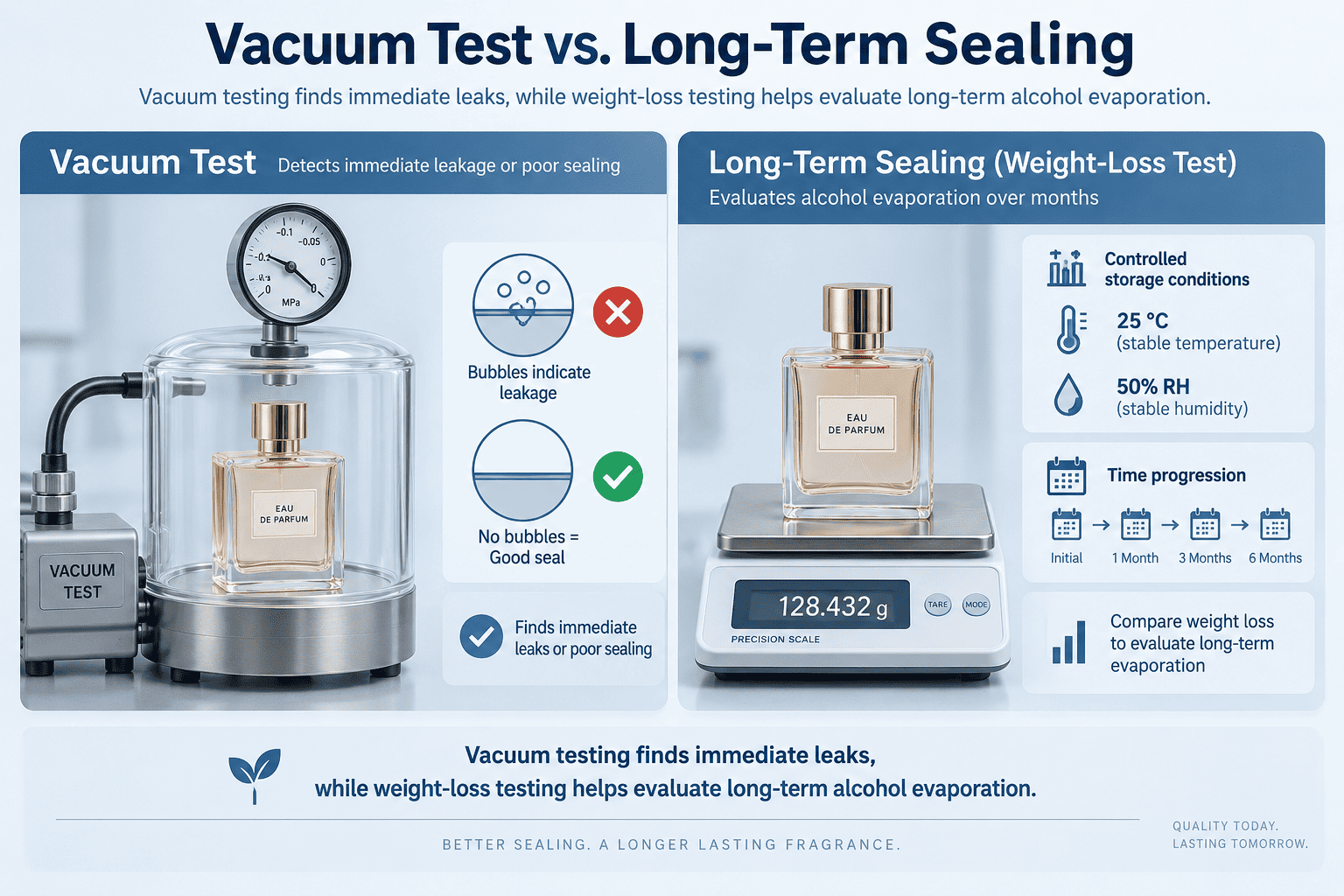
A vacuum test can help find immediate leakage or poor sealing, but it cannot fully prove that alcohol will not slowly evaporate over several months. For long-term sealing, I prefer to combine vacuum testing with a weight-loss test under controlled storage conditions.
Vacuum Testing and Weight-Loss Testing Tell Me Different Things
We often use [vacuum testing][[2]] to check perfume bottle sealing.
The idea is simple.
We place the package under a pressure difference and observe whether the bottle or closure shows leakage.
This test can help us find an obvious problem quickly.
For example, if the pump is not crimped correctly, or if there is a large sealing gap, a vacuum test may reveal it.
But I do not think a passed vacuum test means the bottle will definitely have no evaporation after six months or one year.
Perfume contains a large amount of volatile material.
Ethanol can escape very slowly.
The loss may be too small to appear during a short vacuum test.
This is why I also pay attention to weight-loss testing.
We fill the bottle with the real perfume formula or a suitable test liquid.
We record the starting weight.
Then we store the bottle under defined conditions.
After a certain period, we weigh it again.
If volatile material is escaping, the total weight will gradually decrease.
| Test | What I Use It For | Limitation |
|---|---|---|
| Vacuum test | Immediate leakage and major sealing defects | Does not fully represent long-term evaporation |
| Weight-loss test | Long-term alcohol or volatile loss | Needs more time |
| Horizontal storage | Closure leakage | Does not measure all vapor loss |
| High-temperature storage | Accelerated sealing stress | Needs careful interpretation |
| Spray test | Pump function after aging | Does not directly measure evaporation |
A bottle can pass the vacuum test and still lose weight slowly over time.
That is an important point.
For a perfume that needs a long selling period, I prefer to look at both short-term leakage and long-term weight change.
How Does Alcohol Evaporation Change a Perfume Over Time?
A perfume may slowly lose volatile materials even when no visible liquid appears around the pump.
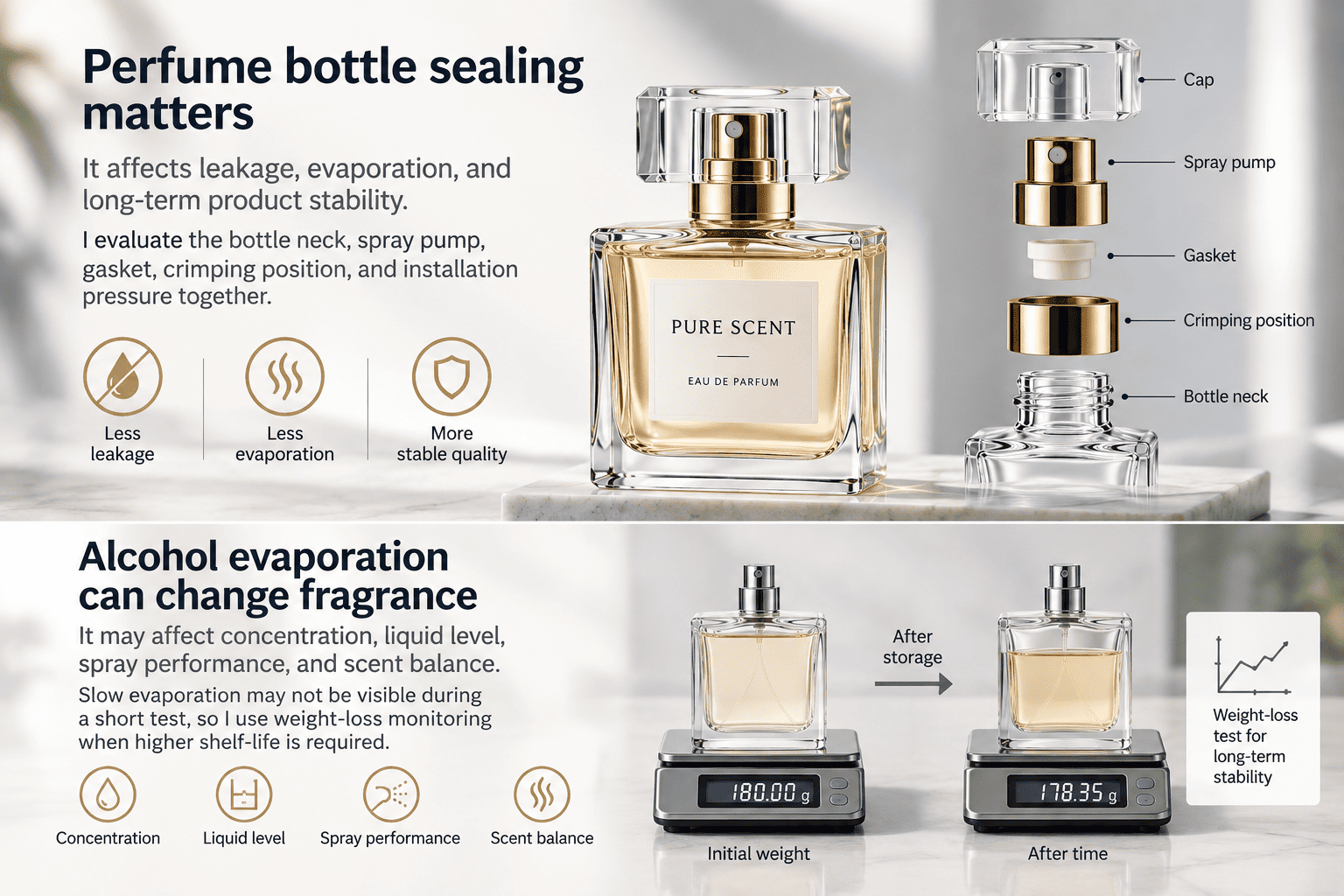
Alcohol evaporation can change fragrance concentration, liquid level, spray performance, and scent balance. Slow evaporation may not be visible during a short test, so I use weight-loss monitoring when the brand has higher shelf-life requirements.
Weight Loss Can Happen Without Visible Leakage
Many customers think leakage always means there will be perfume outside the bottle.
That is not always true.
Sometimes the bottle remains dry.
There is no wet carton.
There is no visible dripping.
But the total weight slowly decreases.
Perfume contains alcohol and many fragrance materials with different levels of volatility.
If part of the alcohol and some lighter aromatic compounds slowly escape, the formula balance can change.
The customer may notice:
- A lower liquid level
- A heavier fragrance smell
- A weaker fresh opening
- A different spray feeling
- Changes in fragrance concentration
This is why I like using weight as an objective measurement.
For a long-term test, I can record:
- Initial filled weight
- Storage date
- Storage temperature
- Bottle position
- Final weight
- Weight-loss percentage
- Pump condition
- Liquid appearance
- Spray performance
Temperature also matters.
A bottle stored in a warm warehouse can behave differently from the same bottle stored in an air-conditioned room.
This is especially important for many of our customers in Southeast Asia, the Middle East, and other warm markets.
The perfume may also spend time inside a hot container or delivery vehicle.
| Storage Condition | What I Watch |
|---|---|
| Room temperature | Normal long-term weight change |
| Higher temperature | Faster evaporation or sealing weakness |
| Horizontal storage | Leakage around the pump |
| Temperature cycling | Expansion and contraction effects |
| Shipping simulation | Pump stability after vibration |
This is one reason I do not recommend choosing a pump only by unit price.
A small saving on a pump is not useful if the final product loses fragrance, damages the carton, or creates customer complaints.
Why Does the Crimping Tool Affect Perfume Bottle Sealing?
A good bottle and a good pump can still fail if the pump is installed at the wrong height.
The crimping tool affects sealing because the chuck position determines where the aluminum collar locks onto the bottle neck. If the pump sits too deep or too shallow inside the tool, the locking position can move and reduce sealing performance.
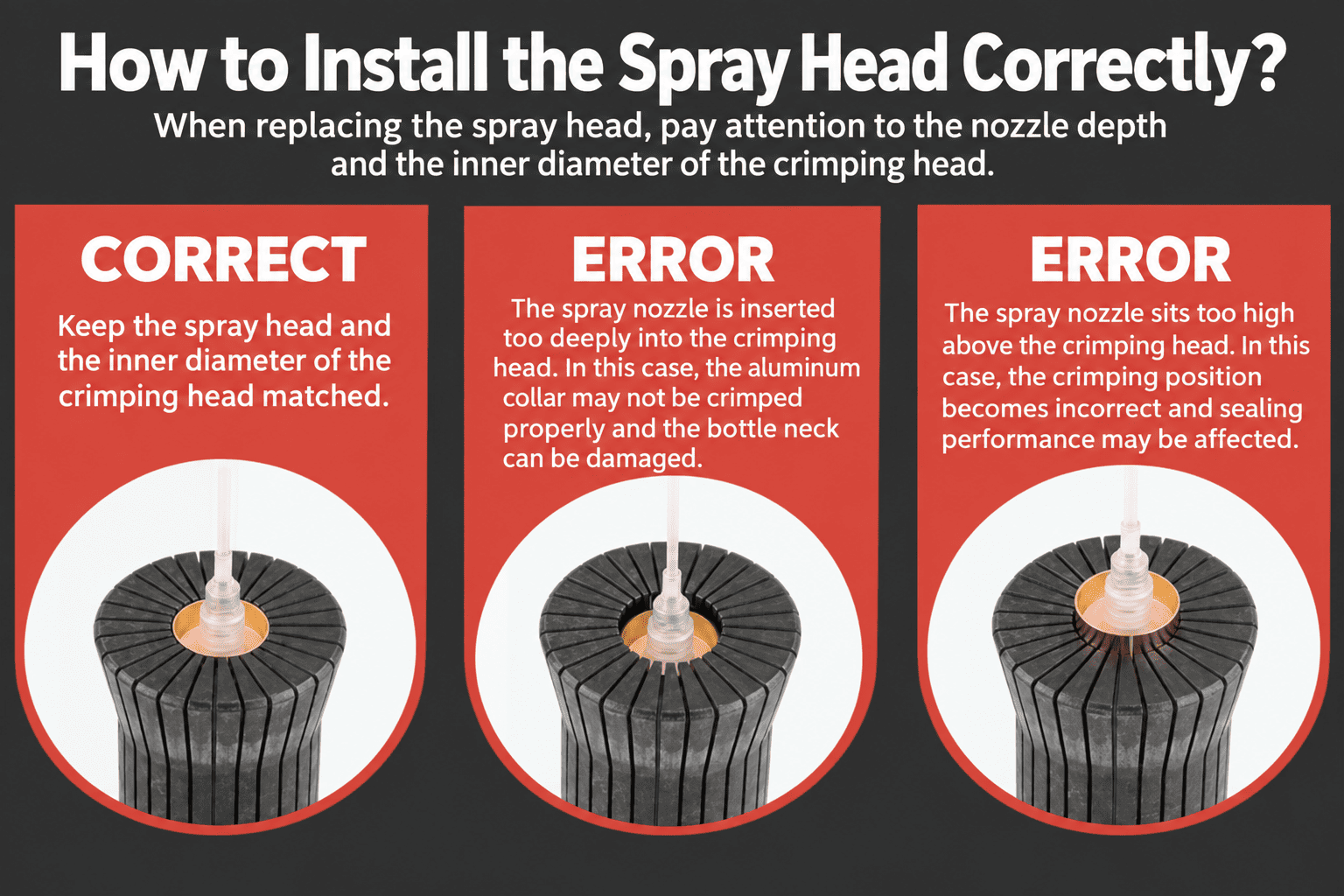
The Pump Should Not Sit Too Deep Inside the Crimping Head
This is one practical problem I have seen during customer troubleshooting.
When the spray pump is installed, the operator places the pump onto the bottle and uses a crimping machine or manual crimping tool.
The tool grips the aluminum collar.
Then it presses the collar around the neck.
The height relationship between the pump and the crimping chuck is very important.
If the pump is pushed too deeply inside the chuck, the tool may crimp the collar at the wrong vertical position.
The locking area can become too high.
It can also become too low.
Then the collar may not lock correctly around the intended area of the glass neck.
This can reduce gasket compression.
It can also reduce sealing performance.
I have seen customers install the pump and then move it with their fingers.
The pump could still turn.
For me, that is a clear sign that something needs to be checked.
I would first look at the crimping tool setting.
Then I would measure the bottle neck and pump.
Bottle-Neck and Pump Tolerances Can Also Cause Problems
Glass bottles are molded products.
They always have dimensional tolerances.
Spray pumps also have tolerances.
Sometimes the bottle neck and pump are both technically within their own specifications, but the combination is still not ideal.
For example, the bottle neck may be at one side of its tolerance range.
The pump may be at the opposite side.
Then the actual fit can become loose or difficult to lock correctly.
| Symptom | Possible Cause | What I Check |
|---|---|---|
| Pump rotates after crimping | Crimp too loose | Pressure and chuck setting |
| Collar sits too high | Tool position problem | Pump insertion depth |
| Collar sits too low | Incorrect tool setup | Chuck height |
| Pump does not seat correctly | Size mismatch | Pump and neck dimensions |
| Sealing varies by bottle | Glass tolerance | Multiple neck measurements |
I prefer to troubleshoot the whole system.
I do not immediately say that the glass bottle is bad.
I also do not immediately blame the pump.
The real problem may come from the interaction between both components and the crimping process.
Should I Use a Crimp Pump or a Screw Pump for Refillable Perfume Bottles?
Many brands now want refillable perfume packaging because of sustainability goals, bottle reuse, and customer convenience.
A screw-neck pump is easier to open and refill, but when long-term fragrance stability is more important, I usually prefer a crimp-neck system. In my experience, a properly crimped pump normally gives a more stable closure for perfume that needs a longer selling or storage period.
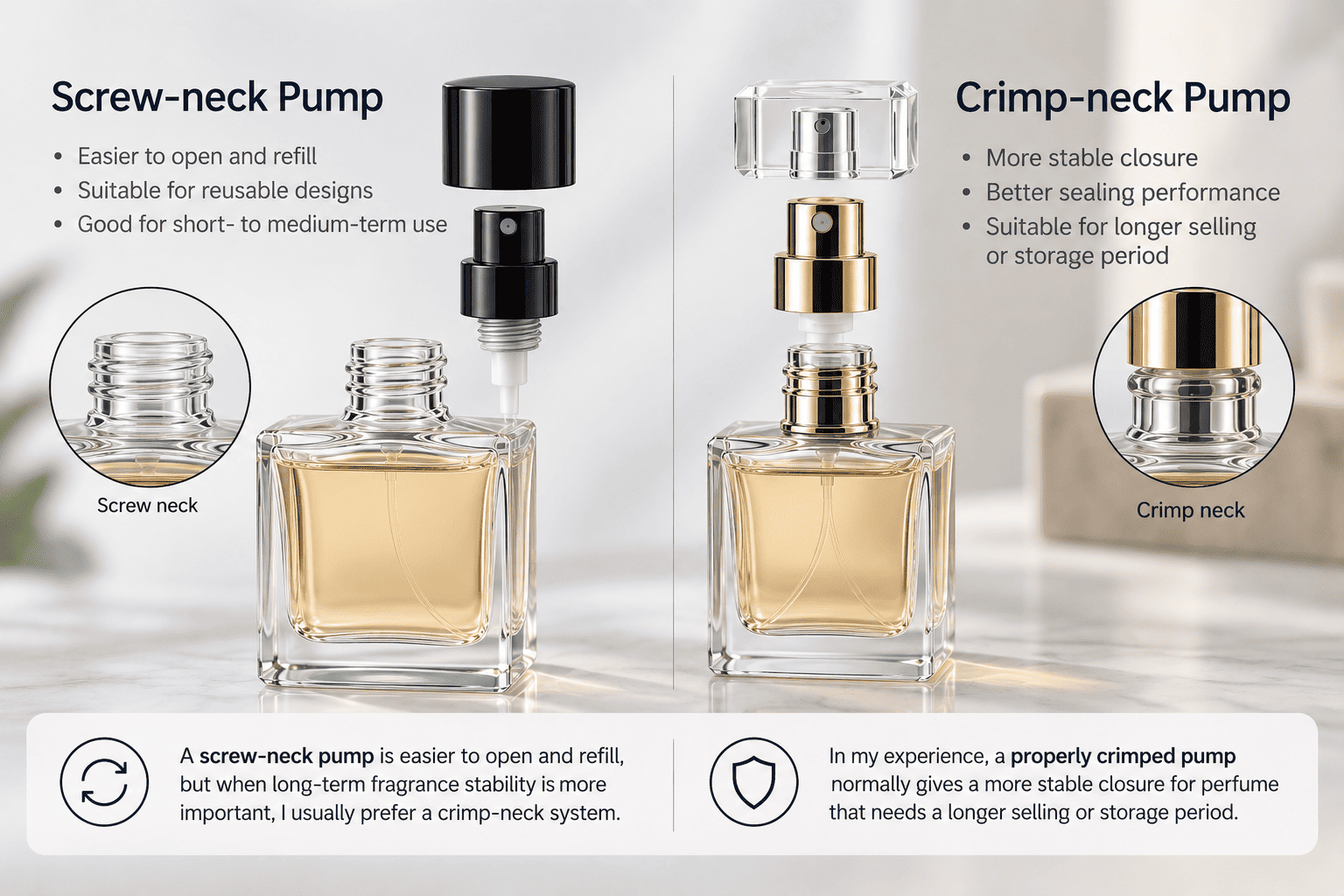
Refillable Perfume Packaging Is Becoming More Common
I understand why many perfume brands now ask for refillable bottles.
Environmental requirements are becoming more important.
A heavy glass perfume bottle also has a much longer physical life than one filling of perfume.
Brands want customers to reuse the bottle.
This can reduce waste.
It can also support a stronger sustainability story.
A screw-neck bottle is a simple way to make refilling easier.
The customer can unscrew the pump, refill the bottle, and install the pump again.
This is also useful when the customer wants to transfer perfume from a larger bottle into a smaller travel bottle or sample bottle.
But I do not choose the neck type only based on refill convenience.
I also think about how long the perfume needs to remain inside the bottle.
I Usually Prefer Crimp Pumps When Long-Term Sealing Is More Important
For perfumes with higher quality requirements or a longer selling period, I normally lean toward a crimp-neck system.
A correctly matched crimp pump creates a stable mechanical closure.
The pump is locked onto the bottle neck.
The user cannot easily loosen it during normal use.
This removes one variable from the sealing system.
A screw pump is different.
The user can open it.
The user can also close it again.
This is convenient, but the final sealing condition can depend on how tightly the customer screws it back.
If the pump is not tightened enough, the sealing may become weaker.
The thread, gasket, and pump dimensions also need to work well together.
| Closure Type | Main Advantage | Main Concern |
|---|---|---|
| Crimp pump | Stable long-term closure | Harder to remove manually |
| Screw pump | Easy to open and refill | Sealing depends more on repeated opening |
| Refillable system | Extends bottle life | Needs a controlled refill method |
| Travel atomizer | Easy small-volume transfer | Adds another transfer step |
For me, the choice depends on the brand priority.
If the first priority is easy refill, I can consider a screw-neck solution.
If the first priority is stable long-term sealing, I normally prefer a crimp-neck solution.
A Crimp Bottle Can Still Support Refilling
Many people assume that a crimp perfume bottle cannot be refilled.
That is not always true.
There are refill devices that can transfer perfume through the valve system without removing the crimped pump.
The refill tool connects from the outside.
Then the perfume can be transferred into the bottle through the pump system.
I think this gives brands another option.
They can keep the crimp closure and still create a refill experience.
This can be useful when the brand wants both better sealing and bottle reuse.
I Look at Refillability as a Complete Packaging System
When a customer asks me for a [refillable perfume bottle][[3]], I normally think about several questions.
I want to know:
- How many times the bottle may be refilled
- Whether the pump needs to be removed by hand
- Whether an external refill device will be used
- How long the perfume will stay in the bottle
- Whether the product will be sold in a hot market
- Whether the brand has strict weight-loss requirements
- Whether the bottle is for retail, travel, or samples
- Whether customers will refill from a larger perfume bottle
For me, refillability is not simply about adding a screw thread.
It is a balance between usability and product protection.
A bottle should be easy to reuse, but it still needs to protect the fragrance after every refill.
Should Perfume Glass Bottles Be Cleaned Before Filling?
A new perfume bottle may look clean, but its inner wall can still contain glass powder, mold-release residue, oil, fingerprints, or packaging particles.
Perfume glass bottles should be cleaned before filling when the incoming cleanliness does not meet the filling standard. For industrial production, I usually recommend ultrasonic cleaning with purified or deionized water, followed by multiple rinsing stages and controlled hot-air drying.
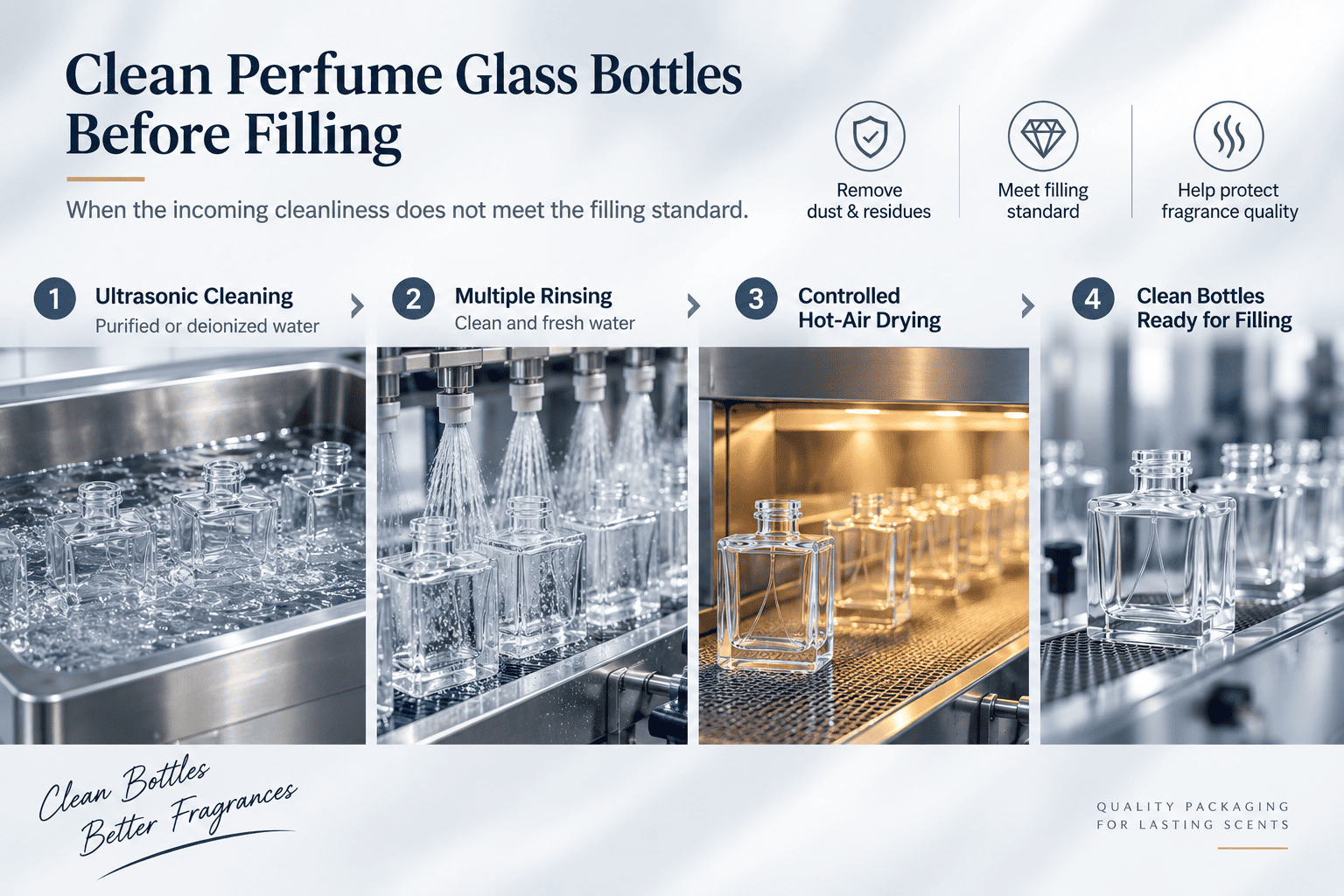
I Separate Industrial Cleaning and Small-Batch Filling
In my business, I look at two different cleaning situations.
The first is industrial perfume or cosmetic filling.
The second is small-batch manual filling.
These two situations should not use exactly the same cleaning process.
New glass bottles can contain:
- Fine glass powder
- Mold-release residue
- Silicone oil
- Mold oil
- Fingerprints
- Dust
- Paper fibers
- Small packaging particles
If these materials stay inside the bottle, they may enter the perfume after filling.
Then the customer may see cloudiness, sediment, or small suspended particles.
This is why I do not judge bottle cleanliness only by appearance.
For Industrial Production, I Prefer Ultrasonic Cleaning and Hot-Air Drying
For large-scale perfume or cosmetic filling, one common process is ultrasonic cleaning followed by hot-air drying.
The process usually starts with pre-rinsing.
Purified water removes loose dust and small particles.
Then the bottles enter an ultrasonic cleaning tank.
The tank can use purified water or deionized water at around 40–55°C.
The ultrasonic action helps remove mold-release residue, silicone oil, and very fine glass powder from the inner wall.
If a cleaning agent is needed, I do not recommend normal household detergent.
I prefer a low-foam neutral cleaner made for glass or cosmetic packaging.
I also avoid strongly alkaline cleaners.
Strong alkaline chemicals can attack the glass surface or create whitening.
After ultrasonic cleaning, the bottles should go through two or three purified-water rinsing stages.
The goal is to remove all cleaning-agent residue.
| Cleaning Step | Main Purpose | What I Pay Attention To |
|---|---|---|
| Pre-rinse | Remove loose dust | Use purified water |
| Ultrasonic cleaning | Remove oil and glass particles | Usually 40–55°C |
| Neutral cleaner if needed | Remove oily residue | Low-foam and mild |
| Multi-stage rinsing | Remove cleaner residue | Usually 2–3 stages |
| Hot-air drying | Remove moisture | Match temperature to decoration |
| Clean cooling | Avoid new dust | Controlled environment |
After rinsing, the bottles need proper drying.
For plain transparent glass bottles, hot-air drying can often reach around 140–160°C when the process allows it.
Filtered hot air is better.
A HEPA system can reduce secondary dust during drying and cooling.
After drying, I prefer the bottles to cool in a clean area before filling.
Otherwise, a bottle can be cleaned well and then collect dust again.
Coated and Frosted Bottles Need Lower Temperatures
Not every perfume bottle can use the same drying temperature.
Spray-coated bottles, solid-color bottles, and frosted bottles need more control.
High heat can damage the decorative layer.
The color may change.
The surface may whiten.
The coating may soften or become uneven.
For these bottles, I prefer a lower drying temperature.
In many cases, I would keep the hot-air drying temperature at or below around 120°C, depending on the actual coating.
I also avoid long exposure above 170°C unless the coating has been tested for it.
Strong alkaline cleaners should also be avoided.
They can cause color loss, floating color, or whitening.
| Bottle Type | Cleaning Method | Typical Drying Approach |
|---|---|---|
| Plain transparent glass | Ultrasonic + purified water | Around 140–160°C when suitable |
| Spray-coated bottle | Ultrasonic + mild cleaning | Usually ≤120°C |
| Solid-color bottle | Ultrasonic + mild cleaning | Usually ≤120°C |
| Frosted bottle | Ultrasonic + controlled cleaning | Usually ≤120°C |
| Very clean incoming bottle | Ionized air may be enough | No wet drying needed |
The exact temperature should always follow the actual coating system and production validation.
I do not like using one fixed temperature for every bottle.
Ionized Air Is Useful When the Bottle Is Already Clean
Some packaging factories use high-pressure ionized clean air.
This is useful when the incoming bottles are already very clean.
Ionized air can remove loose dust from the inside and outside of the bottle.
One advantage is that no water is used.
So there is no water mark or water spot.
But ionized air cannot remove everything.
It cannot properly remove oil, mold-release residue, silicone residue, or fingerprints.
For this reason, I see ionized air mainly as a dust-removal method.
I do not see it as a full replacement for wet cleaning when there is oily contamination.
If the incoming bottle is clean enough, ionized air can save time and remove the water-washing step.
The decision should depend on the real incoming condition.
I Do Not Use Alcohol Washing as the Main Industrial Cleaning Method
Alcohol or hydrogen-peroxide spraying is used in some production environments.
But for the glass bottle itself, I do not normally use alcohol rinsing as the main large-scale cleaning process.
Large-volume alcohol washing creates other problems.
It needs vapor control.
It has safety requirements.
It can increase drying cost.
It may also create marks depending on the alcohol quality and drying condition.
For industrial glass bottles, purified-water ultrasonic cleaning and controlled hot-air drying are usually more practical.
Alcohol or disinfecting solutions may still be used for some tools, closure parts, or sanitation steps.
But I do not treat alcohol washing as the standard bottle-cleaning method.
Incoming Bottle Quality Changes the Cleaning Requirement
In export business, I often see customers assume that a brand-new bottle must be completely clean.
That is not always true.
A glass bottle goes through molding, inspection, handling, decoration, packing, warehousing, transportation, and sometimes repacking.
During these steps, contamination can enter the bottle.
If the bottle is filled directly, the customer may later see:
- Cloudiness
- Sediment
- Fine particles
- Fibers
- Oil-like marks
- Unexpected contamination
When this happens, people sometimes blame the perfume formula.
But the cause may actually come from the bottle or the cleaning process.
For Small-Batch Filling, I Use a Simpler Cleaning Process
Small perfume brands and laboratories may not have an industrial ultrasonic cleaning line.
In this situation, the process can be simpler.
I prefer purified or deionized water.
If oily contamination is present, a neutral glass cleaner can be used.
Then the bottle should be rinsed several times with purified water.
After that, it should be placed upside down and dried completely in a clean environment.
I do not recommend household dishwashing liquid.
Household detergent can contain surfactants, fragrances, and other additives.
If they remain inside the bottle, they can create cloudiness, foam, flakes, or suspended material after perfume filling.
| Small-Batch Step | What I Recommend |
|---|---|
| Initial rinse | Purified or deionized water |
| Oily contamination | Neutral glass cleaner if needed |
| Final rinse | Several purified-water rinses |
| Drying | Upside down in a clean environment |
| Household detergent | I do not recommend it |
| Filling | Only after complete drying |
For me, the goal is simple.
I want the perfume to contact clean glass.
I do not want glass powder, mold oil, surfactant residue, dust, or other chemicals entering the fragrance.
Can Inner-Wall Coating Change Perfume Quality?
Creative decoration can make a bottle more attractive, but I become more careful when the decoration is placed inside the bottle.
Inner-wall coating can create a chemical compatibility risk because the paint directly contacts the perfume. If the coating reacts with alcohol or fragrance ingredients, it may change the liquid color or appearance. I usually prefer external coating when possible.
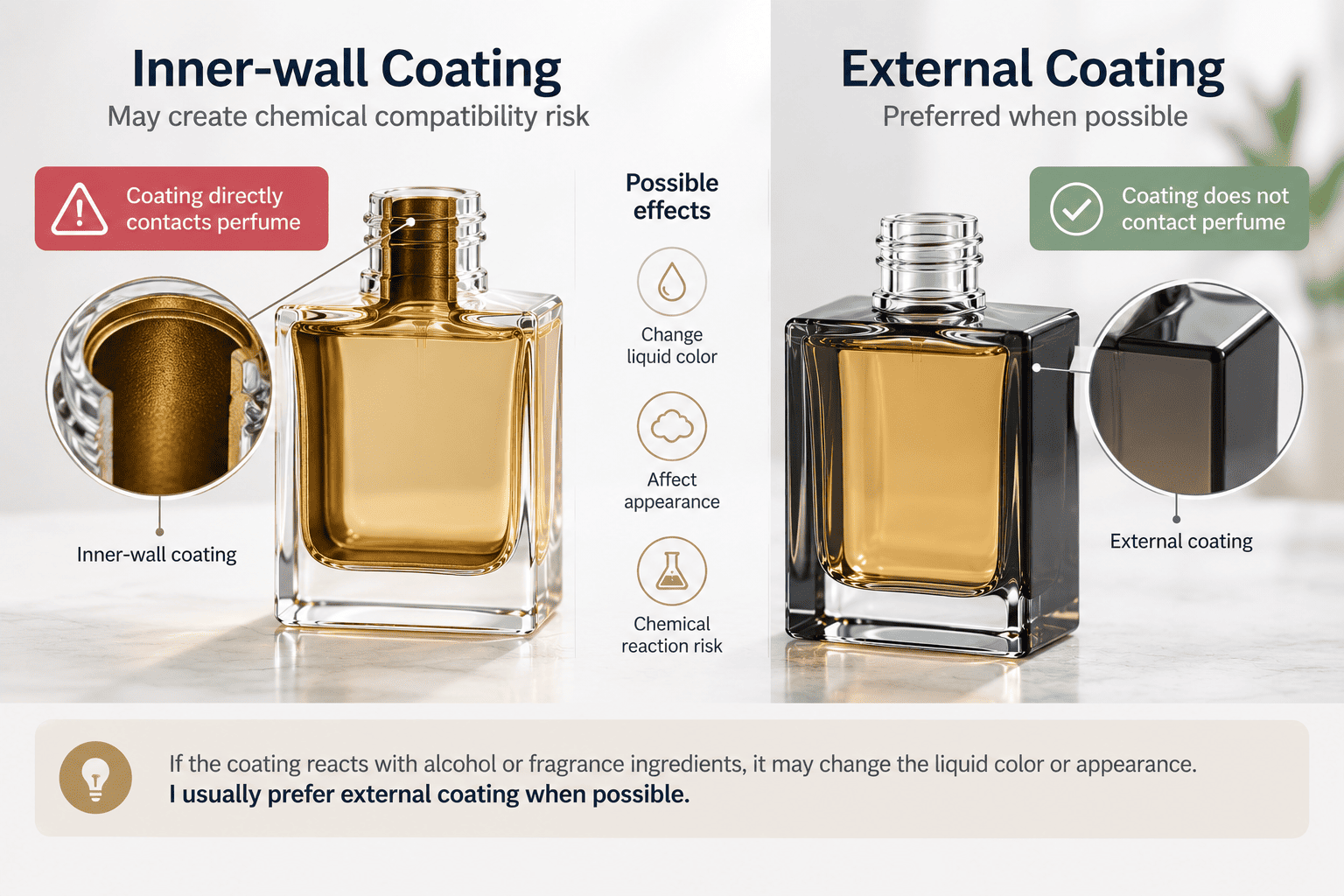
I Usually Prefer External Coating Over Internal Coating
Inner-wall spraying has become one way to create special bottle effects.
The coating is sprayed onto the inside of the glass bottle instead of the outside.
It can create deeper colors and unusual visual effects.
But the coating directly contacts the perfume.
This is the main risk.
Perfume usually contains ethanol, fragrance oils, and many aromatic materials.
If the coating is not compatible with the formula, the perfume may react with it.
The liquid color can change.
The coating can change.
The perfume appearance can become unstable.
| Decoration Method | Direct Contact With Perfume | Main Concern |
|---|---|---|
| External color coating | No | Surface durability |
| External frosting | No | Appearance consistency |
| External printing | No | Adhesion |
| Inner-wall coating | Yes | Chemical compatibility |
| Decal decoration | Usually no | Adhesion and firing quality |
For this reason, I normally prefer external coating.
The paint stays outside the bottle.
It does not directly contact the fragrance.
If a customer really wants internal coating, I recommend compatibility testing with the real perfume formula.
I would check:
- Liquid color
- Coating color
- Coating adhesion
- Sediment
- Odor changes
- Surface changes
- Long-term appearance
I do not recommend judging an inner coating only from a fresh sample.
A beautiful bottle still needs to remain stable after several months of contact with perfume.
Are Double-Wall Glass Perfume Bottles a Good Option?
Some perfume bottles use a double-wall structure to create shapes that are difficult to make with normal single-wall glass.
Double-wall perfume bottles use an inner glass container to hold the fragrance and an outer glass wall to create the final shape. I see this mainly as a design solution rather than a sealing solution, so the inner container still needs proper closure testing.
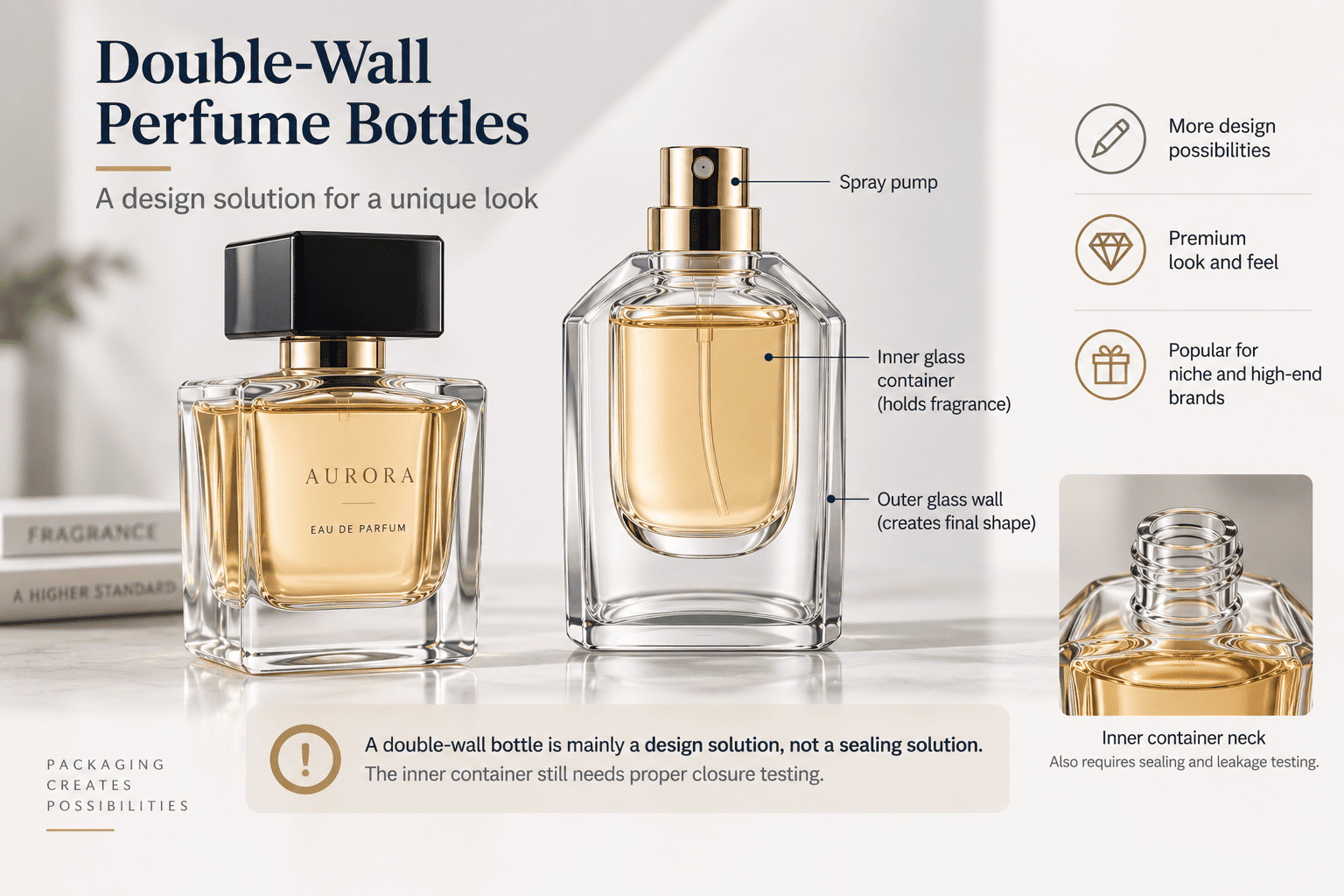
Double-Wall Glass Gives Brands More Design Freedom
A normal perfume bottle uses one glass container.
A double-wall bottle works differently.
There is an outer glass shape.
Inside it, there is another smaller glass container.
The inner bottle holds the fragrance.
There can be an air space between the two glass walls.
This creates a very different visual effect.
The bottle can look thicker.
It can look deeper.
The inner container can also have a different shape from the outer profile.
I think this type of bottle is useful for brands that want something unusual.
It can make the bottle more memorable on a shelf or in a social media video.
But I do not see double-wall glass as a sealing solution.
The inner bottle still needs:
- A correct neck size
- A compatible pump
- A suitable gasket
- Proper crimping
- Leakage testing
- Weight-loss testing
| Feature | Single-Wall Bottle | Double-Wall Bottle |
|---|---|---|
| Structure | One glass container | Inner container plus outer glass |
| Visual effect | More traditional | More dimensional |
| Design freedom | Good | Higher for some shapes |
| Production complexity | Lower | Higher |
| Sealing requirement | Important | Still important |
| Cost | Usually lower | Usually higher |
I think this structure can be very attractive.
But the brand should also consider cost, production complexity, weight, transportation, and filling compatibility.
A unique bottle can help marketing.
It still needs to perform like good perfume packaging.
How Should Perfume Brands Test Bottle Sealing Before Mass Production?
I do not think visual inspection is enough. A bottle can look perfect on the first day and still develop problems later.
I recommend combining vacuum testing, weight-loss testing, horizontal storage, temperature testing, spray-function testing, and dimensional inspection. The test should use the actual bottle, pump, gasket, crimp setting, and ideally the real perfume formula.
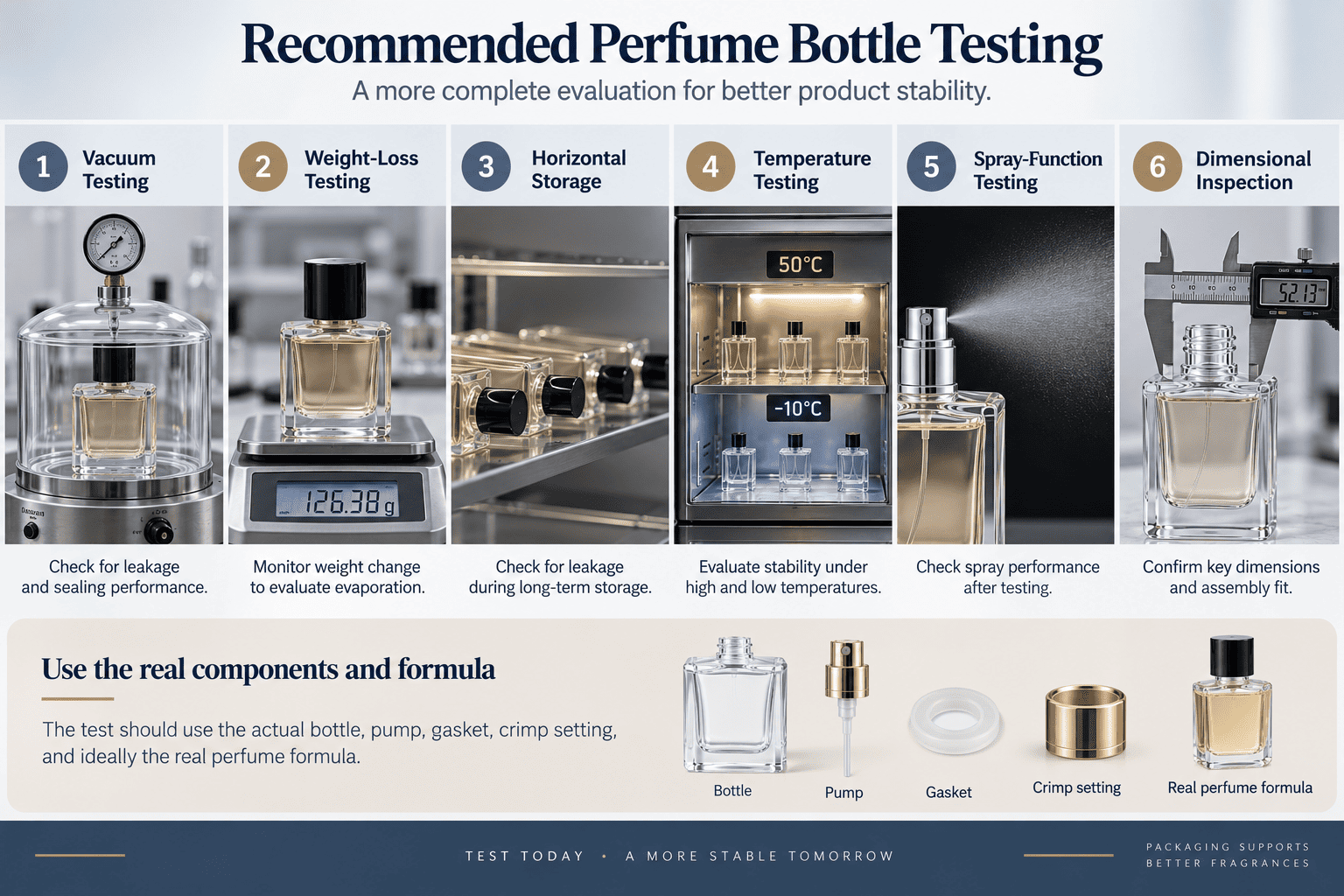
I Prefer Testing the Real Packaging Combination
For me, the best test is not a test of one isolated part.
I want to test the actual package.
That means:
- Actual glass bottle
- Actual pump
- Actual gasket
- Actual crimping setting
- Actual decoration when relevant
- Actual fragrance formula when possible
Many failures only appear after these parts are combined.
A bottle can meet its drawing.
A pump can also meet its drawing.
But the combination can still perform badly.
The crimping tool adds another variable.
The fragrance formula adds another one.
The storage temperature adds another one.
This is why I prefer several tests.
First, I can use vacuum testing to find obvious leakage.
Then I can use weight-loss testing to monitor long-term evaporation.
I can store some bottles horizontally.
I can expose selected samples to higher temperatures.
I can also check whether the pump still sprays correctly after storage.
| Test | Why I Use It |
|---|---|
| Vacuum test | Find immediate leakage |
| Weight-loss test | Monitor long-term alcohol evaporation |
| Horizontal storage | Challenge the closure |
| High-temperature storage | Accelerate some sealing problems |
| Spray-function test | Confirm pump performance |
| Neck measurement | Check glass tolerance |
| Pump measurement | Check pump-neck compatibility |
| Visual inspection | Check crimp position and stability |
I also prefer more than one test sample.
One bottle cannot represent a whole production lot.
If multiple samples show the same result, I have much more confidence in the conclusion.
For a growing perfume brand, early testing costs much less than discovering a problem after thousands of bottles have already been filled.
How Can I Choose Better Perfume Packaging for Longer Shelf Life?
I do not believe a heavier or more expensive bottle automatically gives better shelf life. I focus more on compatibility, sealing, and process control.
I choose perfume packaging by matching the bottle neck, pump, gasket, crimping process, cleaning method, and decoration. Then I verify the complete system with practical tests before mass production.
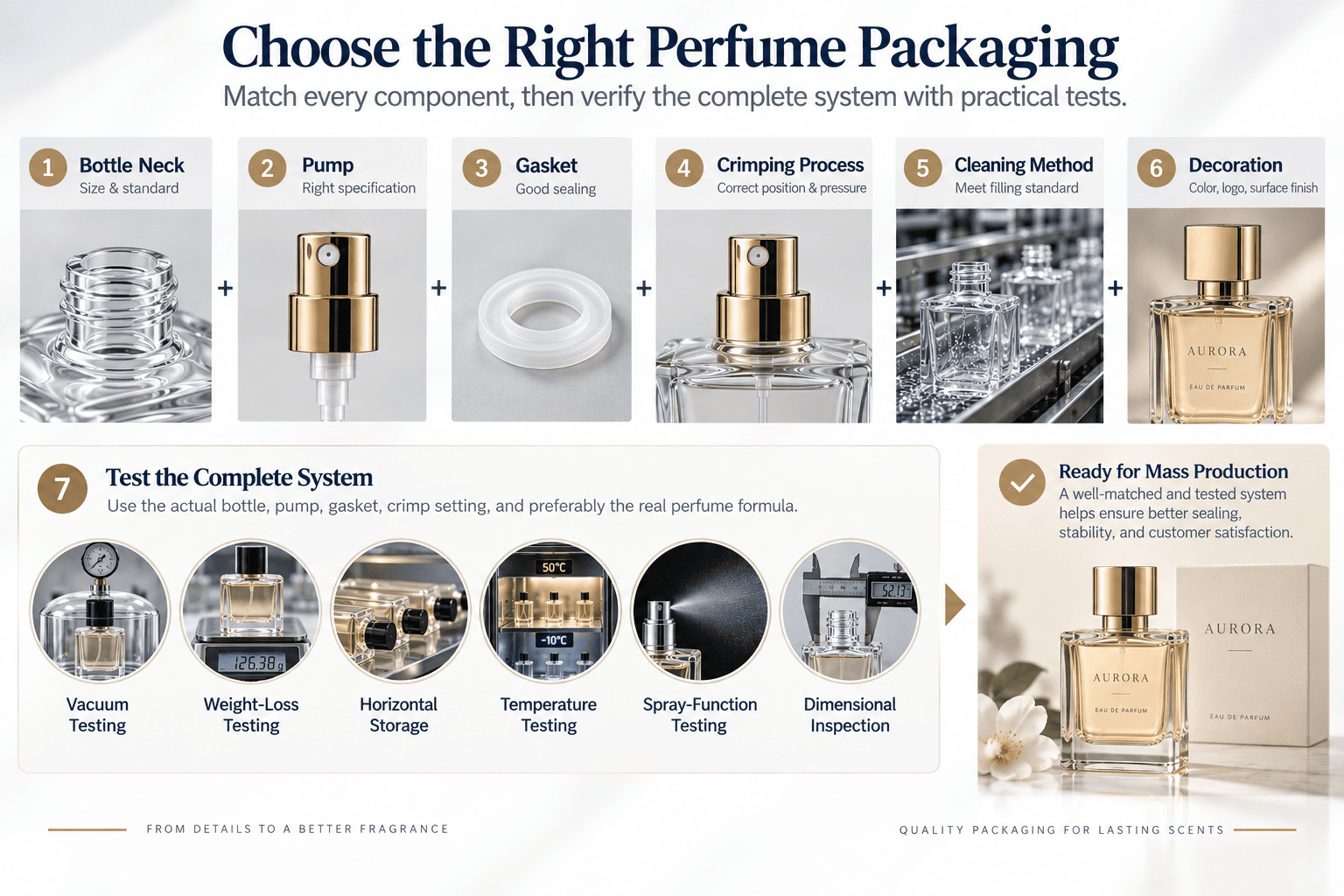
I Start With the Brand's Real Business Model
A perfume brand selling mainly through e-commerce has different risks from a brand selling through local boutiques.
An online order can travel on its side.
It can experience vibration.
It may stay inside a hot delivery vehicle.
A retail bottle may remain upright for most of its life.
A brand selling in Southeast Asia may also face higher temperatures than a brand selling in a cooler market.
So I normally look at:
- Bottle capacity
- Fragrance formula
- Sales country
- Filling location
- Retail price
- Sales channel
- Shipping method
- Pump type
- Refill requirement
- Decoration requirement
- Order quantity
These details help me choose a more practical packaging solution.
Stock Bottles Can Reduce Development Risk
At Hongyan Glass Bottle, we have more than 500 stock perfume bottle designs.
For many small and medium perfume brands, I think stock bottles are a practical starting point.
They can reduce development time.
They can also lower the entry cost.
The brand can then spend more budget on perfume development, decoration, marketing, and distribution.
We support processes such as:
- Color coating
- Frosting
- Gold decoration
- Decal work
- Printing
- Different cap combinations
- Pump matching
For brands that need a new shape, we can also support custom development and 3D sampling.
But I apply the same principle to both stock and custom bottles.
The bottle needs to match the pump.
The pump needs to be installed correctly.
The bottle needs the right cleaning process.
The decoration needs to be compatible.
The complete package needs testing.
| Brand Situation | What I Usually Focus On |
|---|---|
| New perfume startup | Low MOQ and proven components |
| E-commerce brand | Leakage and shipping stability |
| Hot-climate market | Evaporation and temperature testing |
| Refillable perfume | Screw vs crimp balance |
| Long shelf-life product | Crimp sealing and weight-loss testing |
| Custom bottle project | Neck tolerance and pump matching |
| Premium brand | Decoration plus stable sealing |
| Inner-wall coating | Chemical compatibility |
| Double-wall design | Structure and closure performance |
I do not think a supplier should simply promise that one bottle will work perfectly with every perfume formula.
There are too many variables.
I prefer measurement.
I prefer testing.
I prefer checking the problem before mass production.
That protects the perfume.
It also protects the packaging budget and the reputation of the brand.
Conclusion
I see fragrance shelf life as a complete packaging-system issue. Good sealing, correct crimping, proper cleaning, suitable decoration, and long-term testing all help protect perfume quality.
[[1]]: https://www.dictionary.com/browse/leakproof "leak-proof"
[[2]]: https://www.pfeiffervacuum.com/us/en/service/leak-testing-services/?utm_source=google&utm_medium=cpc&utm_campaign=USEN%20NONBRAND%20SERVICE%3Evacuum%20leak%20testing&utm_term=vacuum%20leak%20testing&gad_source=1&gad_campaignid=23170264218&gbraid=0AAAAADx4b5msQ3JHXPrkqLre3ZtCRcj9P&gclid=Cj0KCQjw5P7UBhDaARIsAOSlS1NyfZZYmo8E5NKXT0bYhnRIUxLhHey74nZszRr5MRofcPxZm84jevQaAp6mEALw_wcB "vacuum testing"
[[3]]: https://www.theperfumeshop.com/blog/lifestyle/how-to-refill-perfume/ "refillable perfume bottle"