A perfume bottle may look simple, but poor melting, unstable [forming][1], wrong neck dimensions, or bad cooling can turn a beautiful design into a packaging problem.
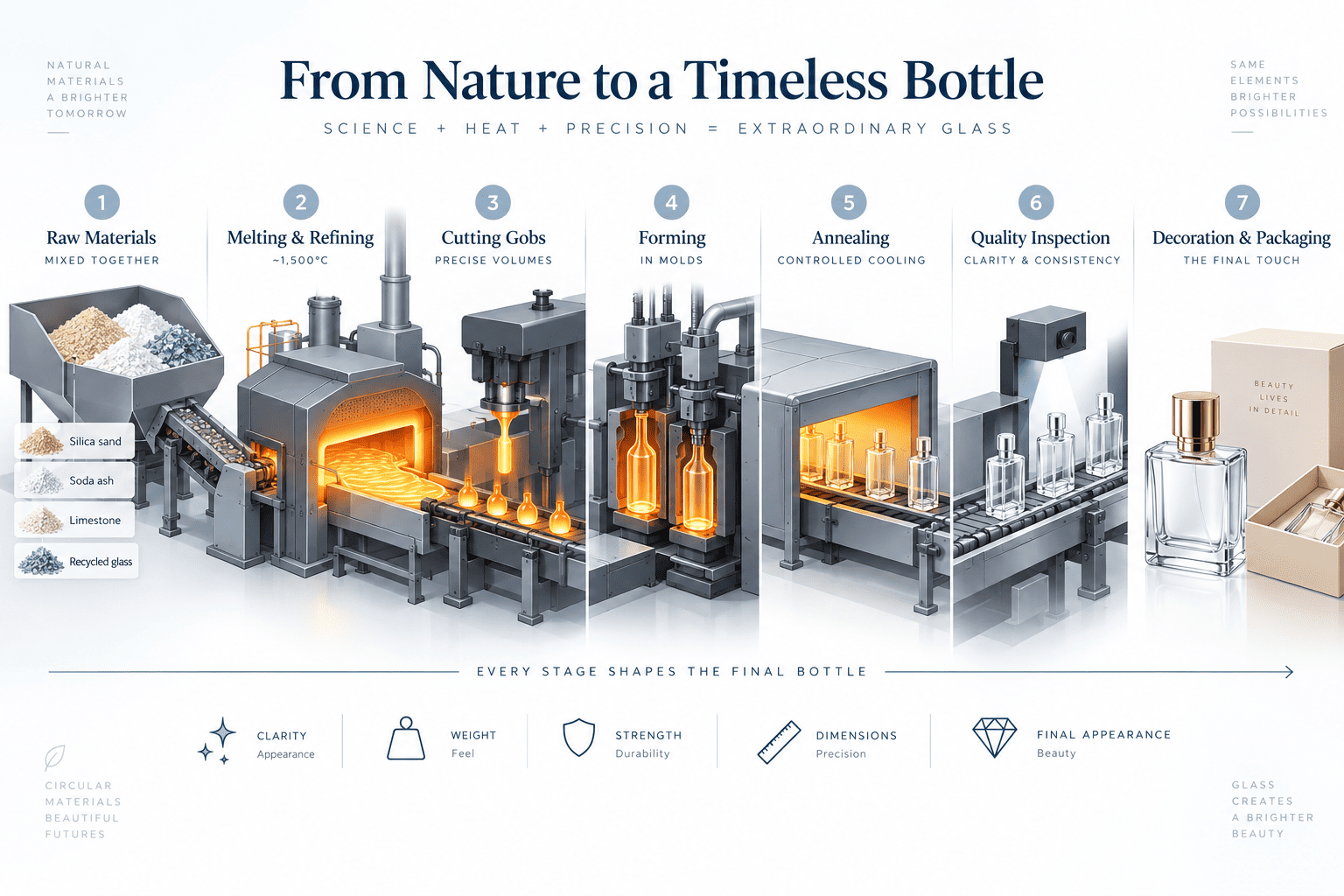
A glass bottle is made by mixing raw materials, melting and refining the glass, cutting it into gobs, forming it inside molds, annealing it, inspecting it, and then applying decoration and packaging. Each stage affects bottle clarity, weight, strength, dimensions, and final appearance.
I work with perfume glass bottles every day. Many customers first focus on shape, color, logo, or cap design. I understand why. These are the parts consumers see first.
But when I evaluate a perfume bottle project, I normally look deeper.
I check glass clarity. I check the bottle weight. I check the neck dimensions. I check the bottom thickness. I also check whether the pump, collar, and cap can work with the bottle as one complete system.
A beautiful perfume bottle is not only created by a designer.
It is created by raw material control, furnace temperature, glass distribution, mold design, annealing, inspection, and decoration.
And for perfume packaging, making a good transparent glass bottle is only the first step.
The real brand expression often starts after the bottle comes out of the glass production line.
What Are Glass Bottles Made Of?
A clear perfume bottle may look like one simple material, but glass quality depends on a carefully controlled mixture of several raw materials.
Most packaging glass bottles are made from soda-lime glass. The main raw materials include silica sand, soda ash, limestone, dolomite, recycled glass called cullet, and small amounts of other materials used to adjust color or glass properties.
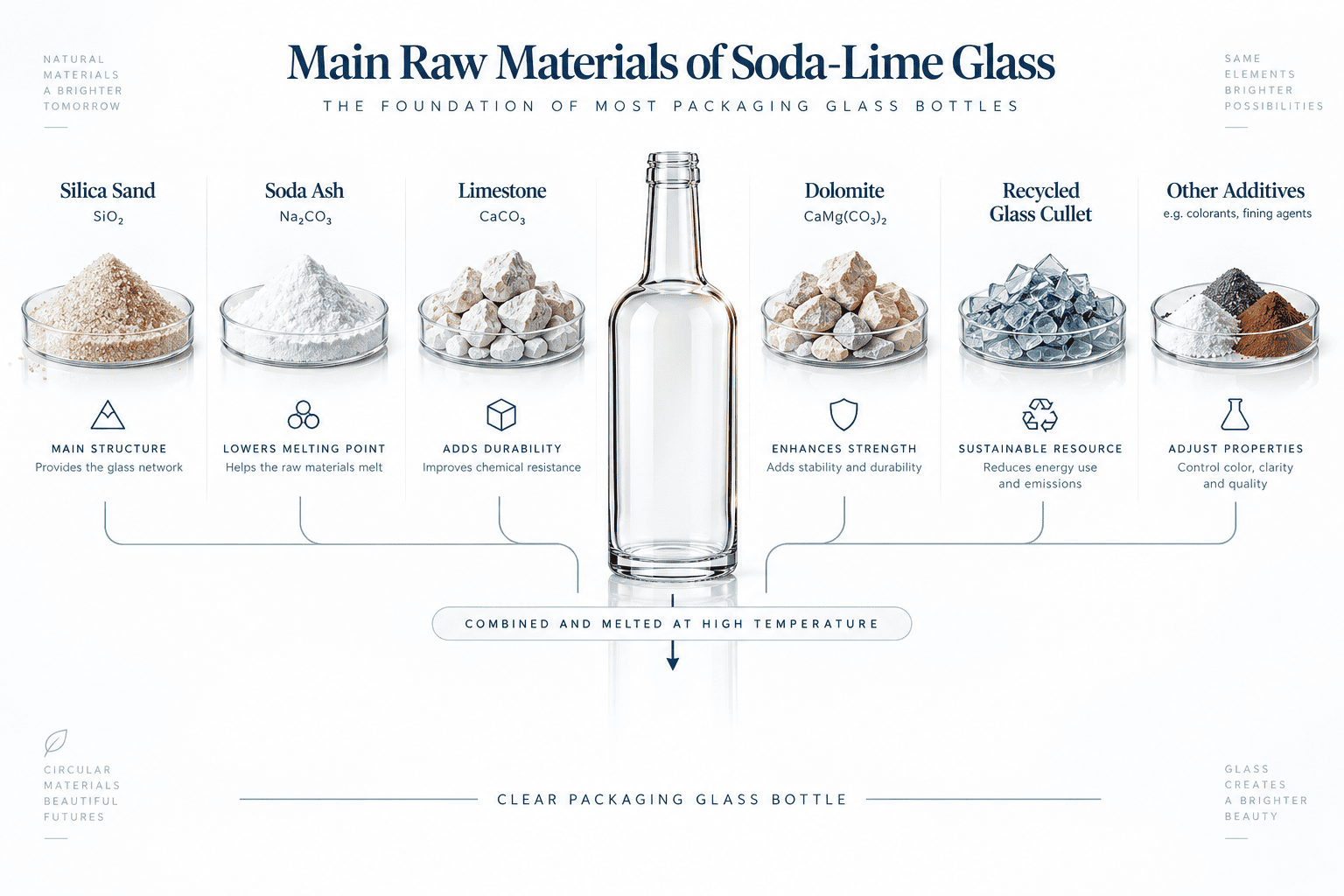
The Main Raw Materials Used in Glass Bottle Production
The glass formula has a direct influence on transparency, color, melting behavior, and final bottle performance.
| Raw Material | Main Function | Why It Matters |
|---|---|---|
| Silica sand | Main glass-forming material | Creates the basic glass structure |
| Soda ash | Lowers melting temperature | Makes melting easier and more efficient |
| Limestone | Improves stability | Helps improve durability and chemical resistance |
| Dolomite | Adds magnesium and calcium | Supports glass stability |
| Cullet | Recycled broken glass | Helps glass melt faster and can reduce energy use |
| Color-adjusting materials | Changes glass tone | Used for clear, amber, green, blue, or other colors |
Silica is the main material.
The problem is that pure silica needs a very high temperature to melt.
Soda ash helps lower that temperature.
Limestone and dolomite help make the finished glass more stable.
Cullet is also very important. It is recycled glass that has already been melted once. Because of this, it can melt more easily inside the furnace.
For perfume bottles, I pay special attention to the purity of the raw materials.
Clear perfume bottles normally need high transparency.
If the raw materials contain too much iron or other impurities, the finished bottle may show a slight green or gray tone.
For a basic product, this may be acceptable.
For a premium fragrance bottle, customers may notice it very quickly.
This is especially clear when the bottle has a thick base.
A thick bottom contains more glass, so the natural color of the glass becomes easier to see.
This is why I never judge a perfume bottle only by the mold shape.
Two factories can make a similar bottle shape, but the final appearance may still be different because of glass formula, raw material quality, furnace control, and production standards.
How Are the Raw Materials Prepared Before Melting?
The furnace cannot correct every problem. If the raw material batch is already unstable, defects can appear later in the finished bottle.
Before melting, silica sand, soda ash, limestone, dolomite, cullet, and other materials are weighed according to a fixed formula and mixed into a consistent batch. Stable weighing and mixing help control glass composition, transparency, and production consistency.
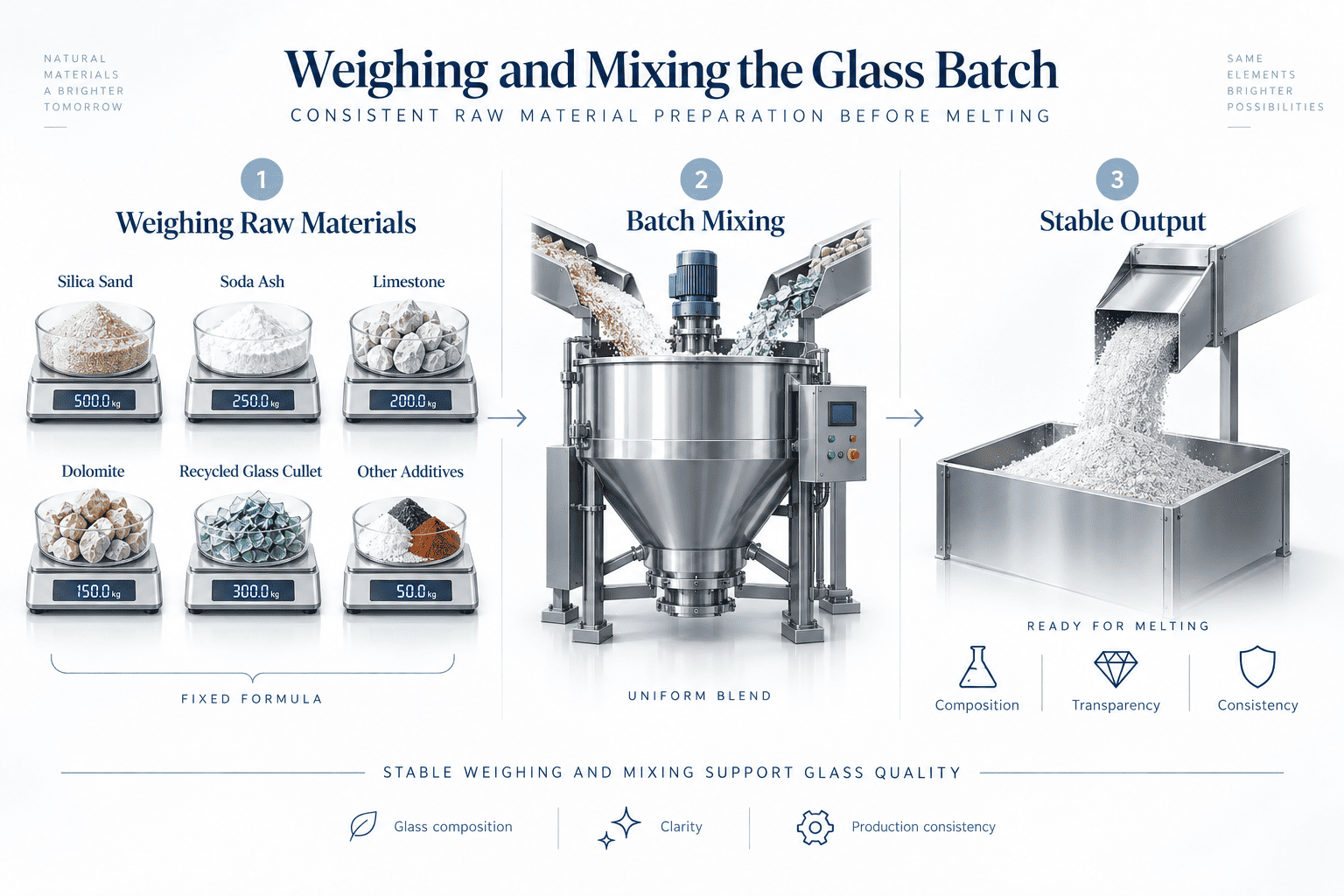
Why Mixing Accuracy Matters
Raw material preparation may look like one of the simplest parts of production.
It is not.
If the batch is not mixed evenly, the furnace receives unstable material.
This can lead to problems such as:
- Bubbles
- Stones
- Uneven glass color
- Poor transparency
- Chemical inconsistency
- Unstable melting
For perfume glass bottles, visual defects matter more than they do in many industrial containers.
A small defect in a food jar may not affect the buying decision.
A visible defect in a luxury perfume bottle can make the whole product feel cheap.
This is why clear flint glass needs better raw material control.
I also pay attention to recycled glass quality.
Cullet is useful because it improves melting efficiency. But it still needs to be clean and compatible with the glass formula.
If contaminated material enters the batch, it may create unexpected color changes or hard particles.
For customers, this stage is almost invisible.
They normally never see the raw material room.
But many visible problems in the final bottle can begin here.
That is one reason why I prefer to discuss glass quality standards before mass production instead of only checking the final bottle after everything is finished.
How Is Glass Melted Inside the Furnace?
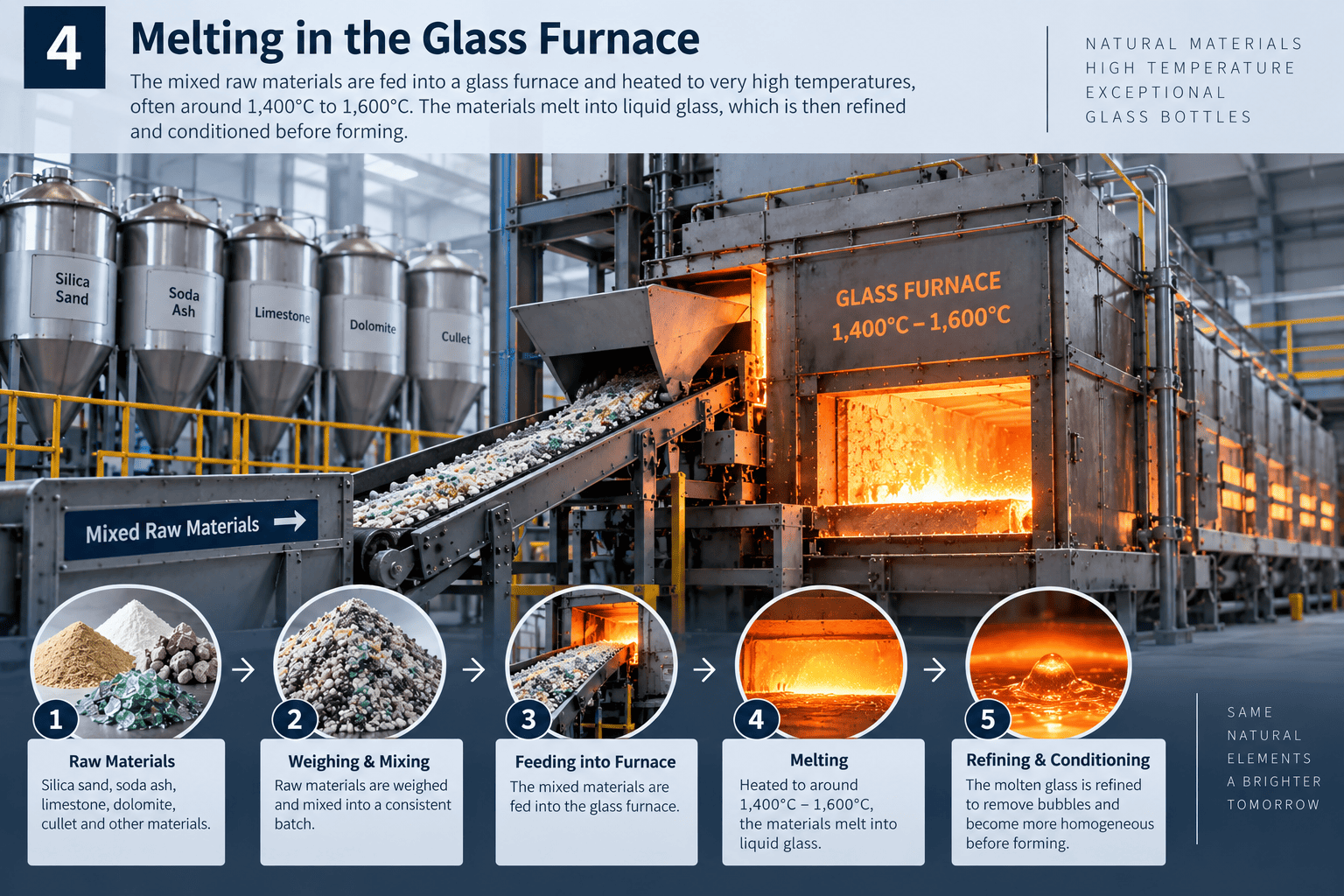
Glass must become completely molten before it can be shaped into a bottle. Poor temperature control can cause bubbles, stones, streaks, or unstable forming.
The mixed raw materials are fed into a glass furnace and heated to very high temperatures, often around 1,400°C to 1,600°C. The materials melt into liquid glass, which is then refined and conditioned before forming.
Why Furnace Stability Matters
A glass furnace normally runs continuously.
The factory does not simply turn it on for one order and turn it off after production.
The process needs stable heat.
Glass viscosity changes when temperature changes.
If the molten glass is too hot, it becomes too fluid.
If it is too cold, it becomes too thick.
Both situations can create forming problems.
The glass may not enter the mold correctly.
The wall thickness may change.
The bottle weight may become unstable.
The glass may also fail to reach difficult areas of the mold.
For perfume bottles, this matters because many designs have thick bottoms, narrow necks, sharp shoulders, or unusual shapes.
A design that looks easy in a 3D rendering may be much harder to produce in real molten glass.
I often explain this to customers developing a custom bottle.
A rendering only shows the outside appearance.
It does not show how hot glass will flow inside the mold.
That is why technical evaluation is important before tooling.
What Is Glass Refining and Conditioning?
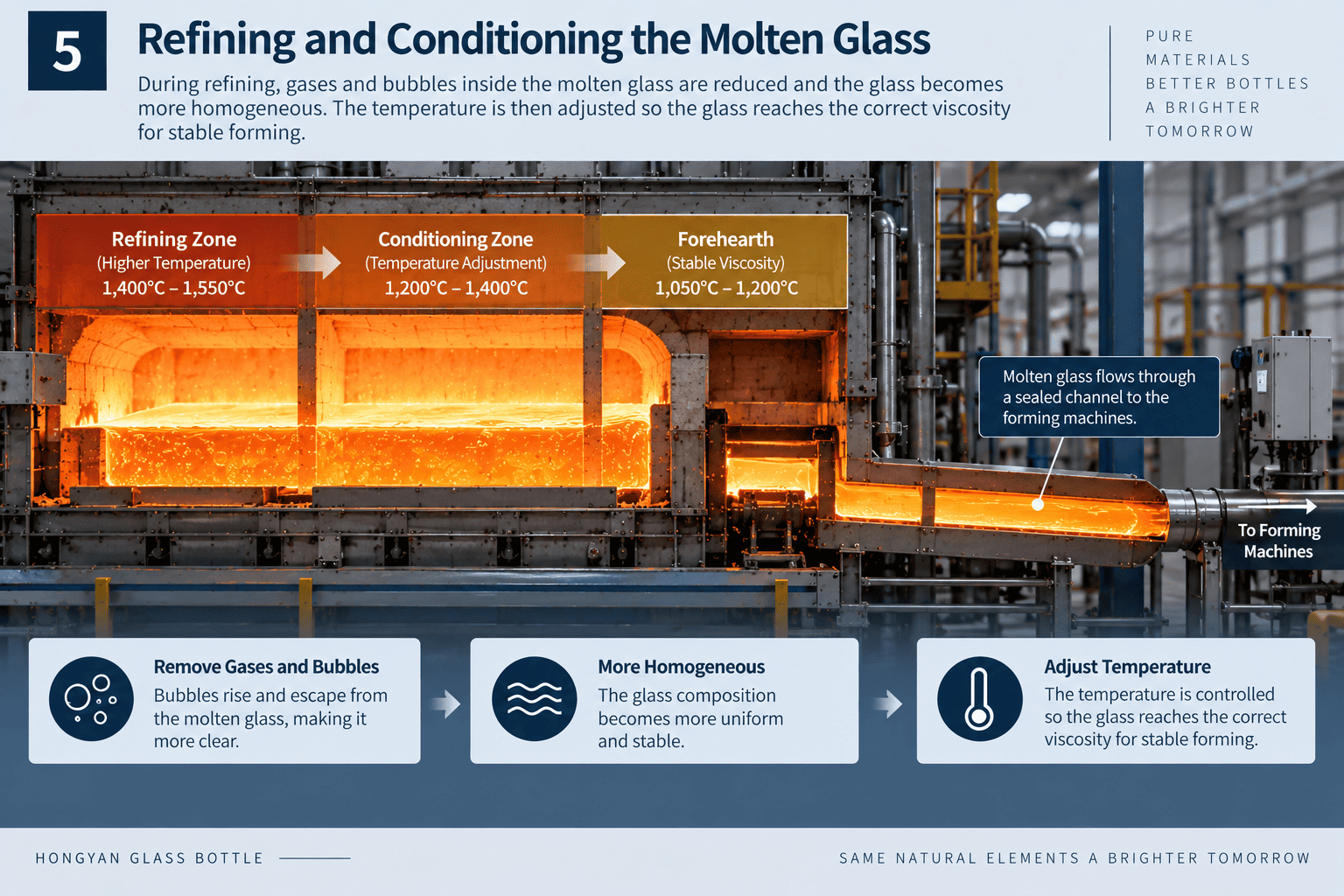
Melting does not mean the glass is ready for production. The molten material still needs to become more uniform before it enters the forming machine.
During refining, gases and bubbles inside the molten glass are reduced and the glass becomes more homogeneous. The temperature is then adjusted so the glass reaches the correct viscosity for stable forming.
Refining Directly Affects Bottle Appearance
This is an important stage for perfume packaging.
Poor refining can create:
| Defect | What It Looks Like | Why It Matters |
|---|---|---|
| Bubbles | Small gas pockets | Very visible in clear perfume glass |
| Stones | Hard inclusions | Can affect appearance and strength |
| Streaks | Uneven glass pattern | Reduces visual quality |
| Uneven transparency | Different optical appearance | Makes premium glass look unstable |
| Surface imperfections | Local defects | Can become more obvious after decoration |
Small bubbles can naturally appear in glass production.
The important point is not whether one tiny bubble exists.
The important point is the agreed quality standard.
A premium fragrance bottle normally has stricter visual requirements than a basic industrial bottle.
I prefer to confirm acceptable defect standards before production.
If a customer simply says, “I want perfect glass,” that is too general.
Glass is an industrial material.
The better approach is to define what sizes, quantities, and types of defects are acceptable.
This makes inspection more practical and reduces disagreements later.
How Is Molten Glass Cut Into Gobs?
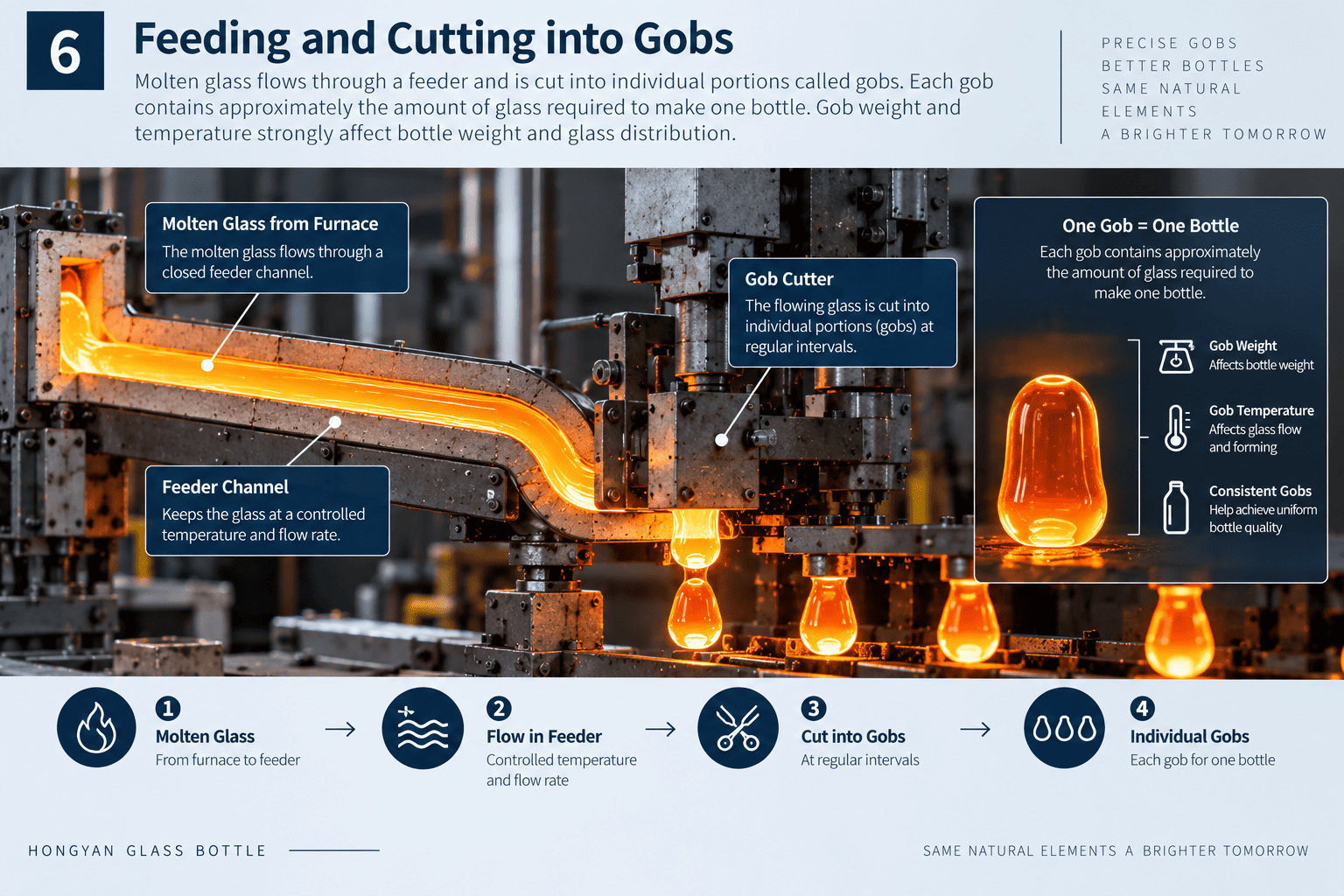
The forming machine does not receive one endless stream of glass. It receives one controlled portion for each bottle.
Molten glass flows through a feeder and is cut into individual portions called gobs. Each gob contains approximately the amount of glass required to make one bottle. Gob weight and temperature strongly affect bottle weight and glass distribution.
Why Gob Weight Is Important for Perfume Bottles
Bottle weight control starts before the glass enters the mold.
If the gob is too heavy, the bottle may contain too much glass.
If the gob is too light, some areas may become too thin.
| Gob Condition | Possible Result |
|---|---|
| Too heavy | Excess bottle weight or thick areas |
| Too light | Thin walls or incomplete forming |
| Uneven temperature | Poor glass distribution |
| Wrong shape | Unstable forming |
| Wrong timing | Production inconsistency |
Perfume customers often like heavy glass.
A heavy bottle can feel more premium in the hand.
But I always explain one important point.
Heavy does not automatically mean good.
Glass distribution is more important than total weight.
The glass needs to move correctly into the wall, shoulder, corners, neck, and bottom.
If one side is very thick and another side is thin, the bottle may still have a weak area.
A heavy bottom also needs good control.
Many perfume brands want a thick base because it creates a luxury feeling.
But if the bottom thickness is uneven, the bottle may look unbalanced.
The best result is not simply more glass.
The best result is controlled glass.
How Is a Glass Bottle Formed Inside a Mold?
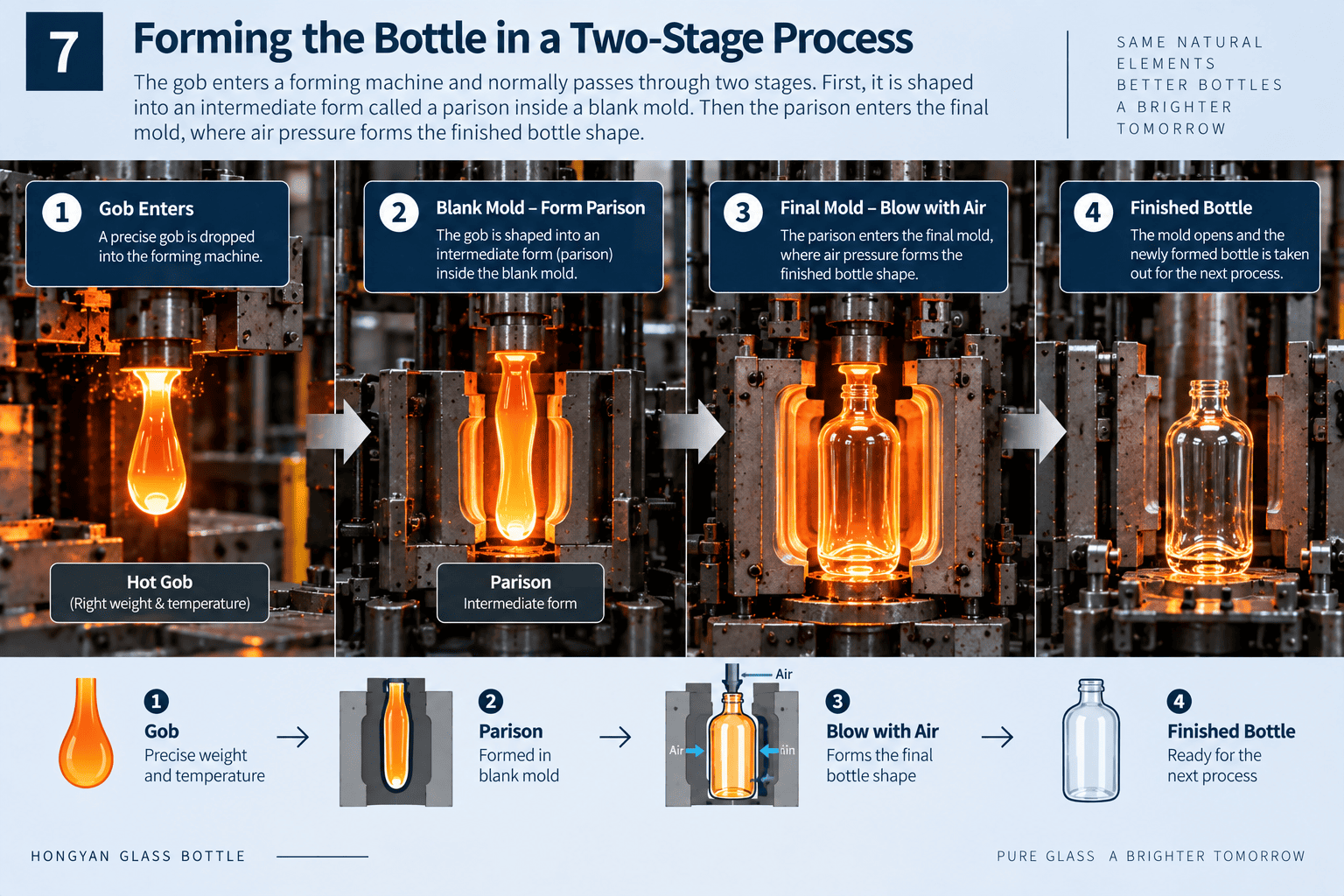
This is the stage where a glowing piece of molten glass becomes a recognizable bottle.
The gob enters a forming machine and normally passes through two stages. First, it is shaped into an intermediate form called a parison inside a blank mold. Then the parison enters the final mold, where air pressure forms the finished bottle shape.
Blow-and-Blow and Press-and-Blow Processes
Two common methods are used in glass container production.
Blow-and-Blow
Compressed air helps create the first parison.
The parison then enters the final mold.
Compressed air expands it again until the glass touches the mold surface.
This method is commonly associated with narrow-neck containers.
Press-and-Blow
A metal plunger helps form the first parison.
The bottle is then transferred into the final mold and finished with air pressure.
The exact forming method depends on several factors.
| Factor | Why It Matters |
|---|---|
| Bottle shape | Complex shapes change glass flow |
| Neck diameter | Affects forming method and tooling |
| Bottle weight | Changes glass distribution |
| Wall thickness | Must remain stable |
| Bottom design | Thick bases need more control |
| Mold structure | Determines the forming conditions |
| Production equipment | Different machines have different limits |
For a buyer, I do not think the most important question is always, “Which forming method are you using?”
The better question is:
Can the factory keep the bottle dimensions, weight, neck, bottom, wall thickness, and appearance stable in mass production?
That is what finally affects your packaging.
Why Is the Perfume Bottle Neck So Important?
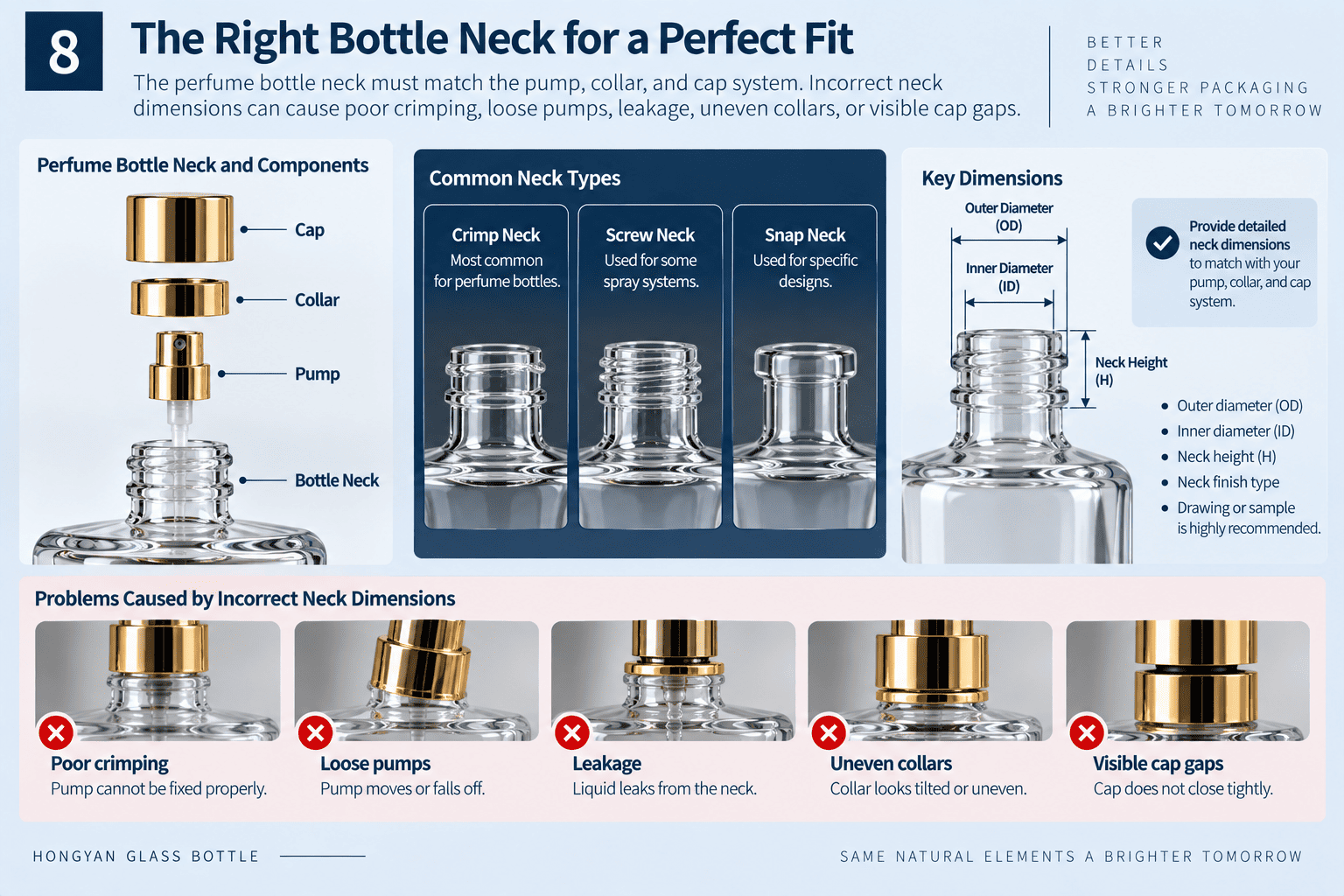
A perfume bottle can look perfect and still fail during assembly. The neck is one of the most important functional areas of the whole package.
The perfume bottle neck must match the pump, collar, and cap system. Incorrect neck dimensions can cause poor crimping, loose pumps, leakage, uneven collars, or visible cap gaps.
I Treat the Bottle, Pump, Collar, and Cap as One System
This is one of the strongest lessons I have learned from perfume packaging projects.
Customers sometimes source the bottle from one supplier.
Then they source the pump from another supplier.
Then they buy a cap somewhere else.
Each part looks correct on paper.
But after everything arrives, they discover that the parts do not fit well together.
Possible problems include:
- Pump cannot be installed correctly
- Crimping is unstable
- Collar does not sit flat
- Pump becomes loose
- Perfume leaks
- Cap gap looks uneven
- Cap height looks wrong
- The finished package looks unbalanced
This is why I prefer to confirm the bottle neck, pump, collar, and cap together.
Different projects may use crimp necks or screw necks.
The exact neck structure depends on the pump system and packaging design.
For custom perfume bottle development, I recommend confirming the neck specification before the final glass mold is made.
Once a production mold is finished, changing the neck structure can create extra cost and delays.
The body creates the visual identity.
The neck protects the function.
Both matter.
Why Does the Bottle Need Annealing?
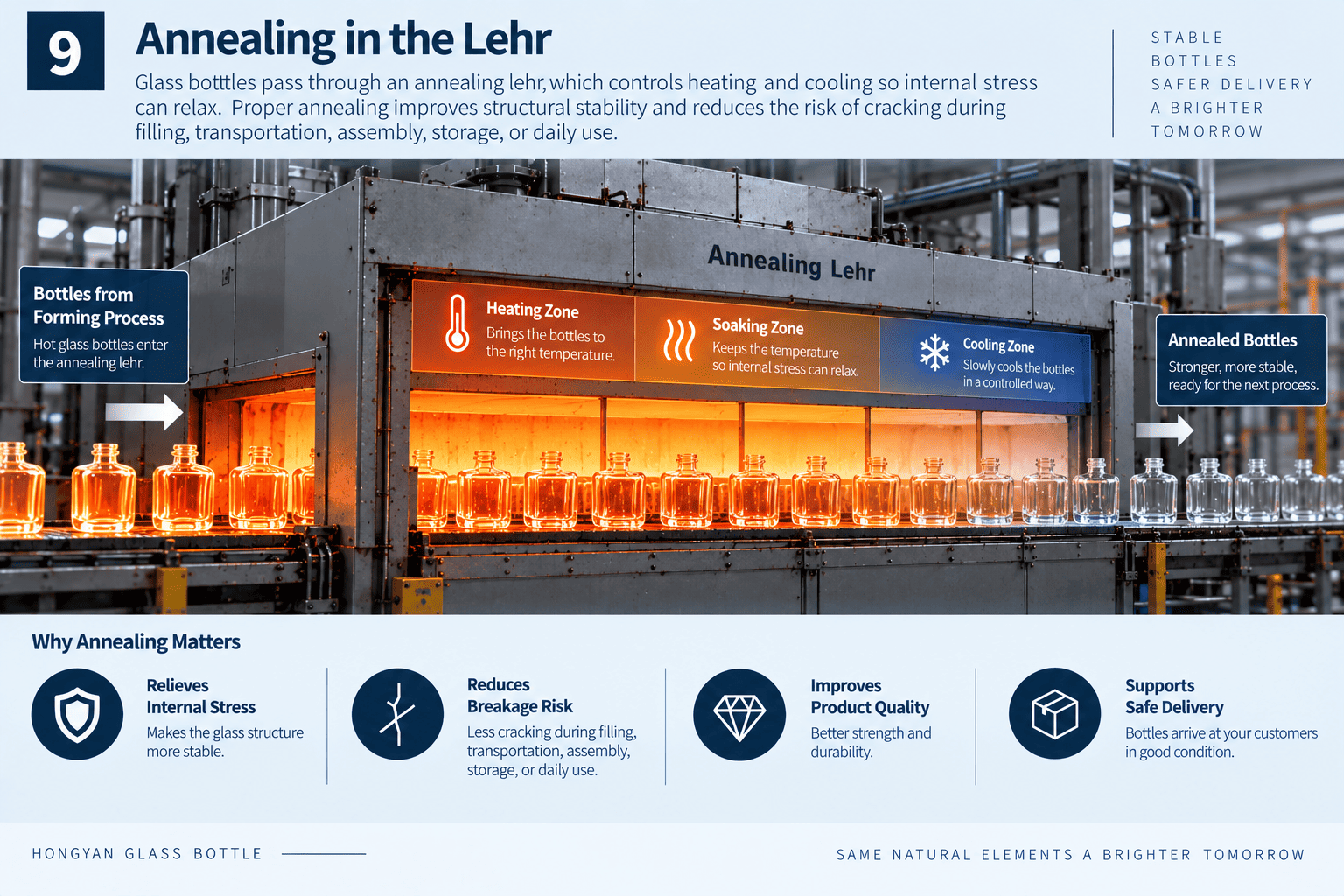
The bottle may already look finished when it leaves the mold, but the glass still contains internal stress.
Glass bottles pass through an annealing lehr, which controls heating and cooling so internal stress can relax. Proper annealing improves structural stability and reduces the risk of cracking during filling, transportation, assembly, storage, or daily use.
Thick Perfume Bottles Need Careful Cooling
Different parts of a bottle cool at different speeds.
A thin wall cools faster.
A thick bottom cools more slowly.
If the temperature drops too quickly, different parts of the glass contract at different rates.
This creates internal stress.
The bottle may look completely normal.
But it can become more vulnerable to cracking later.
| Cooling Problem | Possible Risk |
|---|---|
| Cooling too quickly | Higher internal stress |
| Uneven cooling | Weak areas |
| Poor temperature control | Inconsistent bottle strength |
| Poor annealing | Greater risk during later handling |
Perfume bottles often have more glass in the base than many standard containers.
This creates a more premium appearance.
But it also makes cooling control more important.
The annealing lehr slowly brings the bottle temperature down.
The bottle passes through controlled temperature zones instead of cooling suddenly in open air.
Customers rarely see this process.
But it can have a major influence on bottle reliability.
This is also why I do not judge bottle strength only by weight.
A heavy bottle can still have stress problems.
Proper annealing matters.
How Are Glass Bottles Inspected After Production?
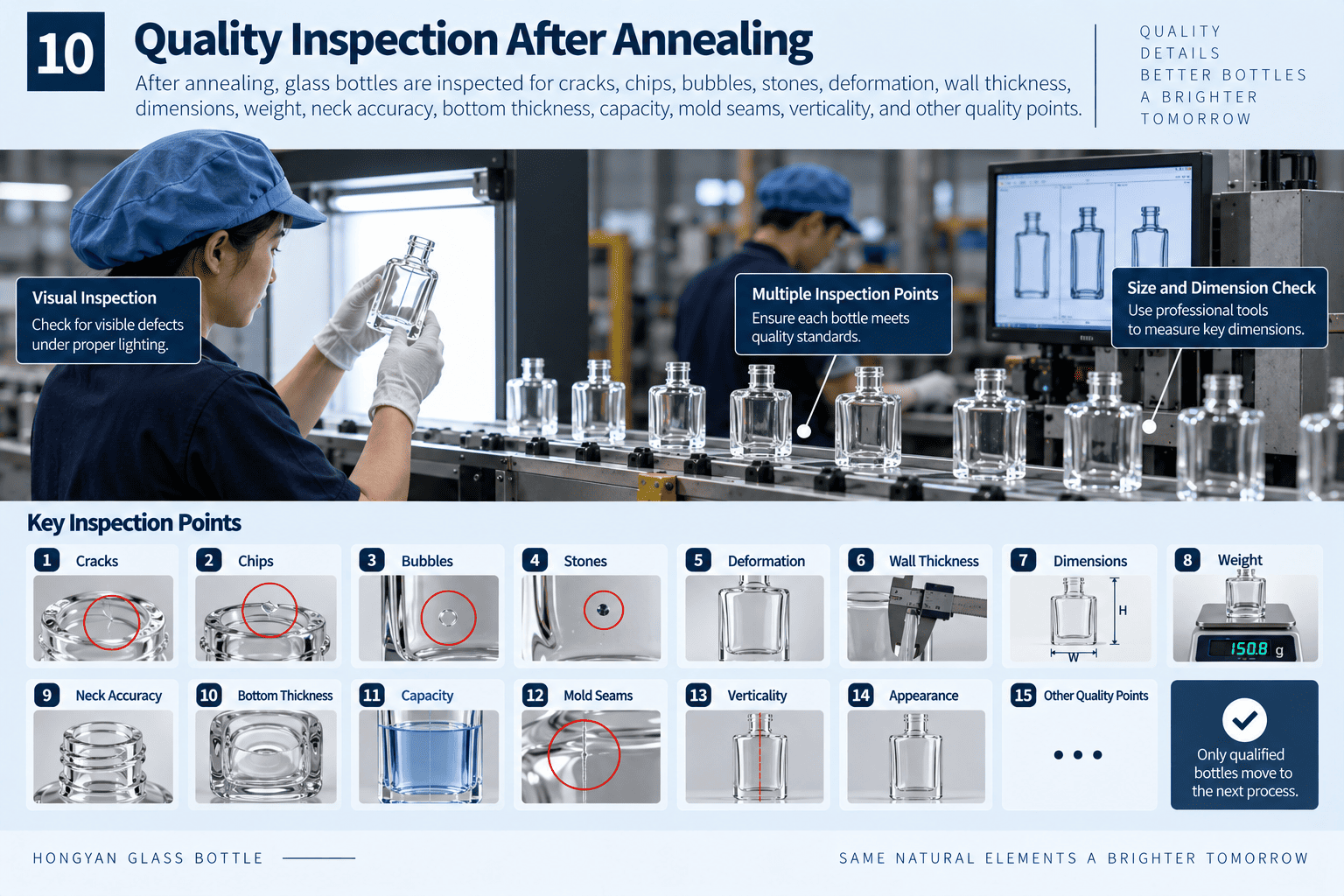
Industrial glass production always has tolerances. The important issue is whether the factory can detect unacceptable defects before shipment.
After annealing, glass bottles are inspected for cracks, chips, bubbles, stones, deformation, wall thickness, dimensions, weight, neck accuracy, bottom thickness, capacity, mold seams, verticality, and other quality points.
Common Defects I Watch for in Perfume Bottles
Perfume bottles normally need stricter visual control because the packaging is part of the brand image.
Here are some defects I usually pay attention to.
| Defect | Why I Check It |
|---|---|
| Air bubbles | Large bubbles reduce visual quality |
| Stones | Can affect appearance and structure |
| Black spots | Very visible in transparent glass |
| Uneven glass | Can affect appearance and strength |
| Heavy mold line | Makes the bottle feel less premium |
| Uneven bottom | Affects visual balance |
| Neck deformation | Can create pump assembly problems |
| Scratches | Become more obvious after decoration |
| Poor verticality | Bottle may look tilted |
| Size variation | Can affect caps and collars |
Not Every Bubble Means the Bottle Is Defective
This is an important detail.
Glass is not plastic.
Very small bubbles can naturally appear during production.
The correct question is not:
“Does the bottle contain any bubble?”
The better question is:
“What bubble size and quantity are acceptable for this project?”
Premium perfume packaging normally requires stricter limits.
A low-cost promotional bottle may allow more variation.
The quality standard should match the market positioning.
I prefer to define this clearly before mass production.
It makes communication much easier.
Is Making a Clear Glass Bottle the Final Step?
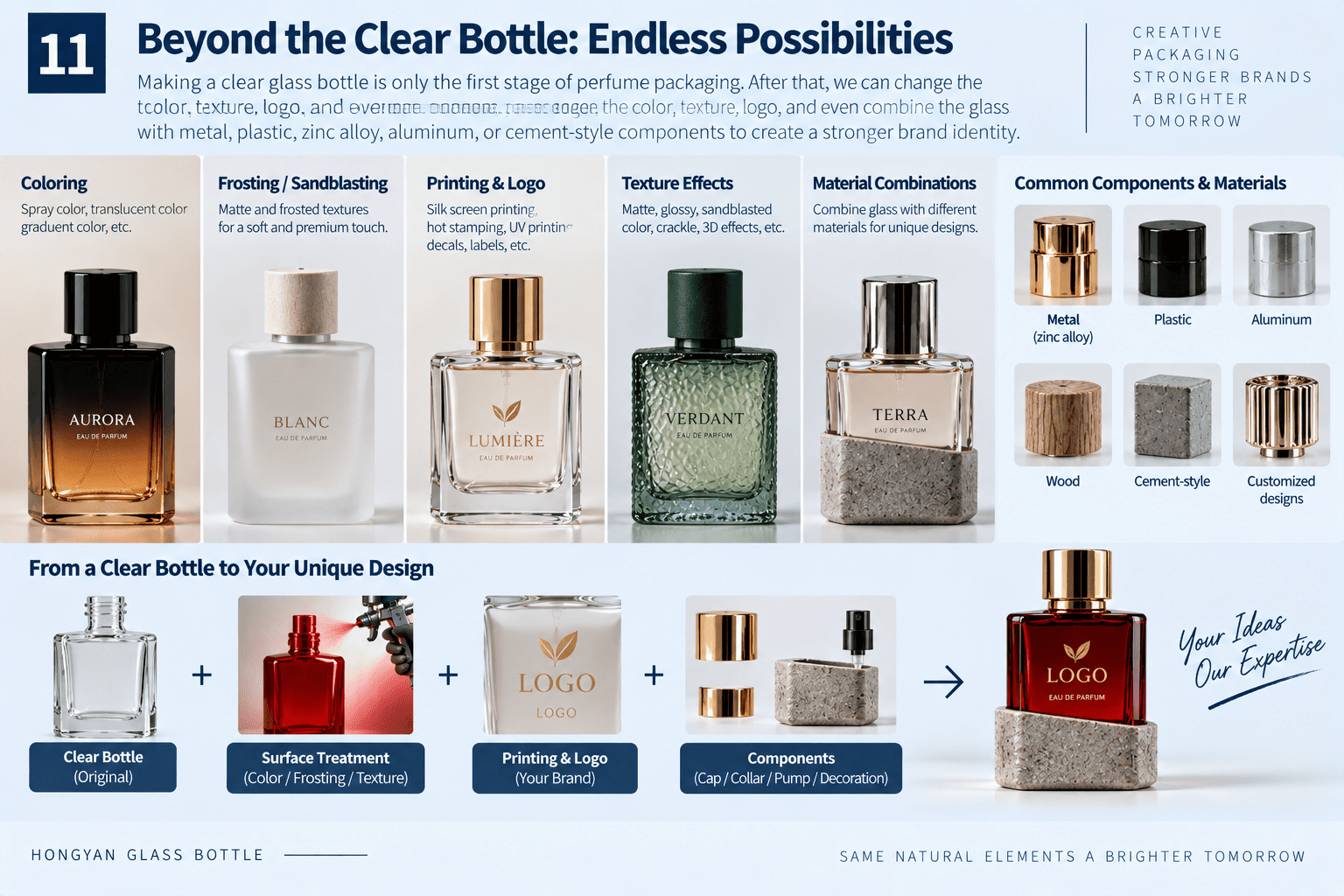
For perfume packaging, this is where I think many people misunderstand glass bottle manufacturing. A good transparent bottle is important, but it is only the starting point.
Making a clear glass bottle is only the first stage of perfume packaging. After that, we can change the color, texture, logo, and even combine the glass with metal, plastic, zinc alloy, aluminum, or cement-style components to create a stronger brand identity.
I See the Clear Bottle as a Raw Canvas
When a transparent perfume bottle comes off the glass production line, I do not see it as the finished package.
I see it as the original model.
It gives us the basic shape, capacity, weight, neck, and structure.
After that, we can start building the visual language of the brand.
This is one of the parts of perfume packaging that I enjoy most.
The same transparent bottle can become ten very different products after we change the surface treatment and accessories.
We can change its color.
We can change how light passes through the glass.
We can make the surface glossy, matte, frosted, metallic, rough, soft, or more industrial.
We can add a logo.
We can add a decorative component around the shoulder, base, cap, or bottle body.
We can also introduce a completely different material.
This is where a simple glass container starts to carry a brand story.
For example, a clean transparent bottle with a small black logo may communicate simplicity.
A frosted bottle with a soft beige cap may feel calm and natural.
A black bottle with gold metal components may communicate luxury.
A bottle combined with cement-gray material may feel architectural, raw, or modern.
The glass bottle gives us the structure.
The [finishing processe][2]s give us the personality.
What Surface Finishes Can Be Added to a Perfume Bottle?
A clear bottle has limited visual information. Surface finishing allows us to add color, texture, graphics, and brand details without changing the original glass mold.
Common perfume bottle finishing methods include frosting, sandblasting, spray coating, water transfer printing, heat transfer printing, silk-screen printing, hot stamping, silver stamping, decals, metallization, and other decorative coatings.
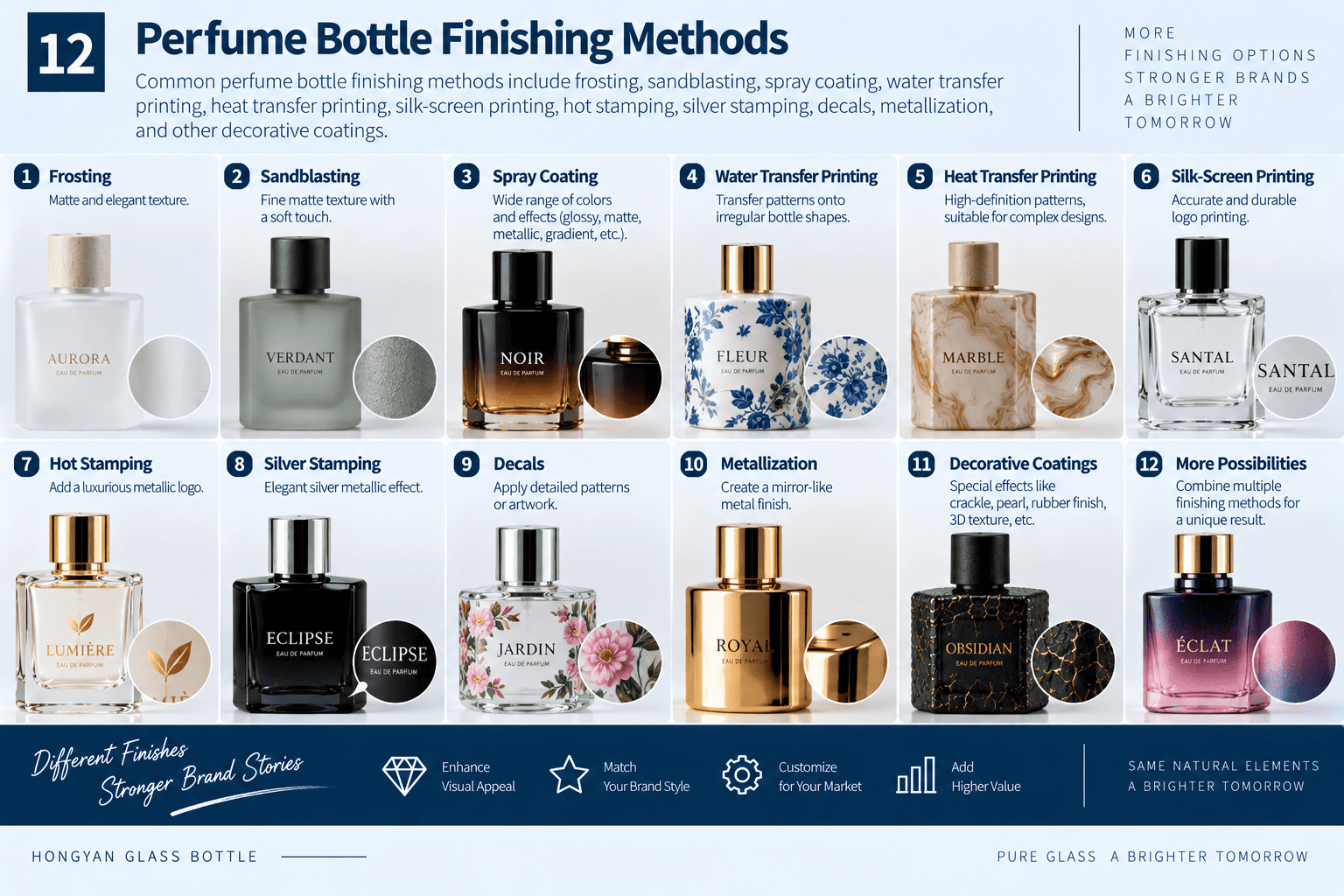
Different Processes Create Different Visual Languages
Here are some of the processes we often work with.
| Process | What It Changes | Typical Brand Effect |
|---|---|---|
| Spray coating | Glass color | Flexible brand color |
| Frosting | Surface transparency and touch | Soft and premium |
| Sandblasting | Surface texture | Matte and tactile |
| Water transfer printing | Graphic pattern | Complex decorative effect |
| Heat transfer printing | Graphic and color | Detailed branding |
| Silk-screen printing | Logo and text | Clean direct branding |
| Hot stamping | Metallic logo | Premium gold effect |
| Silver stamping | Metallic logo | Modern silver effect |
| Decal | Detailed graphics | Flexible visual design |
| Metallization | Reflective surface | Strong luxury appearance |
Color spraying is one of the most useful tools.
A brand may already like one of our existing bottle shapes.
The shape does not need to change.
We can simply give the bottle a completely different character through color.
We can use solid colors.
We can use transparent colors.
We can create gradients.
We can also combine clear and colored areas.
Frosting and sandblasting change the feeling in another way.
They reduce the transparent appearance and create a softer surface.
This can make even a very simple bottle feel more refined.
Logo processing is also important.
A logo is small, but it often becomes the most direct link between the bottle and the brand.
We can use screen printing for a clean logo.
We can use gold or silver hot stamping when the brand wants more shine.
We can also use transfer processes when the graphic is more complex.
I do not think one process is always better than another.
The right process depends on the story the brand wants the bottle to tell.
How Can Different Materials Be Combined With Glass?
Glass does not need to work alone. Some of the most interesting perfume packages I see today use glass as the center and then combine it with completely different materials.
Perfume bottles can be decorated with components made from zinc alloy, plastic, aluminum alloy, cement-style materials, and other materials. These components can change the bottle's texture, weight, contrast, and overall brand character.
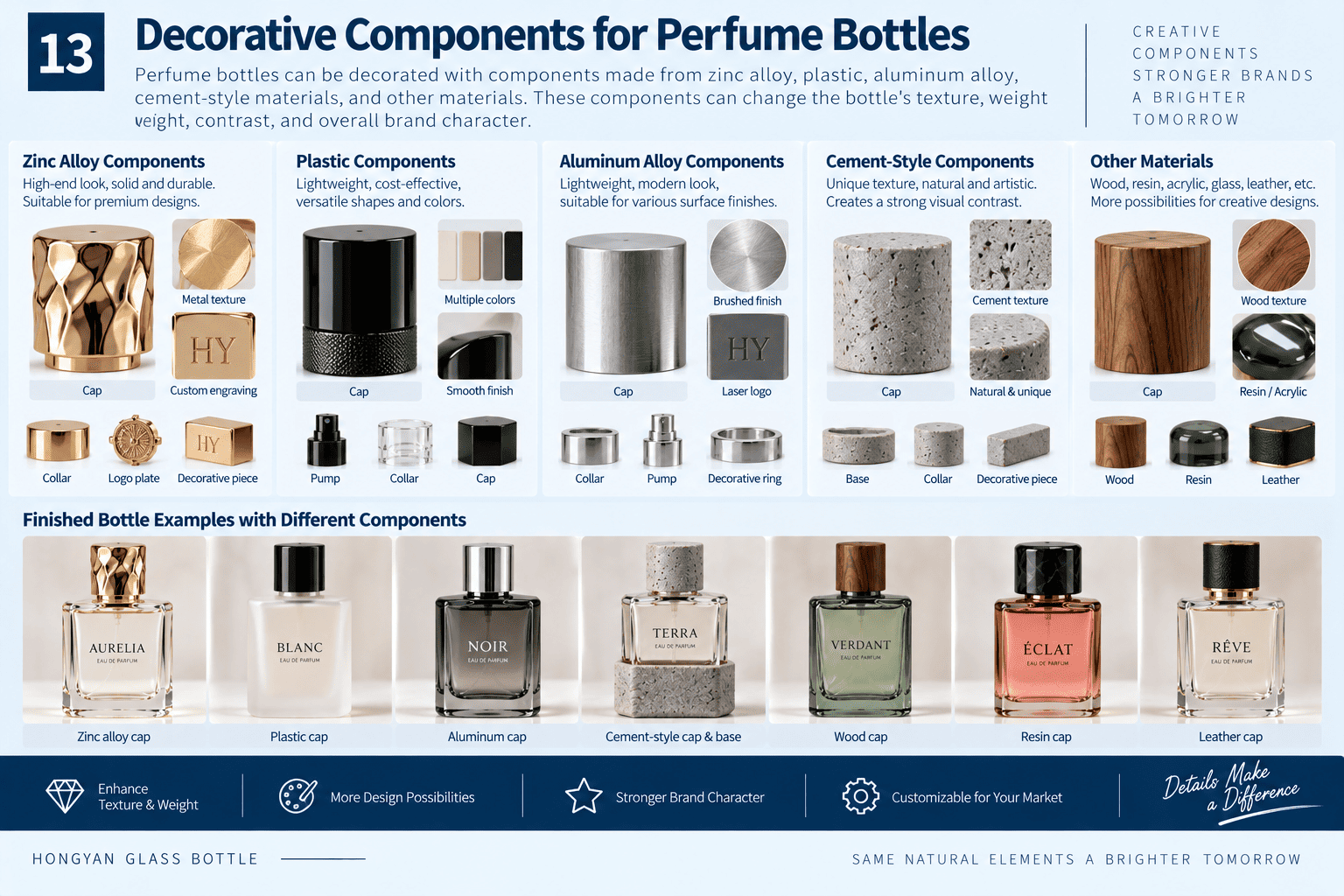
Material Contrast Can Make a Simple Bottle Feel Unique
This is another area where I think brands have a lot of room to be creative.
Many customers think customization means changing the glass mold.
I do not think that is always necessary.
Sometimes the bottle itself can stay simple.
We can create uniqueness by building other materials around it.
For example, we may add a zinc alloy decorative component.
Zinc alloy has a solid and heavy feeling.
It works well when the brand wants a more premium or sculptural appearance.
We can use aluminum alloy when we want a cleaner metallic feeling.
Aluminum can work well on collars, caps, or decorative shells.
Plastic gives us more flexibility.
It can be molded into many shapes.
It can also help control weight and cost.
Then there are newer decorative directions, such as cement-gray or cement-style components.
These materials create a very different visual feeling from traditional perfume packaging.
They can feel raw.
They can feel architectural.
They can feel industrial.
They can also help a niche perfume brand create a visual identity that feels less traditional.
| Material | Main Character | Possible Application |
|---|---|---|
| Zinc alloy | Heavy and premium | Decorative plates, caps, components |
| Aluminum alloy | Clean and metallic | Caps, collars, shells |
| Plastic | Flexible and cost-effective | Caps, inserts, decorative parts |
| Cement-style material | Raw and architectural | Caps, bases, outer components |
| Glass | Clear, solid, premium | Main bottle structure |
The key is not to add materials just because we can.
Every material should support the brand concept.
If the fragrance story is about nature, softness, and calm, a heavy shiny metal component may not be the best choice.
If the brand story is about architecture, concrete, and city life, a cement-style cap may make much more sense.
This is why I see perfume bottle development as more than manufacturing.
It is also visual storytelling.
How Can Decoration Help Tell a Perfume Brand Story?
A fragrance is invisible. The packaging has to give the customer the first clue about what the scent and brand are trying to say.
Bottle color, texture, logo treatment, cap material, metal details, and decorative components can all communicate a perfume brand's mood before the customer smells the fragrance.
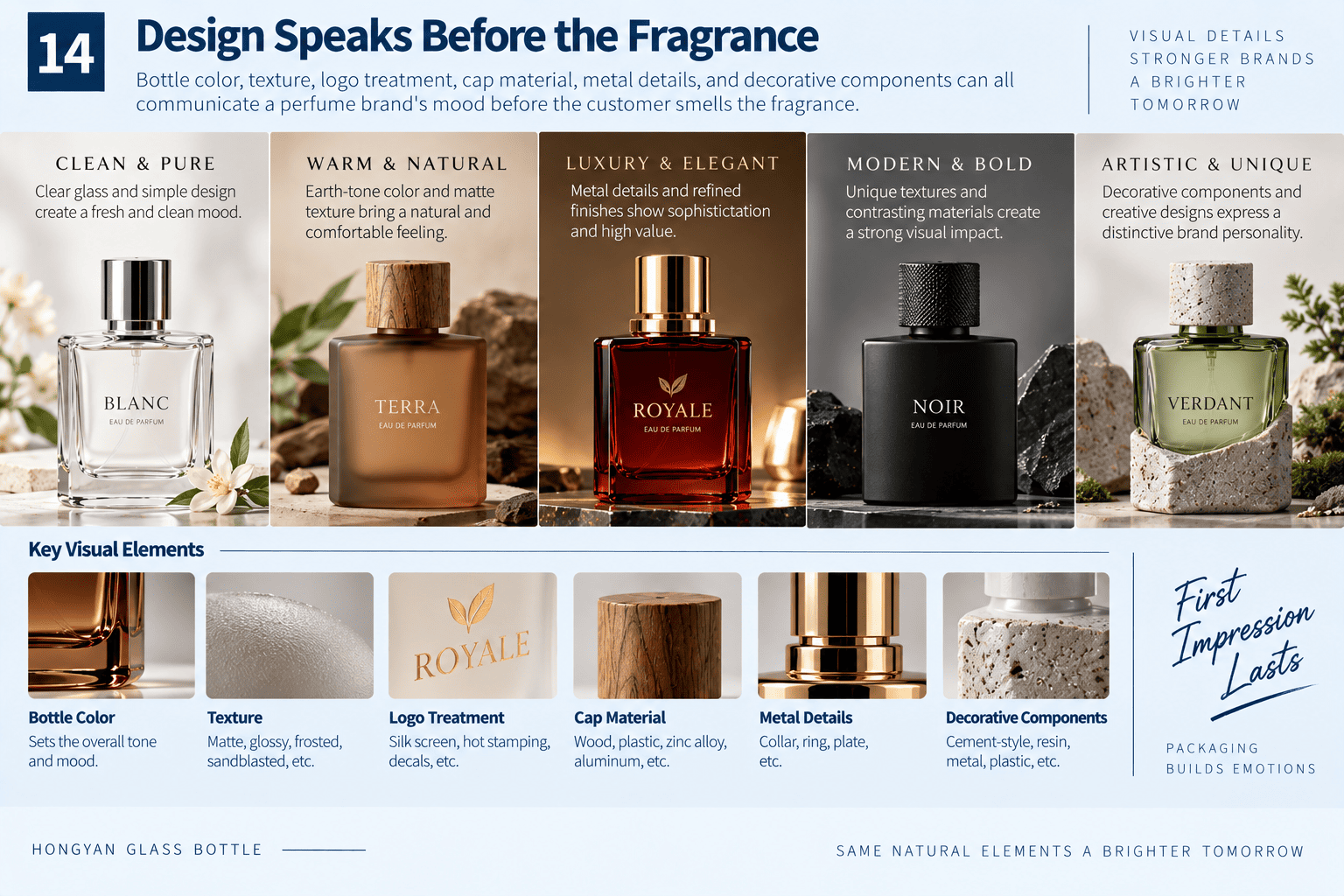
The Bottle Should Speak Before the Customer Smells the Perfume
This is one of my personal views about perfume packaging.
Perfume is very different from many other products.
A customer cannot understand the fragrance from an online image.
They cannot smell the perfume through an e-commerce page.
So the bottle has to do more work.
The packaging needs to give the customer clues.
Color can give one clue.
Texture can give another.
The weight can also give a clue.
The cap material can change the feeling again.
A transparent bottle with pale pink liquid may feel romantic.
A dark bottle with matte black coating may feel mysterious.
A clear bottle with brushed aluminum may feel technical and modern.
A heavy glass bottle with a zinc alloy decoration may feel more luxurious.
A simple bottle with a cement-gray cap may feel artistic or architectural.
This is why I do not see decoration as something we add at the end just to make the bottle look nicer.
Decoration is part of the product message.
The glass bottle is the base.
The color, logo, texture, and material combination help turn that base into a brand asset.
For smaller perfume brands, this is especially useful.
They may not have the budget or order quantity for a completely custom glass mold.
But they can still build a recognizable packaging language through decoration and material combinations.
That gives them much more freedom than many new brands first realize.
What Changes When I Develop a Custom Perfume Bottle Mold?
A custom bottle needs more work before glass production starts. A beautiful 3D rendering is not automatically a production-ready bottle.
Custom perfume bottle development usually includes design review, dimension confirmation, neck confirmation, glass weight evaluation, technical drawings, 3D prototyping, mold development, glass sampling, accessory testing, and final approval before mass production.
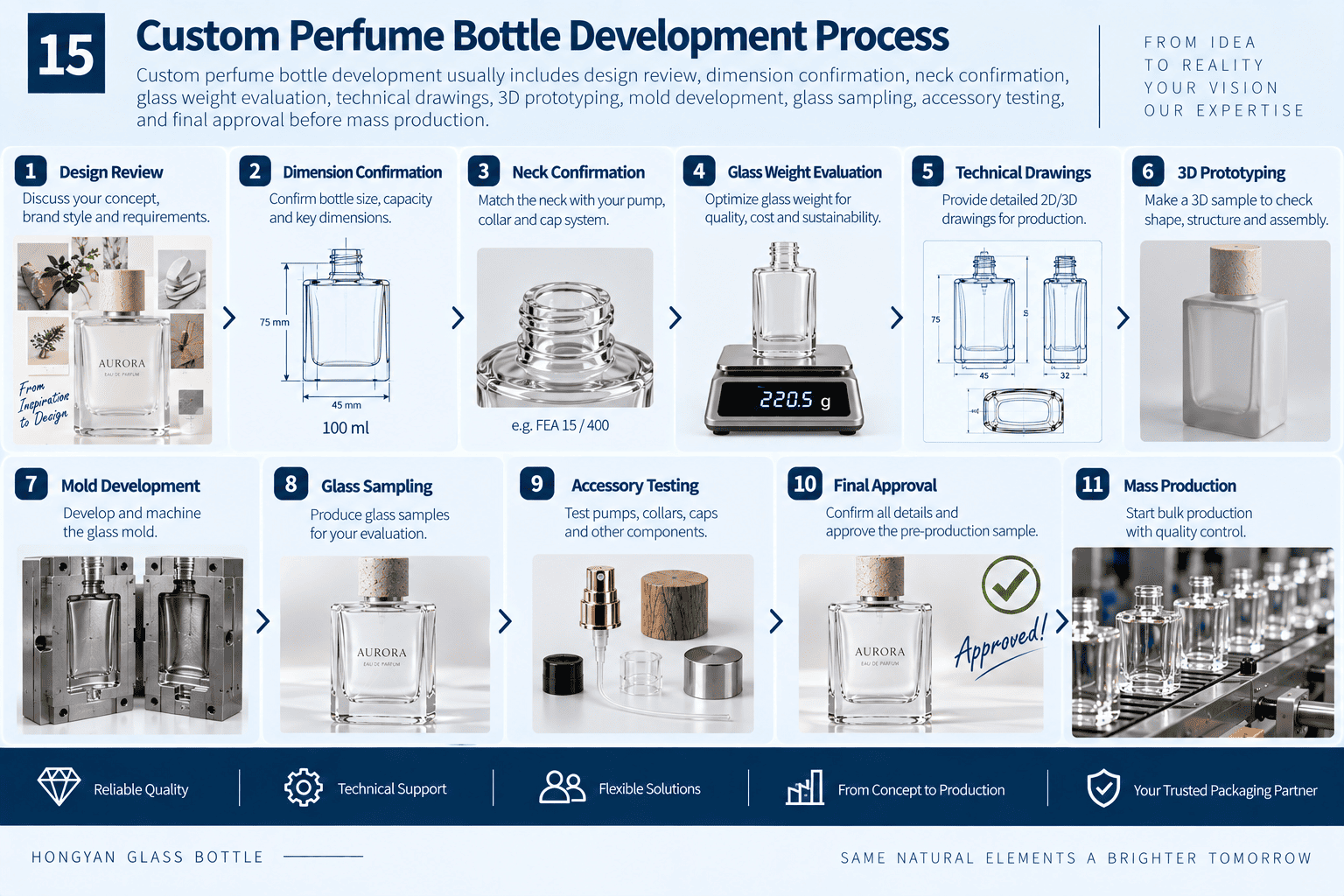
I First Check Whether the Design Can Actually Be Made in Glass
This is where many new brands misunderstand the process.
AI images and 3D renderings can create very attractive bottle shapes.
But molten glass has physical limits.
Some designs need changes to:
- Corners
- Shoulder angles
- Wall thickness
- Bottom structure
- Neck connection
- Glass weight
- Surface detail
- Embossed logos
A sharp corner may look beautiful in a rendering.
But it may be difficult for molten glass to fill consistently.
A very heavy base may look premium.
But it can create difficult glass distribution.
A tiny embossed logo may look clear on a computer screen.
But it may not appear clearly in real glass.
This is why we support 3D prototyping before final glass tooling.
A [3D sample][3] is not the same material as glass.
But it allows the customer to check bottle size, proportions, cap relationship, shape, and visual balance before paying for the final mold.
For me, the goal is not to change the designer's idea.
The goal is to keep the original idea while making it stable for mass production.
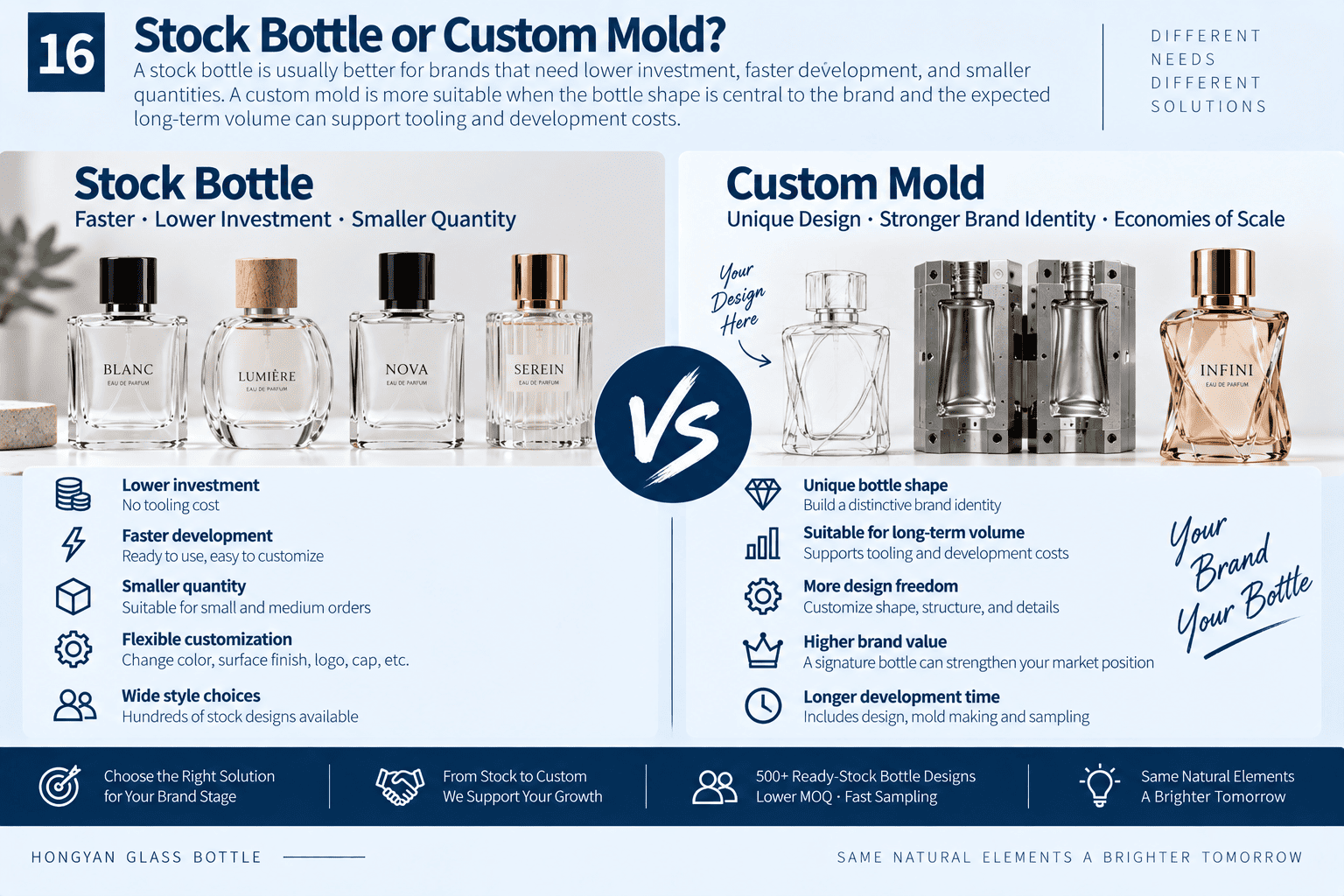
Should a New Perfume Brand Use a Stock Bottle or Custom Mold?
Many new brands spend too much money on glass tooling before they know whether the fragrance will sell.
A stock bottle is usually better for brands that need lower investment, faster development, and smaller quantities. A custom mold is more suitable when the bottle shape is central to the brand and the expected long-term volume can support tooling and development costs.
I Usually Recommend a Step-by-Step Packaging Strategy
There is no single correct answer.
It depends on the brand stage.
| Option | Best For | Main Advantage |
|---|---|---|
| Stock bottle | New brands | Faster and lower risk |
| Stock bottle + decoration | Growing brands | Strong branding without custom tooling |
| Stock bottle + custom accessories | Brands needing differentiation | More unique look without new glass mold |
| Custom mold | Established or differentiated brands | Unique bottle structure |
| 3D sample before mold | Custom projects | Helps verify proportions before tooling |
For many small and medium fragrance brands, I like this strategy:
Existing bottle → surface decoration → customized accessories → market test → custom bottle mold
I think this is especially useful for e-commerce fragrance brands.
The first goal should be to prove that customers like the fragrance, brand story, price, and overall presentation.
The brand can still create differentiation through:
- Custom spray colors
- Frosting
- Sandblasting
- Water transfer printing
- Heat transfer printing
- Logo printing
- Gold or silver hot stamping
- Zinc alloy decorations
- Aluminum components
- Plastic components
- Cement-style accessories
- Custom caps
- Collars
- Boxes
- Labels
This gives a brand many design possibilities without immediately opening a completely new bottle mold.
After the product develops stable sales, the brand can invest in a unique glass bottle.
This reduces risk.
It also allows the packaging to evolve together with the business.
At Hongyan Glass Bottle, we have more than 500 perfume glass bottle styles available from stock or existing molds.
For me, these bottles are not 500 finished designs.
They are more like 500 starting points.
Once we add different colors, surface treatments, logos, caps, metal parts, plastic parts, or other decorative components, one bottle can develop into many different visual directions.
Our mission is to give small and medium perfume brands a cost-effective packaging solution.
I do not believe every customer needs the most expensive packaging option.
I believe the packaging solution should match the brand stage, target market, selling price, order volume, and brand story.
What Should I Confirm Before Glass Bottle Production?
Many packaging problems begin because important details were never clearly confirmed before production.
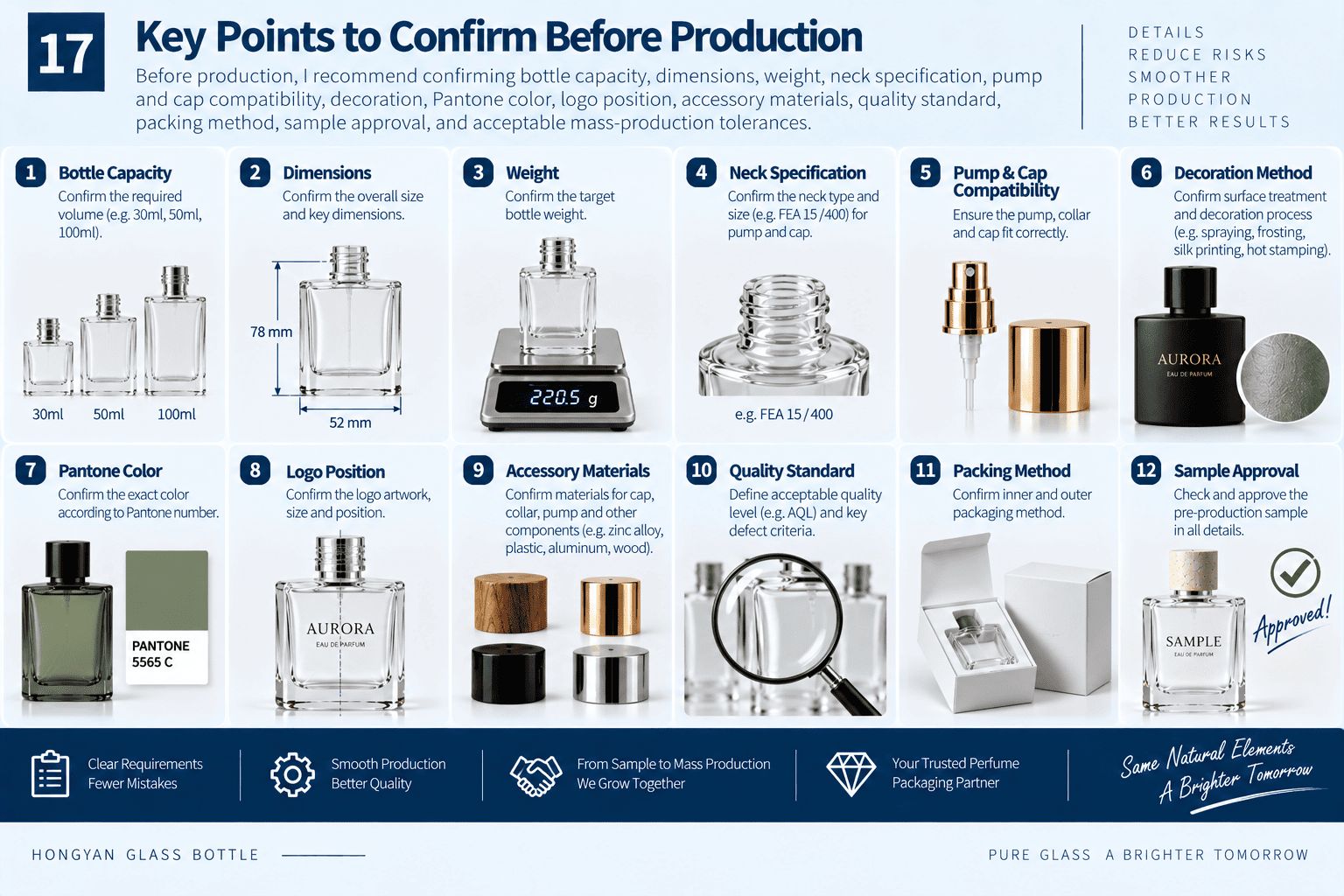
Before production, I recommend confirming bottle capacity, dimensions, weight, neck specification, pump and cap compatibility, decoration, Pantone color, logo position, accessory materials, quality standard, packing method, sample approval, and acceptable mass-production tolerances.
My Practical Pre-Production Checklist
Before I move a perfume packaging project into production, I want to confirm more than the bottle design.
I normally look at the full system.
| Item | What I Confirm |
|---|---|
| Capacity | Actual filling volume |
| Dimensions | Height, width, and key tolerances |
| Bottle weight | Target weight |
| Neck | Crimp or screw specification |
| Pump | Compatibility with bottle neck |
| Collar | Fit and final visual gap |
| Cap | Size, height, material, and alignment |
| Glass | Transparency and defect standard |
| Color | Pantone or approved sample |
| Logo | Position, size, and method |
| Decoration | Spray, frost, sandblast, print, transfer, or metal effect |
| Accessories | Zinc alloy, plastic, aluminum, cement-style, or other materials |
| Quality | Agreed inspection standard |
| Packing | Carton, tray, partition, or individual protection |
| Sample | Final approved reference |
| Tolerance | Acceptable mass-production variation |
This step is not exciting.
But it can save a lot of problems later.
The more details we confirm before production, the fewer surprises appear during assembly.
For perfume packaging, I do not like treating the glass bottle, pump, cap, decoration, and accessories as separate products.
I prefer to treat them as one packaging system.
The transparent glass bottle is the starting structure.
The surface process adds color and texture.
The logo adds recognition.
The accessories add another layer of material and personality.
Together, these elements help the customer understand the brand before they even smell the fragrance.
That is also why we provide one-stop perfume packaging support.
A complete package needs to work together.
It also needs to tell one clear story.
Conclusion
A clear glass bottle is only the beginning. I use color, texture, logos, and different materials to turn that basic bottle into packaging that communicates the fragrance brand's story.