
A beautiful perfume bottle can still disappoint customers when the [pump leaks][[1]], blocks, sprays unevenly, or feels uncomfortable during daily use.
Perfume bottle dispensing mechanisms control dosage, spray quality, liquid flow, portability, and user experience. Fine mist pumps suit most alcohol-based perfumes, rollerballs suit portable fragrance oils, and droppers suit special concentrated formulas.
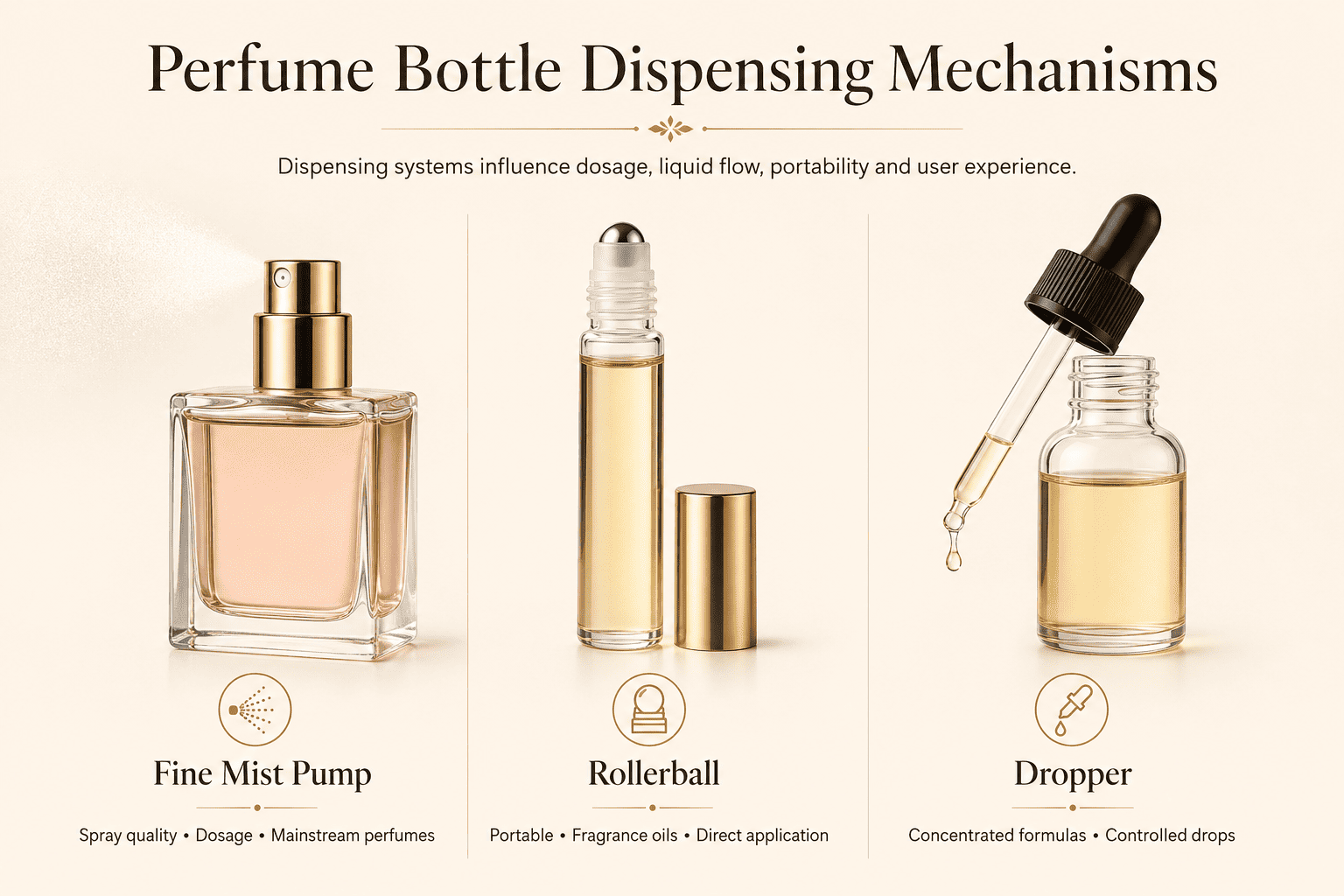
When I help a perfume brand choose packaging, I never look at the bottle alone. I also check the dispensing mechanism. A pump, rollerball, or dropper may look like a small component, but it directly touches the formula and the customer.
The right mechanism must match the perfume concentration, bottle neck, target market, retail price, filling method, and expected user experience. The flow performance also depends on several connected parts. A problem rarely comes from only one component.
What Parts Inside a Fine Mist Perfume Pump Affect Spray Quality?
A fine [mist pump][[2]] contains several small parts. A weak part can cause poor suction, uneven mist, leakage, slow return, or complete pump failure.
A fine mist perfume pump normally includes a nozzle, actuator, dip tube, housing, valve ball, spring, gasket, and sealing structure. These parts work together to control suction, pressure, dosage, and atomization.
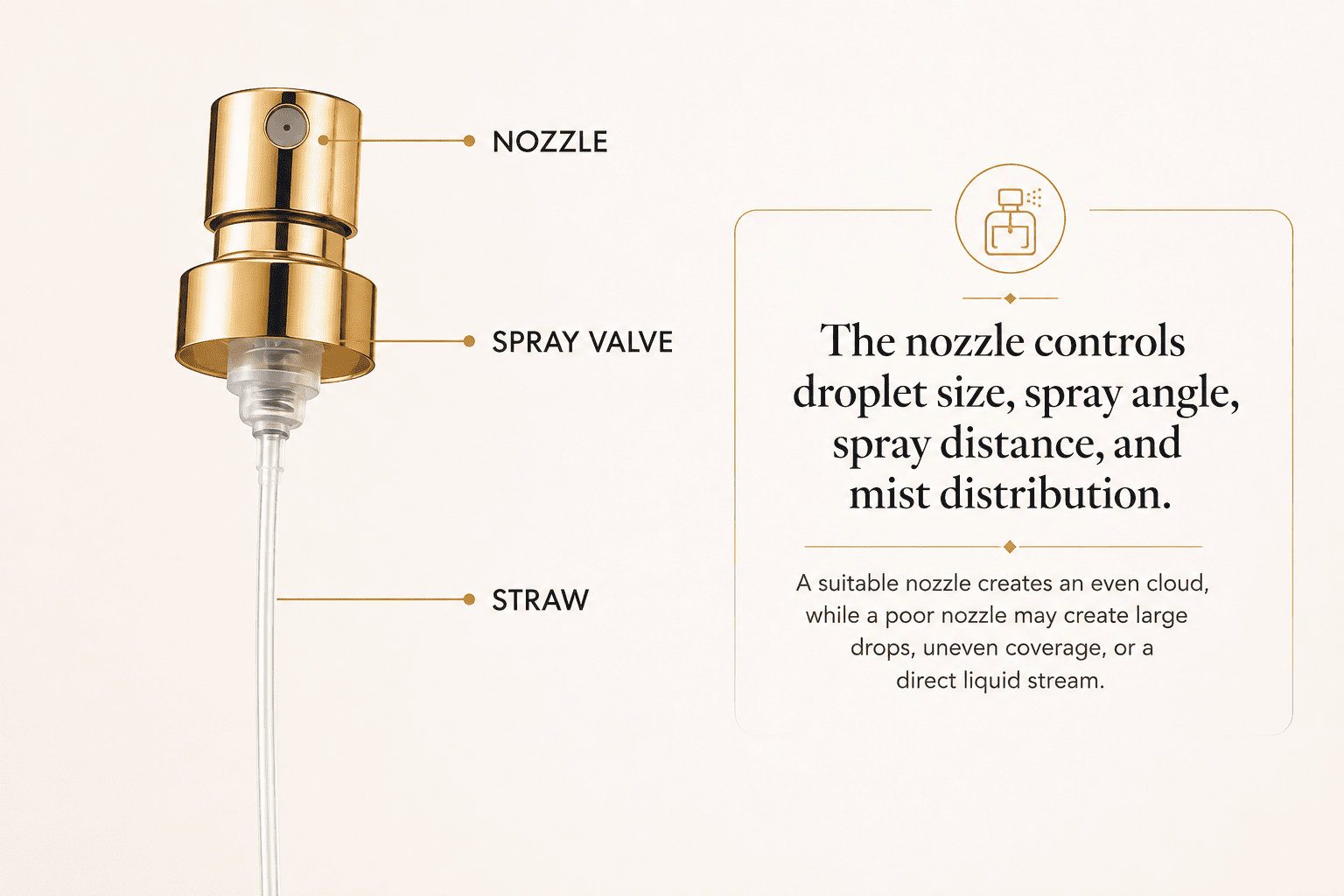
How the Fine Mist Pump Works
When the customer presses the actuator, the spring and piston create pressure inside the pump chamber. The liquid moves from the chamber to the nozzle. The nozzle then breaks the liquid into small droplets.
When the customer releases the actuator, the spring pushes the system back to its original position. The valve opens, and new perfume enters the chamber through the dip tube.
This process happens in a very short time. However, every part must work at the correct speed and pressure.
If the valve does not seal correctly, the pump may lose suction. If the spring is too weak, the actuator may return slowly. If the nozzle is not suitable for the formula, the perfume may come out as large drops or a straight liquid stream.
| Pump component | Main function | Possible problem |
|---|---|---|
| Actuator | Transfers finger pressure | Hard or uncomfortable pressing |
| Nozzle | Creates the spray pattern | Large drops or liquid stream |
| Dip tube | Draws perfume from the bottle | Air intake or remaining liquid |
| Valve ball | Controls liquid entry | Weak suction or slow flow |
| Spring | Controls pressure and return | Slow return or poor atomization |
| Gasket | Creates a seal | Leakage or evaporation |
| Housing | Holds the pump system | Cracking or formula reaction |
Why the Dip Tube Matters
The dip tube carries perfume from the bottom of the bottle to the pump chamber. It looks simple, but its material, length, diameter, and cutting angle all affect performance.
I normally work with two common dip tube options. One is a standard dip tube. The other is an invisible dip tube.
A standard dip tube is usually transparent or slightly white. Customers can see it inside a clear bottle. This option is common because it has a stable supply and a lower cost.
An [invisible dip tube][[3]] has a special optical effect. It becomes less visible after the bottle is filled. Many premium brands prefer this option because the bottle looks cleaner.
However, the tube does not always become completely invisible. The final effect depends on the perfume color, refractive index, tube material, wall thickness, and lighting conditions.
I always suggest testing the real perfume inside the final bottle. A tube that looks invisible in water may still be visible in a colored or oily formula.
The tube length must also match the bottle height. A tube that is too short cannot reach the liquid near the bottom. A tube that is too long may bend too much. The bent area may restrict the flow.
The cutting angle also matters. A straight cut may sit directly against the bottle base. An angled cut gives the liquid more space to enter.
| Dip tube option | Advantage | Limitation | Suitable project |
|---|---|---|---|
| Standard tube | Lower cost and stable supply | More visible | Mass-market perfume |
| Invisible tube | Cleaner bottle appearance | Higher cost | Premium perfume |
| Straight-cut tube | Simple structure | May sit against the base | Flat-bottom bottle |
| Angled-cut tube | Better liquid entry | Needs correct length | Curved or deep bottle |
How the Valve Ball Affects Liquid Flow
A small ball inside the pump helps control the opening and closing of the liquid channel. It is sometimes called a valve ball.
The ball may be plastic, glass, or metal. Each option has a different weight, surface condition, and chemical resistance.
A plastic ball is light and cost-effective. It works well in many standard pumps. However, the plastic material must be compatible with the perfume.
A glass ball has more weight. It can move smoothly and create stable valve action. Glass also has good resistance to many perfume ingredients.
A metal ball can provide strong valve control. However, the metal grade must be suitable. Poor material may create corrosion or discoloration risks.
The ball material alone does not decide the final performance. The diameter, roundness, weight, chamber size, and valve seat also matter.
A ball that is too light may not seal quickly. A ball with a rough surface may stick. A ball with the wrong diameter may allow air to enter the system.
This is why I do not judge a pump by a single internal part. I test the complete system with the real perfume formula.
How the Spring Affects Pressure and Return Speed
The spring controls the return force of the actuator. It also helps create the pressure needed for atomization.
A softer spring is easier to press. It can give the customer a gentle and comfortable feeling. However, it may not create enough pressure for a thick or oily formula.
A stronger spring can create a faster return and higher pressure. It may support a wider and finer mist. However, the customer may feel that the actuator is too hard.
The spring normally uses stainless steel. The steel grade, wire thickness, coil design, and surface treatment all affect performance.
Poor-quality stainless steel may corrode after long contact with the formula or moisture. Rust is not common when the correct material is used, but it is still a risk when the steel grade or production control is poor.
A damaged spring can cause several problems:
| Spring problem | Customer experience |
|---|---|
| Weak return force | Actuator rises slowly |
| Excessive force | Pump feels hard to press |
| Corrosion | Staining or pump failure |
| Uneven spring shape | Inconsistent spray |
| Wrong pressure level | Large drops or liquid stream |
High fragrance concentration creates more pressure on the pump system. Some formulas contain more fragrance oil, resin, pigment, or heavy aroma materials.
These materials may leave deposits around the valve, spring, or nozzle. If the pump structure is weak, the product may spray normally at first and fail later.
How Does the Nozzle Control the Fine Mist Experience?
The nozzle is the final part that shapes the spray. A poor nozzle can turn a good formula and pump system into an unpleasant user experience.
The nozzle controls droplet size, spray angle, spray distance, and mist distribution. A suitable nozzle creates an even cloud, while a poor nozzle may create large drops, uneven coverage, or a direct liquid stream.
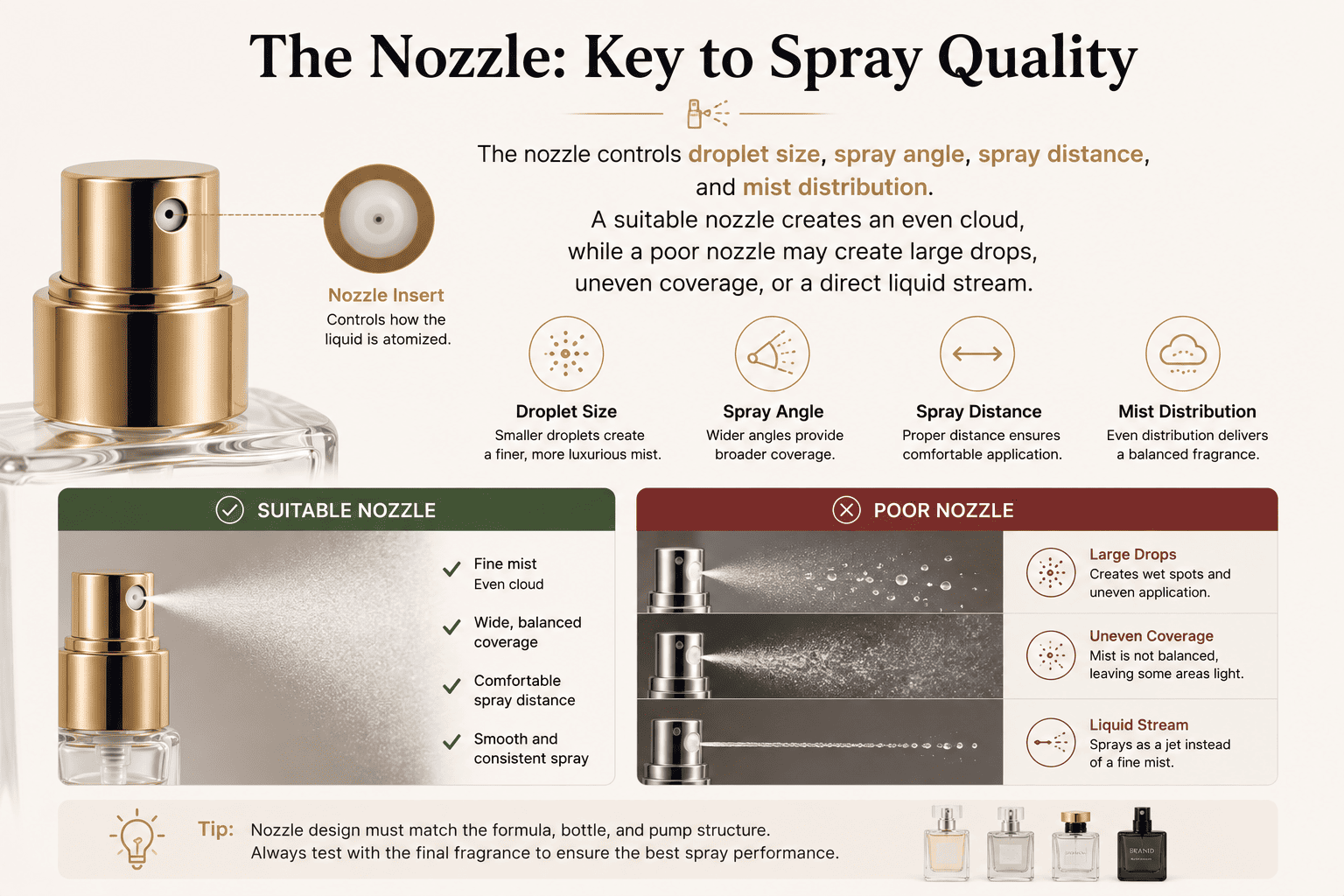
Spray Pattern and Droplet Size
Many customers describe a good perfume spray as soft, wide, and even. They do not want large wet drops on the skin or clothing.
The nozzle opening and internal channel decide how the liquid breaks into droplets. A very small opening may create a fine mist, but it can also block more easily.
A larger opening may support thicker formulas, but the droplets may feel heavier.
The spray angle also affects the experience. A narrow spray sends perfume to a small area. A wide spray covers more skin or clothing.
There is no single perfect spray angle for every perfume. A strong concentrated perfume may need a controlled spray. A fresh body fragrance may need wider coverage.
| Spray characteristic | Effect on the user |
|---|---|
| Fine droplets | Soft and premium feeling |
| Large droplets | Wet feeling on skin |
| Narrow angle | Controlled application |
| Wide angle | Larger coverage |
| Long spray distance | Strong projection |
| Short spray distance | Close and focused use |
Why Some Pumps Produce a Liquid Stream
A pump may sometimes release a straight liquid stream instead of mist. Several problems can cause this result.
The nozzle may be blocked. The spring may not create enough pressure. The valve ball may move slowly. The formula may be too thick. The user may also press the actuator only halfway.
A high-concentration perfume may create deposits inside the nozzle over time. These deposits change the liquid channel.
The pump may work well during the first week and develop problems after several months. This is why long-term testing is important.
I normally test full presses and partial presses. A customer will not always press the actuator in the same way. A reliable pump should still provide an acceptable spray during normal use.
How Much Perfume Should a Spray Pump Release Per Press?
Spray dosage affects perfume strength, product consumption, and customer habits. Two pumps with the same appearance can release very different amounts.
Common perfume pump outputs range from about 0.08 cc to 0.14 cc per full press. Lower output gives more control, while higher output creates stronger coverage and a richer spray experience.
Common Perfume Pump Output Levels
A pump output of around 0.08 cc gives the user more control. It works well for strong fragrances, small bottles, samples, travel sizes, and concentrated products.
An output of around 0.10 cc is common for many standard perfume projects. It provides a balance between coverage and product use.
An output of around 0.12 cc creates a fuller cloud. Many eau de parfum products can use this dosage.
An output of around 0.14 cc feels stronger and more generous. Some customers in Middle Eastern markets prefer this type of spray. They may expect strong projection and a rich fragrance cloud.
| Approximate output | User experience | Common application |
|---|---|---|
| 0.08 cc | Light and controlled | Travel perfume and concentrated fragrance |
| 0.10 cc | Balanced | Standard perfume |
| 0.12 cc | Full and noticeable | Eau de parfum |
| 0.14 cc | Strong and generous | Bold fragrance and Middle Eastern market |
The output value does not directly show the spray quality. A 0.14 cc pump can still create fine mist. A 0.08 cc pump can still create large drops.
Dosage, droplet size, spray angle, and spray distance must be evaluated separately.
The formula also changes the measured output. Alcohol-based perfume normally flows more easily than thick perfume oil.
The testing method must remain consistent. I normally measure several full presses and calculate the average. One single press cannot provide a reliable result.
How Market Preference Changes the Dosage Choice
Customers in different markets may have different application habits.
Some customers prefer a light spray because they apply perfume several times during the day. Some customers prefer a strong spray because they want immediate projection.
Bottle size also matters. A 10 ml travel bottle with a 0.14 cc pump may empty quickly. A 100 ml bottle with a 0.08 cc pump may require too many presses.
I choose the pump output based on the bottle capacity, formula strength, market preference, and brand position.
A luxury experience does not always mean a larger dosage. A soft and controlled mist can also feel premium when the pump has a smooth press and an even spray pattern.
What Is the Difference Between Plastic, Aluminum, and Alloy Spray Components?
The outside material affects the appearance, weight, touch, price, and decoration options of the perfume pump.
Plastic pump components offer lower cost and flexible colors. Aluminum creates a clean metallic appearance. Alloy components feel heavier and more luxurious, but they usually require a higher budget.
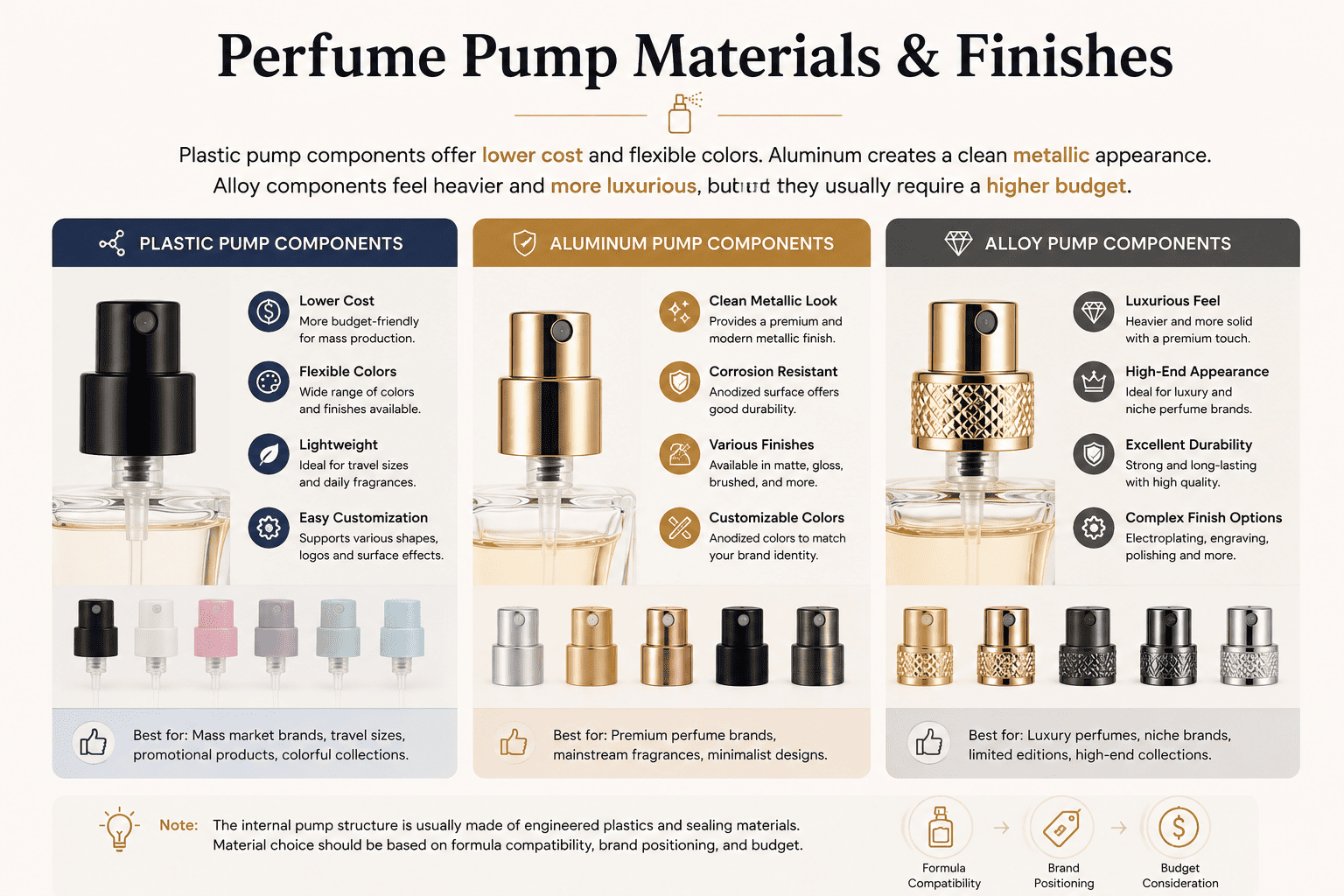
Plastic Spray Pump Components
Plastic actuators and collars are common in perfume packaging. They are light, practical, and cost-effective.
Plastic can use many colors. It can also have a glossy, matte, metallic, or soft-touch surface.
A good plastic component can still look premium. The mold quality, wall thickness, color consistency, and surface finishing decide the final result.
A poor plastic part may show visible mold lines. The coating may peel. The color may look uneven. The actuator may also feel weak during pressing.
Plastic is suitable for new brands, promotional products, mass-market perfumes, and projects with strict cost control.
Aluminum Spray Pump Components
Aluminum is often used as a decorative outer shell for the collar or actuator. It gives the pump a clean metallic appearance.
Aluminum can be polished, brushed, anodized, matte, or colored. Gold, silver, black, and rose gold are common choices.
The aluminum thickness affects the feeling. Thin aluminum may look good but feel light. Thicker aluminum can feel more solid.
The edge quality also matters. A rough edge can lower the perceived quality. An uneven gold tone can create problems when it must match a cap or bottle decoration.
Aluminum normally costs more than basic plastic. However, it is still suitable for many mid-range and premium perfume projects.
Alloy Spray Pump Components
Alloy parts can create more weight and detail. They often appear in luxury or custom packaging.
An alloy actuator can support a special shape, engraved logo, deep pattern, or decorative texture.
The heavier touch can make the customer feel that the packaging is more valuable. However, the higher weight also increases material and shipping costs.
Alloy parts normally need molding, polishing, plating, and stricter quality control. The tooling investment may also be higher.
| Material | Appearance | Weight | Cost level | Suitable market |
|---|---|---|---|---|
| Plastic | Flexible and practical | Light | Low | Entry-level and mass market |
| Aluminum | Clean and metallic | Light to medium | Medium | Mid-range and premium |
| Alloy | Detailed and luxurious | Heavy | High | Luxury and custom perfume |
I always match the pump material with the bottle and cap. A heavy alloy actuator may feel unbalanced on a small travel bottle.
A simple plastic pump may also look too weak on a thick glass bottle with a heavy cap.
How Does a Perfume Pump Connect to the Bottle?
The material controls appearance, but the connection method controls assembly, sealing, refilling, and bottle reuse.
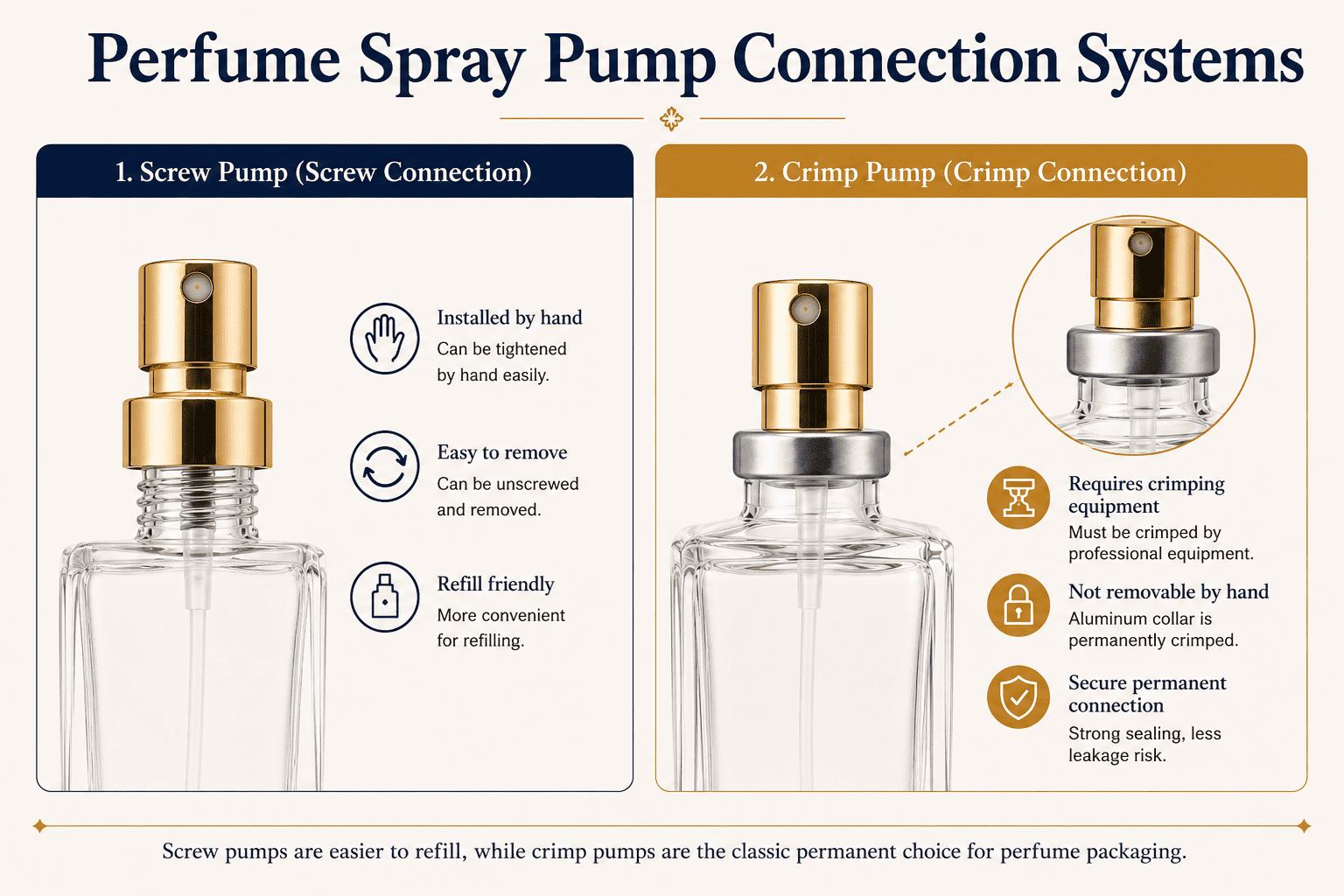
Perfume spray pumps mainly use two bottle connection systems: screw pumps and crimp pumps. Screw pumps can normally be installed by hand, while crimp pumps require professional crimping equipment.
What Is a Screw Perfume Pump?
[A screw pump ][[4]]connects to a threaded bottle neck. The operator places the pump on the bottle and turns it until the closure is tight.
A small perfume brand can often install screw pumps by hand. The brand does not always need an expensive machine.
This option works well for small production runs, handmade filling, product testing, and refillable packaging.
The pump can also be removed later. The user can unscrew it, refill the bottle, and close it again.
However, the screw thread must match the bottle neck. The neck diameter, thread shape, gasket, closure height, and torque must work together.
A pump that is too loose may leak during transport. A pump that is too tight may damage the thread or gasket.
The final appearance can also be different. A screw collar sometimes looks larger because it needs to cover the threaded bottle neck.
What Is a Crimp Perfume Pump?
A crimp pump connects to a crimp-style bottle neck. The operator places the pump on the bottle. A professional tool then presses the metal collar around the bottle finish.
Crimp pumps are very common in traditional perfume packaging. They can create a clean and professional appearance.
The connection is firm when the bottle neck, pump size, gasket, and crimping process match correctly.
A crimp pump cannot normally be installed by hand. The filling company needs a manual, pneumatic, or automatic crimping machine.
The crimping head must match the pump size. The machine pressure must also be adjusted correctly.
Weak pressure may leave the pump loose. Excessive pressure may deform the collar or place stress on the glass neck.
| Connection type | Installation | Main advantage | Main limitation |
|---|---|---|---|
| Screw pump | Hand or simple tightening tool | Easy to install and remove | May loosen without correct torque |
| Crimp pump | Professional crimping tool | Clean appearance and firm sealing | Difficult to remove traditionally |
Can a Crimp Perfume Bottle Be Refilled?
In the past, I saw one clear limitation with crimp perfume bottles. Once the pump was installed, the user normally had to damage the pump to open the bottle.
Many customers want to reuse a beautiful glass perfume bottle after it becomes empty. They may want to add the same fragrance or use a new fragrance.
However, a crimp pump is fixed tightly to the bottle neck. A customer may try to remove it with pliers, scissors, or another basic tool.
This method can deform the metal collar. It can damage the pump. It can scratch the bottle. It may also break the glass neck.
We now have a new tool that changes this situation. The tool allows us to refill a crimp perfume bottle without removing the pump.
The new perfume enters through the existing spray system. The user does not need to destroy the pump or open the crimp collar.
I explain the full method in this guide: How to Refill a Crimp Perfume Bottle Without Removing the Pump.
This tool gives brands and users a safer way to reuse a crimp perfume bottle. It also protects the original appearance of the packaging.
A screw pump is still easier to open by hand. However, a crimp bottle is no longer always a single-use package when the correct refilling tool is available.
How I Choose Between Screw and Crimp Pumps
I check the filling method first. A brand that fills bottles by hand may prefer a screw pump.
I then check the production quantity. A large filling line may use crimp pumps because the machine can install them quickly and consistently.
I also check the bottle design. Some bottles are available only with a crimp neck. Some bottles are designed for a screw closure.
The refill plan also matters. A brand may want customers to open the bottle directly. In this case, a screw pump is practical.
A brand may want the traditional appearance of a crimp pump. The new refilling tool can provide another refill option without removing the pump.
| Decision factor | Screw pump | Crimp pump |
|---|---|---|
| Manual filling | Very suitable | Requires a tool |
| Large production | Suitable | Very suitable |
| Hand removal | Easy | Difficult |
| Refill by opening | Easy | Normally not recommended |
| Refill without removal | Usually unnecessary | Possible with a special tool |
| Equipment investment | Lower | Higher |
| Appearance | Practical | Clean and traditional |
I never select the connection method only from a catalog photo. I test the bottle, pump, gasket, dip tube, formula, and filling process as one complete packaging system.
When Should a Perfume Brand Use a Rollerball?
A rollerball gives customers a simple and portable application method. However, the ball material and housing gap strongly affect the flow and skin feeling.
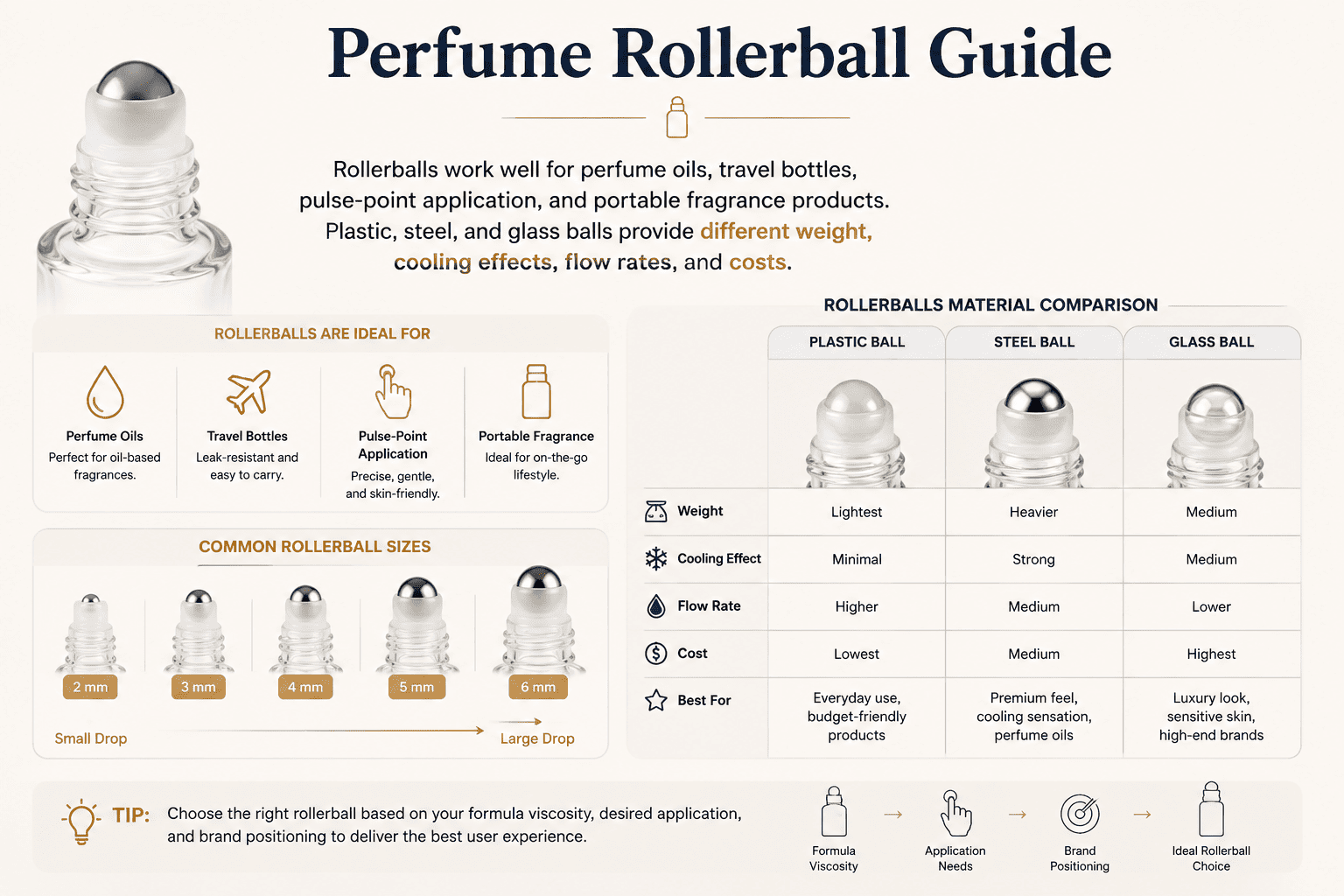
Rollerballs work well for perfume oils, travel bottles, pulse-point application, and portable fragrance products. Plastic, steel, and glass balls provide different weight, cooling effects, flow rates, and costs.
Plastic Rollerballs
Plastic rollerballs are light and affordable. They are common in entry-level perfume oils, samples, and promotional products.
Plastic feels warmer on the skin than steel. It can provide a soft rolling experience.
However, low-quality plastic may have an uneven surface. The ball may not rotate smoothly. The material may also react with some fragrance oils.
The ball and housing materials must both pass compatibility tests.
Steel Rollerballs
Steel rollerballs feel cool when they touch the skin. Many customers connect this cooling feeling with freshness and quality.
Steel also has more weight. The weight can help the ball rotate smoothly.
However, the steel grade must be suitable for the formula. Poor metal may corrode, stain, or create an unwanted smell.
A steel ball may also create a small sound when the customer shakes or moves the bottle.
Glass Rollerballs
Glass rollerballs have good resistance to many fragrance ingredients. They can also support a clean and premium brand image.
A high-quality glass ball feels smooth on the skin. However, the roundness and surface quality must be controlled.
An uneven glass ball may become stuck. A weak glass ball may break after strong impact.
The housing must hold the ball firmly while leaving enough space for rotation and liquid flow.
| Rollerball material | Skin feeling | Flow behavior | Cost | Main concern |
|---|---|---|---|---|
| Plastic | Light and warm | Moderate | Low | Uneven rolling or compatibility |
| Steel | Cool and solid | Controlled | Medium | Corrosion risk |
| Glass | Smooth and clean | Smooth with correct fit | Medium to high | Breakage risk |
Why Rollerball Flow Depends on Several Parts
The ball material is only one factor. The flow also depends on the ball diameter, housing gap, formula viscosity, bottle angle, and application pressure.
A large gap may release too much perfume. It may also cause leakage during transport.
A small gap may restrict the formula. The customer may need to roll the bottle several times before the perfume comes out.
A thick perfume oil needs a different structure from a thin alcohol-based product.
Temperature also changes the flow. Heat makes many formulas thinner. Cold makes them thicker.
I test rollerball bottles in upright, sideways, and upside-down positions. I also test them under warm and cold conditions.
Rollerballs are common in 3 ml, 5 ml, 8 ml, and 10 ml portable bottles. They work well for the wrist, neck, and other pulse points.
Are Droppers Suitable for Perfume Packaging?
Droppers are less common in traditional perfume packaging, but they can support concentrated oils, artistic products, and formulas that need controlled dosing.
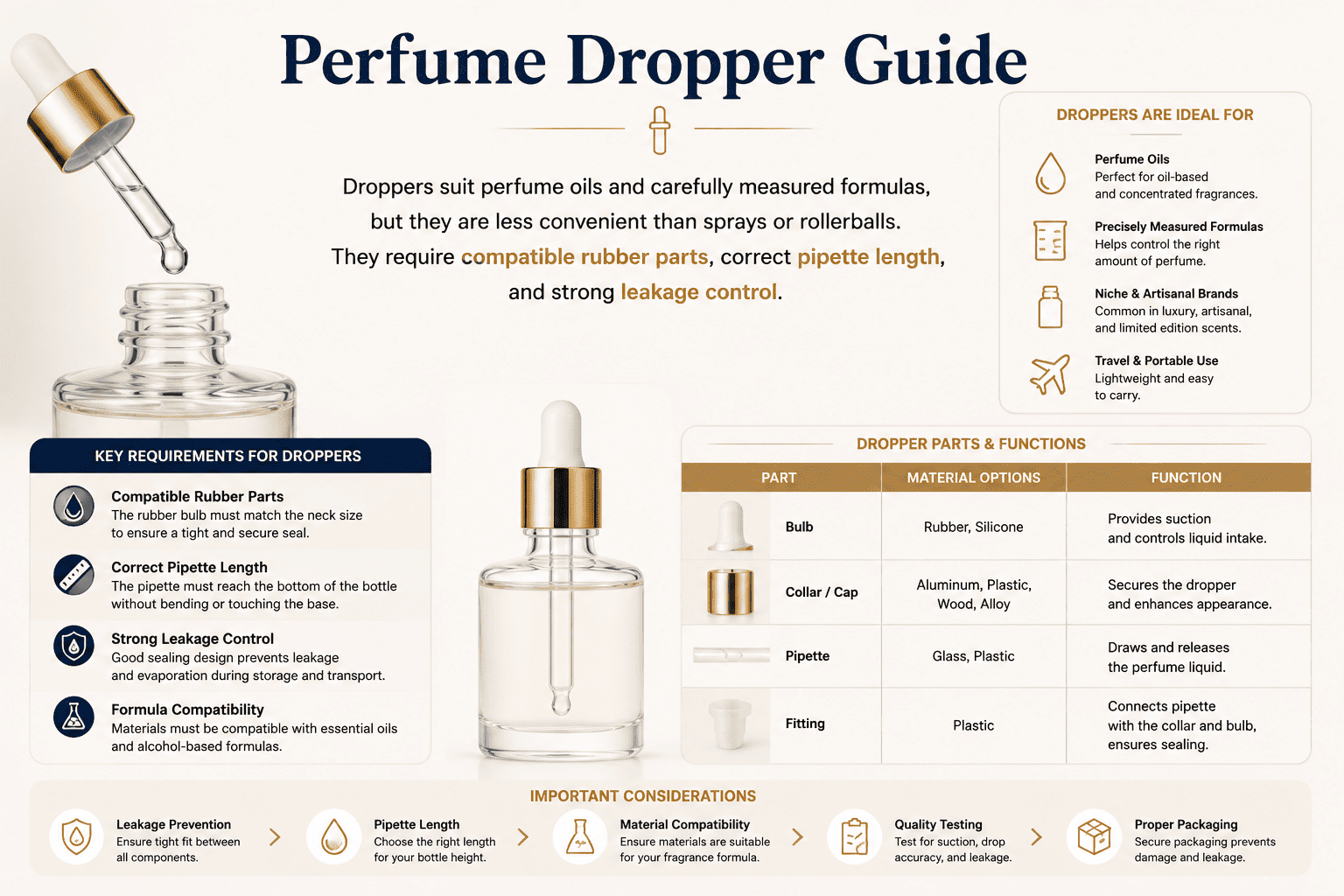
Droppers suit perfume oils and carefully measured formulas, but they are less convenient than sprays or rollerballs. They require compatible rubber parts, correct pipette length, and strong leakage control.
Why Droppers Are Less Common in Perfume
Droppers are common in skincare, serum, essential oil, and cosmetic packaging.
Traditional perfume customers normally expect a spray. A spray applies the fragrance quickly and covers a larger area.
A dropper releases separate drops. The customer must open the bottle, squeeze the bulb, collect the liquid, and place the drops on the skin.
This method is slower. It can also create spills.
The pipette may touch the skin. The user may then place it back inside the bottle. This action can introduce contamination.
However, droppers can match niche perfume oils, concentrated extracts, handmade fragrances, and apothecary-style branding.
The drop-counting process can also become part of the product story.
What Parts Affect Dropper Performance?
A dropper normally includes a rubber bulb, collar, glass pipette, gasket, and sometimes a wiper.
The rubber bulb creates suction. It must resist alcohol, fragrance oil, and other ingredients.
An unsuitable rubber bulb may swell, harden, change color, or transfer an odor to the formula.
The glass pipette must have the correct length. A long pipette may hit the bottle base. A short pipette may leave too much product inside.
The pipette edge must also be smooth. A rough edge can create safety and quality problems.
The collar connects the dropper to the bottle. It may be plastic, aluminum, or alloy.
The gasket controls sealing. A poor gasket can allow leakage or evaporation.
| Dropper part | Function | Common risk |
|---|---|---|
| Rubber bulb | Creates suction | Swelling or hardening |
| Glass pipette | Holds and releases liquid | Breakage or wrong length |
| Collar | Connects to the bottle | Loose closure |
| Gasket | Prevents leakage | Formula incompatibility |
| Wiper | Removes excess liquid | Poor dosage control |
Droppers normally cost more than simple caps because they contain several parts. They also need more careful assembly and transport protection.
I recommend droppers for special fragrance oils, concentrated perfume extracts, and products that use careful drop-by-drop application.
How Can Brands Prevent Clogging, Leakage, Rust, and Poor Flow?
Dispensing problems normally come from the interaction between the formula, mechanism, bottle, sealing parts, filling process, and storage conditions.
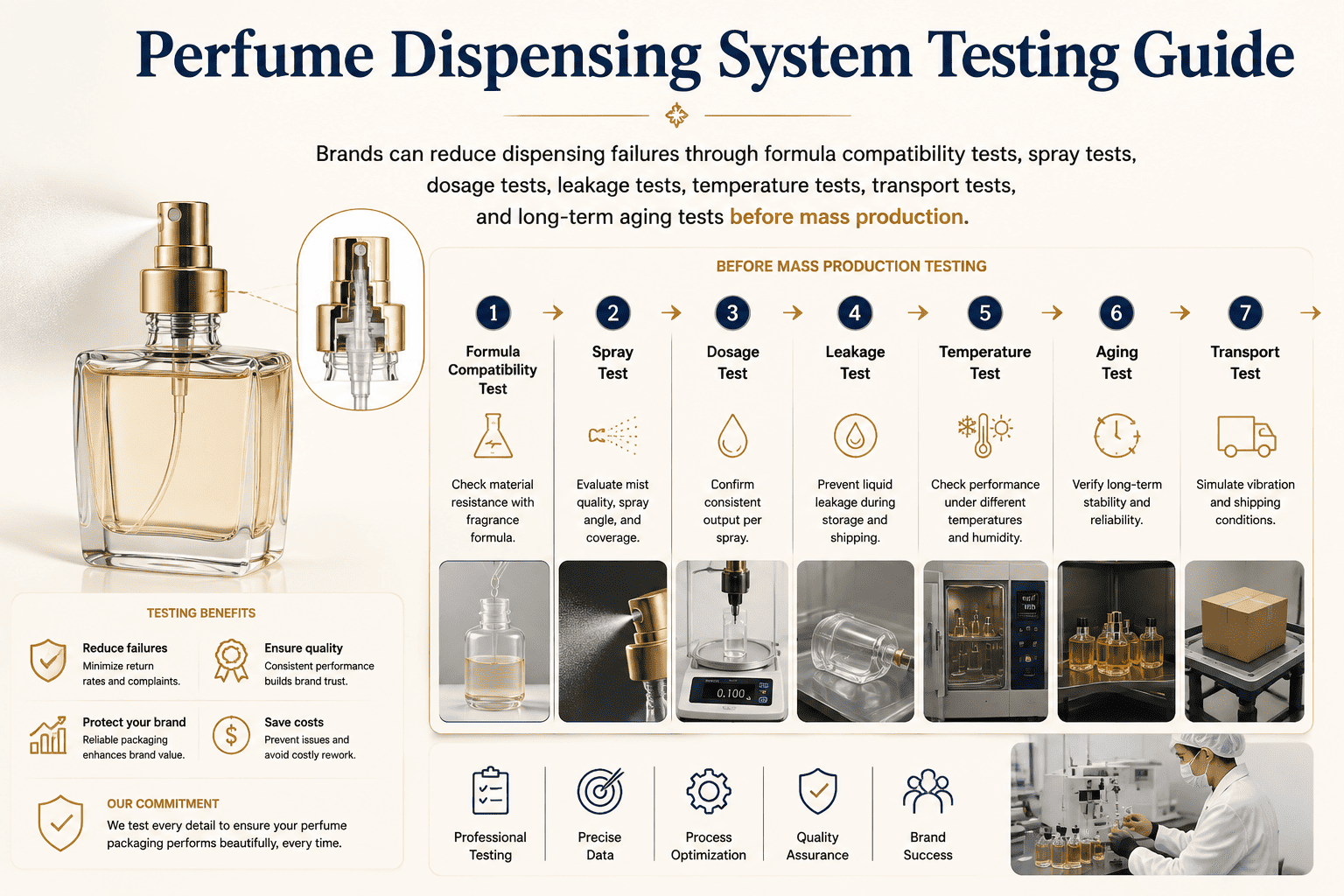
Brands can reduce dispensing failures through formula compatibility tests, spray tests, dosage tests, leakage tests, temperature tests, transport tests, and long-term aging tests before mass production.
Why the Real Formula Must Be Tested
Water testing is useful for basic checks, but water cannot fully represent a real perfume formula.
Alcohol, fragrance oil, pigment, resin, and natural ingredients may react differently with the pump parts.
A high fragrance concentration may leave deposits inside the valve, nozzle, or dip tube.
Some formulas may soften plastic. Some may swell a gasket. Some may damage a coating. Some may increase the risk of spring corrosion.
The first test may look normal. The problem may appear after several weeks.
This is why I use the final formula, final bottle, final pump, final gasket, and final dip tube during compatibility testing.
Important Pre-Production Tests
A dosage test checks the average output per press. I do not rely on one press. I measure several presses and calculate the average.
A spray pattern test checks droplet size, angle, distance, and distribution.
A leakage test checks the bottle in upright, sideways, and upside-down positions.
A temperature test checks performance under heat and cold. High temperature may increase internal pressure and leakage risk.
A low temperature may make the formula thicker and slow down the flow.
An aging test checks whether the pump blocks, rusts, changes color, or loses suction over time.
A transport test checks vibration, pressure changes, and movement during shipping.
| Test | Main purpose | What I observe |
|---|---|---|
| Formula compatibility | Check material reaction | Swelling, color, odor, corrosion |
| Spray pattern | Check mist quality | Droplet size, angle, consistency |
| Dosage test | Measure output | Average cc per press |
| Leakage test | Check sealing | Liquid loss in different positions |
| Heat test | Check high-temperature risk | Leakage, pressure, deformation |
| Cold test | Check low-temperature flow | Slow spray or blockage |
| Aging test | Check long-term stability | Rust, deposits, weak return |
| Drop test | Check physical strength | Cracks or loose parts |
| Transport test | Check shipping performance | Leakage and component movement |
Why the Cheapest Pump May Create a Higher Total Cost
A cheaper pump can reduce the first packaging cost. However, it can create a larger cost after the product enters the market.
A blocked pump may lead to customer complaints. A leaking bottle may damage the carton and label. A rusty spring may damage the brand image.
The company may need to replace products, issue refunds, or lose repeat customers.
I compare the unit price, but I also check the failure risk. A small increase in pump cost can protect a much more expensive perfume product.
I normally test several pump options with the same formula. I compare the spray softness, dosage, return speed, finger pressure, leakage performance, and long-term stability.
This process helps me find a balance between cost and performance.
Conclusion
I choose each dispensing mechanism by matching the formula, bottle, target market, filling method, user habits, budget, and long-term performance requirements.
[[1]]: https://www.packamor.com/blogs/knowledge-hub/why-perfume-bottles-leak-how-to-prevent?srsltid=AfmBOoqfm9g-VMpC1gA9moOvSQA31rMbj1OjgKuMPGnRX4pdXkdCxZpy "pump leaks"
[[2]]: https://www.amazon.com/misting-pump/s?k=misting+pump "mist pump"
[[3]]: https://www.reddit.com/r/IndustrialDesign/comments/o3mpc0/making_a_perfume_bottles_dip_tube_invisible/ "invisible dip tube"
[[4]]: https://aptar.com/en-us/products/essencia-screw-refillable-fragrance-pump "A screw pump "