
Many fragrance brands spend months developing their perfume formula, but they often forget one important fact: customers see the bottle before they smell the fragrance.
A perfume bottle is not only a container. It is the first [visual communication][1] between the brand and the customer. A well-designed glass bottle can create a feeling of luxury, trust, creativity, and desire within a few seconds.
The three key factors that catch customers’ attention in perfume glass bottle design are bottle shape, bottle size, and surface effects. A successful design combines visual appeal, brand positioning, production feasibility, and cost control.
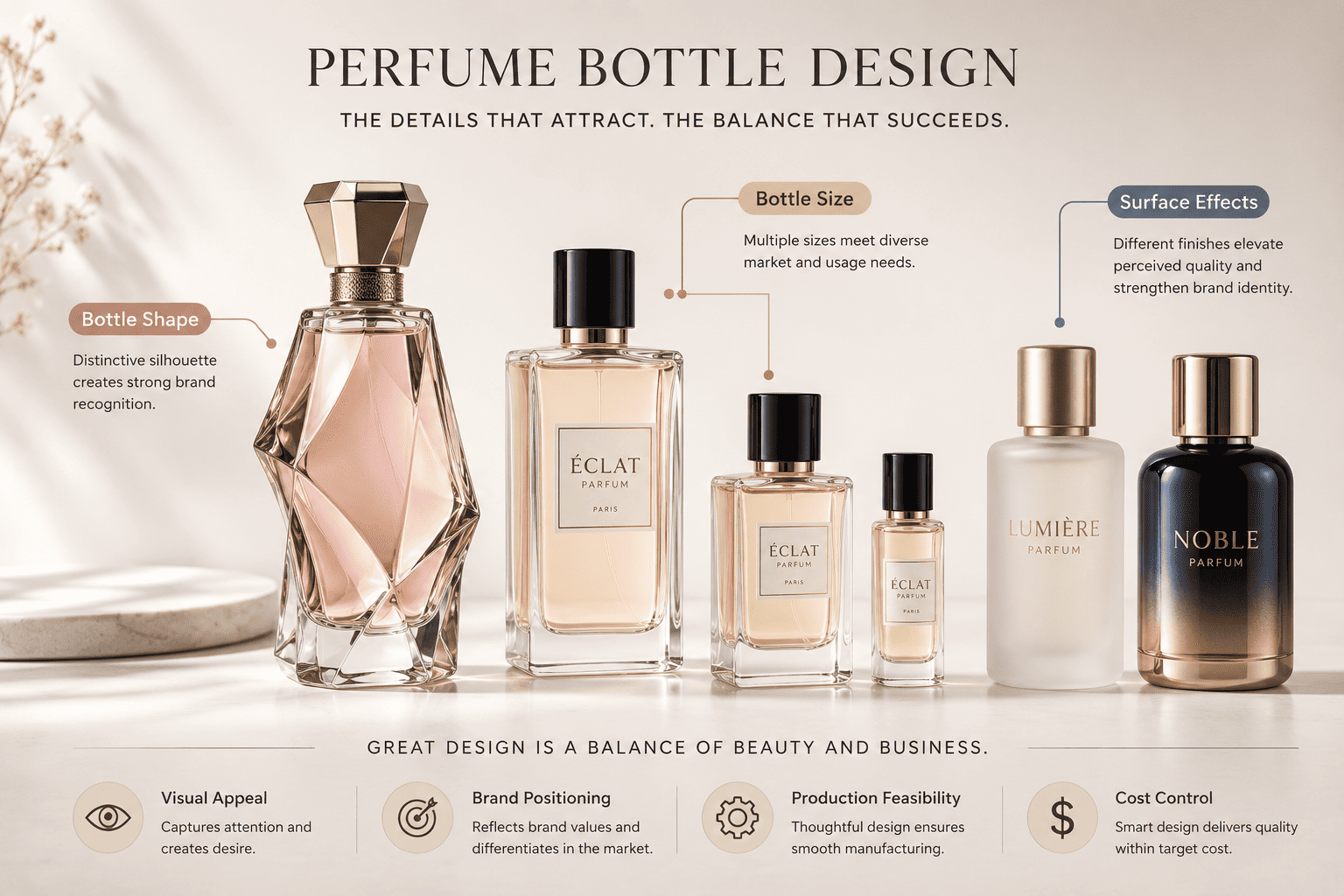
When I work with fragrance brands, I always explain that creating a successful perfume bottle is not only about making a beautiful shape.
A professional bottle design needs to consider:
- Customer perception
- Brand identity
- Production difficulty
- Mold investment
- Mass production stability
- Decoration possibilities
- Final product cost
Many new brands think a complicated bottle design automatically creates a premium feeling.
However, my experience tells me that premium packaging is not always about complexity.
The best perfume bottle is the one that creates a strong emotional connection with customers while remaining realistic for production.
In this article, I will share the three most important factors that every fragrance brand should understand before developing a glass perfume bottle.
Why Does Bottle Shape Decide Both Brand Impression and Production Cost?
Many brands think bottle shape is only a design decision.
However, the bottle structure directly affects mold cost, production difficulty, defect rate, and the final cost of each bottle.
Bottle shape is the foundation of perfume packaging development. A well-designed bottle shape can improve brand recognition while controlling production risk and long-term manufacturing costs.
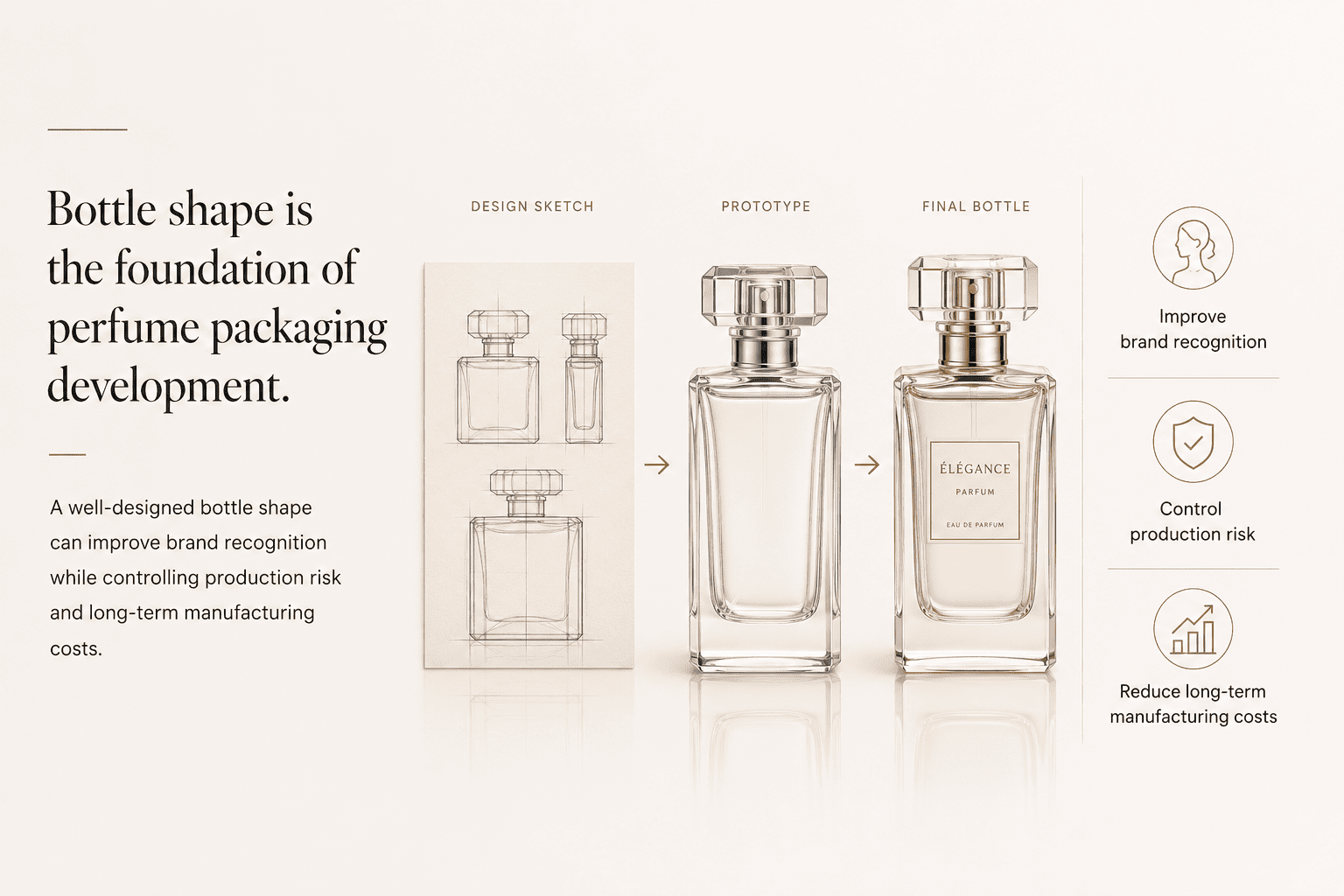
Why does bottle shape affect production?
Glass bottle manufacturing is a combination of design and engineering.
During production, high-temperature glass flows into the mold and slowly cools into the final shape.
A balanced bottle structure allows the glass material to flow more evenly.
A complicated structure creates more challenges:
- Uneven glass distribution
- Different cooling speeds
- Higher internal stress
- More difficult mold processing
- Lower production efficiency
This is why two bottles with similar capacity can have very different production costs.
Four common perfume bottle shape categories
From my experience, perfume bottles can generally be divided into four categories.
| Bottle Type | Characteristics | Typical Yield Rate |
|---|---|---|
| Straight cylinder bottle | Simple structure, stable production, lowest risk | 95%-98% |
| Round / square / rectangle bottle | Regular geometric design, good stability | 88%-93% |
| Multi-faceted diamond bottle | More cutting surfaces, higher mold complexity | 88%-93% |
| Asymmetrical artistic bottle | Complex curves, highest development difficulty | 80%-88% |
1. Straight cylinder bottle
The straight cylinder bottle is one of the safest choices for perfume packaging.
Its structure follows the natural forming process of glass.
The glass liquid flows more evenly, and cooling stress is easier to control.
This creates advantages such as:
- Better wall thickness consistency
- Lower deformation risk
- Higher production yield
- More stable cost
For brands that want reliable mass production, this bottle type is often the best starting point.
2. Round, square, and rectangle bottles
These bottles create stronger visual identity while maintaining reasonable production stability.
Round bottles usually have better stress distribution.
Square and rectangle bottles create a modern and luxury feeling. However, sharp corners can create stress concentration during cooling.
Compared with cylinder bottles, the defect risk becomes slightly higher.
3. Multi-faceted diamond bottles
Diamond-cut bottles can create strong visual impact.
The multiple surfaces reflect light and create a premium appearance.
However, every additional surface increases:
- Mold processing difficulty
- Cooling challenges
- Stress concentration
- Quality inspection requirements
More complex geometry also increases the possibility of:
- Bubbles
- Mold lines
- Uneven wall thickness
4. Asymmetrical artistic bottles
Some niche fragrance brands choose unusual shapes to create strong brand memory.
These designs can become a signature product.
However, they also require higher investment.
Complex curves can create:
- Uneven glass flow
- Thickness variation
- Bottle deformation
- More mold adjustments
- Lower yield rate
Many brands only focus on the one-time mold fee.
However, the real cost is not only the mold.
A complex bottle can create repeated costs during:
- Mass production
- Surface decoration
- Quality inspection
- Packaging process
My suggestion is:
A unique bottle can create strong brand value, but brands should evaluate whether the expected sales volume can support the additional production cost.
Why Is Bottle Size More Than Just a Capacity Choice?
Many perfume brands choose bottle size based only on the amount of fragrance inside.
They ask:
"Should we produce 30ml, 50ml, or 100ml?"
However, bottle size affects much more than capacity.
Bottle size influences customer usage habits, purchasing decisions, travel convenience, packaging cost, and brand positioning. The right size should match both consumer behavior and product strategy.
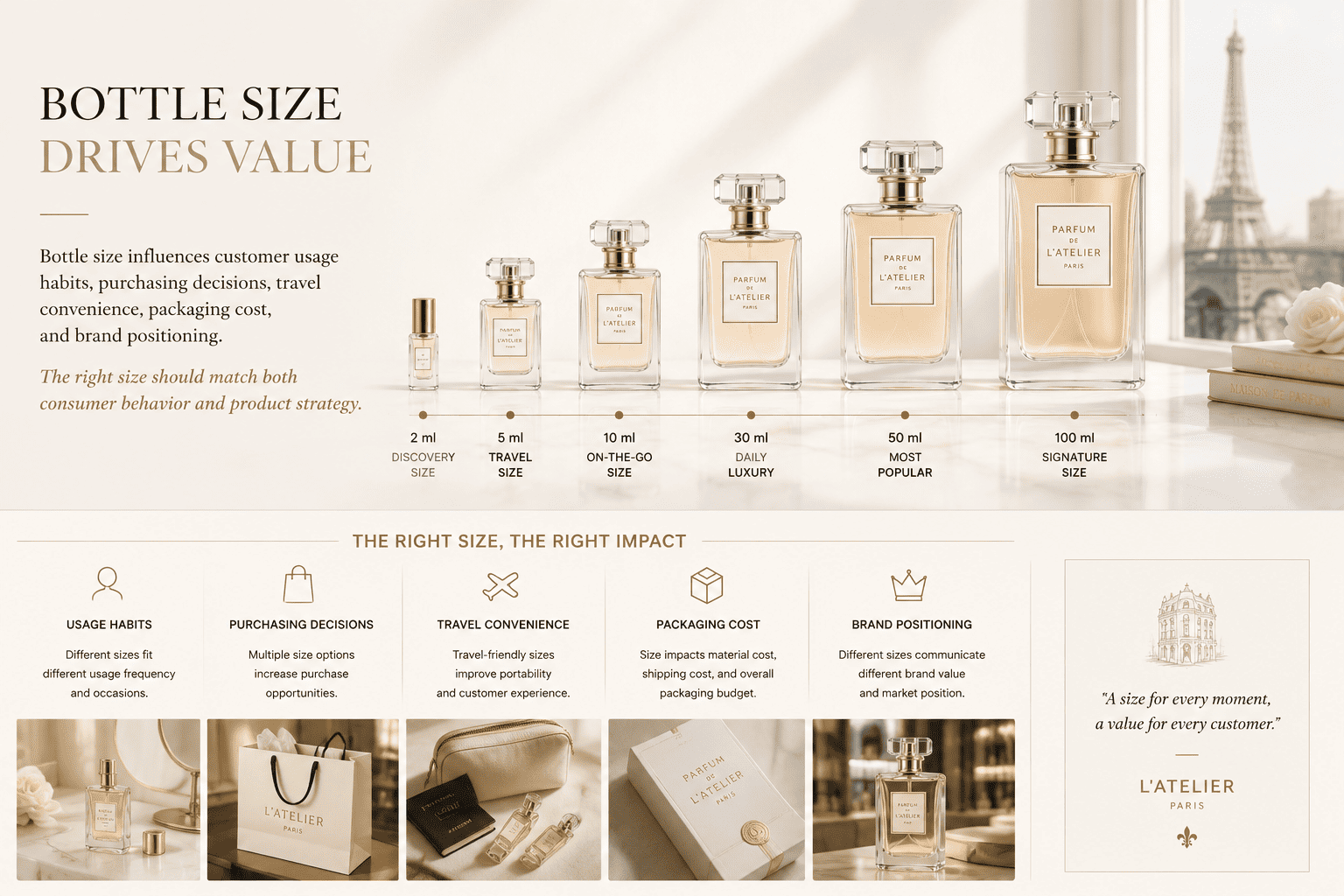
Why are 30ml and 50ml popular?
The most common perfume bottle sizes are:
- 30ml
- 50ml
- 100ml
Among these options, 30ml and 50ml usually provide the best balance.
They are suitable for:
- Daily use
- Gift purchases
- Online sales
- Travel
They also reduce the customer’s purchase risk.
A customer who is trying a new fragrance may feel more comfortable buying a smaller size first.
The challenge with 100ml bottles
100ml bottles are popular among customers who already love a fragrance.
They represent:
- Better value
- Long-term usage
- Customer loyalty
However, brands should also consider [perfume usage cycles][2].
Perfume contains alcohol, and after opening, the fragrance quality can gradually change.
A high-quality perfume usually has an ideal usage period of around 2.5 to 4 years after opening.
A standard perfume pump releases around 0.1ml each spray.
If a customer only sprays once per day, a 100ml bottle may last several years.
Sometimes the customer may not finish the perfume before the fragrance quality changes.
Travel convenience matters
Modern consumers often travel.
Many airlines allow carry-on liquids only when each container is 100ml or below.
However, 30ml and 50ml bottles provide better convenience because they are:
- Easy to carry
- Suitable for business trips
- Suitable for vacations
- More practical for daily use
Bottle size also affects packaging cost
Larger bottles require:
- More glass material
- Larger packaging
- Stronger protection
- Higher shipping cost
Smaller bottles require more attention to:
- Cap proportion
- Label placement
- Overall balance
Bottle size is not only a volume decision.
It is a customer experience decision.
How Do Surface Effects Transform a Standard Bottle Into a Premium Package?
Bottle shape creates the foundation.
Bottle size creates the proportion.
Surface effects create the final emotional impression.
Surface treatments can completely change how customers perceive a perfume bottle. Through spraying, electroplating, frosting, decals, and silk printing, brands can create unique packaging without always developing a new mold.
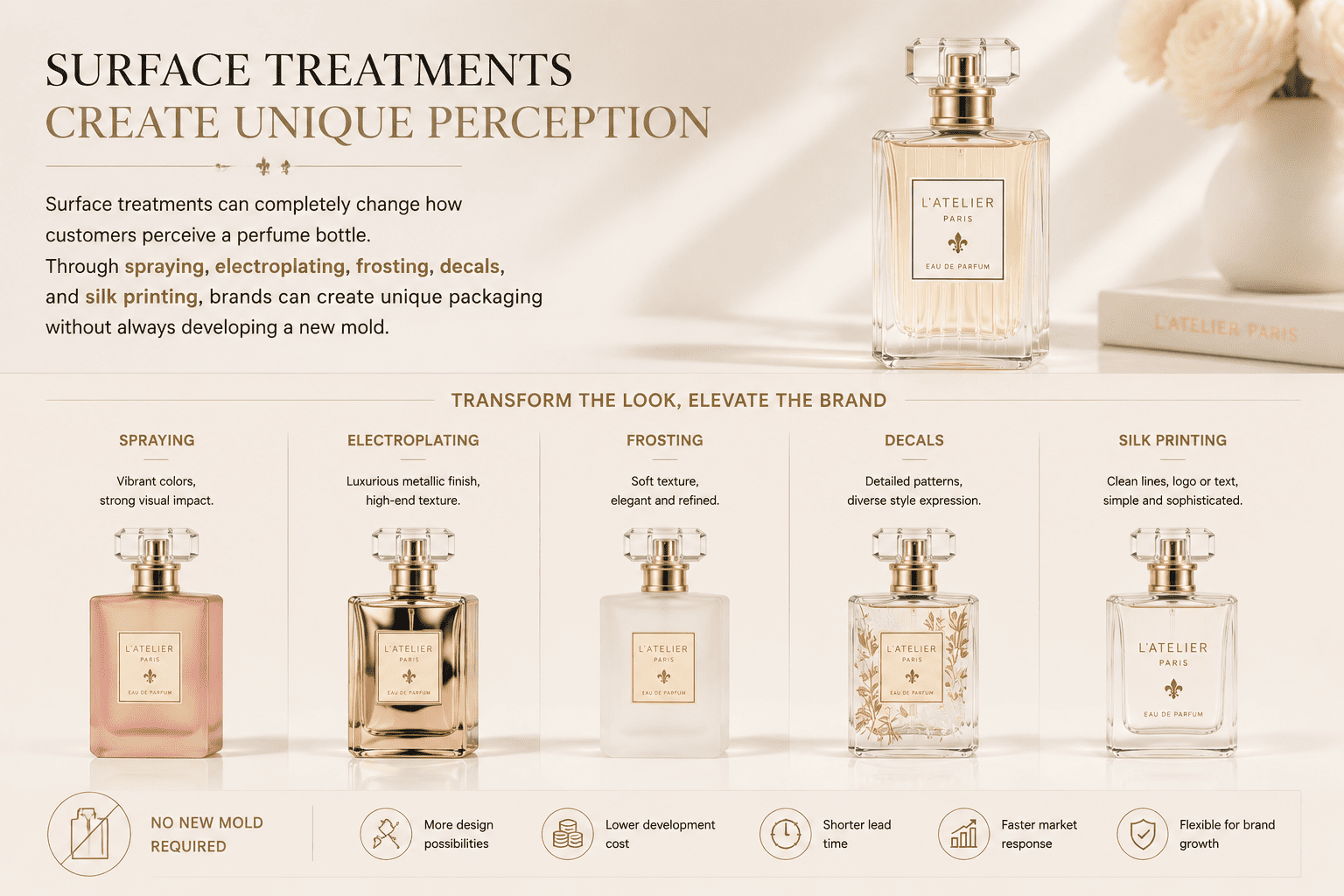
Why do surface effects matter?
The same glass bottle can communicate completely different feelings through different finishing processes.
For example:
Transparent glass can feel:
- Clean
- Natural
- Elegant
Frosted glass can feel:
- Soft
- Premium
- Artistic
Gold electroplating can feel:
- Luxury
- Exclusive
- High-end
Common perfume bottle surface treatments
| Surface Effect | Brand Feeling |
|---|---|
| Spray coating | Strong color identity |
| Electroplating | Luxury metallic appearance |
| Frosting | Soft premium texture |
| Decal | Artistic and detailed patterns |
| Silk printing | Logo and simple graphics |
Spray coating
Spray coating applies colored paint onto the glass surface.
It can create:
- Solid colors
- Transparent colors
- Gradient colors
[Gradient spraying][3] is popular because it creates smooth visual transitions.
Electroplating
Electroplating creates a metallic reflective surface.
Common choices include:
- Gold
- Silver
- Gradient metallic effects
This process is often used for luxury perfume packaging.
Decal decoration
Decals are suitable for detailed artwork.
They can reproduce:
- Illustrations
- Complex patterns
- Multiple colors
This is useful for artistic fragrance brands.
Frosting
Frosting uses acid treatment to create a soft matte glass surface.
It creates a smooth and elegant feeling.
Silk printing
Silk printing is widely used for:
- Brand logos
- Text
- Simple patterns
Important quality reminder
Surface treatment quality starts before decoration.
The bottle surface must be cleaned carefully before spraying or electroplating.
If small dust particles or impurities remain on the glass, they can become trapped under the coating.
This creates:
- Surface spots
- Uneven appearance
- Quality rejection
Many premium perfume bottles are not created by one single process.
They often combine two or three techniques.
For example:
- Frosting + gold printing
- Spray coating + electroplating
- Transparent color + decal
The combination creates stronger visual depth and premium feeling.
How Should Brands Balance Design, Cost, and Production Stability?
A successful perfume bottle needs both creativity and practicality.
The best perfume bottle design combines shape, size, and surface effects while considering production stability, investment level, and long-term brand development.
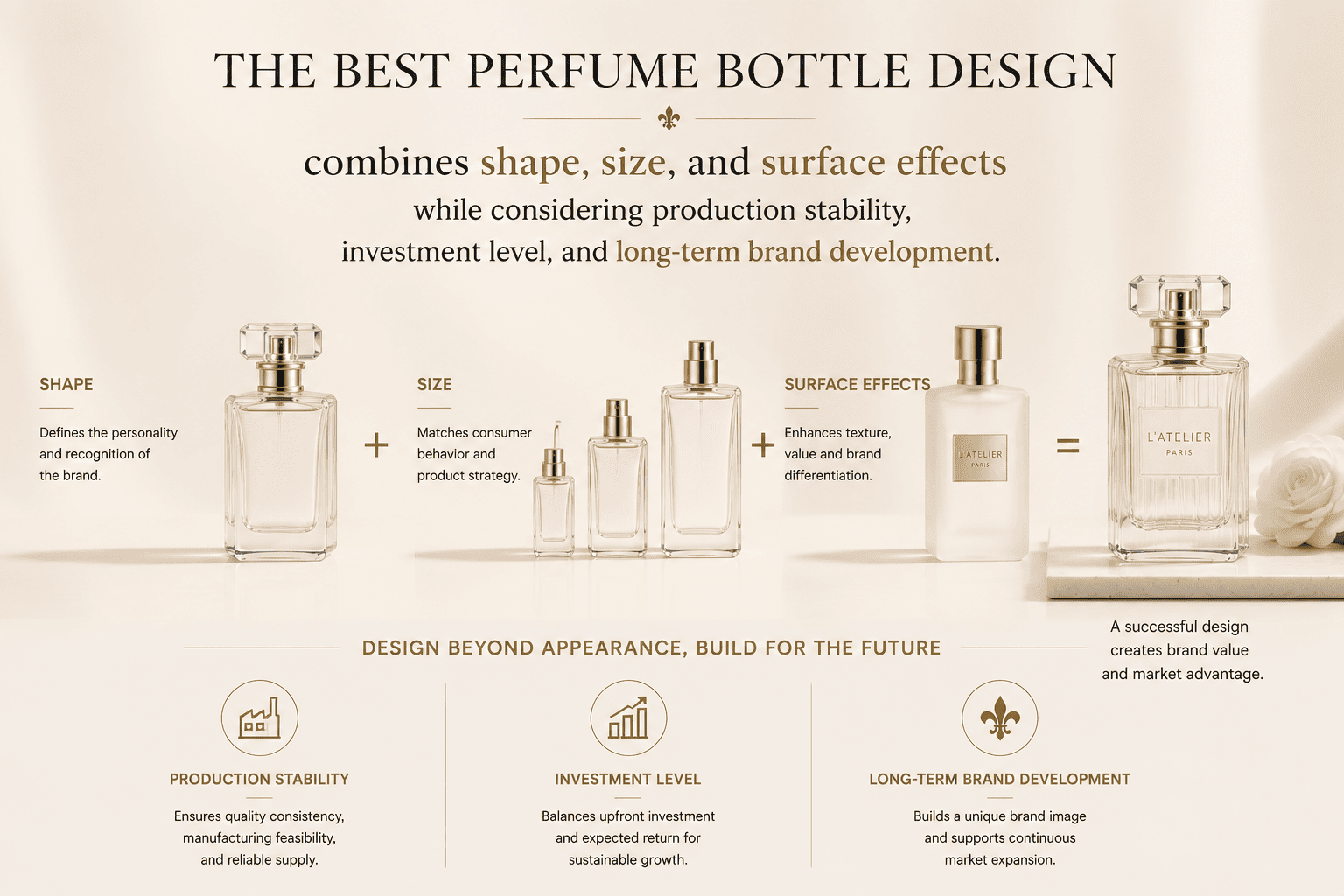
I usually explain bottle design with this formula:
Bottle shape creates recognition.
Bottle size creates customer experience.
Surface effects create emotional connection.
Brand positioning connects all elements together.
For example:
Luxury perfume brand
Usually suitable for:
- Heavy glass
- Balanced proportions
- Premium caps
- Metallic decoration
Fresh lifestyle fragrance brand
Usually suitable for:
- Transparent glass
- Simple structure
- Light colors
- Minimal decoration
Niche artistic perfume brand
Usually suitable for:
- Unique shapes
- Special surface effects
- Limited production
However, brands should always consider production reality.
A beautiful design that creates extremely high waste rates may not be the best business decision.
Good packaging is where creativity meets manufacturing experience.
My Experience Helping Perfume Brands Create Better Packaging
After years working with perfume packaging, I have learned that successful packaging is not only about appearance.
It is about making the right decision at the right stage.
At Hongyan Glass Bottle, we help fragrance brands choose practical packaging solutions based on their positioning, budget, and growth stage. We support brands from in-stock bottles to customized bottle development and decoration services.
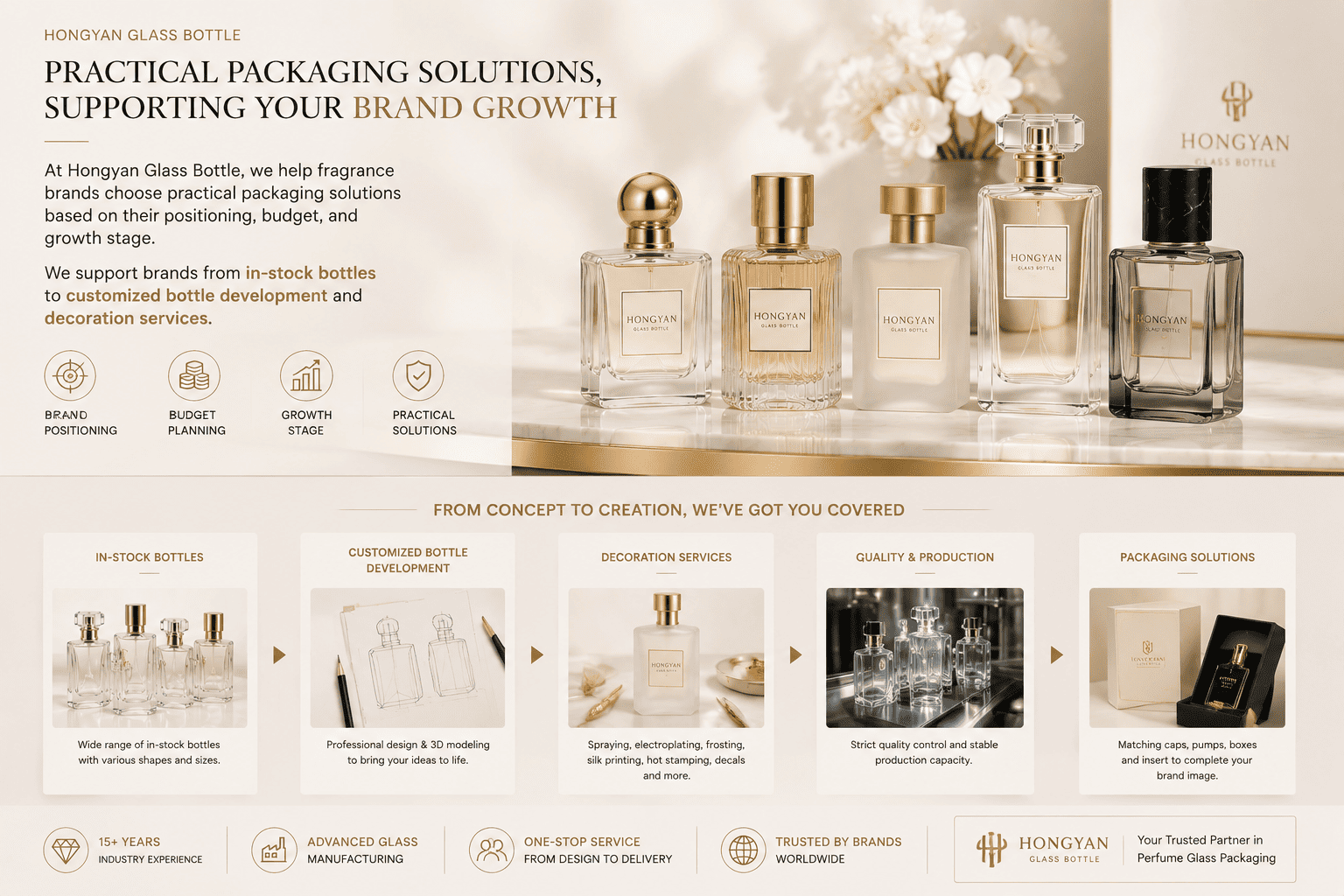
At Hongyan Glass Bottle, we provide:
- More than 500 in-stock perfume glass bottle designs
- Custom bottle development
- 3D sampling
- Spray coating
- Frosting
- Electroplating
- Decal decoration
- Silk printing
- Pump and cap matching
My mission is to help small and medium perfume brands find practical packaging solutions.
A startup brand may need a cost-effective bottle with beautiful decoration.
A growing brand may need semi-custom packaging.
An international brand may need a completely unique bottle design.
My role is to help brands balance creativity, production feasibility, and cost.
A perfume bottle is not only glass.
It is the combination of design, engineering, and brand strategy.
Conclusion
A successful perfume bottle design depends on three key factors: shape, size, and surface effects. The best packaging creates customer attention while supporting brand growth and production stability.