
When a perfume bottle leaks, the problem is not only wasted fragrance. It can also cause returns, bad reviews, and lost trust. I have seen good perfume projects get damaged by one small sealing issue.
To reduce leakage in a glass perfume bottle, I do not only look at the bottle itself. I check the bottle neck size, spray pump structure, cap inner dimensions, gasket material, crimping process, shipping method, and protective packaging together. Only when the whole system is stable can the perfume package be truly safe.
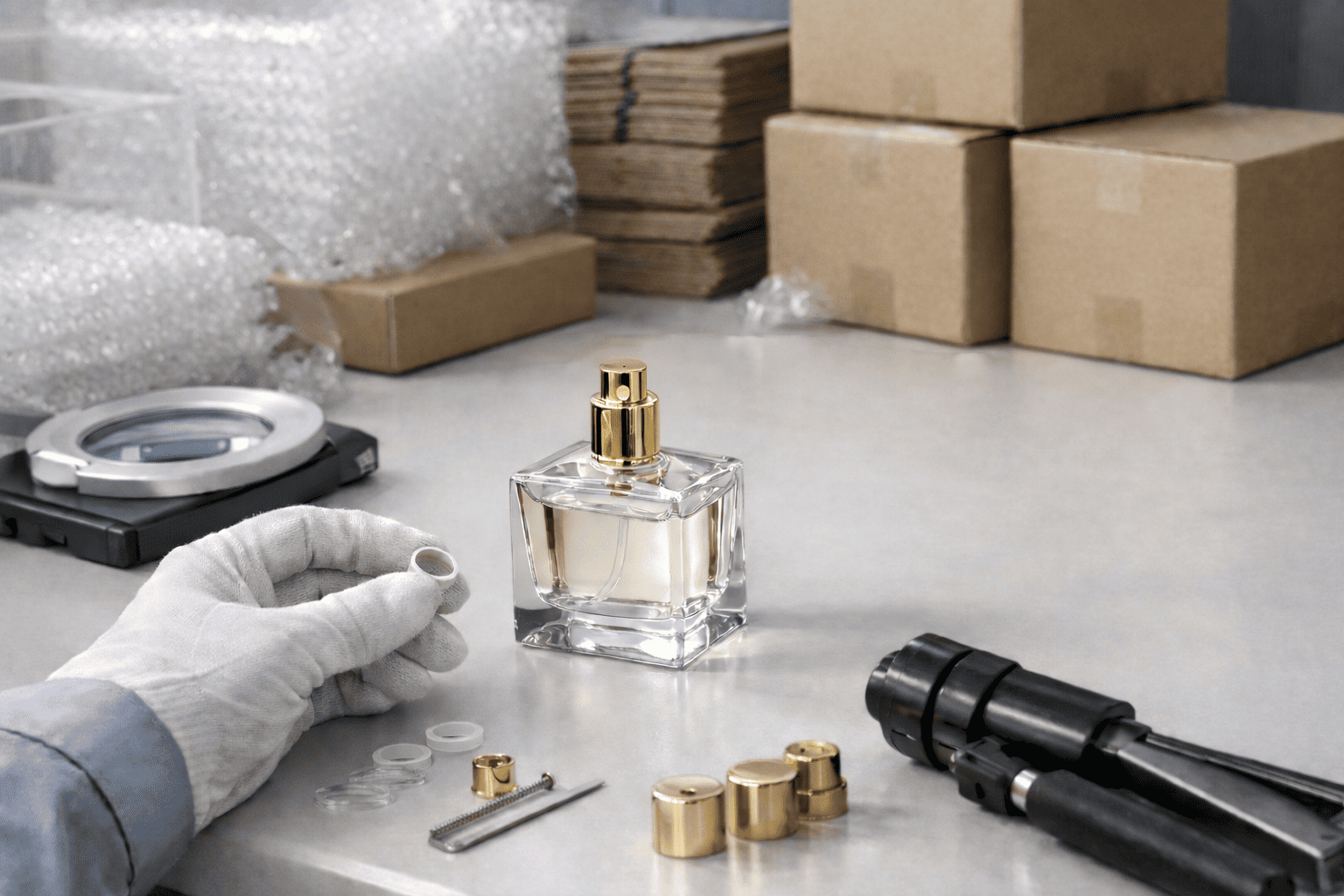
In my experience, leakage in a glass perfume bottle is never caused by one single factor. Very often, the problem is hidden in small details that people ignore. For example, the cap may press the actuator slightly, or e-commerce shipping may create constant vibration. These issues can make the customer see liquid around the neck, smell fragrance inside the carton, or even receive a broken bottle. For a perfume brand, these details also shape how consumers judge the quality and positioning of the brand.
Why does a glass perfume bottle leak?
Many people think a leaking perfume bottle means the glass bottle itself is poor quality. In my view, the more common reason is that several parts in the packaging system do not work well together.
A glass perfume bottle usually leaks because the sealing system around the neck fails. Common reasons include poor fit between the spray pump and bottle neck, cap dimension changes, unsuitable gasket material, unstable crimping, or vibration and impact during shipping.

I first look at the full leakage path
When I help clients analyze [perfume bottle leakage][1], I do not only stare at the glass bottle. I first check where the liquid is actually coming from. It may seep from the area between the spray pump and the bottle neck. It may come from the crimping area if the seal is not tight enough. It may also happen because the cap keeps pressing the actuator during transport, which slowly pushes liquid out. In some cases, the bottle has a hidden micro-crack, and the leakage starts only after shipping.
So I prefer to treat leakage as a full path, not a single point. Once there is pressure change, poor fitting, or material failure in one part of that path, the perfume will find a way out. Many brands ask me first, “Is the bottle leaking?” In real projects, I care more about where the liquid comes from, when it starts, and in what condition the package is when it happens.
I once saw a very typical real case
We once worked on a perfume packaging project for a client and faced a very typical issue. After filling, everything looked normal. The spray pump did not show obvious leakage. But when we installed the cap onto the pump and opened it again, we found very small liquid droplets on the top of the actuator and inside the cap. At first, this looked like leftover liquid from filling or handling.
Later, after careful checking, we found that the real issue was not the pump itself. The problem came from the inner dimension of the cap. One of the cap molds had been changed in the supply chain, but we were not informed. The change looked very small. The inner height of the cap became slightly lower. But that small change was enough to create a problem. When the cap was installed on the spray pump, it applied a downward force to the actuator. That means every time the cap was placed on the bottle, the spray pump was being pressed slightly. Once the actuator was pushed down, even a little, liquid could start to come out. That is why we saw small droplets when we removed the cap.
This case made me more certain that perfume packaging cannot be judged only by outer dimensions. I also need to check whether there is hidden interference between parts. The height relationship between the cap and the pump must be tested in real assembly, not only checked on a drawing. Even a very small mold size change can directly affect the sealing result of a glass perfume bottle.
| Leakage Area | Common Cause | What I Check First |
|---|---|---|
| Top of actuator | Cap inner height too low, pressing the actuator | Cap inner height, total pump height, assembly clearance |
| Bottle neck connection | Gasket not compressed enough or material failure | Gasket material, crimp condition, neck flatness |
| Crimping area | Loose or uneven crimping | Crimp width, depth, alignment |
| Glass bottle body | Shipping impact or hidden crack | Visual check, drop test, stress inspection |
| Inside the package | Logistics vibration causing slow leakage | Shipping method, inner support, anti-shock structure |
I also separate liquid leakage from evaporation
Some clients tell me that the box smells strongly of perfume, but the bottle surface is not wet. In that case, I do not always define it as liquid leakage right away. Sometimes this is evaporation. The seal is not tight enough, and alcohol and fragrance molecules slowly escape. The customer may not see visible liquid, but they still feel something is wrong because they can smell the fragrance as soon as they open the parcel.
So when I work on perfume packaging, I always check two things at the same time. First, is there visible liquid coming out? Second, is there long-term weight loss or fragrance loss? The first issue is about obvious leakage. The second issue is about long-term sealing stability. For brands that sell online or export internationally, both matter a lot.
Why do the spray pump, cap, and crimping affect leakage?
When many brands develop perfume packaging, they focus first on bottle shape, color, and decoration. But from my experience, the parts that really decide whether a glass perfume bottle will leak are often the spray pump, cap, and crimping details.
The spray pump controls dispensing, crimping creates the seal, and the cap protects the top system. If the size relationship between these parts is not stable, the bottle can still leak even when the glass itself is fine.
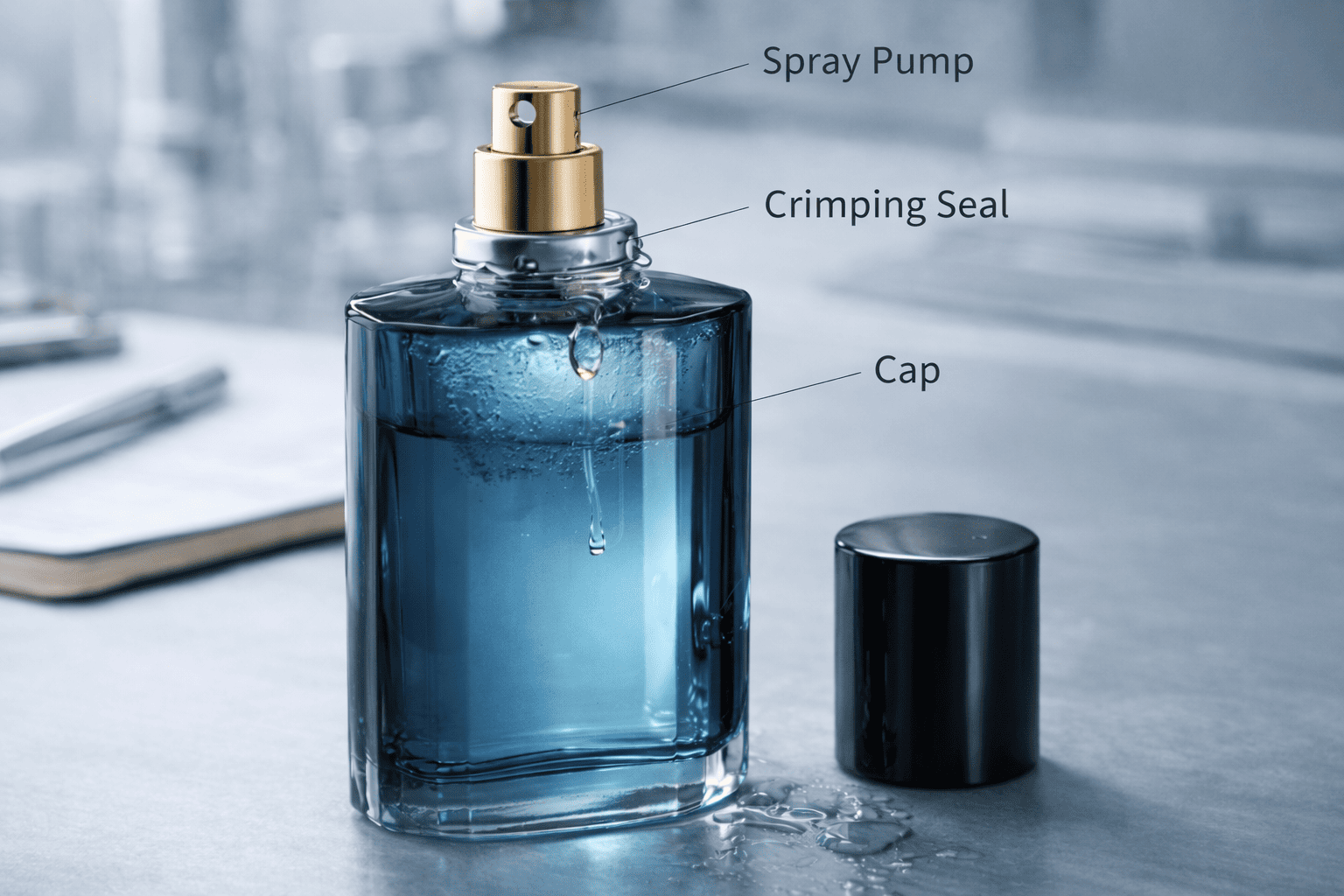
I treat the pump and bottle neck as one system
I always believe that a perfume spray pump cannot be judged as a single part. It must be matched with the glass neck, gasket, and cap together. The actual seal is not created by one part alone. It is created by the full top system working together.
For example, if the total pump height is slightly higher, and the cap inner height is slightly lower, interference will happen when the cap is installed. Or the nominal neck size may look correct, but if the roundness or height varies a little, the force after crimping may become uneven. These may look like small tolerance issues on paper, but for the customer, the result becomes liquid droplets near the actuator or a strong fragrance smell around the neck.
This is why I do not suggest mixing bottles, pumps, and caps from different suppliers casually. Even if the catalog says they use the same standard size, their mold practice, material thickness, and structural details may still be different. Without real assembly testing, the risk becomes high.
Crimping stability decides the sealing result
Most perfume glass bottles use crimp pumps. If the crimp is too loose, the pressure between the pump and the neck is not enough, and liquid can slowly seep out. If the crimp is too tight, it may deform the pump, damage the gasket, or create too much stress on the glass neck. Many people think tighter means safer, but that is not true in real production. The biggest problem is not only weak force. It is unstable force.
When I work on a project, I pay close attention to whether the crimp is centered, whether one side is tighter than the other, and whether there are deep local marks. These details may not look serious in the sample stage, but in mass production they can quickly become a repeated problem.
| Crimp Condition | Possible Result | Leakage Risk |
|---|---|---|
| Too loose | Weak seal, slow seepage | High |
| Too tight | Deformation, high stress, gasket failure | High |
| Uneven | One side sealed, one side leaking | High |
| Stable and proper | Even seal and firm pump fixing | Low |
The cap is not only decorative, it also affects dispensing
At first, many clients see the cap as a decorative part. They think it is only for appearance and dust protection. But in real packaging work, I find that the cap has a big effect on stability. In logistics and e-commerce, the cap does more than protect the actuator. It also affects whether the pump can be triggered by external force.
The earlier case is a good example. After the cap mold inner height became lower, the cap created a constant downward force on the spray pump. That force was small, but it was enough to let shipping vibration trigger the actuator again and again. Once the actuator is pressed repeatedly, even in a very small movement, droplets can build up inside the cap. When the customer opens the package and sees this, they often decide that the bottle is leaking, and the brand image is affected immediately.
So now, when I build a perfume packaging solution, I include cap inner dimensions, height clearance, fitting feel, and transport pressure in my tests. A good cap should protect the pump, avoid pressing the pump, and stay stable during shipping.
Gasket material directly affects sealing and corrosion resistance
At the joint area between the spray pump and the glass bottle neck, the gasket is a key sealing part. Common gasket materials include foam-based options and silicone-based options. On the surface, both can provide sealing, but their real performance can be quite different.
From my experience, silicone gaskets usually give better sealing, better corrosion resistance, and better long-term stability. This is especially true for perfume formulas with high alcohol content or more complex fragrance ingredients. Foam gaskets are more cost-friendly, so they are often used in projects where cost performance is the main goal. But if a brand is positioned in the mid-to-high-end market, or if long-term stability matters more, I usually prefer to recommend silicone gaskets.
Consumers will never ask what gasket you used. But they will feel the result directly. They will notice whether there is fragrance leaking into the box, whether small droplets appear around the spray pump, and whether the bottle starts leaking after some time. These details become their judgment of your brand quality.
Pump material and surface finishing also affect the full experience
Besides the gasket, the pump material itself also deserves attention. Common spray pumps may use plastic or aluminum parts. Different materials create different effects in appearance, corrosion resistance, and hand feel. Then there is surface treatment. Some pumps use basic finishing, while others use [[electrolytic finishing]][2].
In actual use, electrolytic finished pumps usually perform better in corrosion resistance, and the surface brightness stays attractive for a longer time. For some mid-to-high-end perfume brands, this matters a lot. Consumers touch the pump every day. The pressing feel, the visual texture, and the long-term appearance all shape how they judge product quality.
These may look like very small details, but small details are often what customers remember for the longest time. If a perfume brand wants a more premium image, I usually suggest using silicone gaskets together with a better electrolytic spray pump solution. The overall quality will be stronger, and the consumer experience will be better.
Which bottle and packaging design details matter most?
When people talk about perfume packaging, many focus on whether the bottle shape is special, whether the color is beautiful, and whether the decoration looks premium. In my view, the details that really decide whether a glass perfume bottle arrives safely in the customer’s hands are bottle neck structure, protective packaging, and shipping suitability.
Perfume packaging design must balance display effect and shipping safety. Bottle neck tolerance, cap fitting, glass strength, and carton inserts all affect leakage rate and breakage rate.

I always check the neck first, then the body
The bottle neck is the most critical area in the whole perfume packaging system. The pump, gasket, crimping, and cap all meet there. If the neck height is unstable, the top surface is uneven, or the roundness is poor, all later sealing work becomes harder. The body may look beautiful, and the base may feel heavy and premium, but if the neck is unstable, the bottle can still leak.
So when I review a perfume glass bottle solution, I usually do not start with the shape. I start with the neck data. I look at outer diameter, top flatness, height consistency, and whether it truly matches the selected pump specification. Only when the neck is stable do the later steps have a solid base.
| Design Detail | Why It Matters | What I Usually Recommend |
|---|---|---|
| Neck outer diameter and height | Decide the fitting relationship with the pump and cap | Confirm both samples and drawings |
| Cap inner height | Affects whether it will press the actuator | Do real assembly testing |
| Gasket material | Affects sealing and corrosion resistance | Use silicone for mid-to-high-end lines |
| Pump material and finish | Affects durability and premium feel | Pay attention to electrolytic finish |
| Carton insert | Reduces shock and protects glass | Standard for e-commerce shipping |
I always consider the shipping method in advance
This is one point that many brands ignore early on. When I talk about perfume packaging, I do not only care how it looks when assembled at the factory. I also need to know how it will finally reach the customer. Different delivery methods need different packaging priorities.
For example, products sent to offline retail stores usually move in full cartons and pallets, and the transport chain is more controlled. But in e-commerce, many orders are delivered as small parcels. Small parcels are sorted, stacked, dropped, and shaken during shipping. In that situation, the glass perfume bottle faces much more risk. The leakage risk becomes higher, and the breakage rate also rises.
So I usually suggest that clients add a paper box with an inner insert outside the glass bottle. The insert helps reduce vibration and absorb impact. It lowers bottle movement during shipping. Glass is fragile by nature. It is not a material that should face repeated e-commerce handling without support. For small and growing perfume brands, a proper insert box not only protects the product. It also protects after-sales cost and customer experience.
Packaging details also define brand positioning
I always feel that perfume packaging is not only a tool to hold the product. It is also part of the brand positioning. Consumers do not only see whether the bottle looks beautiful. They also judge the brand by the quality of the spray pump, the feeling of the cap, whether there is fragrance smell in the box, and whether the product arrives clean and complete.
So when I discuss perfume packaging with clients, I do not only talk about cost. I also ask what kind of feeling the brand wants to deliver. If the brand focuses on value for money, I help them protect sealing and shipping safety first within the budget. If the brand wants a mid-to-high-end image, I usually suggest stronger choices in gasket material, pump finishing, cap fitting, and carton inserts. These details may look small, but they become part of the long-term memory consumers keep about the brand.
How do I test and solve perfume bottle leakage before mass production?
In my view, the best way is never to fix leakage after it happens. The best way is to find the problem before mass production. Once the perfume has been filled, packed, and shipped, the cost of leakage becomes much bigger.
To reduce glass perfume bottle leakage, I do not rely on luck. I rely on pre-production testing. I test real assembly, check whether the cap presses the actuator, verify gasket compatibility, and confirm packaging stability under shipping conditions.
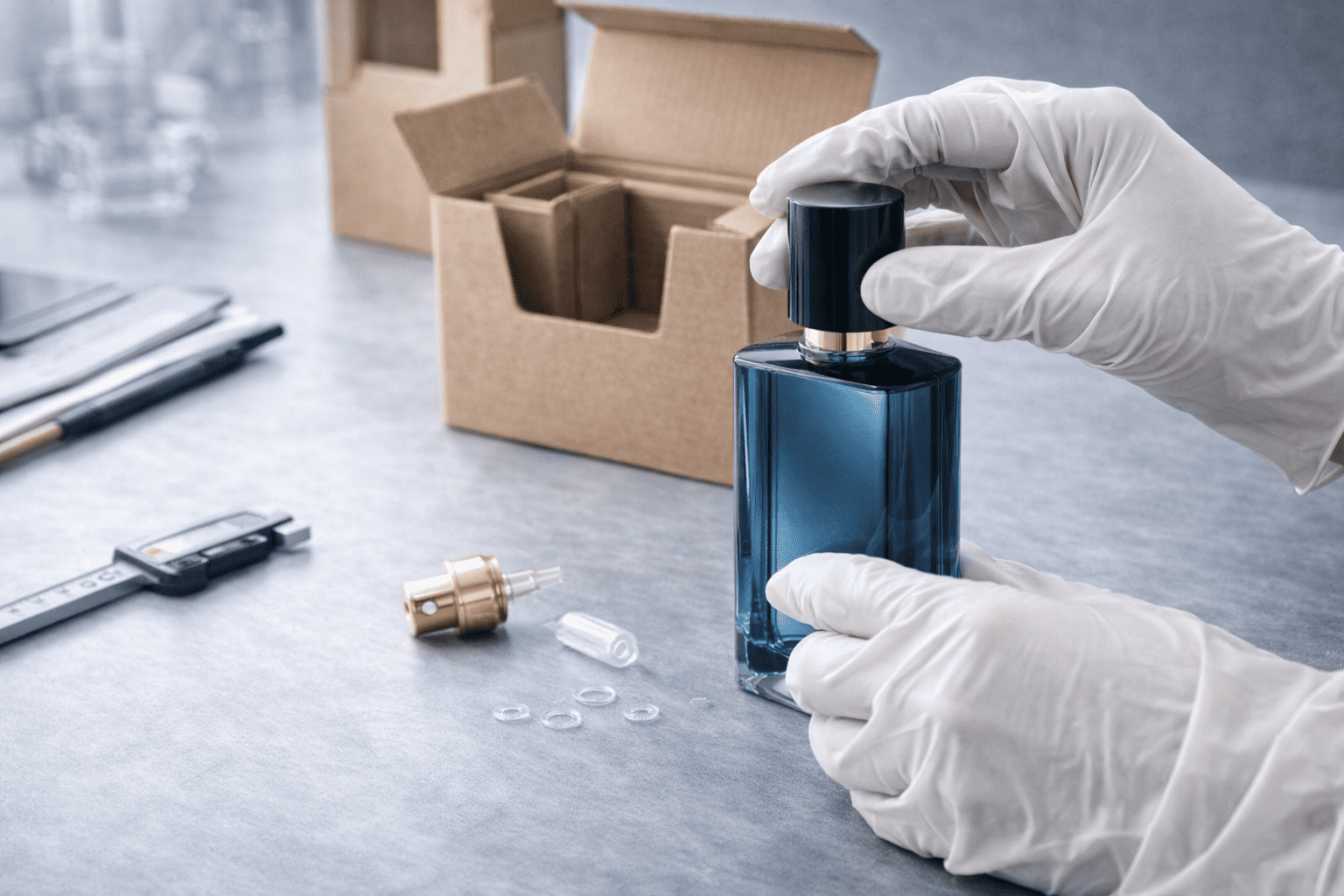
I insist on real assembly testing
Some samples look perfect, but that does not mean real production will be safe. So I always insist on real [[assembly testing]][3]. That means I do not only press the pump onto the bottle and look at it. I also install the cap, open and close it many times, and simulate what happens after transport. Problems like cap inner dimension changes are often invisible unless the whole package is tested in actual assembly.
I pay special attention to whether the cap pushes the actuator down, whether small droplets appear inside the cap, and whether there is fragrance residue on the pump top. These signs are small, but they are often the earliest warning signals.
I divide testing into several layers
To find problems more clearly, I divide testing into several layers. First, I do basic appearance and assembly checks. Then I do inversion tests and static observation. After that, I move to transport simulation and long-term storage performance. Some issues appear right away. Others only show up after days of vibration or temperature change.
| Test Type | What It Can Reveal | How I Usually Use It |
|---|---|---|
| Assembly check | Whether the cap presses the actuator or parts interfere | First step for every new project |
| Inversion test | Whether the top seal leaks immediately | Early sample screening |
| Static observation | Whether small droplets or slow seepage appear | Observation after filling |
| Transport simulation | Vibration and impact risk in e-commerce logistics | Validation before shipment |
| Pack drop test | Glass breakage risk and package protection level | Key test for e-commerce |
| Material compatibility test | Whether the gasket and pump resist perfume formula | Required for new formulas |
I change only one variable at a time
When a leakage problem appears in a project, I do not change many things at once. That makes it hard to know what really solved the issue. I prefer to adjust one variable at a time. For example, I first confirm whether the cap inner height is the problem. Then I check whether the total pump height is off. Then I check whether the gasket material is stable enough. This step-by-step method may look slower, but it gives a clearer result and is easier to repeat in mass production.
That earlier cap case was solved exactly this way. If we had changed the pump, bottle, and gasket all at once, we might never have found that the true problem was only a cap mold dimension change.
I treat small details as part of long-term brand value
Many people think [[silicone gaskets]][4], electrolytic pumps, carton inserts, and better finishing are only small upgrades. I do not see them that way. In many cases, the real competitiveness of a perfume brand is built by these small upgrades. Customers will not study your technical sheet, but they will remember whether the bottle was clean when they opened it, whether the pump felt smooth, whether the glass arrived intact, and whether the package felt premium in the hand.
So when I recommend perfume packaging solutions, I do not only help clients reduce leakage in glass perfume bottles. I also look at brand positioning and decide which details deserve investment and which details should not be reduced too much. These packaging details shape the consumer experience, and they also affect whether the customer wants to buy again.
Conclusion
To reduce leakage in a glass perfume bottle, I do not only focus on the bottle. I focus on the spray pump, cap, gasket, transport, and full packaging system. In my experience, reliable perfume packaging is built on these small details that many people overlook.