
An old perfume bottle can hide oil residue and a worn spray pump. I check both before refilling so the fresh perfume keeps its intended scent.
For my in-store refill service, I reuse the customer's original glass bottle and replace its crimp-on spray pump. I confirm the same fragrance and formula, inspect and clean the glass with approved perfume-grade ethanol, let it dry completely, refill it, and check the new pump for leaks and spray performance.
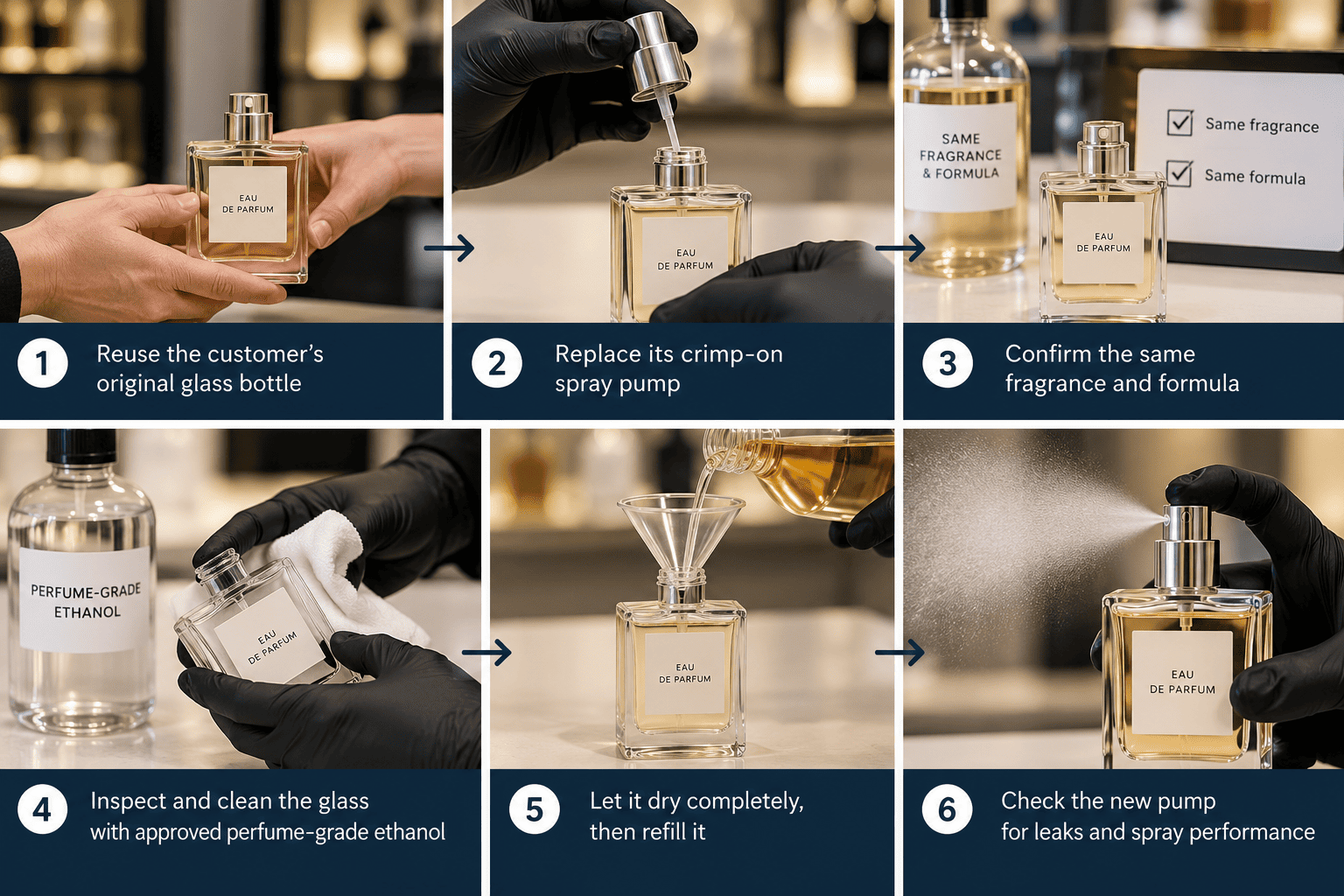
As the founder of Hongyan Glass Bottle, I consider cleaning and refilling part of the packaging decision. A beautiful bottle needs a suitable pump, a reliable seal, and a practical refill process.
My approach here focuses on a common store situation. A customer brings back an original glass bottle with a crimp-on pump and requests the same perfume. I keep the glass in use when it passes inspection. I replace the pump at every refill.
This process differs from cleaning a small screw-top travel atomizer at home. I work with a fixed pump connection, trained staff, and controlled filling equipment. Each step helps me protect the fragrance and extend the useful life of the glass bottle.
Why Do I Replace the Crimp-On Spray Pump Before Refilling?
A removed pump may still spray, but its collar or seal may be damaged. I do not rely on its appearance when preparing a refill.
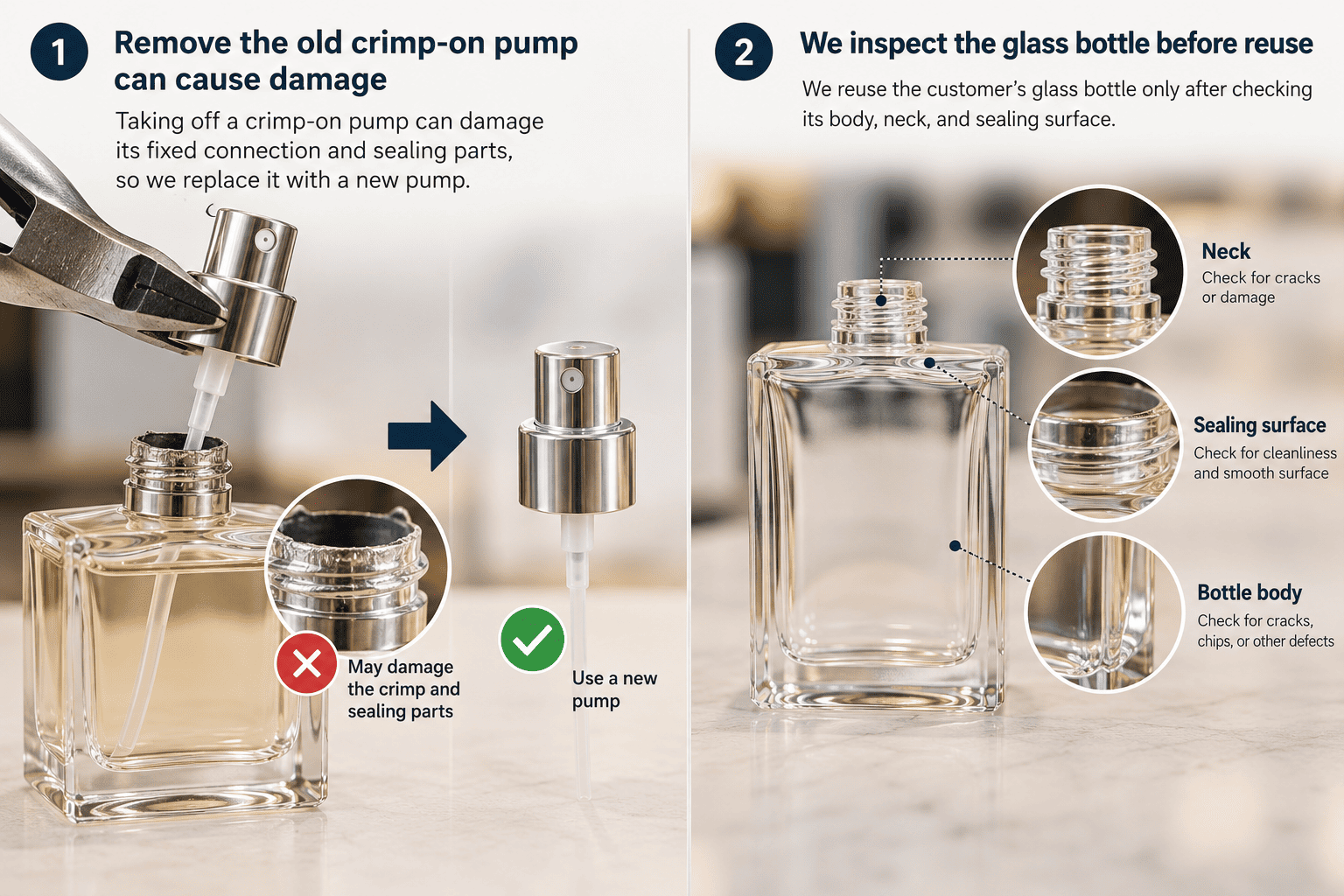
I replace the old crimp-on pump because removal can damage its fixed connection and sealing parts. My store policy treats the removed pump as a replacement item. I reuse the glass bottle only after checking its body, neck, and sealing surface.
I Separate Bottle Reuse From Pump Reuse
I explain my refill service as two separate decisions. I assess whether the glass bottle can be reused. I then fit a new, qualified pump.
A conventional crimp-on pump has a metal collar secured around the bottle neck. It has no screw thread that allows the customer to open it by hand. I do not ask staff to twist it off or force it open with unsuitable tools.
I use removal equipment suited to the bottle and pump. My operator protects the glass neck during removal, even though I plan to discard the old pump. A chipped neck can prevent the replacement pump from sealing correctly.
| Component | My decision | My inspection focus |
|---|---|---|
| Glass bottle body | I reuse it if it passes inspection | I check for cracks, chips, and persistent deposits |
| Glass neck | I inspect it after pump removal | I check the sealing surface for damage |
| Removed crimp-on pump | I retire it from service | I do not put it back into refill stock |
| New replacement pump | I use an approved unit | I check fit, cleanliness, and formula compatibility |
I Make the Replacement Policy Part of the Service
I do not claim that every removed pump is visibly broken. My policy addresses the uncertainty around removal damage, wear, and future leakage.
I also keep this rule specific to the conventional crimp-on bottles accepted by my store. Other packaging systems may have different refill or servicing instructions.
I tell the customer about the pump replacement before I begin. This makes the price and process easier to understand.
My environmental message stays clear: I extend the life of the original glass bottle. I do not describe the service as waste-free because it still uses a new pump and produces cleaning waste. I believe a precise explanation builds more trust than a broad environmental claim.
What Do I Check Before Cleaning a Returned Perfume Bottle?
I do not accept a returned bottle based on its label alone. I check its contents, storage history, and condition before deciding whether to refill it.
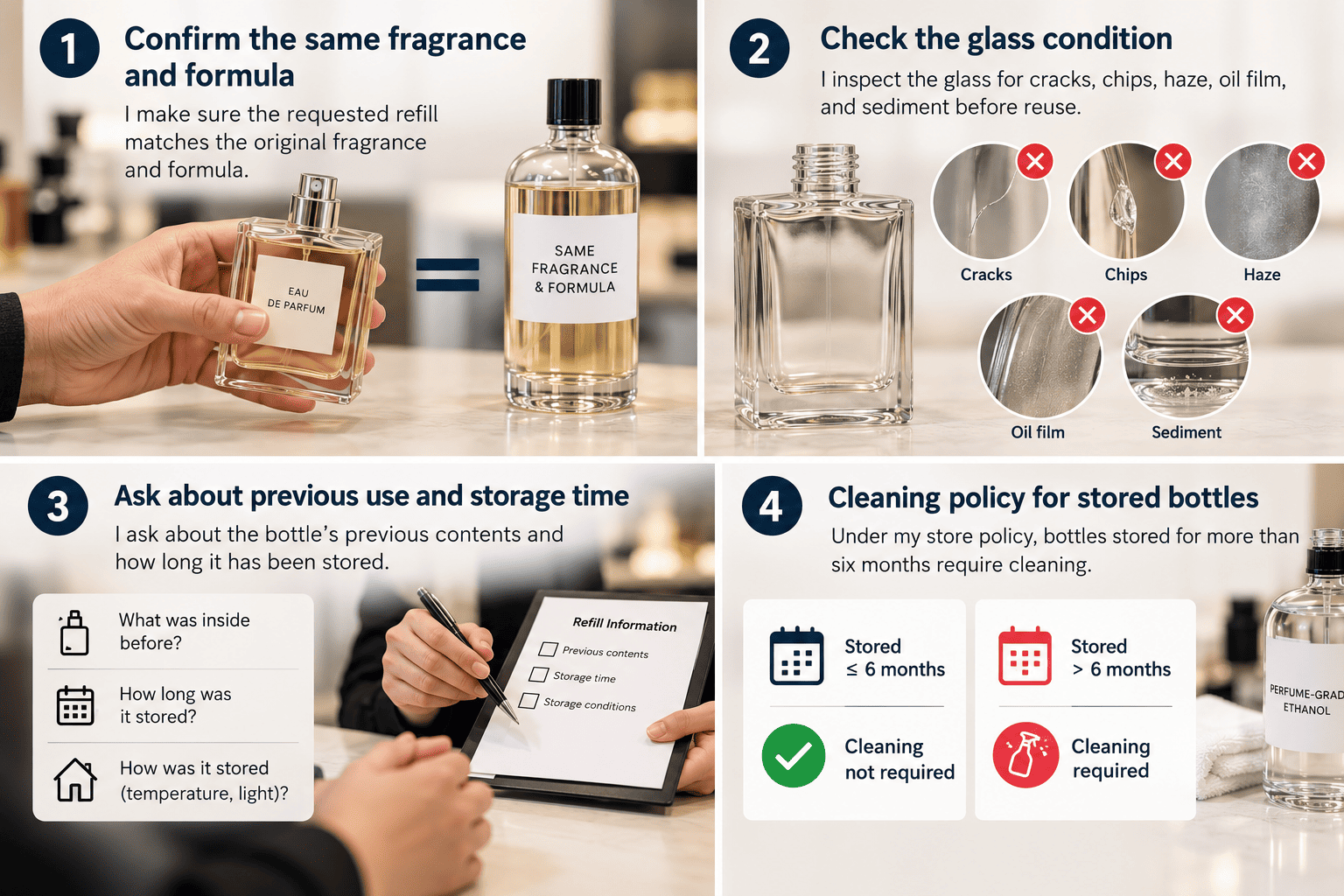
I confirm that the requested refill matches the original fragrance and formula. I check the glass for cracks, chips, haze, oil film, and sediment. I ask about previous contents and storage time. Under my store policy, bottles stored for more than six months require cleaning.
I Confirm What the Bottle Previously Held
I ask the customer whether the bottle has contained only its original perfume. I also ask whether anyone has added another fragrance, water, or a household cleaner.
My service accepts the same fragrance and formula. I do not switch perfume types in a returned bottle. This gives staff a clear rule and reduces uncertainty about scent carryover.
I check formula identity where records are available. A fragrance can retain its name after a formula change. If I cannot confirm that the requested refill meets the service requirements, I hold the bottle for further assessment.
| Inspection point | What I check | My action |
|---|---|---|
| Previous contents | I confirm the original perfume only | I decline mixed or unknown contents |
| Requested refill | I check fragrance and formula identity | I do not switch scents in this service |
| Glass condition | I inspect the body and neck | I reject cracked or chipped glass |
| Inner wall | I look for haze, oil film, and sediment | I clean and inspect again |
| Storage history | I ask how long the bottle has been unused | I require cleaning after six months |
| Pump connection | I identify the neck and pump type | I prepare a matching replacement |
I Treat a Hazy Inner Wall as a Warning
I sometimes describe an oily or cloudy inner wall as “oil return.” I use this term to describe the visible condition. I do not use it as proof of a specific chemical cause.
Fragrance residue can remain on the glass after storage. However, haze and sediment can have other causes. I therefore inspect the bottle after cleaning rather than assuming that every deposit will dissolve.
If the haze, particles, or unusual odor remain, I do not cover the problem with fresh perfume. I remove the bottle from the refill process.
I treat six months as an internal operating threshold. I do not present it as a universal expiry point for all bottles. Visible contamination or uncertain contents can require action much sooner.
How Do I Remove Oil Film From the Glass Bottle?
Fresh perfume should not be poured over an unresolved oily deposit. I clean the bare glass and reassess it before bringing it to the filling area.
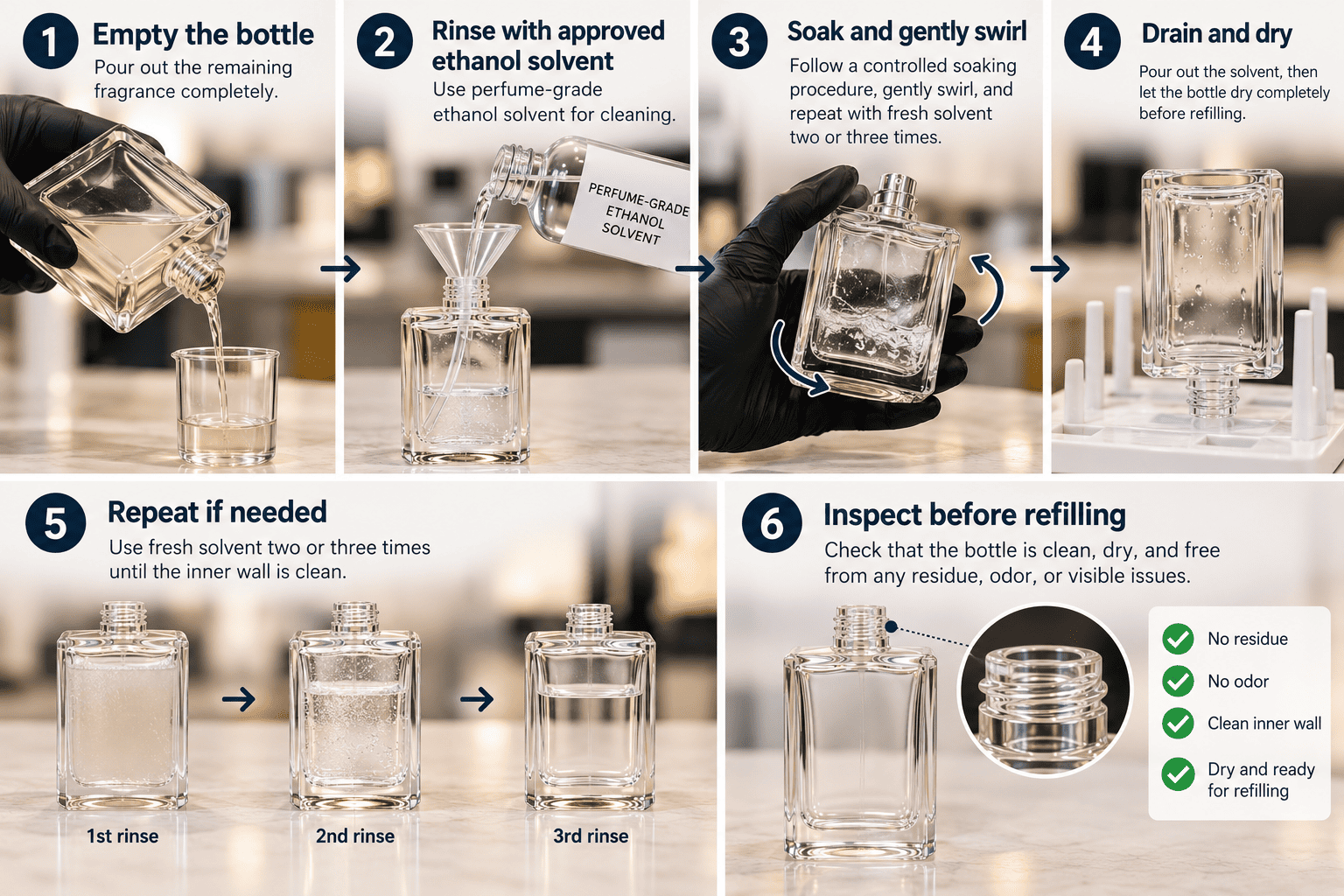
I empty the bottle and rinse its inner wall with the approved ethanol solvent grade used for the perfume. I follow a controlled soaking procedure, gently swirl, and repeat with fresh solvent two or three times. I then drain, dry, and inspect the bottle before refilling.
I Use the Correct Ethanol Grade
I specify the ethanol grade and concentration approved for the perfume and cleaning process. I do not substitute household rubbing alcohol, hand sanitizer, or a solvent with unknown additives.
I also check the bottle's exterior finish. Painted, plated, or printed surfaces may react differently from bare glass. I keep the cleaning solvent away from decoration unless its compatibility has been confirmed.
I work with suitable ventilation and keep ethanol away from flames, sparks, and heat. I collect used solvent in the designated waste container. I never return it to the clean solvent supply or fragrance stock.
| Cleaning stage | What I do | What I assess |
|---|---|---|
| Emptying | I remove the remaining old perfume | I check for liquid and deposits |
| Initial rinse | I wet the inner wall with approved ethanol | I check whether the film loosens |
| Controlled soaking | I follow the established procedure | I avoid an undefined soaking time |
| Repeated rinsing | I use fresh solvent two or three times | I check for remaining residue |
| Draining | I place the bottle in the approved draining position | I check for trapped liquid |
| Drying and inspection | I allow complete drying in a clean area | I check for haze, particles, and odor |
I Keep Water Out of This Refill Procedure
I do not use a water rinse in this store workflow. Uncontrolled water remaining in the bottle can change the perfume's solvent balance and may cause cloudiness, depending on the formula.
I do not claim that water always spoils perfume. Some formulas contain a controlled amount of water. My concern is extra water introduced during cleaning.
I also avoid refilling while cleaning ethanol remains. Additional ethanol changes the intended fragrance concentration, even if it is the same solvent type used in the perfume.
I let the bottle drain and dry completely in a clean, low-dust area. I protect the opening without trapping moisture inside. I do not use heat or a fixed waiting time as my only drying check.
For a commercial refill service, I establish the cleaning and drying procedure before routine use. I do not treat a clear appearance or a quick smell check as proof that every relevant residue has been removed.
How Do I Choose a Replacement Pump That Protects the Fragrance?
A new pump can still be unsuitable for the perfume. I check its materials and performance before approving it for my refill service.
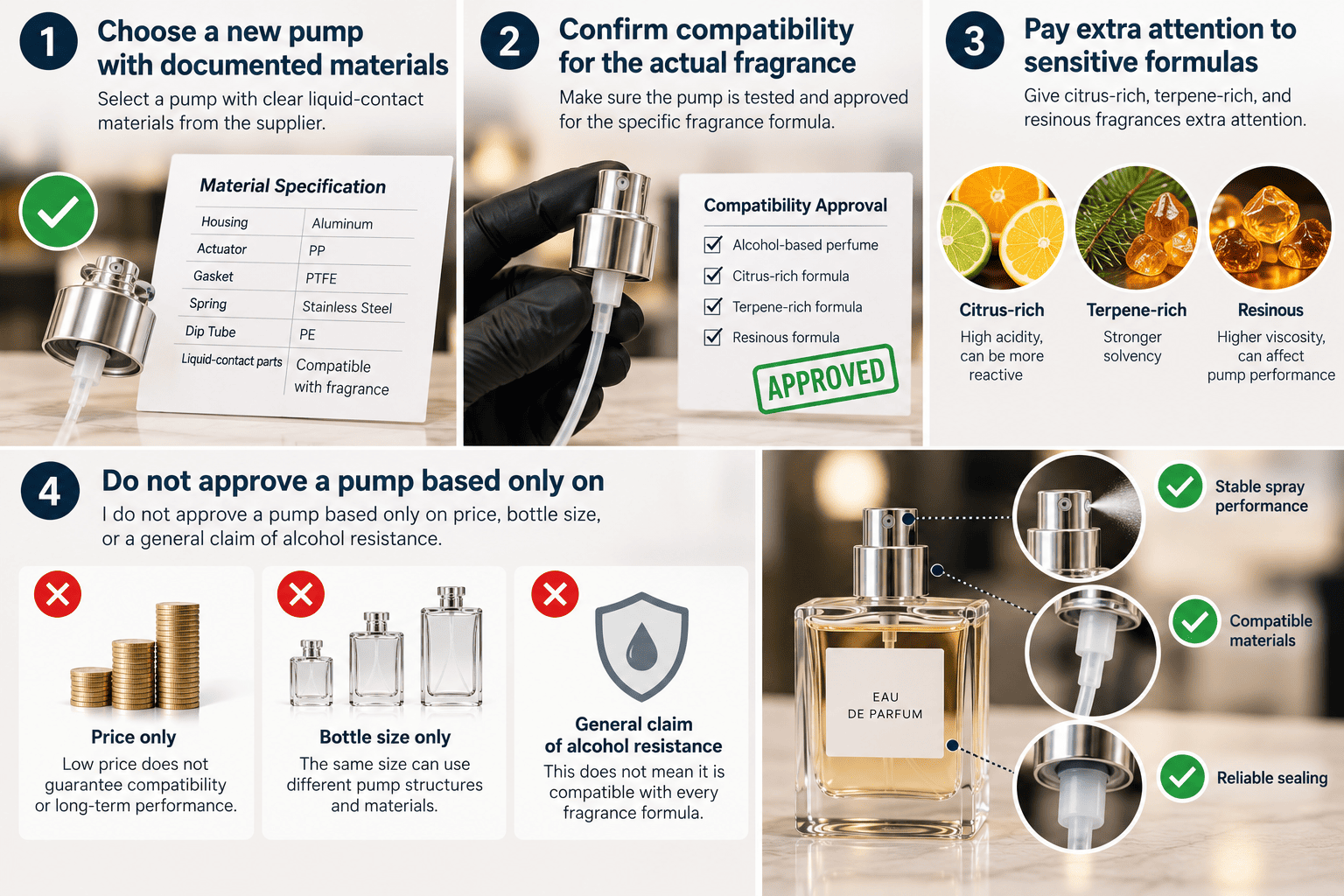
I choose a new pump with documented liquid-contact materials and compatibility approval for the actual fragrance. I give citrus-rich, terpene-rich, and resinous formulas extra attention. I do not approve a pump based only on price, bottle size, or a general claim of alcohol resistance.
I Check the Internal Materials
I distinguish the decorative actuator from the parts that contact perfume or vapor. An ABS outer button does not automatically mean that ABS contacts the liquid.
I pay close attention to low-cost sample atomizers when their material specifications are unclear. I do not assume every sample pump contains ABS. I also do not assume that every original 30, 50, or 100 ml pump uses the same internal materials.
I request information about the dip tube, pump internals, and seals. I want the specification for the actual pump model.
| Material or part | My approval approach |
|---|---|
| PP liquid-contact components | I check the grade and formula compatibility |
| PTFE components | I check their function and the complete assembly |
| EPDM seals | I require approval for the actual fragrance blend |
| ABS liquid-contact components | I reject unqualified use under my store specification |
| Unspecified rubber seals | I require material documentation before acceptance |
| Outer decorative components | I assess finish durability separately |
I Do Not Treat Material Names as Guarantees
I do not treat PP, PTFE, and EPDM as an interchangeable list of universally suitable materials. Each component has a different role, and the full fragrance blend matters.
I give EPDM particular attention. Alcohol resistance alone does not prove compatibility with every fragrance oil or terpene-rich formula. I need confirmation for the intended exposure conditions.
I also consider swelling, leakage, odor transfer, and changes in spray performance. An unsuitable material may affect the perfume or pump function. However, I do not diagnose plastic additive migration from smell alone.
I arrange incoming odor sampling and formula compatibility testing before approving pump stock. I check for unexpected plastic or processing odors and retain the supplier and batch information.
Aptar's fragrance packaging services also include compatibility testing. I use this as a reminder that packaging approval involves more than selecting a material name.
I inspect designated samples rather than dismantling every production pump. Opening an assembled pump can affect cleanliness or function. For citrus-rich formulas, I require a pump qualified for that perfume rather than relying on a “solvent-resistant” label.
How Do I Refill, Seal, and Check the Bottle Before Delivery?
A clean bottle still needs the right fill, seal, and spray. I complete these checks before returning the perfume to the customer.
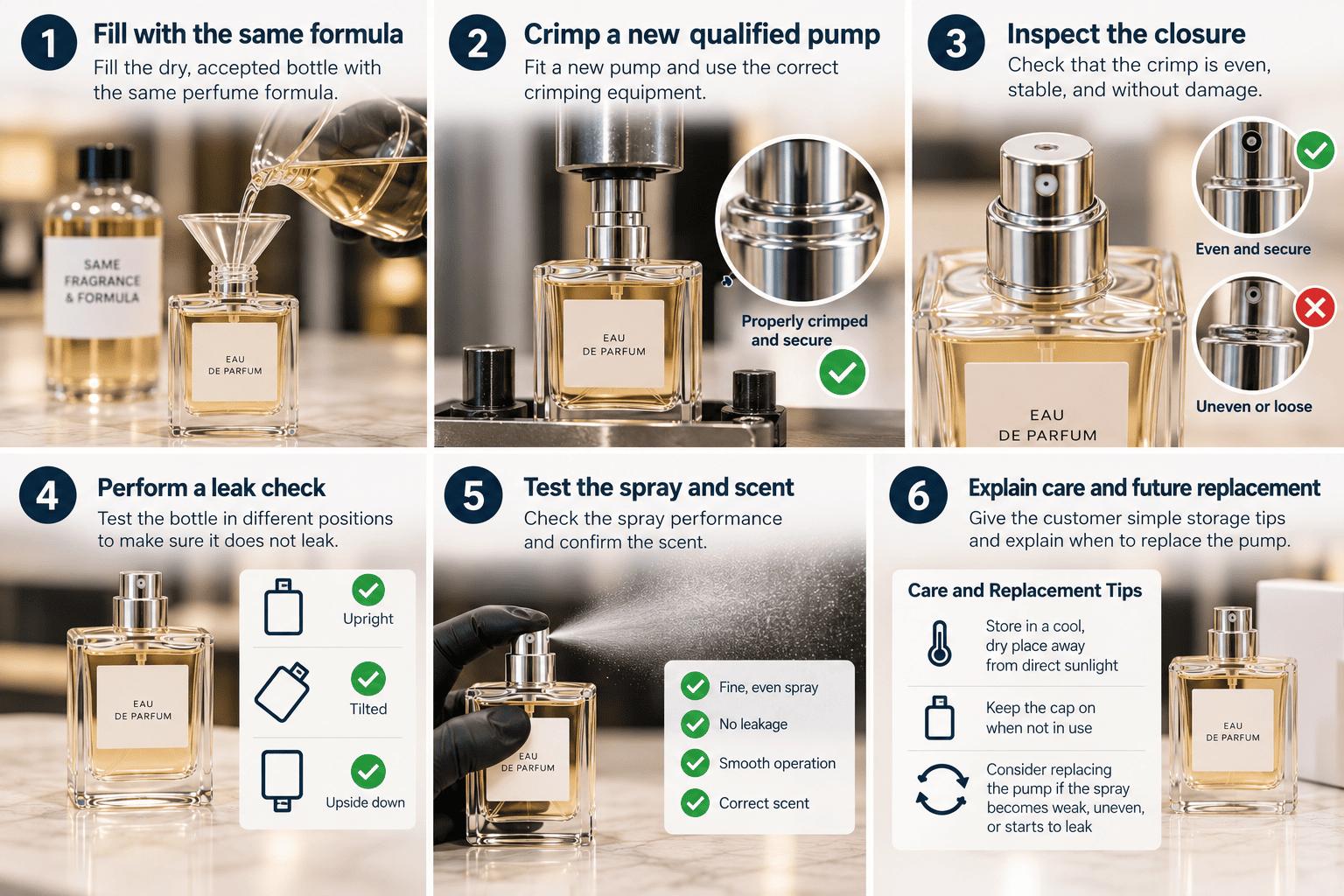
I fill the dry, accepted bottle with the same perfume formula and fit a new qualified crimp-on pump. I use the correct crimping equipment, inspect the closure, perform the defined leak check, and test the spray and scent. I then explain storage care and future pump replacement.
I Control the Fill and Pump Assembly
I confirm that the bottle has passed cleaning and drying checks. I use approved fragrance stock and clean filling equipment.
I fill to the specified level. I leave the required headspace rather than filling the bottle to the brim.
I check the new pump's neck fit, gasket, and dip-tube length. I then use the crimping head and settings approved for that bottle-and-pump combination.
After assembly, I inspect the collar and glass neck. I look for uneven positioning, wetness, or damage. If the assembly fails, I investigate the cause rather than repeatedly tightening it.
| Final check | What I look for | My action if it fails |
|---|---|---|
| Crimp position | I check collar alignment and consistency | I hold the bottle for assessment |
| Seal | I perform the defined inverted leak check | I withhold any leaking bottle |
| Spray | I check for consistent atomization without dribbling | I investigate the pump |
| Scent | I check for a new off-odor | I hold the refill for further checks |
| Traceability | I record fragrance and pump batch details | I complete the record before delivery |
I Check Performance Without Overstating the Result
I invert the bottle for the period specified in the store procedure. I do not describe a short inversion as a complete transport or shelf-life test.
I prime the pump and test the spray on a clean fragrance blotter. I check for blockage, dribbling, and an unusual spray pattern. I assess the scent for unexpected plastic or processing odors.
I use this sensory check as a final screen. It does not replace earlier compatibility testing.
I Explain the Refill Service to the Customer
I tell the customer that I have reused the original glass bottle and installed a new pump. I explain that the next refill will also include a pump replacement under this service.
I recommend storage away from direct light and heat, following the perfume brand's instructions. For citrus-rich perfumes, I explain that suitable packaging remains important during storage. I encourage use within the brand's stated period.
My staff follow clear rules. I do not reuse removed crimp-on pumps, fill over unresolved deposits, mix fragrance types, accept unqualified liquid-contact materials, or introduce a water rinse into this workflow.
At Hongyan Glass Bottle, I help small perfume brands consider these practical details when choosing packaging. I assess the bottle, neck finish, pump, and refill procedure together.
Conclusion
I reuse suitable glass, remove residue, and install a qualified new pump. I protect each refill through clear inspection, cleaning, sealing, and delivery checks.