
Choosing the wrong perfume bottle size can affect your retail price, customer acceptance, shipping cost, and even your brand position. I see many new fragrance brands underestimate this decision.
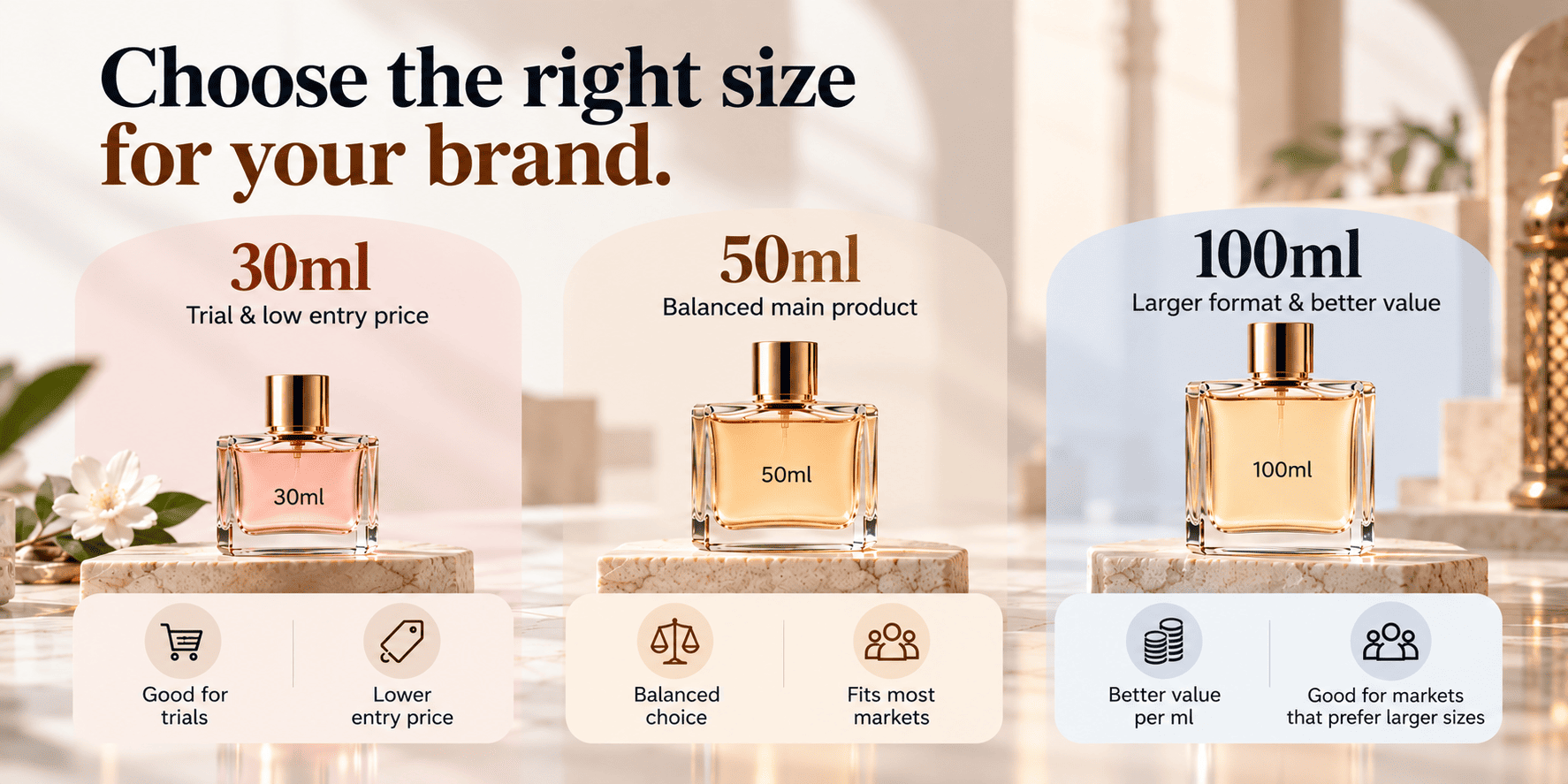
There is no single best perfume bottle size for every brand. I usually recommend 30ml for lower entry prices, 50ml as a balanced main size, and 100ml for markets or brands that focus on larger volume and better value per milliliter.
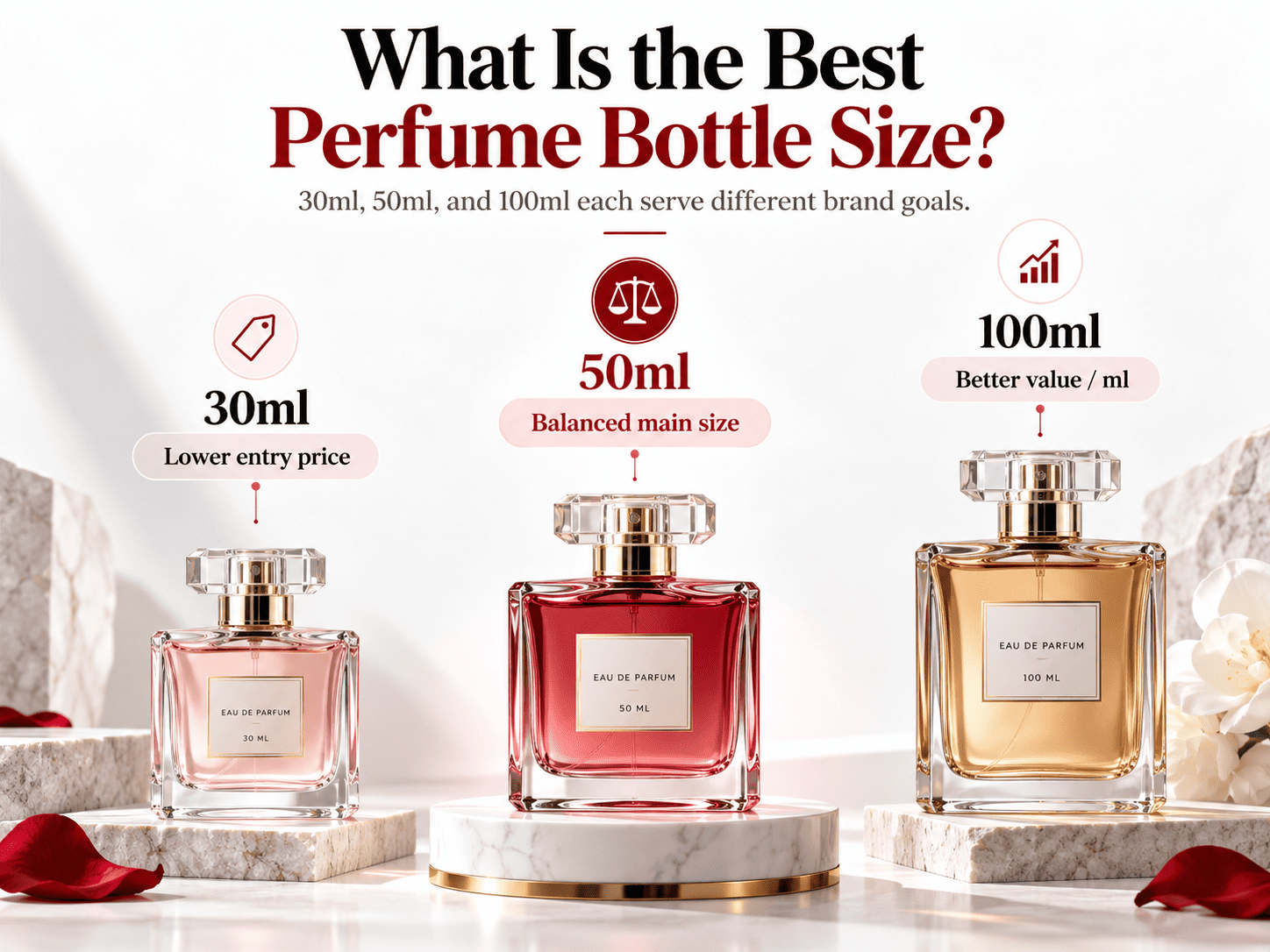
When I help a customer choose a perfume bottle, I do not only ask which size looks better. I first look at the [target market][[1]], customer habits, brand positioning, retail price, and sales channel. These factors often decide whether 30ml, 50ml, or 100ml makes more sense.
Is a 30ml Perfume Bottle Best for a New or Growing Brand?
A 30ml bottle can help reduce the customer's first-purchase risk. This is especially useful when people do not know your brand or fragrance yet.
I usually recommend 30ml perfume bottles for new brands, trial-focused products, younger customers, online fragrance businesses, and brands that want to keep the retail entry price low. It is also useful when customers like buying several scents instead of one large bottle.
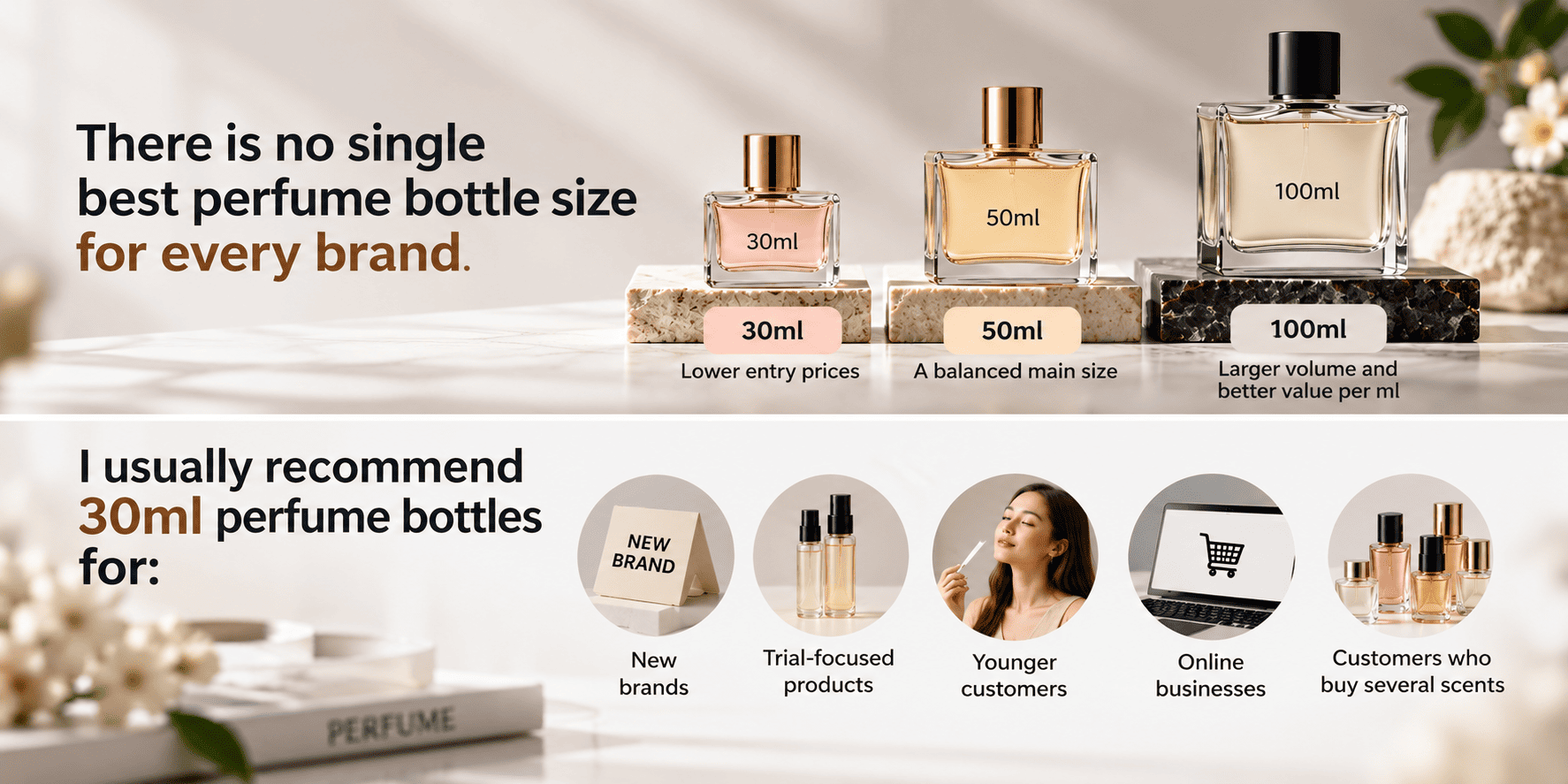
Why I Consider 30ml a Good Entry Size
When I work with smaller perfume brands, I often see the same problem.
The brand may have a good fragrance. It may have a strong story. The packaging may also look attractive. But the customer still does not know the product.
That makes the first purchase difficult.
A 30ml bottle can reduce that barrier.
The customer does not need to spend as much money to test the fragrance. This is useful for brands selling through their own website, Instagram, TikTok, Shopee, Lazada, Amazon, or other online channels.
| Factor | 30ml Bottle |
|---|---|
| Customer entry price | Low |
| Trial purchase | Excellent |
| Online sales | Very good |
| Travel convenience | Good |
| Multiple-scent purchase | Very good |
| Packaging cost per ml | Relatively high |
| Blind-buy risk | Lower |
| Repeat purchase potential | High |
I also think 30ml works well when a brand has several fragrances.
For example, a customer may hesitate to buy one 100ml fragrance from a new brand. But the same customer may be willing to buy two different 30ml perfumes.
This gives the customer more variety.
It can also help the brand introduce more fragrances to the same person.
However, there is one thing I always explain to customers.
A smaller bottle does not mean that the packaging cost becomes proportionally smaller.
The bottle is smaller, but you still need a pump, collar, cap, decoration, label, box, and assembly.
Some of these costs are very close to the cost of a 50ml product.
Because of this, the packaging cost per milliliter for a 30ml perfume can actually be higher.
So I do not recommend looking only at the bottle price.
I look at the final retail price and the customer's willingness to make the first purchase.
If 30ml helps more people try your fragrance, the higher packaging cost per milliliter may still be worth it.
Is a 50ml Perfume Bottle the Best All-Round Choice?
If a customer asks me to choose only one size for a new fragrance line, 50ml is often my first recommendation.
A 50ml perfume bottle gives a strong balance between retail price, product value, daily use, packaging design, and shipping. I often recommend it as the main size for small and medium fragrance brands, especially in markets where customers prefer a practical middle-size product.
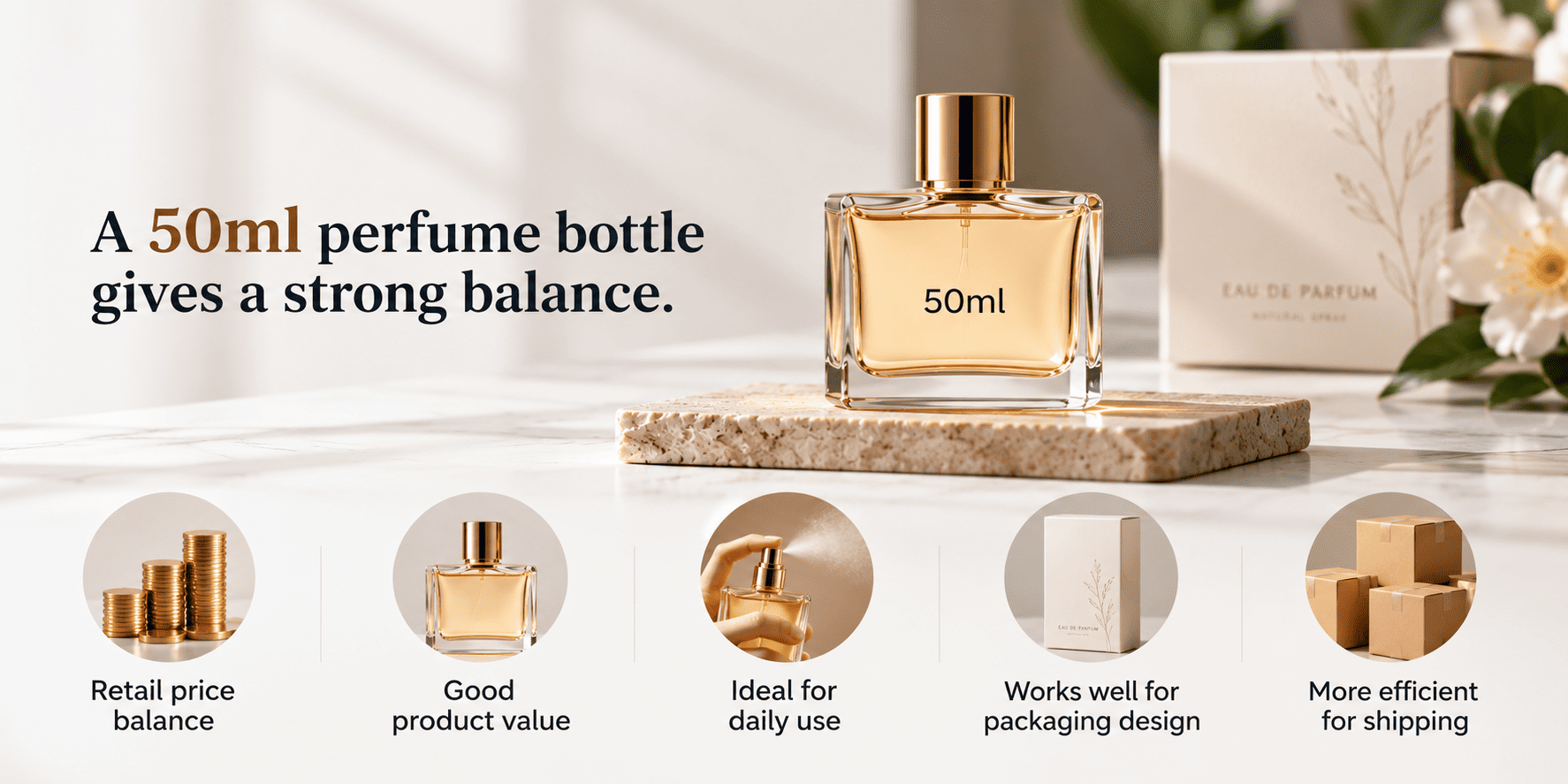
Why I Often Recommend 50ml as the Main Size
I see 50ml as the middle point.
A 30ml bottle can sometimes feel small.
A 100ml bottle can create a higher purchase price.
A 50ml bottle sits between these two options.
This gives the brand more flexibility.
| Factor | 50ml Bottle |
|---|---|
| Customer entry price | Medium |
| Perceived value | High |
| Premium positioning | Very good |
| Online sales | Very good |
| Retail store sales | Very good |
| Gift use | Very good |
| Shipping efficiency | Good |
| Customer commitment | Medium |
| Main product potential | Excellent |
I also like 50ml because it works with many brand styles.
A premium niche fragrance can use a heavy 50ml glass bottle with a custom cap, metal label, frosting, or special coating.
A more affordable fragrance brand can use a stock 50ml perfume bottle, standard pump, simple cap, and basic printing.
Both can work.
The difference comes from the complete packaging design.
From my experience, 50ml is especially useful in markets such as Southeast Asia and Australia.
In these markets, I often suggest that customers use 50ml as one of their main fragrance sizes.
The reason is simple.
The retail price can stay more manageable than a 100ml perfume.
The bottle still gives customers enough product for regular use.
The size is also practical for e-commerce, gifting, and daily carrying.
For a young perfume brand, this balance is important.
I also think 50ml gives designers enough room to create a strong visual identity.
The front of the bottle has enough space for a logo or label.
The glass proportions usually work well with different cap designs.
We can also use spray coating, frosting, hot stamping, decals, screen printing, or other decoration methods.
This is why I often see 50ml as a safe starting point when the brand wants one main size.
Is a 100ml Perfume Bottle Better for Premium or Value-Focused Products?
A 100ml perfume bottle gives customers more fragrance and usually creates a stronger sense of value. But it also creates a higher final purchase price.
I recommend 100ml when the target market accepts larger fragrance sizes, when the brand focuses on value per milliliter, or when customers already know the fragrance. It can be especially suitable for Middle Eastern markets, daily-use perfumes, and value-focused fragrance brands.
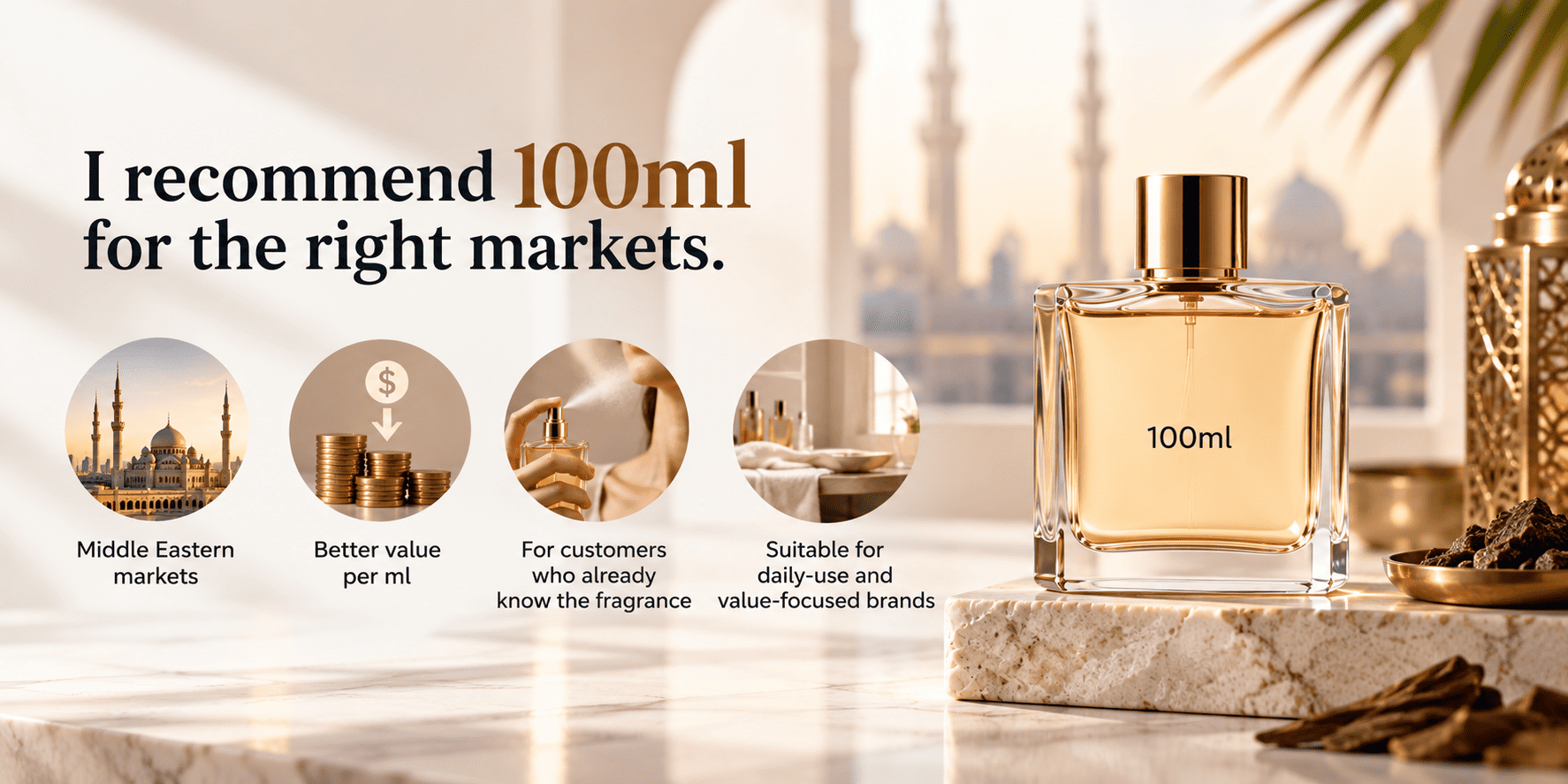
Why 100ml Can Be the Right Choice in Some Markets
When we choose a bottle capacity, I always look at the target market first.
This is one of the most important lessons I have learned from working with different fragrance customers.
Different markets have different expectations.
For example, if my customer is targeting the Middle East, I often ask them to seriously consider 100ml from the beginning.
In many Middle Eastern fragrance markets, consumers are already very familiar with 100ml perfumes.
The larger bottle does not automatically feel too big.
In many cases, it is easier for the customer to understand and accept.
| Situation | Why 100ml Can Work |
|---|---|
| Middle East market | High consumer acceptance |
| Value-focused fragrance | Better value per ml |
| Daily-use perfume | More product for regular use |
| Established bestseller | Customers already trust the scent |
| Strong fragrance culture | Larger size can fit buying habits |
| Repeat customers | Lower risk of buying a large amount |
The second factor I look at is brand positioning.
If the brand wants to communicate good value for money, 100ml can support that positioning.
The customer pays more in total, but the price per milliliter can usually be lower than the 30ml or 50ml version.
For example, I do not need the price of 100ml perfume to be exactly double the price of 50ml.
This creates a clear value difference.
The customer can see that buying the larger bottle gives more fragrance for each dollar spent.
For a value-focused brand, that can be very important.
However, I still do not recommend 100ml for every situation.
A large bottle needs more perfume liquid.
The glass bottle normally weighs more.
The box becomes larger.
The inner support may also need to be stronger.
The shipping weight increases.
For cross-border e-commerce, these factors can become important very quickly.
A 100ml bottle also asks for more commitment from the customer.
If someone has never smelled your fragrance before, buying 100ml can feel risky.
So I usually look at the target customer and target market before making this decision.
How Do 30ml, 50ml, and 100ml Perfume Bottles Compare?
Looking at capacity alone can be misleading. I prefer to compare each bottle size based on the role it plays in the business.
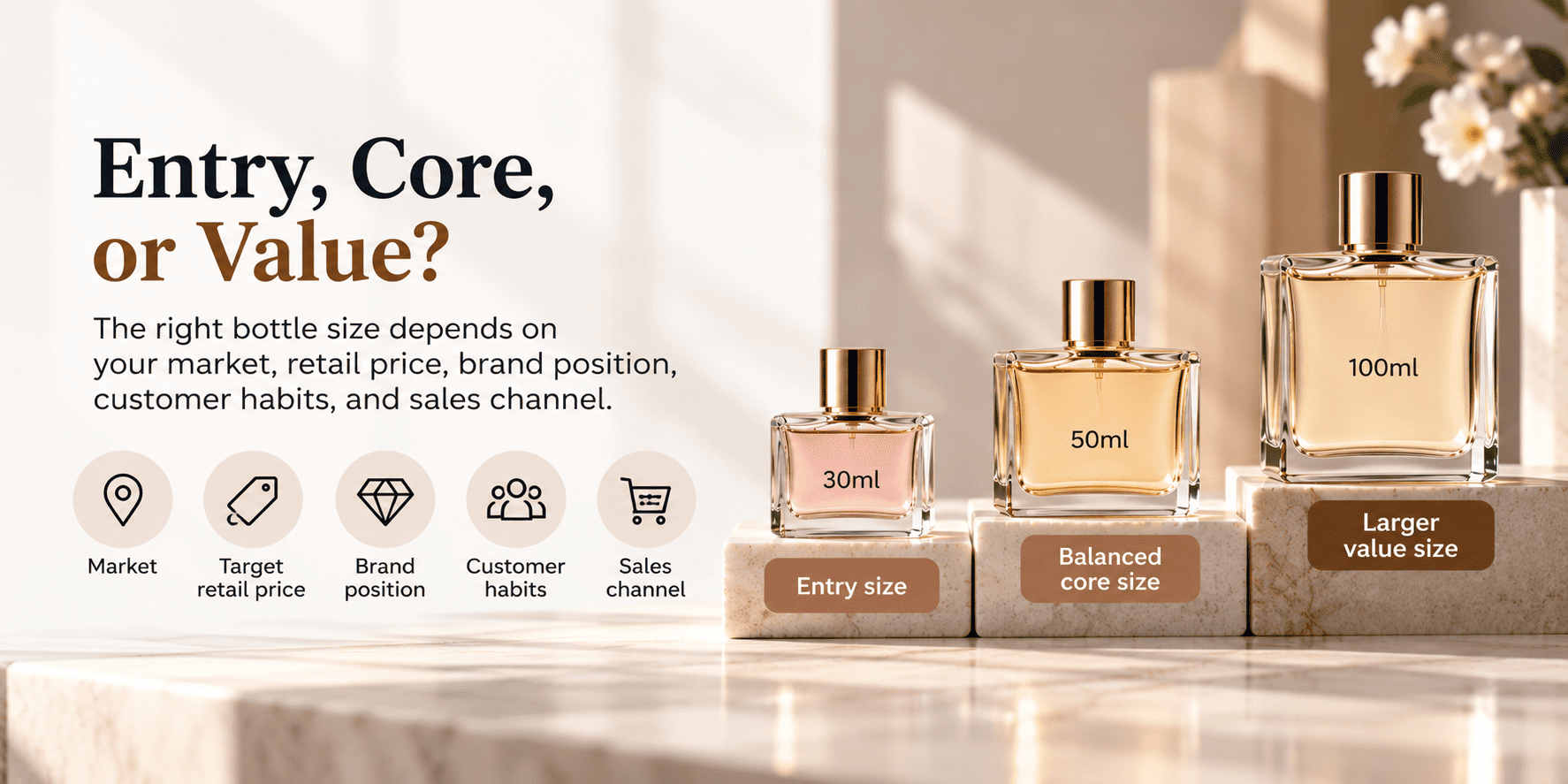
I see 30ml as an entry size, 50ml as a balanced core size, and 100ml as a larger value size. The right choice depends on your market, target retail price, brand position, customer habits, and sales channel.
My Practical Comparison of the Three Sizes
When I compare these three sizes, I do not ask only one question.
I ask several.
Where will the perfume be sold?
Who is buying it?
What price does the brand want to reach?
Can customers smell the fragrance before buying?
Is the brand trying to look affordable, premium, niche, or value-focused?
These questions change the answer.
| Feature | 30ml | 50ml | 100ml |
|---|---|---|---|
| Entry price | Lowest | Medium | Highest |
| Trial friendliness | Excellent | Good | Low |
| Main-product potential | Good | Excellent | Good |
| Value per ml | Lower | Medium | Higher |
| Shipping efficiency | High | High | Lower |
| Shelf presence | Medium | High | Very high |
| Gift potential | Good | Very good | Very good |
| Customer commitment | Low | Medium | High |
| Online sales | Excellent | Excellent | Good |
| Repeat-customer value | Good | Very good | Excellent |
I also think brands should avoid copying another fragrance company without understanding the reason behind its bottle size.
A successful perfume in Dubai may use 100ml.
That does not mean 100ml will automatically be the best size for a young online brand selling mainly to customers in Southeast Asia.
The buying habits may be different.
The retail price expectations may be different.
The shipping structure may also be different.
The reverse is also true.
A 50ml bottle can work very well in Australia or Southeast Asia, but a Middle Eastern customer may prefer a larger 100ml product.
This is why I always put the market before the bottle capacity.
The bottle size should follow the customer.
The customer should not be forced to follow the bottle size.
How Does Your Target Market Affect Perfume Bottle Size?
I believe this question should come before most packaging decisions. A bottle that works well in one country may perform very differently in another.
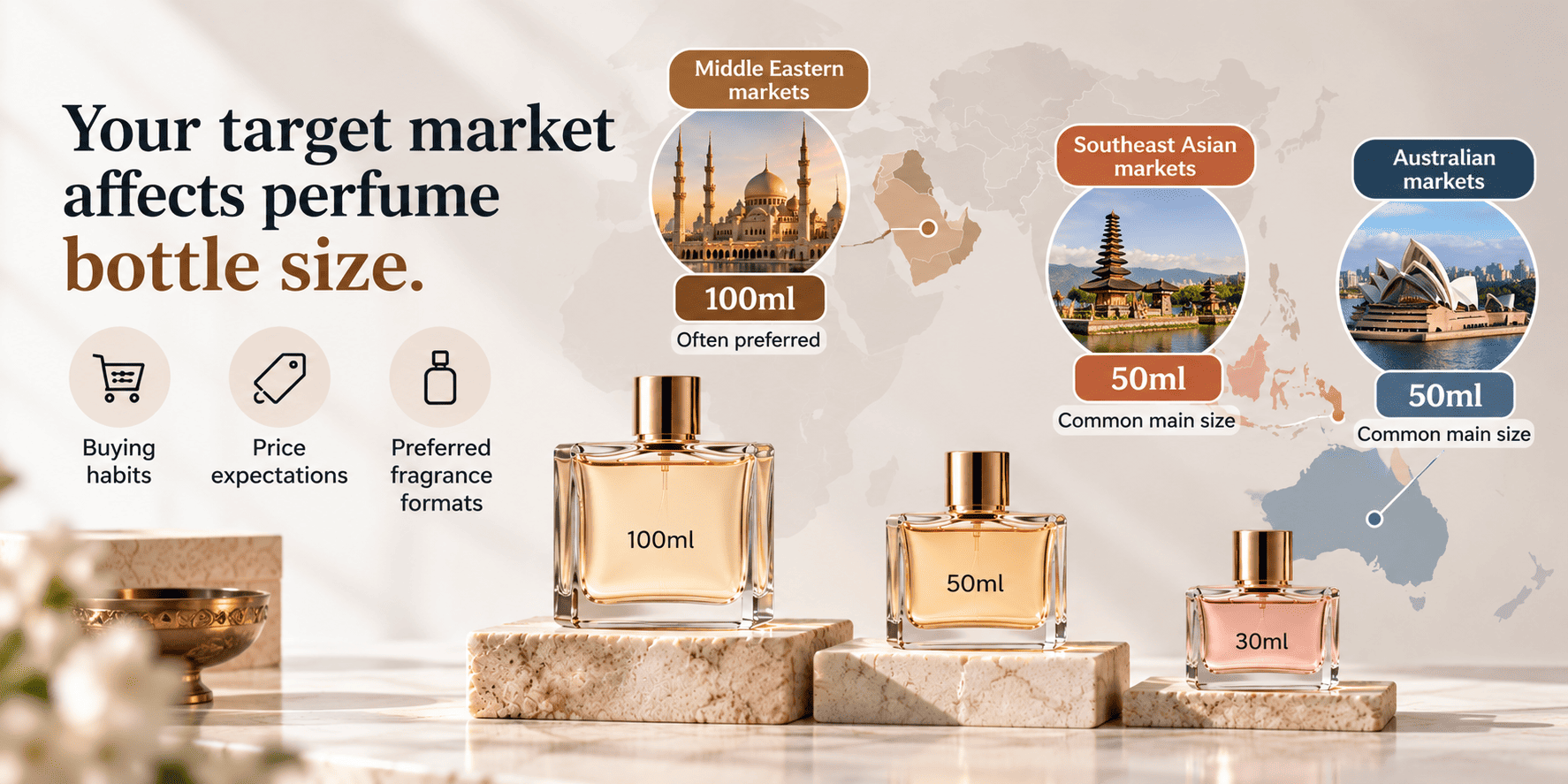
Your target market affects perfume bottle size because customers in different regions have different buying habits, price expectations, and preferred fragrance formats. I often consider 100ml for Middle Eastern markets, while I commonly recommend 50ml as a main size for Southeast Asian and Australian markets.
My Personal Insight From Working With Different Markets
When I help customers choose a perfume bottle, I do not start by showing them three capacities and asking which one they like.
I first ask where they plan to sell.
This question can save a lot of trouble later.
From my experience, the Middle East is a good example.
If my customer is building a fragrance brand mainly for the Middle East, 100ml can often be a very natural starting point.
Consumers in this market are familiar with larger fragrance sizes.
The larger volume can also fit the way many customers understand value.
| Market | Size I Often Consider First | Main Reason |
|---|---|---|
| Middle East | 100ml | Strong acceptance of larger sizes |
| Southeast Asia | 50ml | Balanced price and daily use |
| Australia | 50ml | Practical balance of size and price |
| New online market | 30ml or 50ml | Lower buying barrier |
| Value-focused market | 100ml | Better value per ml |
Southeast Asia can be different.
For customers selling in countries such as Indonesia, Malaysia, Thailand, Vietnam, or the Philippines, I often feel that 50ml can be a very practical main size.
It keeps the total retail price under better control.
This matters when a brand wants customers to buy without thinking too long about the price.
The same idea can apply in Australia.
A 50ml bottle gives enough product for regular use, but it does not create the same level of purchase commitment as 100ml.
I also consider how customers discover the fragrance.
If most people first see the perfume through social media and buy it online without smelling it, I become more careful about choosing a large bottle.
The customer has more risk.
A smaller or medium size can make the buying decision easier.
If customers can test the perfume in stores, or if the brand already has a loyal customer base, a larger size can make more sense.
This is why I believe bottle capacity is part of market strategy.
It is not only a packaging specification.
How Does Brand Positioning Affect the Best Perfume Bottle Size?
Market preference tells me what customers accept, but [brand positioning][[2]] tells me what the product needs to communicate.
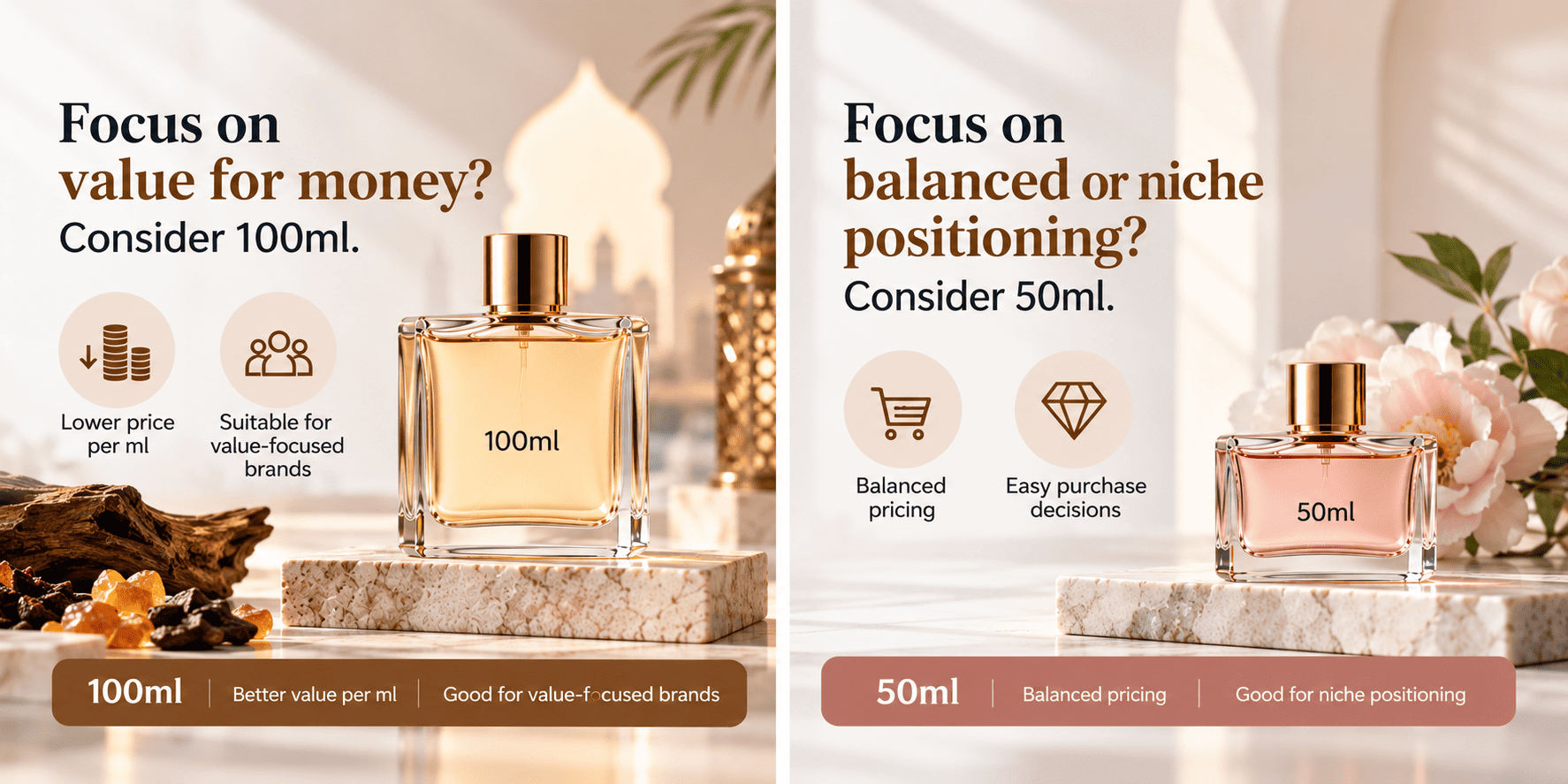
If your brand focuses on value for money, I often consider 100ml because it can offer a lower price per milliliter. If your brand focuses on balanced pricing, easy purchase decisions, or niche positioning, 50ml can often be a stronger main size.
Bottle Capacity Should Support Your Pricing Story
I think perfume packaging should tell the same story as the retail price.
If the brand says it offers great value, the customer should feel that value when looking at the bottle and price.
This is one reason why 100ml can work well for value-focused fragrance brands.
Imagine two products.
One contains 50ml.
The other contains 100ml.
The 100ml product costs more, but the customer gets twice the fragrance volume.
If the retail price does not double, the price per milliliter becomes more attractive.
That supports a value-for-money position.
| Brand Positioning | Size I Would Consider | Main Logic |
|---|---|---|
| Affordable trial fragrance | 30ml | Low first-purchase price |
| Balanced mainstream brand | 50ml | Good price and volume balance |
| Niche fragrance | 50ml | Premium without very high commitment |
| Value-for-money brand | 100ml | Lower cost per ml for customer |
| Established daily fragrance | 100ml | Larger volume makes sense |
| New e-commerce brand | 30ml or 50ml | Easier first purchase |
However, premium positioning does not automatically mean bigger.
I see many people make this mistake.
A niche fragrance brand can sell a 50ml bottle at a much higher price than a mass-market 100ml perfume.
The capacity is only one part of the value.
The bottle design, glass weight, cap, decoration, box, fragrance story, concentration, brand image, and distribution also matter.
This is why I do not say that 100ml is premium and 30ml is cheap.
That is too simple.
I look at the full positioning.
For me, the right capacity is the one that makes the pricing story easier for customers to understand.
Should Your Brand Offer More Than One Perfume Bottle Size?
Offering more sizes gives customers more choices, but it also creates more inventory. This can become a serious problem for a small fragrance brand.
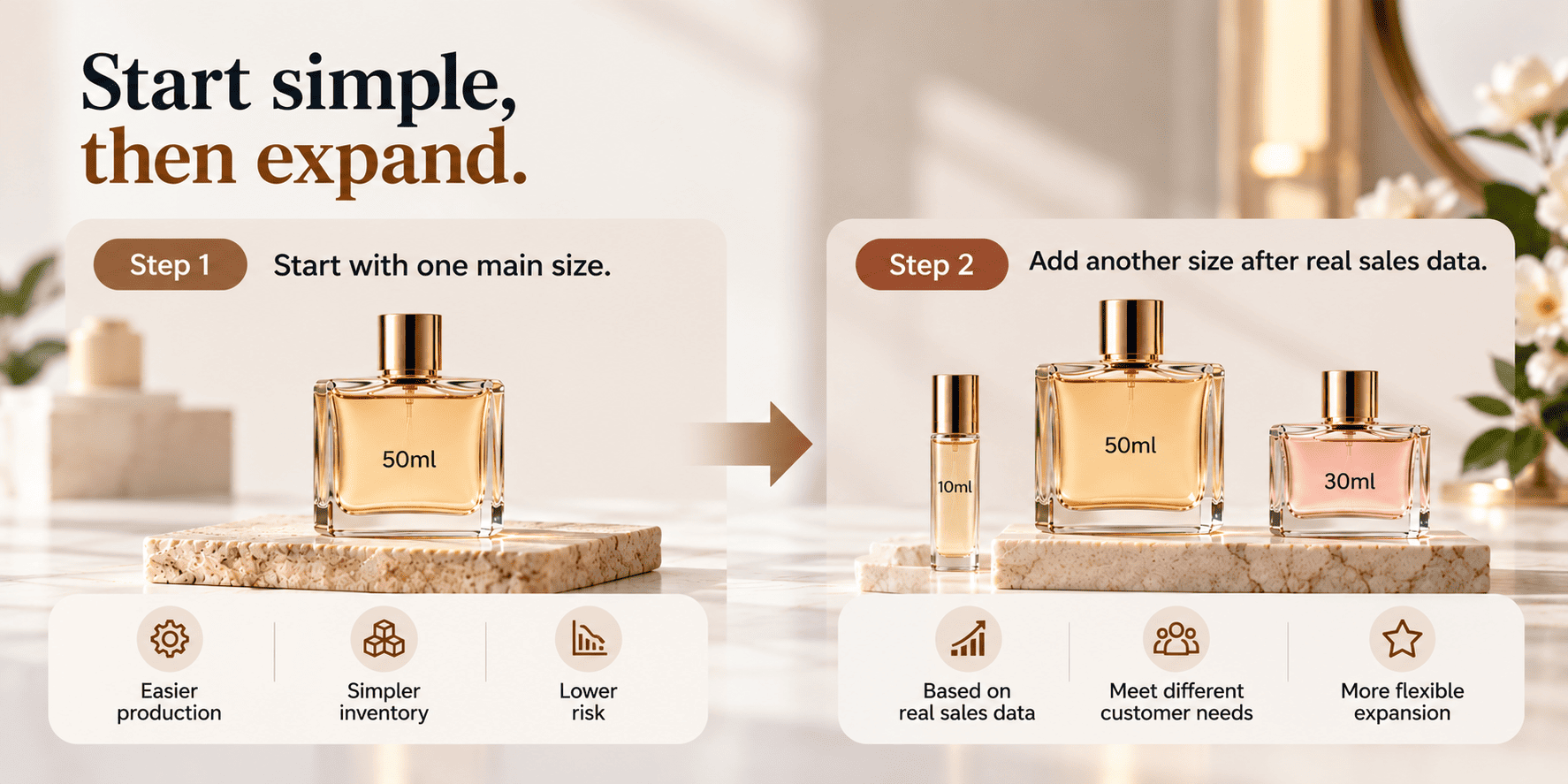
I usually suggest that a small perfume brand starts with one main bottle size and adds another size after getting real sales data. A 50ml main bottle with a smaller 10ml or 30ml option is often easier to manage than launching 30ml, 50ml, and 100ml together.
Why I Prefer a Focused Size Strategy at the Beginning
Every new capacity creates another SKU.
If a brand launches five fragrances in one size, it has five main perfume SKUs.
If the same brand launches every fragrance in 30ml, 50ml, and 100ml, it can quickly reach fifteen SKUs.
That creates more inventory pressure.
| Size Strategy | Advantage | Main Risk |
|---|---|---|
| 30ml only | Easy entry price | Lower average order value |
| 50ml only | Simple and balanced | Fewer customer choices |
| 100ml only | Strong value | Higher entry price |
| 30ml + 50ml | Trial plus main size | More inventory |
| 50ml + 100ml | Main plus value size | More cash required |
| All three sizes | Maximum choice | Complex inventory |
The brand needs more bottles.
It needs more boxes.
It needs more labels.
It needs more finished perfume.
It also needs more warehouse space and more cash.
For a small brand, I think simplicity is often better.
I may recommend using 50ml as the hero product.
Then the brand can add a 10ml travel spray or 30ml perfume as a lower-price entry product.
If the fragrance becomes popular, the brand can introduce 100ml later.
This makes the growth more natural.
At Hongyan Glass Bottle, we provide more than 500 stock perfume glass bottle options.
For a smaller fragrance brand, I often suggest starting with a stock bottle instead of developing a completely new glass mold immediately.
We can change the appearance with spray coating, frosting, hot stamping, decals, printing, and other decoration methods.
We can also help with other perfume packaging components.
When the brand grows and wants a unique bottle shape, we can support 3D sampling and new bottle development.
I prefer this step-by-step approach because it helps brands control both cost and risk.
Which Perfume Bottle Size Should I Choose for My Brand?
I do not think brands should choose a bottle size because another company uses it. I think the decision should start with the customer.
I would choose 30ml when trial and low entry price matter most, 50ml when I need a balanced main product, and 100ml when the market prefers larger formats or the brand wants to emphasize value per milliliter.
The Decision Framework I Use With Customers
Before I recommend a capacity, I normally look at five things.
I look at the target market.
I look at the target customer.
I look at the expected retail price.
I look at the brand position.
I look at the sales channel.
These points usually give me a much clearer answer than simply comparing 30ml, 50ml, and 100ml side by side.
| Brand Situation | Size I Would Consider First |
|---|---|
| Middle East fragrance brand | 100ml |
| Southeast Asian fragrance brand | 50ml |
| Australian fragrance brand | 50ml |
| New online perfume brand | 30ml or 50ml |
| Value-for-money fragrance | 100ml |
| Premium niche fragrance | 50ml |
| Low-price entry product | 30ml |
| Established bestseller | 100ml |
If I were building a new fragrance brand with a limited budget, I would not order three sizes immediately.
I would choose the size that fits my main market first.
If I were targeting the Middle East and my positioning focused on value, I would seriously consider 100ml.
If I were targeting Southeast Asia or Australia and wanted a balanced main product, I would probably start with 50ml.
If my biggest problem was getting customers to try an unknown fragrance, I might start with 30ml or add a smaller size next to the main bottle.
I would then watch the sales data.
If customers want a lower entry price, I can add a smaller format.
If loyal customers want better value, I can add 100ml.
This is the way I prefer to build a fragrance packaging line.
I do not want the brand to carry unnecessary inventory from the first day.
I want every bottle size to have a clear role.
For me, the best perfume bottle size is not the size with the lowest bottle cost.
It is also not the size that looks biggest on the shelf.
The best size is the one that fits the customer's buying habits, the brand's pricing strategy, and the market where the perfume will actually be sold.
Conclusion
I choose perfume bottle size based on market preference and brand positioning first. For many brands, 50ml is balanced, while 100ml works especially well for value-focused and Middle Eastern markets.
[[1]]: https://www.investopedia.com/terms/t/target-market.asp "target market"
[[2]]: https://www.score.org/brand-positioning/?gad_source=1&gad_campaignid=22833222866&gbraid=0AAAAApEg_JsEydZbvELwjENXqu9p312F4&gclid=Cj0KCQjw8ofWBhCHARIsANBj4Lt6rfaE6TkIyAng8Xy37fiABzyv5f4RHk8yt6pDfJzBNx7CHkBnq3EaAi02EALw_wcB "brand positioning"