
Choosing perfume bottle sizes looks simple, but the wrong size can affect pricing, shipping cost, product positioning, and even how customers see a fragrance brand.
Standard perfume bottle sizes usually include 5ml, 10ml, 15ml, 30ml, 50ml, 75ml, and 100ml. For most fragrance brands, 30ml, 50ml, and 100ml are the main retail sizes because they balance price, product value, and customer use.
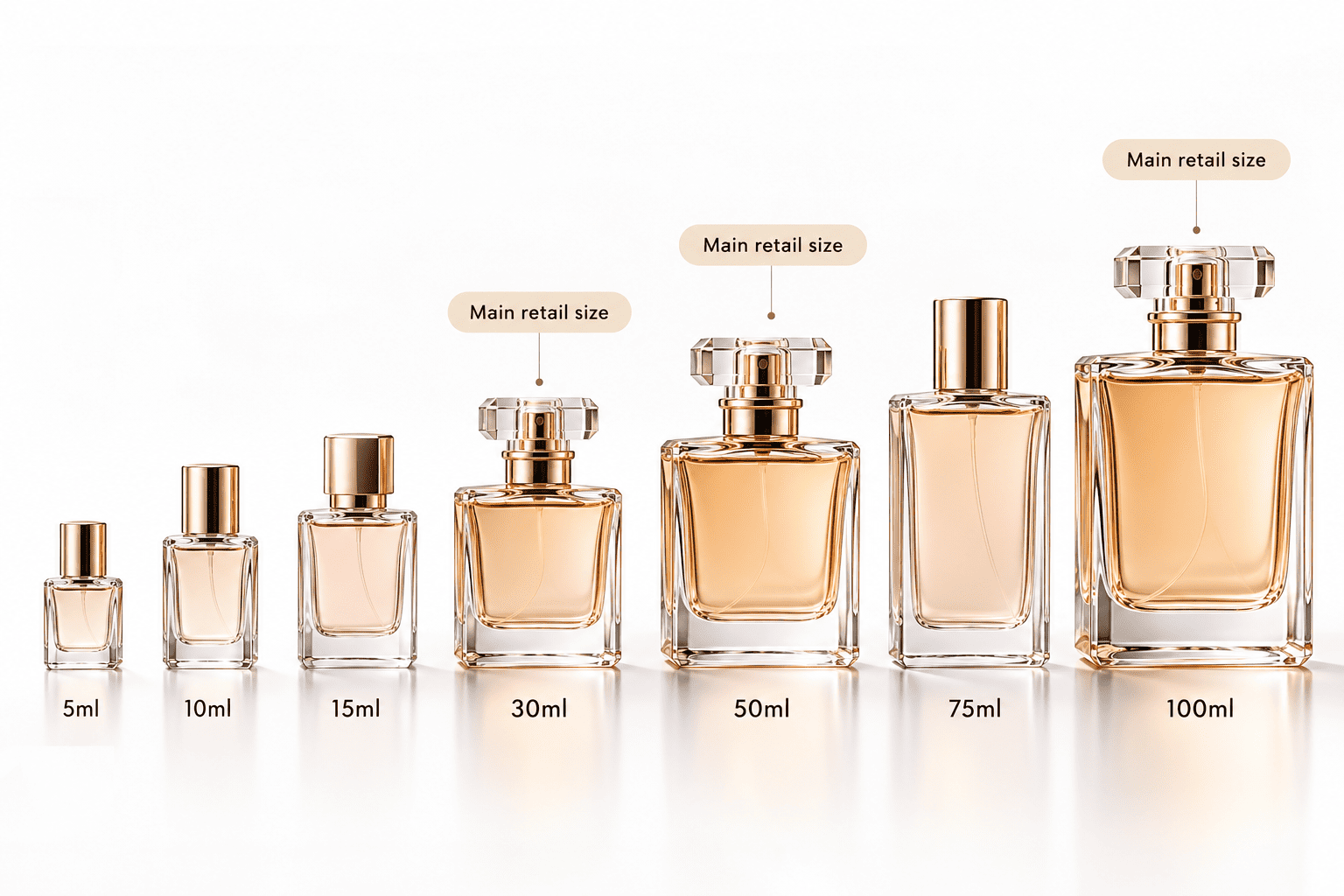
When I help perfume brands choose packaging, I rarely look at capacity alone. I also look at the target price, bottle weight, decoration, market position, and order quantity. A 30ml, 50ml, and 100ml bottle can serve very different business goals.
What are the most common perfume bottle sizes?
Many new fragrance brands see dozens of bottle capacities and do not know which sizes are actually common in the market.
The most common perfume bottle sizes are 30ml, 50ml, and 100ml. Smaller sizes such as 5ml, 10ml, and 15ml are often used for samples, travel sets, discovery sets, or lower-price products.
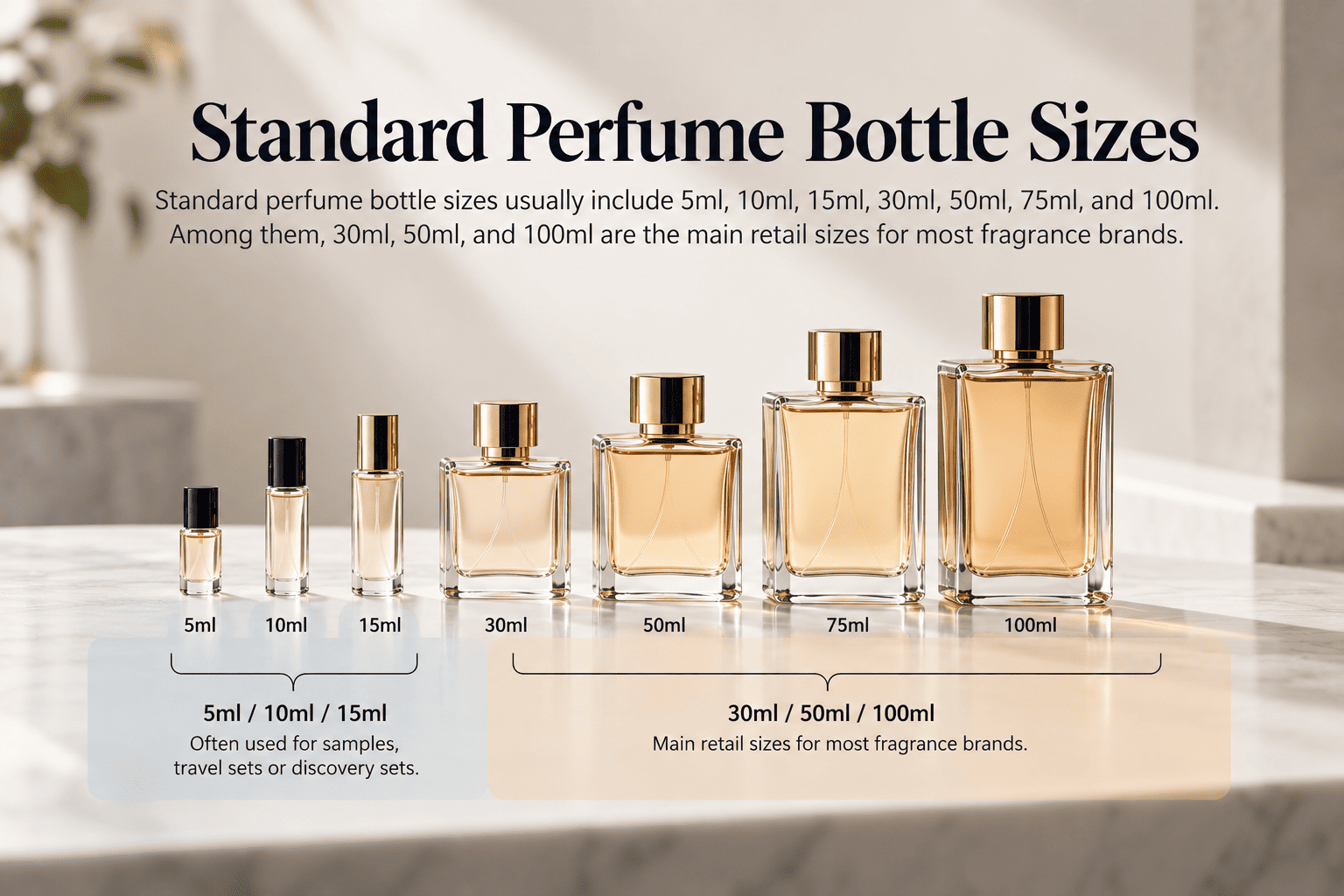
Common perfume bottle sizes in the market
When I work with perfume brands, I normally divide fragrance bottle sizes into three groups. I see small sizes as trial products, medium sizes as main retail products, and large sizes as value products.
This simple structure helps me understand what the brand wants to sell.
| Bottle Size | Common Use | Typical Brand Purpose |
|---|---|---|
| 5ml | Sample or mini perfume | Trial and gift sets |
| 10ml | Travel perfume | Entry product |
| 15ml | Mini retail bottle | Low-price fragrance |
| 30ml | Small retail bottle | Entry-level full size |
| 50ml | Main retail bottle | Core fragrance product |
| 75ml | Medium-large bottle | Premium or special size |
| 100ml | Large retail bottle | Value and signature fragrance |
I usually see 30ml, 50ml, and 100ml as the most important sizes for commercial perfume brands. These capacities are easy for customers to understand. They also give brands enough space to build a clear price ladder.
For example, a brand can sell a 30ml perfume as the lower-price option. The same brand can use 50ml as the main product. It can use 100ml as the higher-value option.
I also pay attention to the bottle design. A 30ml bottle does not always look small. A wide and heavy 30ml glass bottle can look more premium than a simple 50ml bottle.
The outside size of the bottle depends on glass thickness, shoulder shape, base thickness, and bottle width. This is why I do not recommend choosing packaging only by looking at milliliters.
For new brands, I often suggest starting with one or two main capacities instead of launching too many sizes. This can reduce inventory pressure. It can also make purchasing, filling, carton design, and marketing much easier.
My experience: bottle size preferences can be different by market
From my experience working with perfume brands in different markets, I do not think there is one bottle size that works everywhere.
In the Middle East, I often see stronger demand for larger sizes such as 100ml, especially for brands with heavier fragrance usage or stronger fragrance culture. Some mature brands may also develop 150ml or 200ml products.
In Europe, 50ml is a very common core size. Some brands use 100ml as a larger-value option, while 30ml is often used as an entry size, especially when customers prefer rotating several fragrances instead of finishing one large bottle.
In North America, 100ml can be attractive because many customers pay attention to value per ml, while 50ml and 30ml can still work well for niche or higher-priced fragrances.
In South America, I often see 50ml as a practical balance between retail price and product value. Larger 100ml bottles can work as gift or value products, but the final decision is often more sensitive to budget.
In East Asia, 30ml and 50ml are especially practical for many brands. Customers may own several fragrances and rotate them more frequently, so a smaller bottle can sometimes make more sense than a large 100ml bottle.
In Southeast Asia, I also see strong interest in 30ml and 50ml. For many new or growing fragrance brands, these sizes are easier to test in the market, easier to price, and easier to manage for cross-border shipping.
Oceania is another market where I often prefer 50ml as a starting point. Shipping cost can become more important because a heavy 100ml glass bottle increases both product weight and carton volume.
I would not use these preferences as a strict rule. The right size still depends on the brand position, fragrance price, customer habits, sales channel, and shipping cost.
For me, bottle capacity is not only a packaging decision. It is also part of the brand’s market strategy.
What size is a 30ml perfume bottle?
A 30ml perfume bottle is one of the most common small [retail sizes][1], but its physical dimensions can change a lot between different bottle designs.
A 30ml perfume bottle holds about 1 fluid ounce of fragrance. Its exact height and width depend on glass thickness, bottle shape, neck type, base design, and decorative parts.
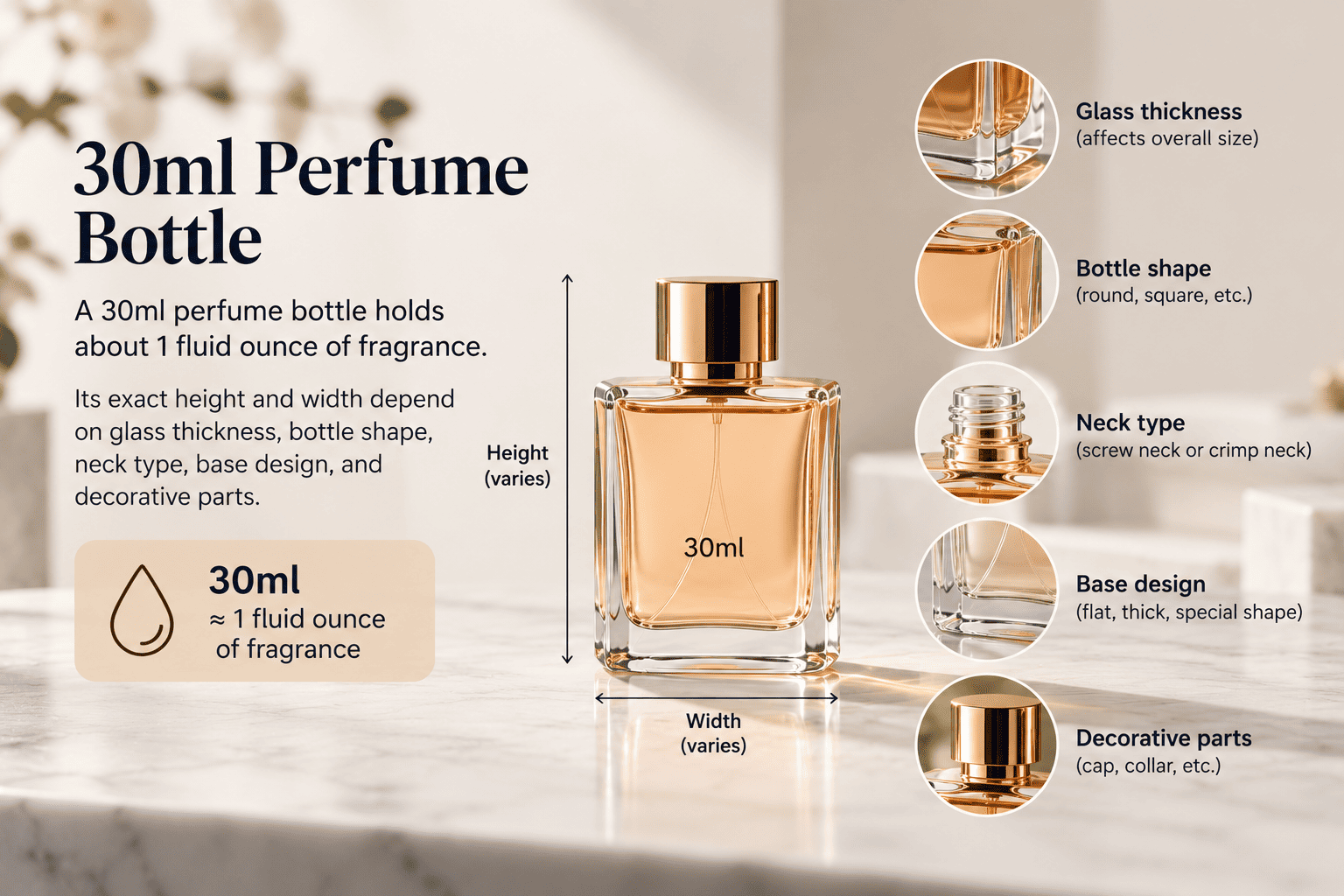
Why 30ml bottles can have different dimensions
I often receive questions from buyers who ask for the exact height of a 30ml perfume bottle. I cannot give one standard measurement because capacity and outside dimensions are not the same thing.
Two bottles can both contain 30ml, but one can be tall and narrow while the other can be short and wide.
The glass distribution also changes the final size.
| 30ml Bottle Feature | Possible Effect |
|---|---|
| Thick glass base | Makes bottle taller or heavier |
| Wide body | Makes bottle look larger |
| Narrow body | Creates a taller shape |
| Heavy shoulder | Adds glass weight |
| Large cap | Increases total package height |
| Decorative collar | Changes neck appearance |
For many fragrance brands, 30ml is useful because it allows customers to try a full-size perfume without paying the price of a 50ml or 100ml bottle.
I also see 30ml bottles used by niche brands because smaller capacities can support a more exclusive positioning. The brand can use heavier glass, a custom cap, or special decoration while keeping the retail price within an acceptable range.
From a packaging side, I always suggest checking more than the bottle capacity. I check the neck finish, pump size, cap fit, label area, decoration area, and carton dimensions.
At Hongyan, we have stock perfume bottles in different shapes and capacities. For some projects, I can also help customers test spray color, frosting, gold plating, decals, and other decoration methods.
A 30ml bottle works especially well when a new brand wants a lower entry price or wants customers to try several fragrances from the same collection.
What size is a 50ml perfume bottle?
A 50ml perfume bottle is often the middle choice between a smaller trial-friendly bottle and a larger value bottle.
A 50ml perfume bottle holds about 1.7 fluid ounces of fragrance. It is widely used as a main retail size because it offers a practical balance between product volume, price, weight, and shelf presence.
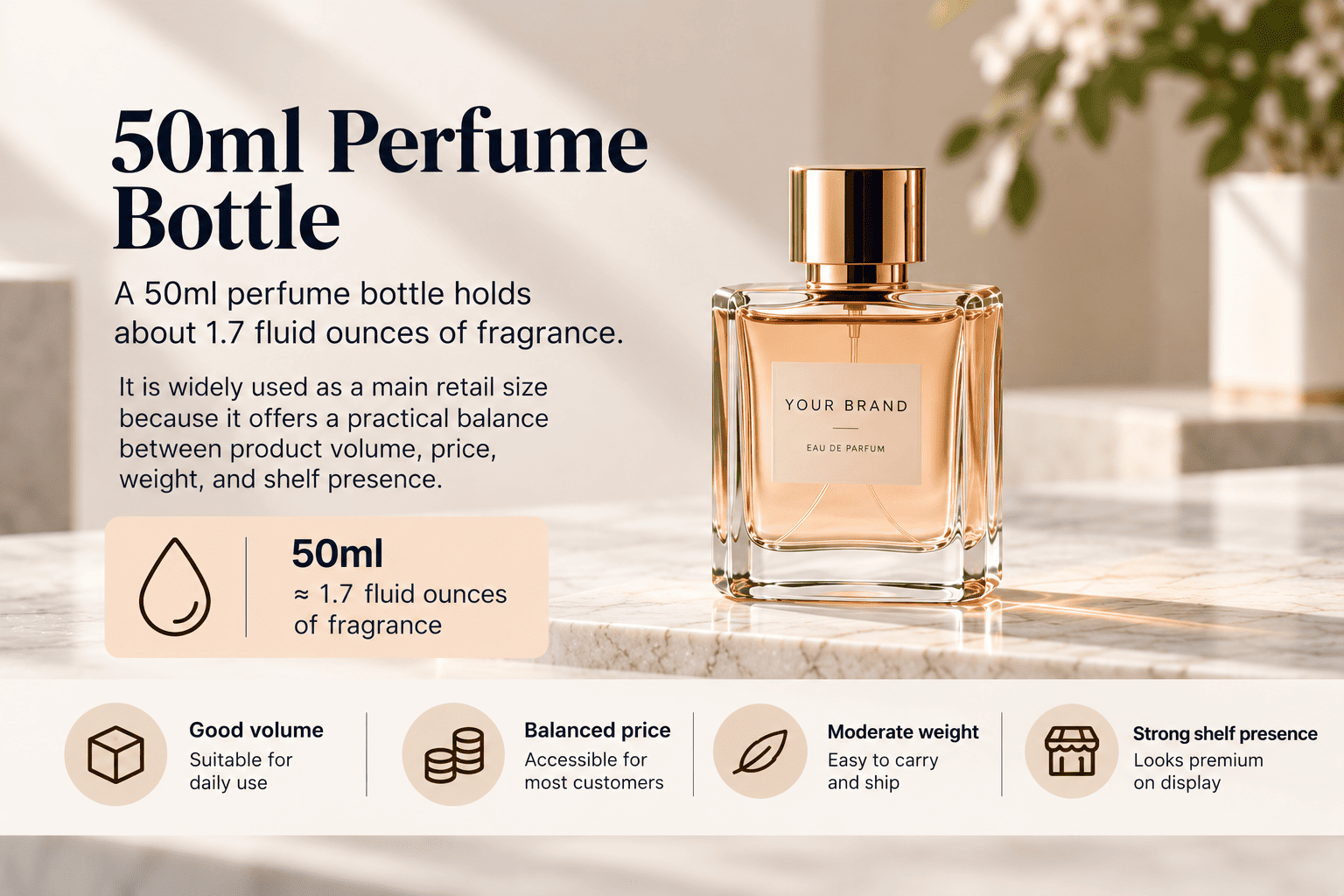
Why I often recommend 50ml as a main SKU
When a customer asks me which bottle size should become the main product, I often look at 50ml first.
I do this because 50ml sits in a useful middle position.
| Factor | 50ml Bottle Performance |
|---|---|
| Retail price | Medium |
| Shipping weight | Moderate |
| Shelf presence | Strong |
| Customer commitment | Moderate |
| Gift suitability | High |
| Packaging flexibility | High |
A 50ml perfume bottle gives enough volume for customers who plan to use the fragrance regularly. At the same time, it usually feels less expensive than a 100ml product.
This can be useful for independent fragrance brands.
I also like 50ml from a packaging design point of view. The bottle has enough surface area for screen printing, labels, decals, or other branding details. It also gives designers more freedom to create a strong visual identity.
For some brands, a 30ml bottle can feel too small for the main [hero product][2]. A 100ml bottle can feel too large or expensive. A 50ml bottle often fits between those two positions.
The outside dimensions can still vary a lot. One 50ml bottle may be compact and square. Another may be tall and slim. A heavy glass base can also make the bottle look much more premium.
When I help a customer choose a stock 50ml bottle, I normally ask about the target retail price, sales channel, decoration method, cap style, and expected order quantity.
These details help me decide whether the bottle only needs to hold 50ml or also needs to support the full brand story.
What size is a 100ml perfume bottle?
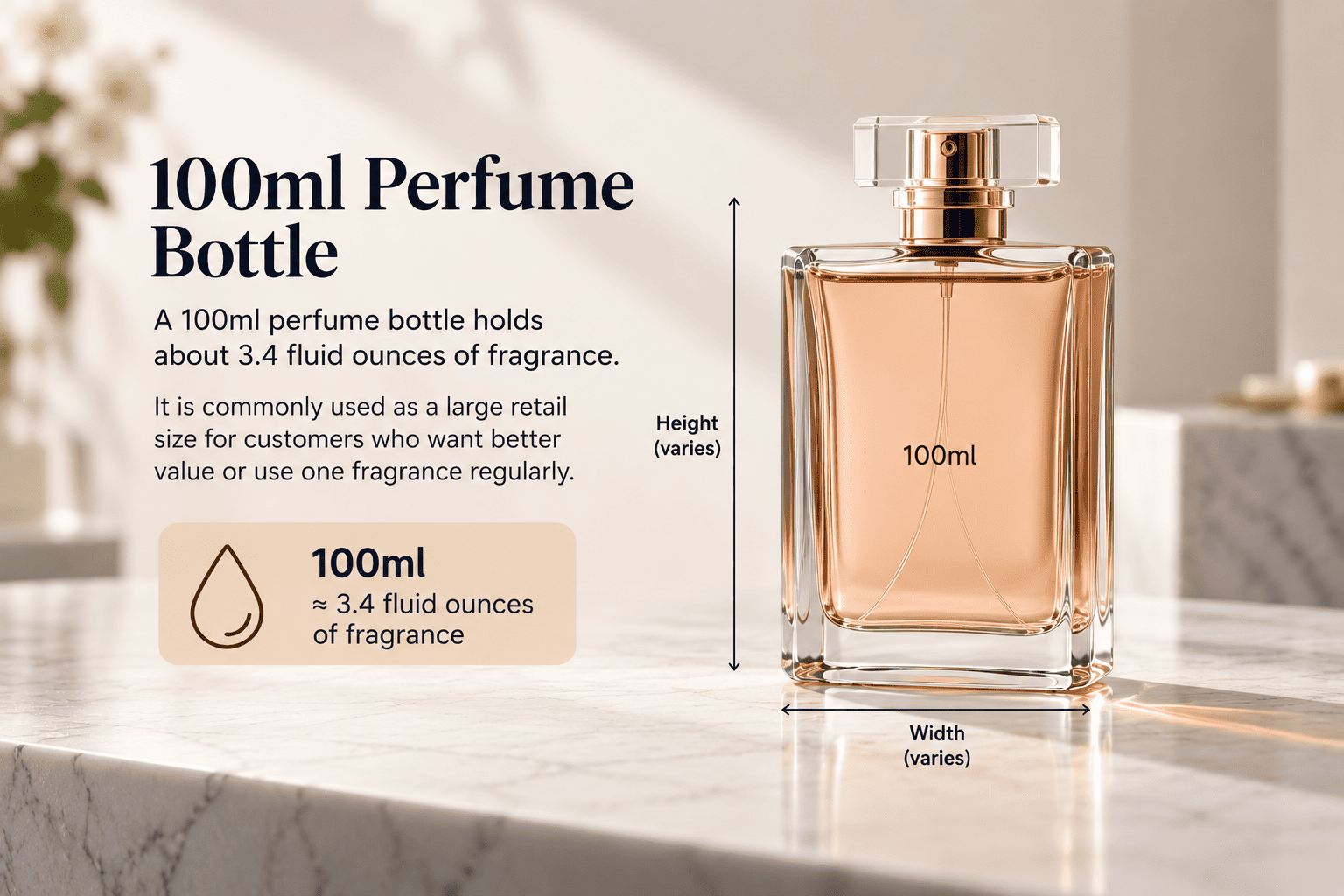
A 100ml perfume bottle usually creates stronger shelf presence, but it also increases glass weight, filling volume, shipping cost, and total package size.
A 100ml perfume bottle holds about 3.4 fluid ounces of fragrance. It is commonly used as a large retail size for customers who want better value or use one fragrance regularly.
What changes when I move from 50ml to 100ml?
I do not see 100ml as simply double the size of 50ml.
From a business view, many other things change.
| Area | 50ml | 100ml |
|---|---|---|
| Fragrance volume | Medium | High |
| Bottle weight | Medium | Higher |
| Carton size | Medium | Larger |
| Shipping cost | Lower | Higher |
| Shelf impact | Strong | Very strong |
| Retail value perception | Balanced | High value |
A 100ml perfume bottle can make the product feel substantial. Customers often see a larger bottle as better value, especially when the price difference between 50ml and 100ml is not too large.
For the brand, the decision is more complex.
The larger bottle uses more glass. The product also needs more fragrance liquid. The inner tray and paper box become larger. The shipping carton becomes heavier.
These differences matter when a brand sells through e-commerce.
I have seen buyers focus heavily on the bottle unit price but ignore the effect of package volume on freight cost. A heavy 100ml glass bottle can increase logistics costs more than expected.
I also check the bottle base carefully. Some 100ml bottles use very thick glass to create a luxury appearance. This can be useful for premium branding, but it may not fit a brand that is focused on low-cost online distribution.
For this reason, I usually ask the customer whether 100ml is the hero product or the value option.
If it is only a secondary size, I may suggest using the same design family as the 50ml bottle. This keeps the brand identity consistent and can simplify product photography and packaging development.
What perfume bottle sizes are best for a new fragrance brand?
A new fragrance brand can easily spend too much money by launching too many bottle sizes before understanding what customers actually want.
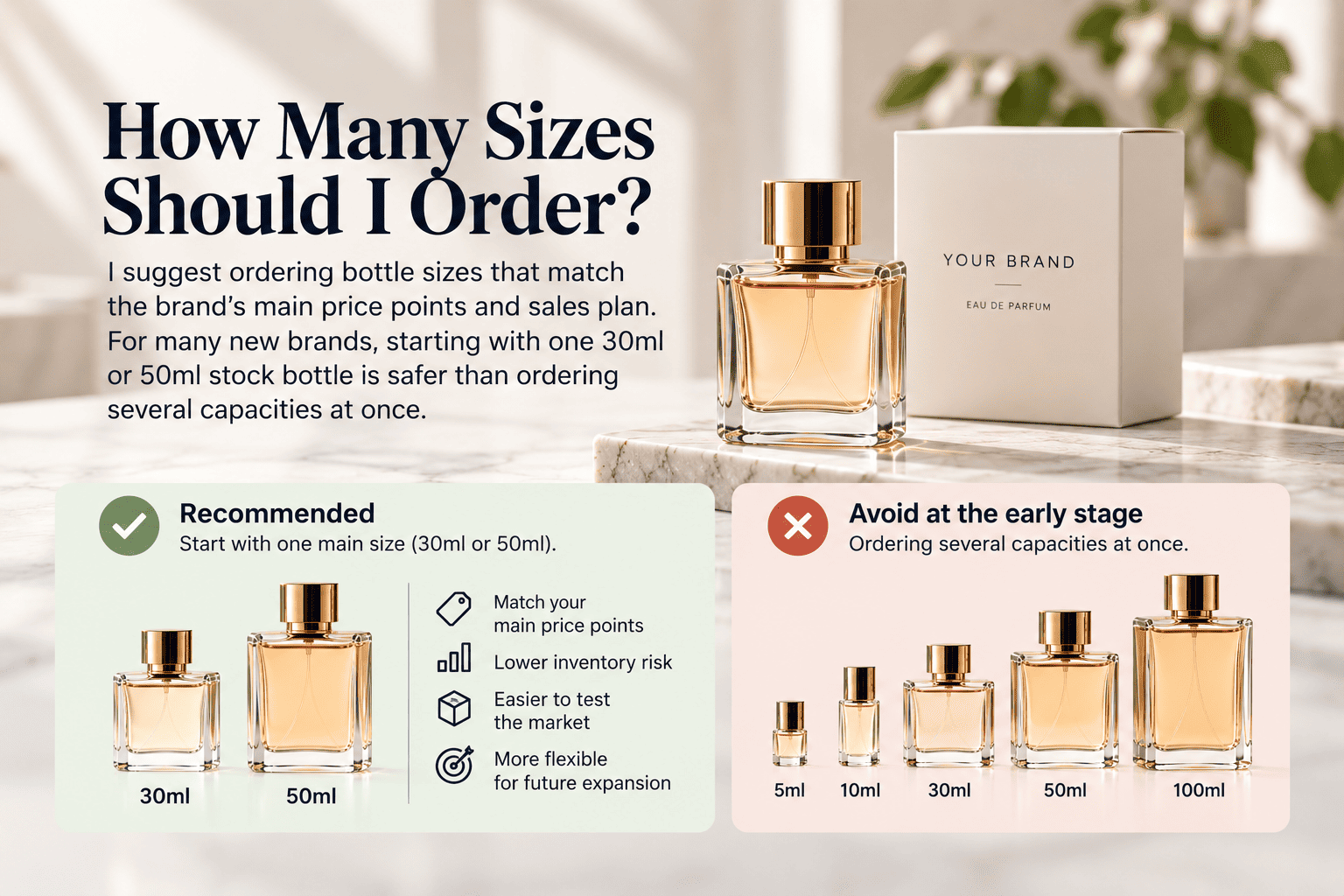
For most new fragrance brands, I recommend starting with 30ml, 50ml, or a combination of both. A 100ml bottle can be added when customer demand, pricing, and inventory capacity become clearer.

I look at the business model before choosing the size
I do not think every new perfume brand should launch the same bottle size.
I first look at how the brand plans to sell.
| Business Model | Suggested Bottle Size |
|---|---|
| New online fragrance brand | 30ml or 50ml |
| Niche perfume brand | 30ml or 50ml |
| Affordable local perfume brand | 50ml or 100ml |
| Gift-focused brand | 30ml or 50ml |
| Discovery-focused brand | 5ml, 10ml, or 15ml |
| OEM perfume business | 30ml, 50ml, and 100ml |
A startup often has limited cash. Inventory is one of the biggest risks.
If the brand launches 30ml, 50ml, and 100ml at the same time, it needs more bottles, more cartons, more labels, and more finished perfume stock.
The brand also has to manage more SKUs.
I often suggest starting with one hero capacity.
For many online brands, 50ml is a practical choice. It looks like a complete retail product. It gives enough space for branding. It also keeps the total product size reasonable.
For brands that want a lower selling price, 30ml can be easier.
A smaller bottle can also encourage customers to try different scents.
This can work well for brands that rely on social media, influencer marketing, and frequent product launches.
At Hongyan, we offer more than 500 stock perfume bottle options. This gives new brands more room to choose a bottle without paying for a custom mold at the beginning.
When a brand grows, I can also support custom development and 3D sampling for new glass bottle designs.
I prefer this step-by-step approach because it helps the customer use money on branding, fragrance development, marketing, and inventory instead of putting too much cash into packaging at the first stage.
Should I choose 30ml, 50ml, or 100ml perfume bottles?
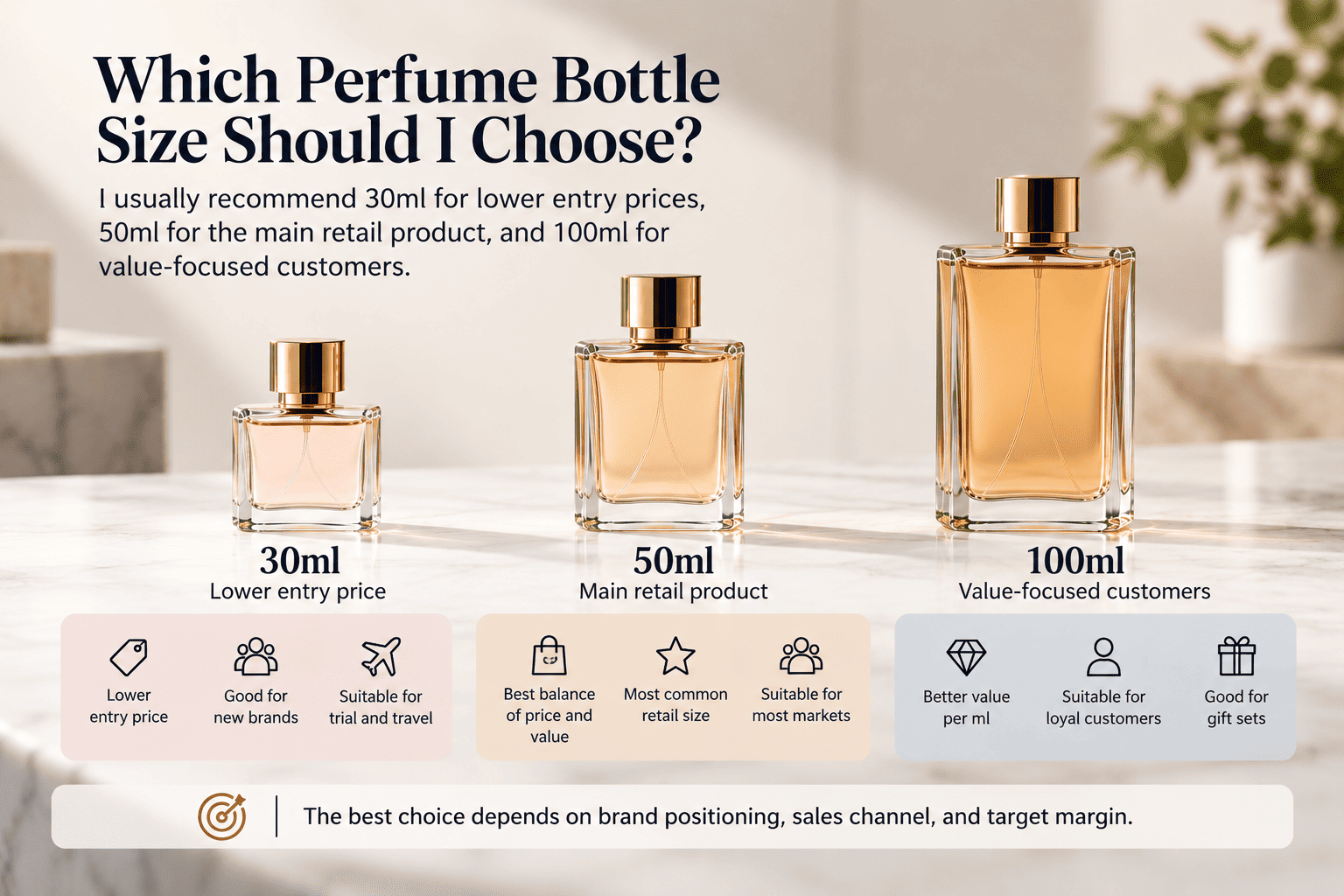
Choosing between 30ml, 50ml, and 100ml is not only about capacity. Each size supports a different price point, customer type, and brand strategy.
I usually recommend 30ml for lower entry prices, 50ml for the main retail product, and 100ml for value-focused customers. The best choice depends on brand positioning, sales channel, and target margin.
How I compare 30ml, 50ml, and 100ml
I use a simple comparison when customers are unsure.
| Factor | 30ml | 50ml | 100ml |
|---|---|---|---|
| Entry price | Low | Medium | High |
| Shipping weight | Low | Medium | High |
| Shelf presence | Small | Balanced | Strong |
| Best for trial | Excellent | Good | Low |
| Best for daily users | Good | Excellent | Excellent |
| Startup friendly | Excellent | Excellent | Moderate |
| Gift use | Good | Excellent | Good |
| E-commerce shipping | Excellent | Good | Moderate |
If I am working with a new e-commerce fragrance brand, I often prefer 30ml or 50ml.
A 30ml bottle makes it easier to create a lower retail price. This can reduce the buying barrier for a customer who has never smelled the perfume before.
A 50ml bottle gives stronger product presence. It can also make the product feel more complete in advertising photos and gift packaging.
A 100ml bottle works better when customers already trust the scent or the brand.
I also consider the fragrance formula cost.
If the perfume contains expensive fragrance oil, moving from 50ml to 100ml can increase the finished product cost quickly.
The packaging cost does not increase at the same rate as the fragrance volume.
This is why the best bottle size should be decided together with the total product cost.
I also think about the sales channel.
A brand selling mainly through local retail stores may benefit from a larger bottle because customers can test the perfume before buying.
An online-only brand may prefer a smaller size because the customer cannot smell the fragrance through a screen.
The right answer comes from the whole business model, not from the bottle alone.
What bottle sizes should I order from a perfume bottle manufacturer?
Ordering perfume bottles from a manufacturer requires more planning than simply selecting the most popular capacities from a catalog.
I suggest ordering bottle sizes that match the brand's main price points and sales plan. For many new brands, starting with one 30ml or 50ml stock bottle is safer than ordering several capacities at once.
What I check before a customer places an order
When a buyer contacts me for perfume bottles, I prefer to understand the project before discussing the final quantity.
I normally look at these points:
| Question | Why I Ask It |
|---|---|
| What is the target capacity? | It defines the bottle category |
| What is the target retail price? | It affects bottle weight and decoration |
| How many pieces are needed? | It affects stock and production planning |
| Is the bottle for online or retail sales? | It affects shipping and shelf needs |
| What decoration is required? | It affects processing cost |
| Does the buyer need a box? | It affects the full packaging solution |
| Is a stock bottle acceptable? | It can reduce development cost and lead time |
| Is a custom mold required? | It changes MOQ, cost, and development time |
I usually recommend that a new brand does not choose three capacities just because large brands sell three capacities.
A smaller company has different cash flow and inventory pressure.
If the first order is relatively small, a stock bottle is often more practical.
The brand can still create a unique look by using spray coating, frosting, gold plating, decals, silk screen printing, labels, custom caps, and packaging boxes.
For example, two brands can buy the same basic glass bottle and create very different final products through decoration.
I also look at whether the same bottle family is available in several capacities.
If a customer plans to grow from 30ml to 50ml and 100ml later, choosing a bottle series with matching shapes can save a lot of work.
The brand can keep the same visual language across different SKUs.
At Hongyan, I focus on helping small and medium perfume brands find practical packaging solutions. We accept custom perfume glass bottle orders, keep more than 500 stock perfume bottle styles, support different surface treatments, provide one-stop perfume packaging services, and support[ 3D sampling][3] for new bottle development.
For me, the right bottle order is not the largest order. It is the order that matches the brand's current stage and gives the brand enough space to grow.
Conclusion
Standard perfume bottle sizes include 30ml, 50ml, and 100ml, but I choose the right size by balancing brand position, cost, customer behavior, and future growth.