AI has changed the way perfume brands create packaging ideas. Today, a founder can generate a luxury-looking perfume bottle concept within seconds.
A beautiful AI image can make a fragrance brand feel closer to reality. However, many founders discover a difficult truth when they try to produce the bottle: the design looks amazing on screen but cannot be manufactured exactly as shown.
AI can help perfume brands create inspiring bottle concepts, but turning an AI design into a real glass bottle requires professional knowledge of molding, production feasibility, decoration processes, component matching, and quality control.
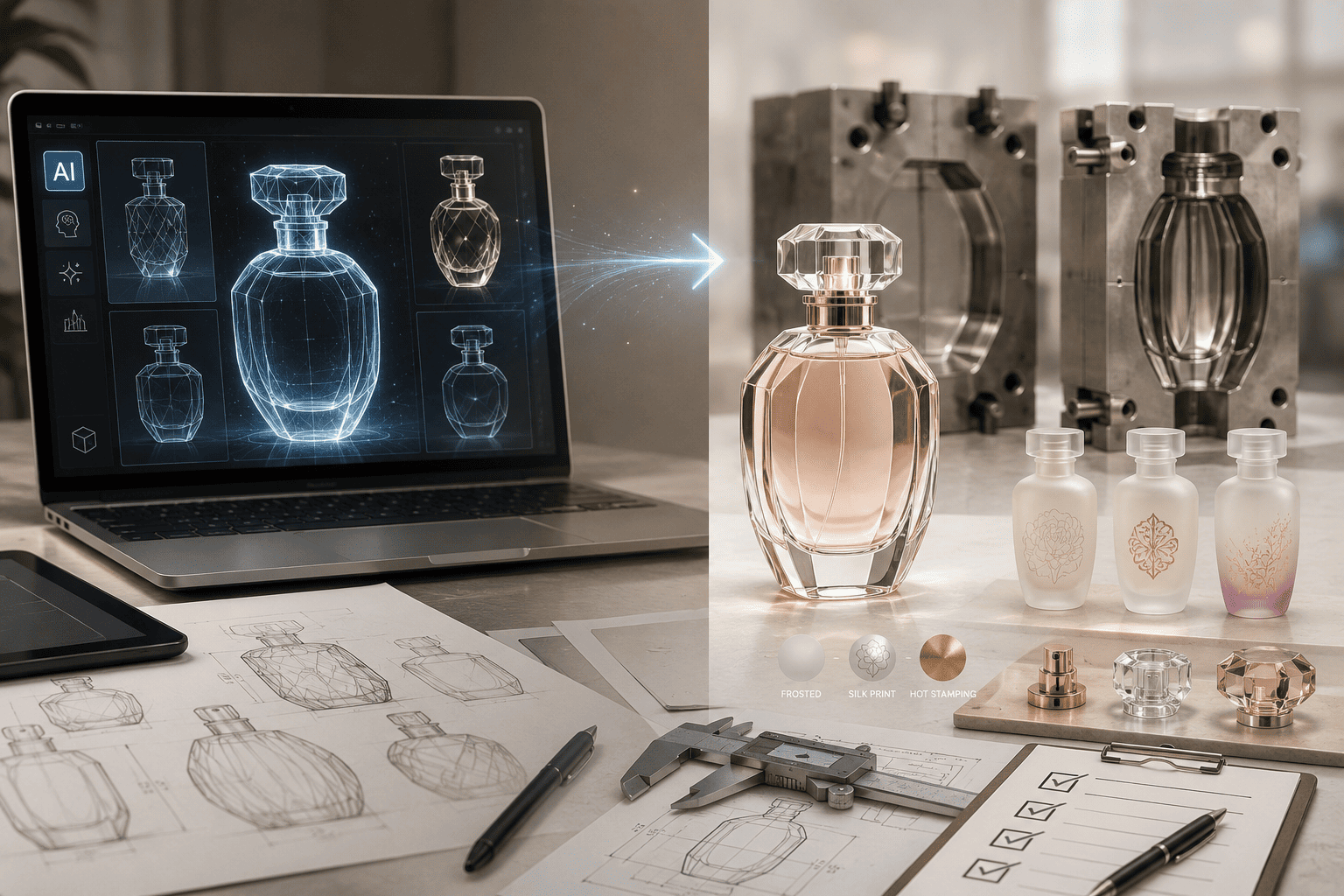
When I work with new perfume brands, I often receive [AI-generated bottle designs][1] from founders.
Many of these designs are impressive.
They have:
- Unique shapes
- Luxury appearance
- Creative structures
- Artistic details
The founder usually asks me:
"Can you make this bottle?"
My answer is usually:
"Yes, but we may need to adjust some details before production."
The reason is simple.
AI understands visual imagination.
Manufacturing understands physical limitations.
A real glass bottle needs to consider:
- How the mold opens
- How glass flows inside the mold
- How the bottle cools
- How the bottle can be decorated
- How the pump and cap match
- How thousands of bottles can maintain the same quality
A successful perfume bottle is not only a design object.
It is a product that needs to survive real manufacturing.
In my experience, the best perfume brands are not the ones with the most complicated AI designs.
They are the brands that know how to transform creative ideas into practical products.
In this article, I will share 10 important tips that every new perfume brand should understand before turning an AI concept into a real glass bottle.
Tip 1: AI Bottle Designs Need Manufacturing Evaluation Before Mold Development
Many AI-generated perfume bottles look beautiful because they are created without production restrictions.
However, glass manufacturing has many physical rules.
Before developing a custom mold, brands should evaluate whether the AI design can be produced through real glass manufacturing. A professional supplier should review the structure, mold possibility, and decoration feasibility before production begins.
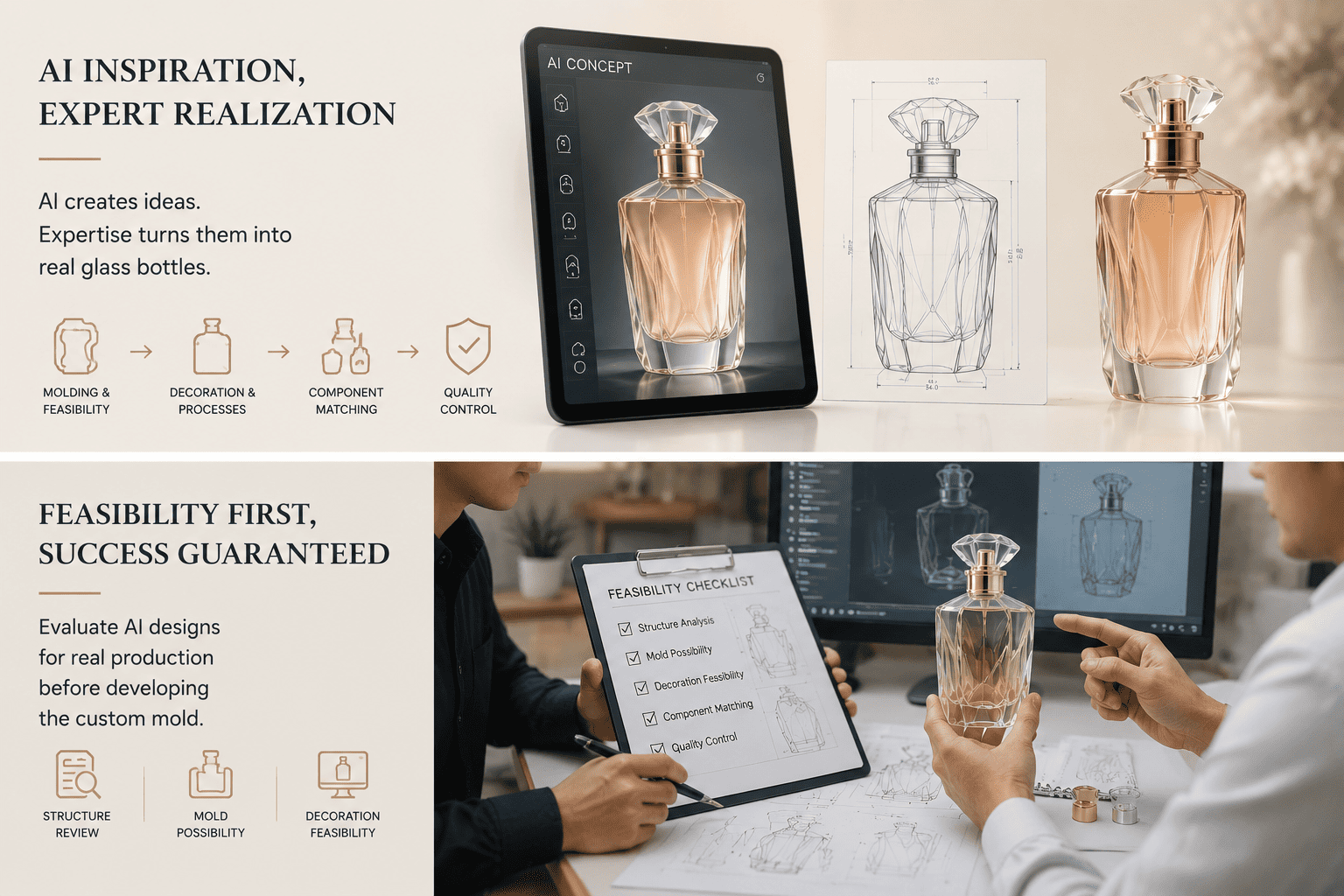
Why do AI designs often fail during production?
AI can easily create:
- Complex curves
- Irregular surfaces
- Floating structures
- Extremely thin shapes
- Unusual proportions
These designs may look impressive in a digital image.
However, glass production requires:
- Stable glass flow
- Balanced wall thickness
- Practical mold structure
- Easy demolding process
- Stable mass production
For example, many brands like AI designs with wave-like surfaces or irregular textures.
The bottle looks artistic.
However, if the brand wants to add:
- Hot stamping gold
- Hot stamping silver
- Silk printing
the surface becomes a challenge.
Decoration processes usually require relatively stable surfaces.
A normal curve or flat area is easier to process.
However, a surface with many:
- Convex areas
- Concave areas
- Irregular waves
can create problems.
The logo or text may not transfer completely.
Some lines may become incomplete.
Some letters may lose their shape.
| AI Design Feature | Manufacturing Challenge |
|---|---|
| Wave-like uneven surface | Difficult for hot stamping and printing |
| Irregular curved area | Logo position becomes unstable |
| Too many details | Higher mold complexity |
| Extreme shape difference | Higher production risk |
This is why I always recommend brands review the design from a manufacturing perspective before opening a mold.
A beautiful idea is only valuable when customers can finally hold it in their hands.
Tip 2: Always Reserve a Clear Branding Area on Complex Bottle Shapes
Many AI bottle designs focus heavily on artistic appearance.
However, a perfume bottle is not only a sculpture.
It is also a communication tool.
A perfume bottle needs enough space for brand identity elements such as logos, names, and product information. Complex shapes should always reserve a practical branding area.
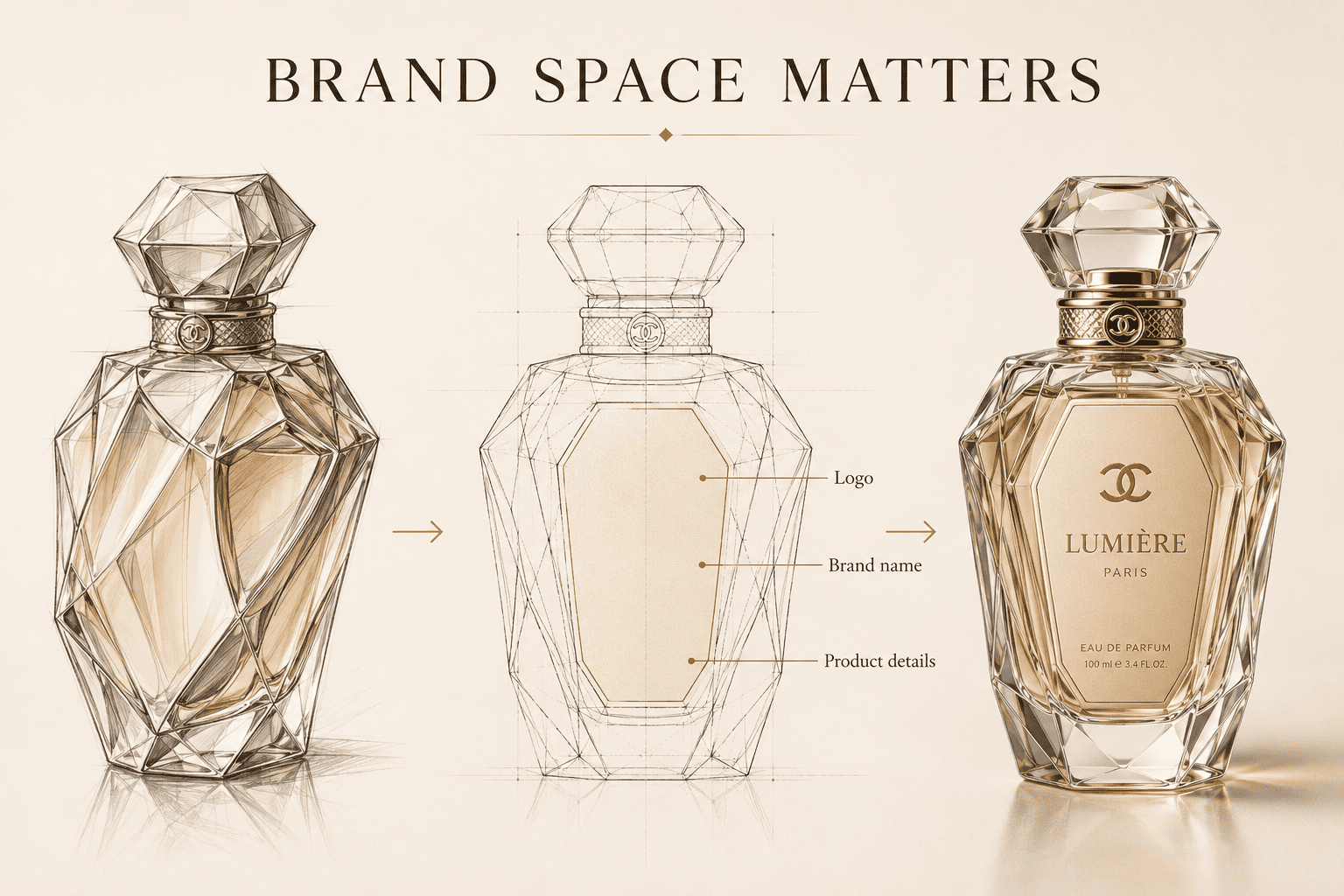
Why is branding space important?
I have seen many AI-generated bottle concepts with:
- Diamond cutting surfaces
- Multiple angles
- Full-body textures
- Artistic structures
The bottle looks very impressive.
However, when the brand wants to add a logo, problems appear.
For example, a diamond-cut bottle may have many small surfaces.
The brand wants to place:
- Logo
- Brand name
- Fragrance name
but there is no stable area.
A perfume bottle needs visual balance.
Customers need to quickly understand:
- Which brand created this product?
- What fragrance is it?
- What makes it special?
A professional design should consider:
| Design Element | Purpose |
|---|---|
| Flat area | Logo placement |
| Smooth surface | Printing quality |
| Balanced front view | Brand recognition |
| Clear visual focus | Customer memory |
A bottle can be artistic, but it should still communicate.
The best designs combine creativity and commercial function.
Tip 3: Production Stability Is More Important Than Only Visual Difference
Many new brands want a bottle that looks completely different from competitors.
This is understandable.
A unique bottle can help create [brand recognition][2].
However, uniqueness should not destroy production stability.
A successful perfume bottle needs to maintain consistent quality during thousands of units of production. A beautiful first sample is not enough. The brand needs a design that can be repeated successfully.
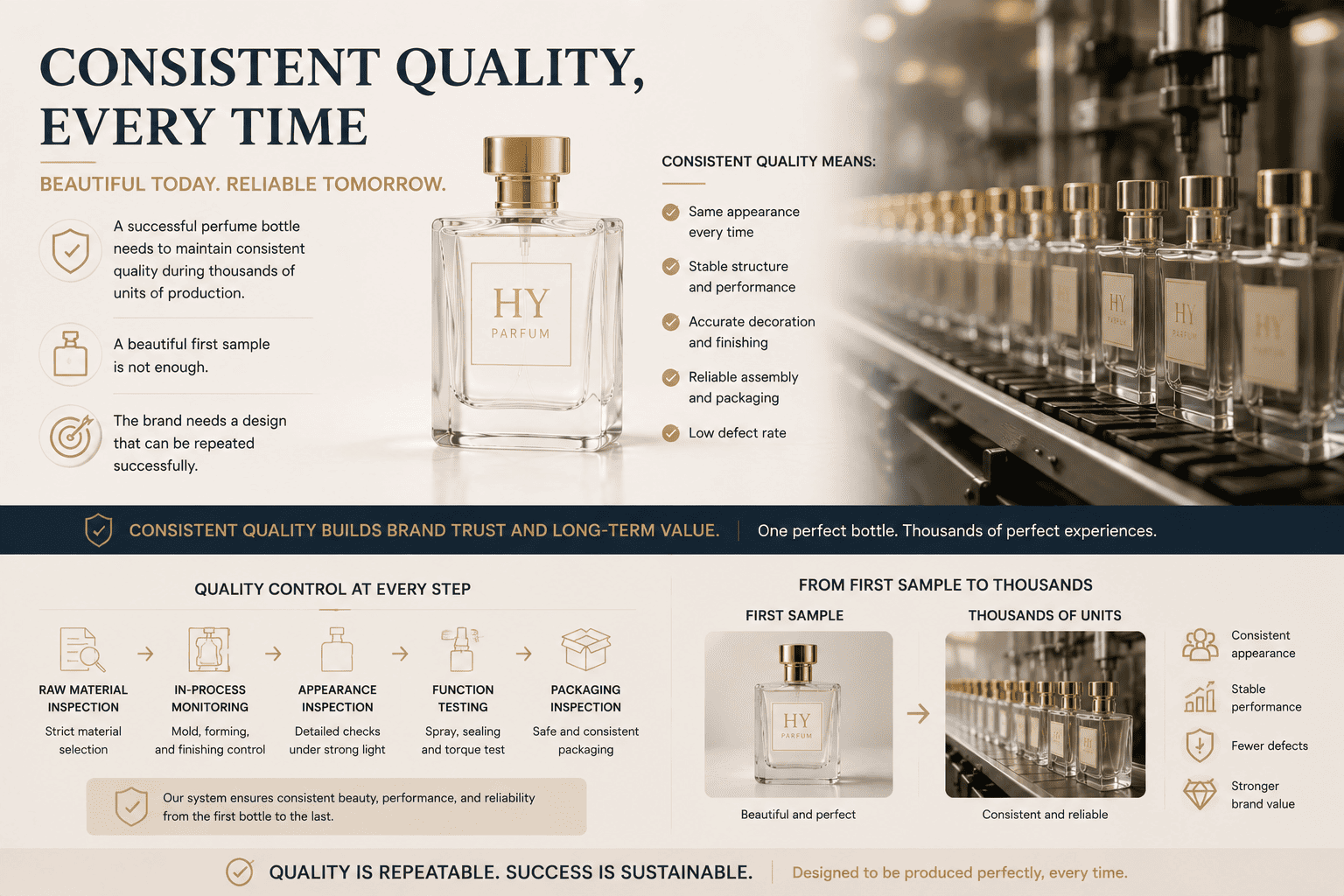
Sample quality and mass production are different
Many founders focus on the first sample.
They see:
- Perfect color
- Beautiful shape
- Excellent finishing
Then they expect every production bottle to look exactly the same.
However, mass production has more variables.
A professional supplier needs to control:
- Glass temperature
- Production speed
- Material distribution
- Surface treatment
- Inspection standards
The goal is not creating one perfect bottle.
The goal is creating thousands of bottles with the same quality.
| Quality Factor | Why It Matters |
|---|---|
| Size consistency | Ensures component matching |
| Weight consistency | Maintains premium feeling |
| Surface quality | Protects brand image |
| Color stability | Keeps visual identity |
A good design must survive production.
Tip 4: Transparent Bottles Reveal More Manufacturing Details Than You Expect
Transparent glass looks simple.
However, it is one of the most demanding bottle styles.
Clear perfume bottles require higher manufacturing standards because every detail becomes visible, including mold seams, bubbles, scratches, and uneven glass thickness.
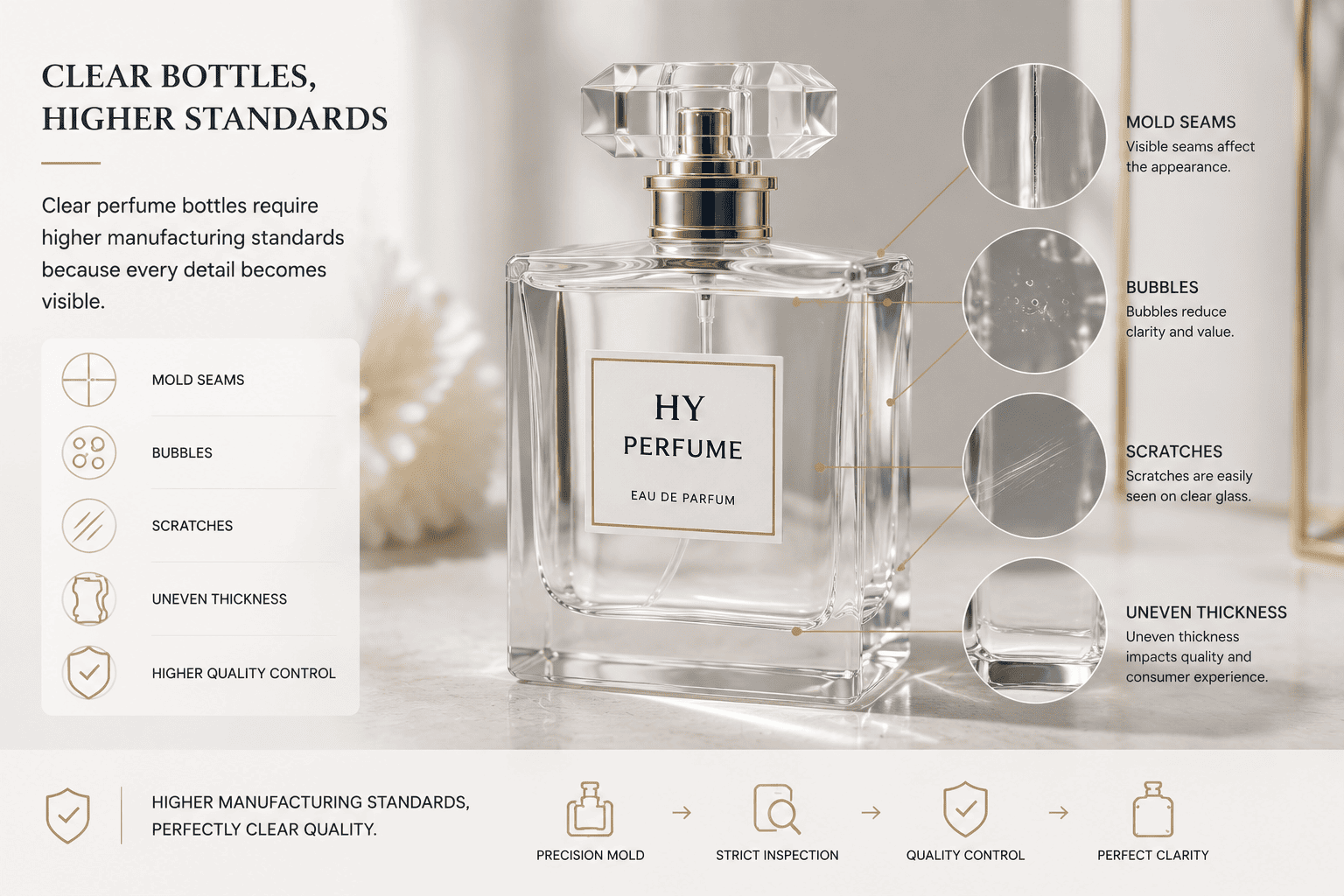
Why are transparent bottles difficult?
Colored bottles can hide some small imperfections.
Transparent bottles cannot.
Customers may notice:
- Mold lines
- Tiny bubbles
- Dust particles
- Surface scratches
- Uneven thickness
A simple transparent bottle actually requires more production control.
Many AI designs show perfectly clean transparent glass.
However, real production requires:
- Better mold processing
- Better glass distribution
- Strong quality inspection
The simpler the bottle looks, the more attention every detail receives.
Tip 5: Complex Asymmetrical Bottles Need Higher Production Investment
AI tools are especially good at creating artistic bottle concepts.
Many founders love:
- Sculpture shapes
- Irregular curves
- Asymmetrical designs
These designs can create strong brand memory.
However, they also increase production difficulty.
Asymmetrical perfume bottles usually require more mold development time, more adjustments, and higher production control compared with traditional symmetrical bottles.
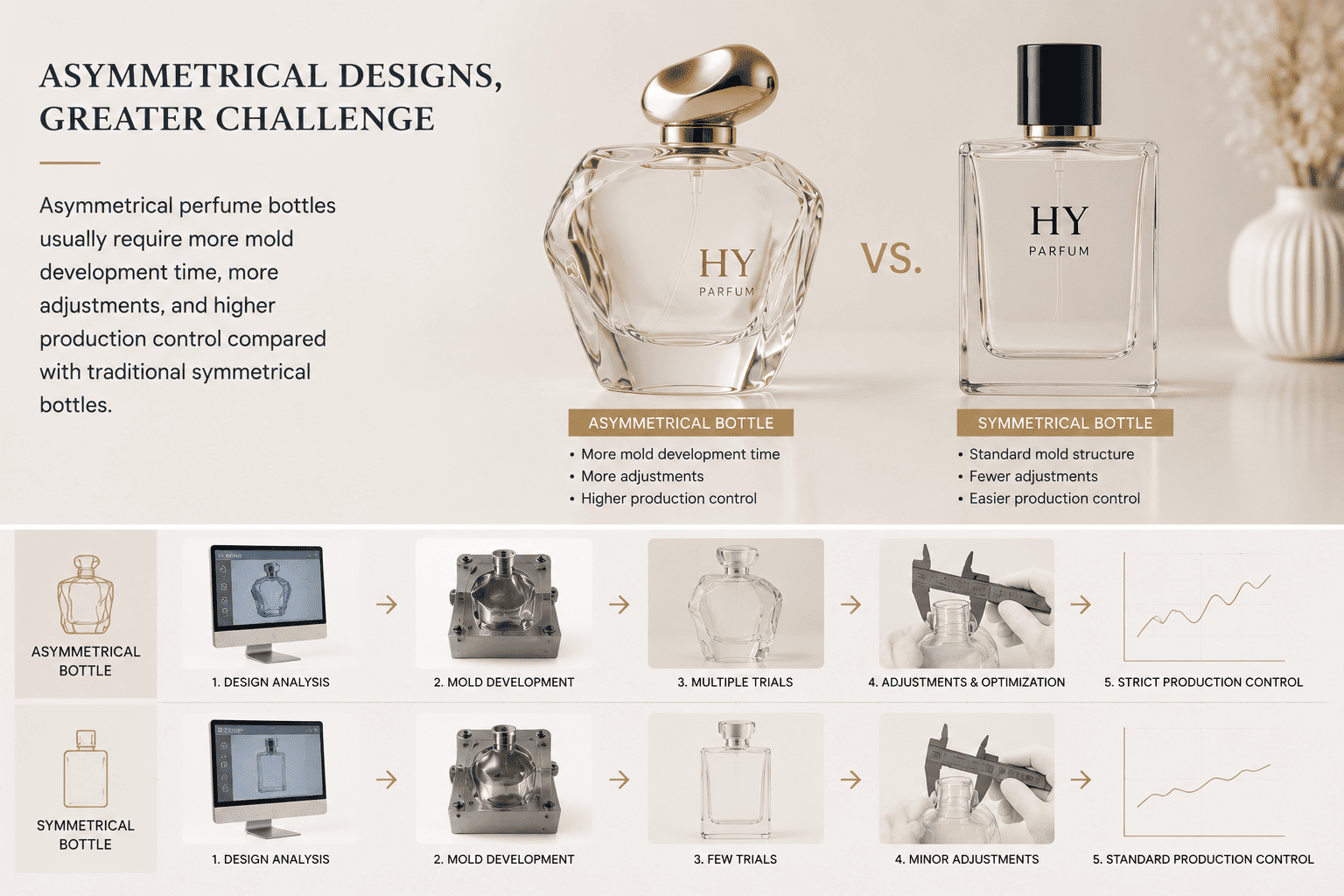
Why are unusual shapes difficult?
Glass production depends on balanced forming.
Complex shapes may create:
- Uneven glass flow
- Different cooling speeds
- Thickness variation
- Higher defect rates
They also increase:
- Mold cost
- Development time
- Trial production requirements
I do not believe brands should avoid unique designs.
A special bottle can become a powerful brand asset.
However, brands should understand the trade-off.
The question should not be:
"Can you make this bottle?"
The better question is:
"Can you make this bottle consistently at my production volume?"
Tip 6: Surface Decoration Has More Limitations Than AI Shows
AI can easily create beautiful effects:
- Gold texture
- Silver texture
- Gradient colors
- Luxury patterns
However, real decoration requires specific manufacturing processes.
Surface effects must be designed together with production methods. A digital effect needs to be converted into a stable physical process.
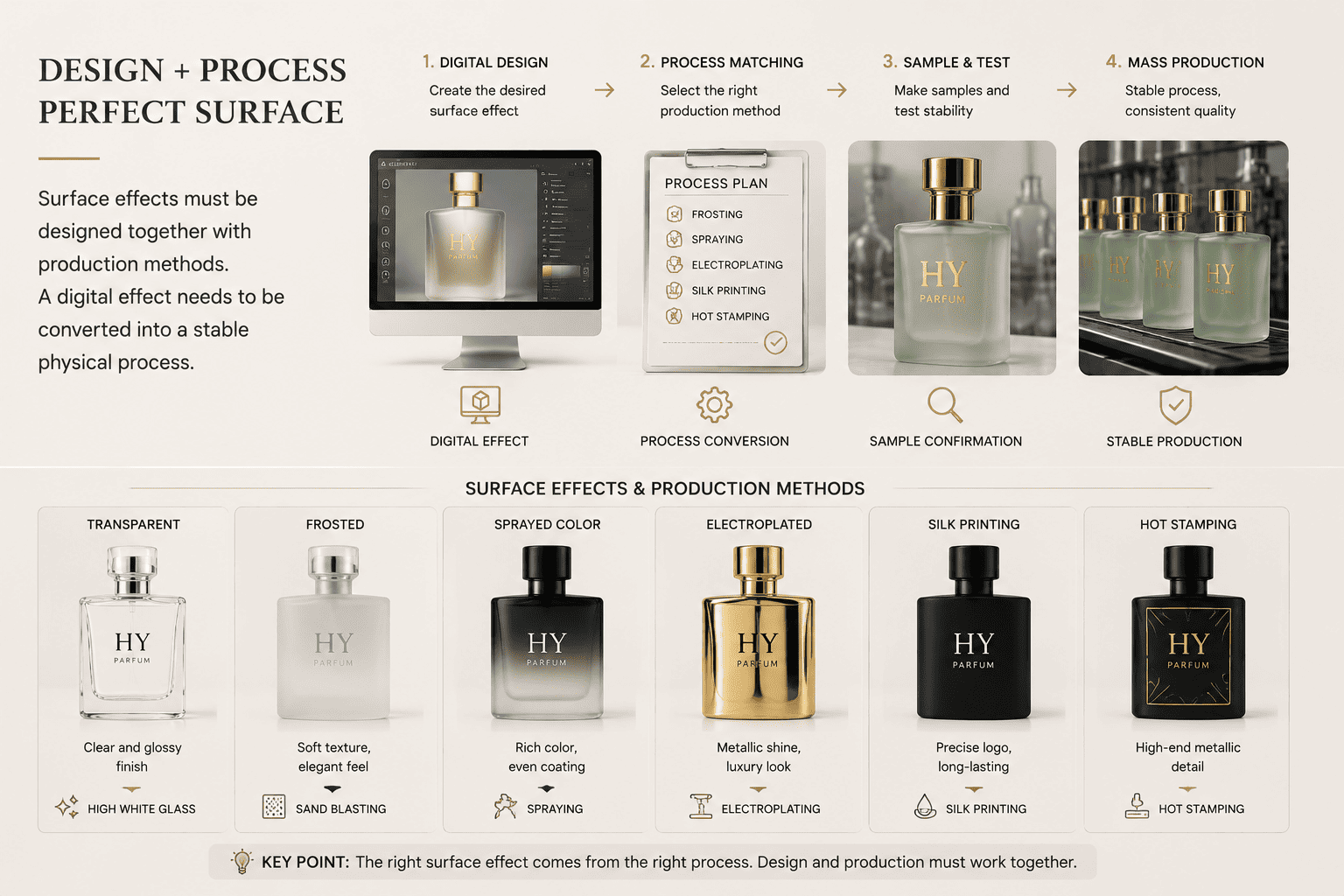
Common decoration methods include:
| Process | Effect |
|---|---|
| Spray coating | Custom colors |
| Electroplating | Metallic luxury feeling |
| Frosting | Soft matte texture |
| Decal | Detailed artwork |
| Silk printing | Logo and text |
A common mistake is designing decoration first and checking feasibility later.
For example:
A beautiful AI-generated gradient may require:
- Special spraying technique
- Multiple color adjustments
- Strict quality control
Before decoration, bottle cleaning is extremely important.
If dust or particles remain on the glass surface, they will become trapped under the coating.
The final bottle may show:
- Small spots
- Uneven texture
- Quality defects
Premium decoration starts with good preparation.
Tip 7: Decorative Accessories Must Match the Glass Bottle System
Many AI concepts add beautiful accessories:
- Leather
- Metal
- Plastic
- Crystal
- Wood
These details can make a bottle more memorable.
However, accessories are not only decoration.
They are also engineering problems.
Bottle accessories should be developed together with the glass bottle because different materials have different tolerance requirements, flexibility, and assembly methods.
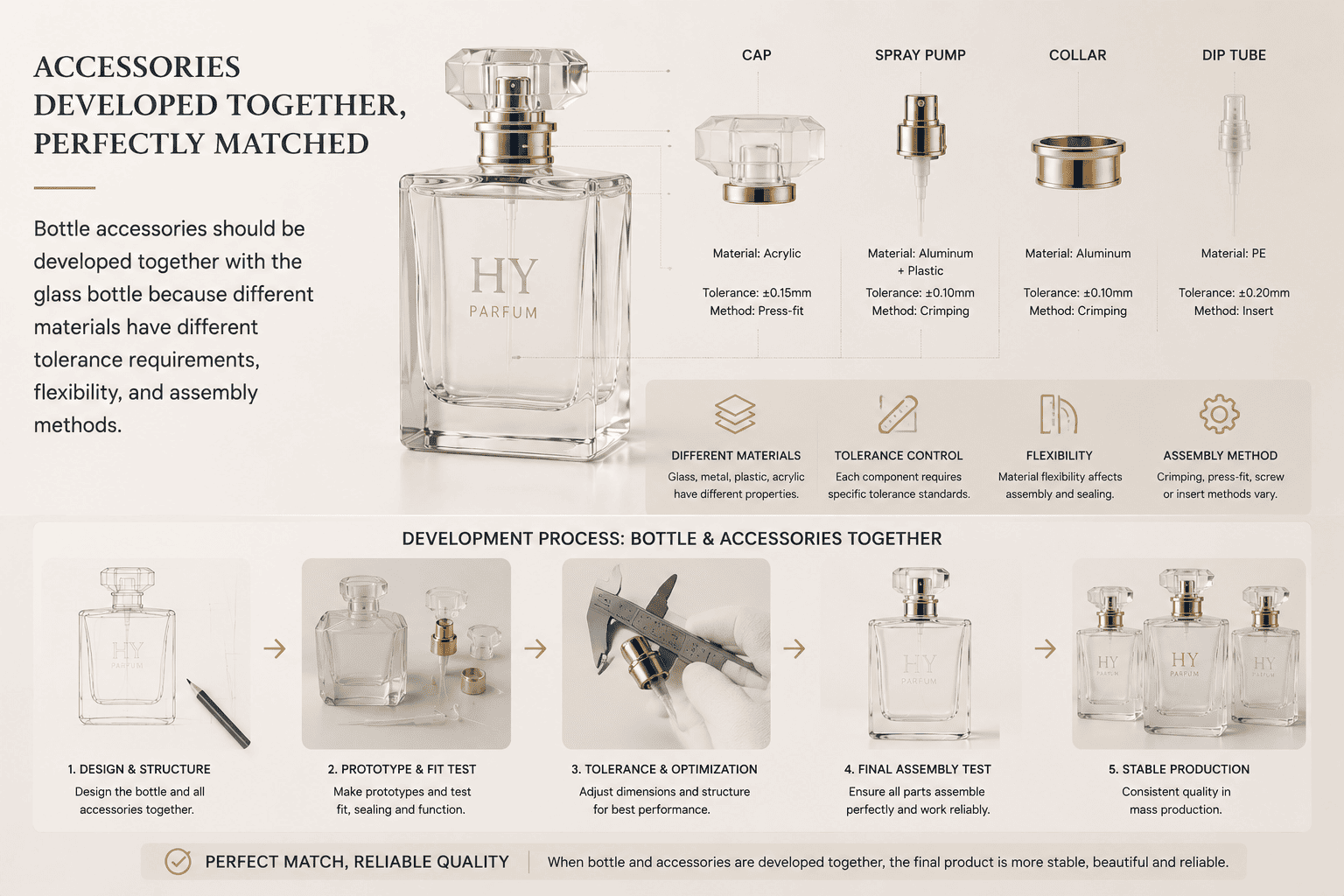
I often compare bottle accessories to clothing.
A beautiful outfit only works when the size matches the person wearing it.
The same idea applies to perfume packaging.
For example:
Leather accessories
Leather has some flexibility.
It can adjust slightly because of its natural characteristics.
Plastic accessories
Plastic parts require more precise dimensions.
Small size differences can create:
- Loose fitting
- Assembly problems
- Poor appearance
Metal accessories
Metal parts require careful matching because they have:
- Fixed dimensions
- Different expansion behavior
- Higher precision requirements
When developing:
- Caps
- Decorative rings
- External parts
the accessory mold and glass bottle mold should be considered together.
Packaging is a system.
Not separate pieces.
Tip 8: Glass Weight Changes the Premium Feeling More Than Brands Expect
Many new brands focus only on bottle shape.
They forget one important customer experience:
The feeling in the hand.
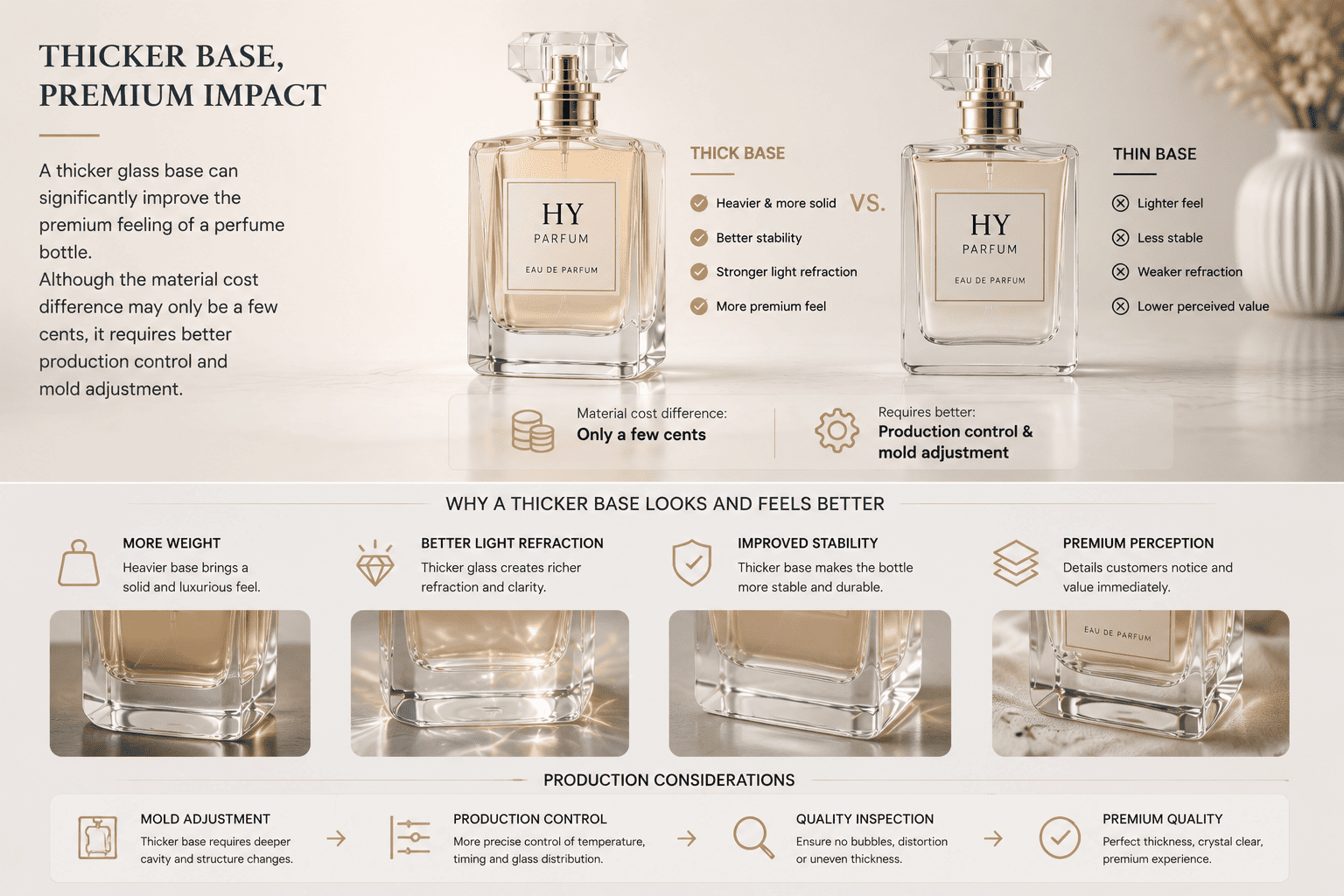
A thicker glass base can significantly improve the premium feeling of a perfume bottle. Although the material cost difference may only be a few cents, it requires better production control and mold adjustment.
Why does glass thickness matter?
When customers pick up a perfume bottle, weight creates an immediate impression.
A heavier bottle often feels:
- More luxurious
- More stable
- Higher value
The same bottle shape can feel completely different with:
- Thin bottom
- Thick bottom
| Structure | Customer Feeling |
|---|---|
| Thin bottom | Lightweight and economical |
| Thick bottom | Premium and luxury |
Many brands do not know that adding thickness may only increase cost slightly.
However, production requires:
- Proper mold adjustment
- Correct machine settings
- Experienced technicians
The challenge is not adding more glass.
The challenge is maintaining good forming quality.
Tip 9: 3D Prototype Is More Important Than AI Rendering
AI images are excellent for creativity.
However, they cannot replace physical verification.
Before mold development, brands should move from AI concept to 3D modeling and physical prototypes. This process helps confirm proportions, appearance, and production feasibility.
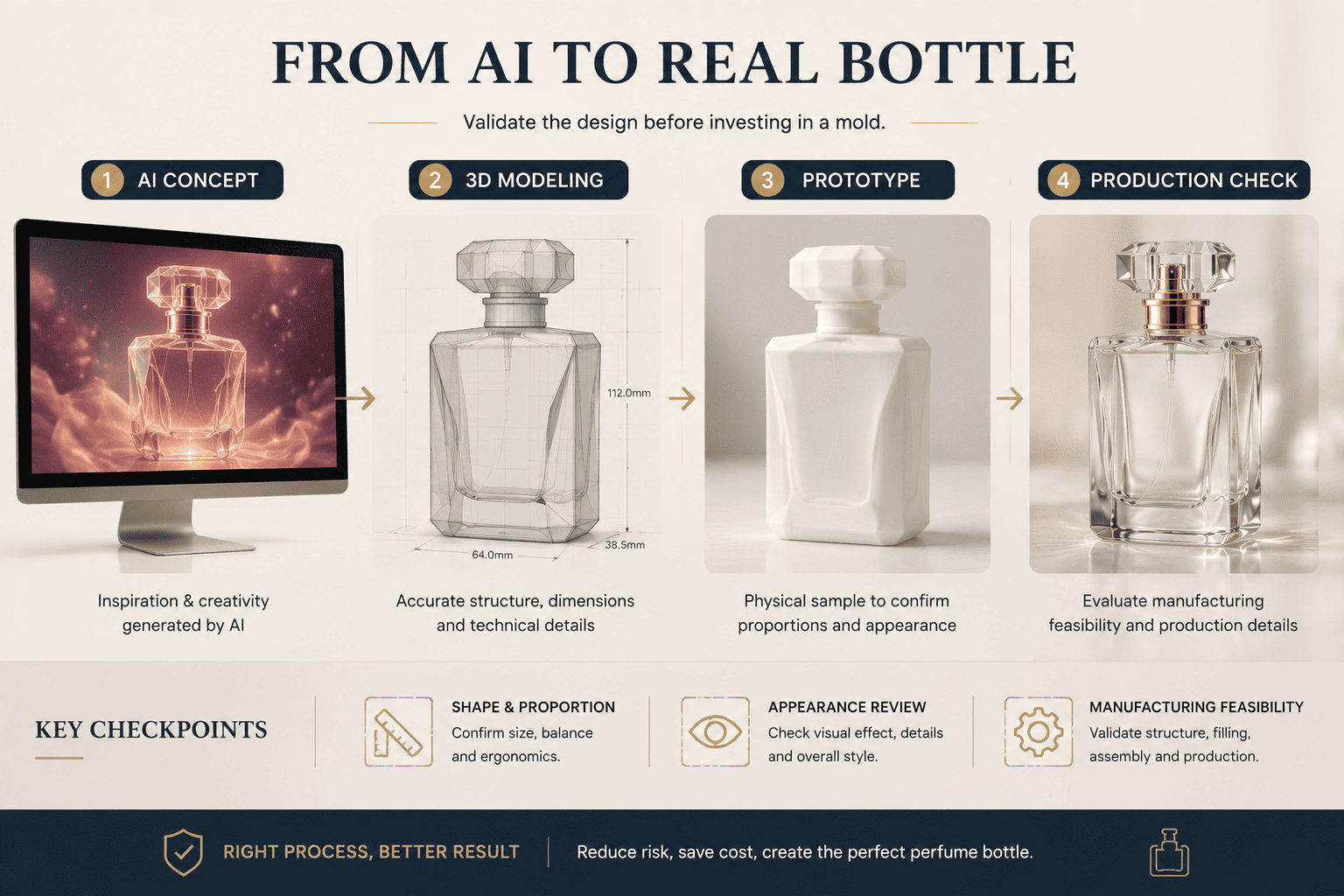
The recommended process is:
AI concept
↓
3D modeling
↓
[3D printing][3]
↓
Design adjustment
↓
Glass prototype
↓
Steel mold
A physical prototype helps brands evaluate:
- Real proportion
- Hand feeling
- Size relationship
- Cap matching
- Overall appearance
This step can prevent expensive mold mistakes.
Tip 10: Choose a Manufacturing Partner Before Finalizing Your AI Design
Many brands finish the design first and only contact a factory later.
I believe this creates unnecessary risk.
A professional manufacturing partner should participate during the design stage to evaluate feasibility, optimize the concept, and prevent production problems before they happen.
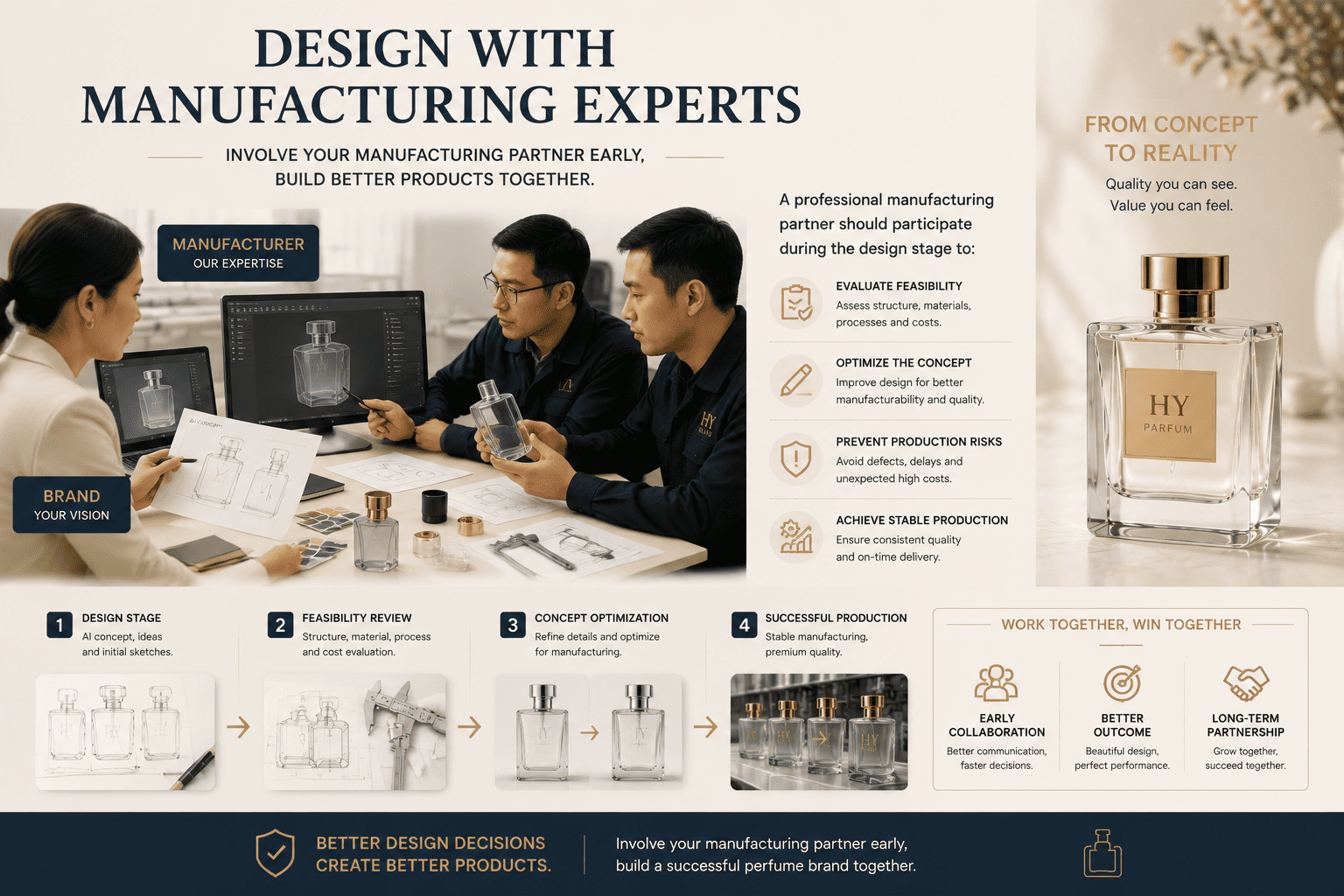
At Hongyan Glass Bottle, we help fragrance brands move from idea to production.
Our support includes:
- AI concept evaluation
- Design feasibility review
- 3D sampling
- Custom mold development
- Surface decoration
- Pump and cap matching
- Packaging compatibility
We provide more than 500 in-stock perfume bottle designs and support customized solutions for growing fragrance brands.
My mission is to help small and medium perfume brands avoid expensive mistakes.
AI can create unlimited ideas.
Manufacturing experience turns those ideas into real products.
A successful perfume bottle is where creativity meets engineering.
Conclusion
AI makes perfume bottle design easier, but production requires real manufacturing knowledge. The best fragrance brands combine creativity with engineering to create beautiful and practical glass packaging.